
What gives a piece its character: its age, the color of its stone, or the craftsmanship that brings them together? Antique aquamarine jewelry invites all three questions. Its pale to deep blue hues can be captivating, but color alone doesn’t tell the full story. The setting, period design, and condition matter just as much.
A product photograph can only show so much. Aquamarine can resemble other blue gemstones, and differences in lighting or wear can make two pieces difficult to compare. Look beyond first impressions at the stone’s cut, how it sits in the setting, and what signs of its history remain.
This guide explains aquamarine’s visual qualities and design history, with practical criteria for comparing period styles and settings. You’ll also learn what to consider when distinguishing aquamarine from similar-looking stones and assessing the condition of an estate piece. At Heirloom Jewelers, we value the craftsmanship and history carried by authenticated estate and vintage fine jewelry, and the details that give each piece its own character.
Key Takeaways
- Assess antique aquamarine jewelry by considering the gemstone, setting, period design, and condition together, not age alone.
- Learn how hue and saturation shape aquamarine’s appearance, and why a photograph may not be enough to identify a blue stone confidently.
- Compare Victorian, Edwardian, Art Nouveau, Art Deco, and mid-century design cues to understand a piece’s character.
- Use a deliberate inspection sequence to consider the gemstone, setting, visible condition, documentation, and overall design.
- Decide whether color, wearability, period character, or craftsmanship matters most to you before choosing an estate piece.
What makes antique aquamarine jewelry distinctive?
Antique aquamarine jewelry pairs a gemstone’s cool color with the design choices of an earlier period. Antique jewelry is made in an earlier historical period and valued for its age, design, and workmanship. The precise age threshold attached to “antique” varies among sellers and references. A period label can help describe a piece, but it doesn’t prove when it was made or that every component is original.
Aquamarine is a blue to blue-green variety of beryl. Its color can give a ring, pendant, brooch, or pair of earrings a clear focal point without overwhelming the surrounding metalwork. Intricate details can make the stone feel delicate, while a simple setting can make it more prominent. To understand a piece’s character, consider the gemstone alongside its workmanship, setting, and visible condition.
Antique, vintage, and antique-inspired: what do the terms mean?
These labels are useful, but they aren’t applied consistently. “Antique” generally refers to jewelry from an earlier historical period, while “vintage” usually describes older jewelry that doesn’t meet a seller’s definition of antique. There is no single age cutoff used by every seller and reference, so look for a stated date or supporting documentation rather than relying on the label alone.
“Antique-inspired” describes newer jewelry designed with historical influences. A look that recalls an older period is not, by itself, evidence of age. Distinguishing these terms helps clarify what you’re assessing: an older object with its own history, or a contemporary piece that borrows from historic design.
Why aquamarine suits historic jewelry
Aquamarine ranges from blue to blue-green, and its hue and saturation affect the impression it makes. A paler stone can look understated, while a more saturated blue may draw the eye. Neither is universally preferable. The right effect depends on your taste and on how the stone relates to the setting, metal, and other details.
That relationship matters across jewelry types. In a ring, the center stone can balance the band’s shape and ornament. In a pendant or brooch, it can anchor the design, while smaller aquamarines in earrings may create a quieter, coordinated effect. These are design possibilities, not proof of a specific period or provenance. For further background on the gem’s composition and characteristics, consult Aquamarine gemstone properties and history.
Assess the whole piece, not just its name or first impression. Consider whether the stone’s color suits the design, whether the setting appears thoughtfully made, and whether visible wear affects the jewelry’s appearance or structure. A period description can guide your assessment, but the gemstone, workmanship, setting, and condition together offer a more useful picture of an individual estate piece.
How aquamarine’s color and gemstone qualities shape each piece
Aquamarine is the blue to blue-green variety of beryl, a mineral whose chemical composition is beryllium aluminum silicate. Trace iron gives aquamarine its characteristic color. The stone’s hue, saturation, clarity, and cut influence how that color appears in jewelry. These qualities work together, so consider a gemstone in its setting and under more than one lighting condition.
For Antique aquamarine jewelry, color is a personal and visual consideration, not a single ranking. Hue describes the color family, such as blue or blue-green. Saturation describes how strong or subdued that color looks. A pale, softly colored stone may complement delicate metalwork, while a more saturated one can become a stronger focal point. Neither is automatically the better choice.
Color, clarity, and cut: what to observe
Look at hue and saturation separately. Then consider clarity: visible inclusions are features to assess, not proof on their own of damage or treatment. Cut matters too. Facet arrangement affects how light returns to the eye, while the outline and proportions shape the gem’s face-up appearance. For a gemological overview of these factors and treatments, the GIA guide to aquamarine quality offers useful context.
Photographs can make comparison difficult. Lighting, camera settings, screen displays, and the background around a stone can all influence how its color appears in an image. A photograph also cannot show every facet clearly or establish a stone’s identity. When comparing images, note the lighting and background where available, and compare the overall impression rather than relying on one image or a single color description.
How settings and metals change the overall look
The metal frames the gemstone and affects the composition. White metal can create a crisp, cool contrast with blue aquamarine; yellow gold can add warmth beside the same hue. Neither combination defines a period or proves authenticity. Diamonds, filigree, and halos may add contrast or ornament when present, but they aren’t features of every aquamarine jewel. Notice how each element supports, rather than competes with, the center stone.
The estate emerald and diamond necklace illustrates how a colored center stone can be framed by diamonds and white gold. The gemstone differs, but the design principle applies: metal tone and surrounding stones guide the eye and shape the piece’s balance.
For a considered comparison, note the stone’s hue and saturation, how its cut presents the color, and how the setting changes its appearance. Heirloom Jewelers curates authenticated estate and vintage fine jewelry, with an emphasis on individual craftsmanship and history. Explore Heirloom Jewelers’ estate and vintage jewelry to see how these details contribute to a piece’s overall character.
How to compare antique aquamarine jewelry by period and design
Period styles offer a helpful starting point, not a verdict. An aquamarine may sit in a setting that reflects one era, while later changes or a revival design can complicate the picture. Compare several features together, and treat each style label as a guide for further consideration rather than proof of a date.
| Period | Common design cues | What to inspect |
|---|---|---|
| Victorian | Ornate metalwork, sentimental motifs, and natural forms may appear. | Look at the detail and construction of the setting, and whether the stone appears integrated with the design. |
| Edwardian | Fine, open metalwork and delicate arrangements of stones are common cues. | Examine the setting’s delicacy, the metalwork, and how any accent stones frame the aquamarine. |
| Art Nouveau | Flowing lines and organic motifs often take precedence over strict symmetry. | Notice whether the ornament moves around the stone as part of a continuous design. |
| Art Deco | Geometric forms, symmetry, and strong outlines are characteristic visual cues. | Compare the center stone’s shape with the setting’s repeated angles or balanced arrangement. |
| Mid-century | Designs can feature sculptural forms, bold profiles, or simpler lines. | Consider the piece’s overall proportions, metalwork, and how the stone sits in the setting. |
Recognizing period-inspired details
Geometry, ornament, and setting style can help you compare pieces, but none belongs exclusively to one era. Art Deco designs often favor symmetry and geometric structure, while Art Nouveau jewelry is more closely associated with flowing, nature-inspired forms. Victorian and Edwardian pieces also vary widely. These are broad design patterns, not fixed rules for dating an individual jewel.
Reading the whole jewel, not just its era
Take in the stone shape, metal, setting, and proportions as a group. A single feature, such as a geometric outline, can’t establish a date. Compare details across the piece and look for consistency in how they’re made and arranged. On a ring, for example, consider how the band, setting, and center stone work together rather than treating one feature as a reliable date marker.
Also consider whether the jewel may have been altered. A replacement stone, modified setting, or change in how components are assembled can affect the piece’s present appearance. That doesn’t make the design unworthy of interest, but it can mean the jewel no longer represents one period in an entirely original form.
Separate what is documented from what is inferred. Provenance supported by records or other reliable documentation is different from an age estimate based on style. For antique aquamarine jewelry, a period description can provide useful context, but a thoughtful comparison considers the whole jewel and the evidence available for its history.
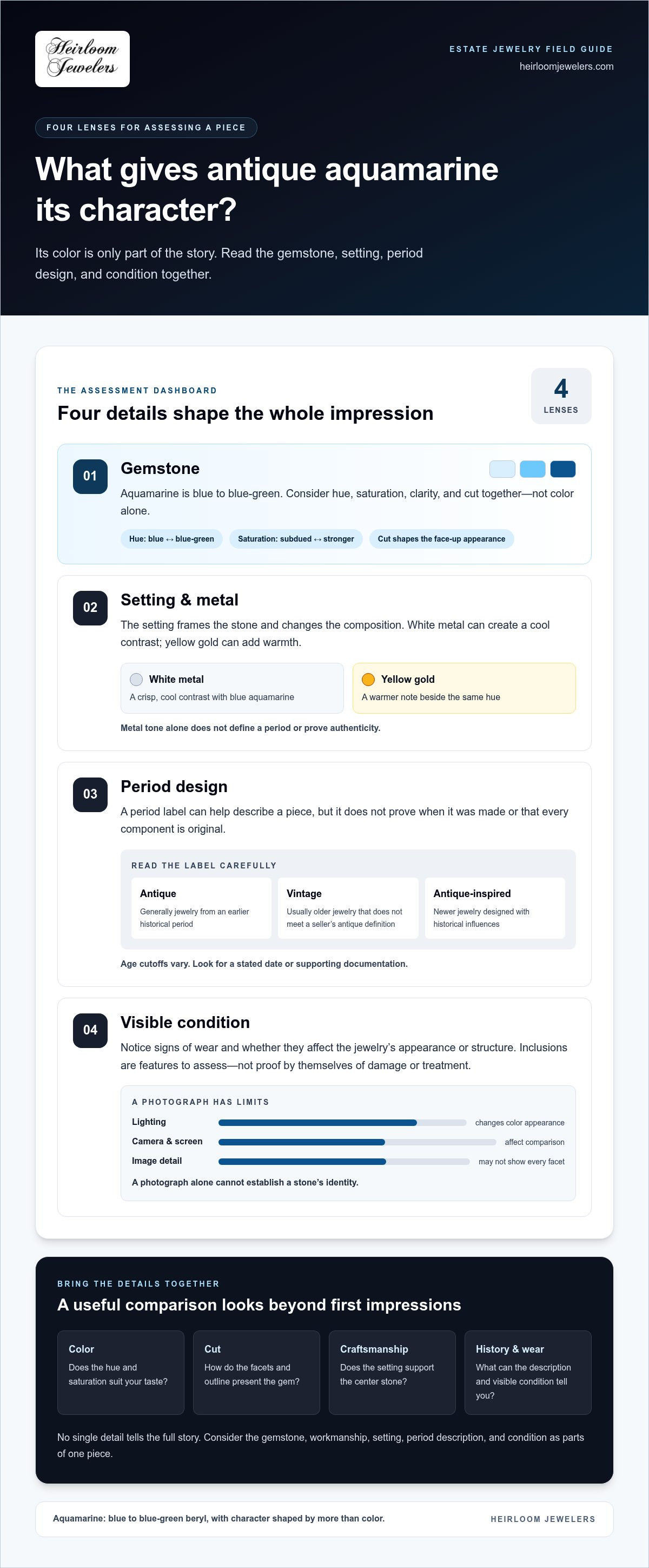
What to inspect before choosing an antique aquamarine piece
A careful review is more useful than a quick judgment based on color or a period label. Work through the gemstone, setting, visible condition, documentation, and overall design in sequence. This helps separate what you can observe from what a description claims and what remains uncertain.
- Assess the gemstone. Review the stated stone identity, shape, color description, and any information about treatment. A photograph can suggest appearance, but lighting, camera settings, and screen displays may alter perceived color. An image alone can’t reliably establish whether a stone is aquamarine or determine treatment. If identity or treatment is central to your decision, look for documentation that specifically addresses it.
- Examine the setting and metal. Look for a clear description of the metal and setting type, such as prongs or a bezel. In photographs, check whether prongs appear aligned and whether the stone seems evenly held. Compare the setting with the surrounding design. Images can’t always reveal how securely a stone is mounted, so don’t treat a front-facing photograph as a full structural assessment.
- Review visible condition. Look for disclosed wear, chips, scratches, repairs, or alterations, and compare those notes with close-up photographs. Pay attention to the stone’s edges and the setting around it. A mark may be difficult to interpret from an image, and visible wear doesn’t automatically show how it affects the piece’s stability. Read condition descriptions as part of the evidence, not as a substitute for examination.
- Read the documentation. Note what records are provided and what each one actually establishes. Provenance may offer historical context, while a gemological report may address stone identification or characteristics. These documents answer different questions. Distinguish documented information from a seller’s description or an interpretation based on appearance.
- Consider the whole design. Step back from individual details. Ask whether the stone, setting, metal, and proportions form a coherent piece, and whether the design suits your priorities. A style clue is not proof of a piece’s age. Period attribution is more meaningful when supported by documentation and consistent construction details.
Compare the written description with every available view. If a listing describes a secure setting, look for clear images of the mount rather than assuming a single front-facing photograph shows its condition. If an important detail remains difficult to assess visually, keep that uncertainty separate from what is documented.
Heirloom Jewelers curates authenticated estate and vintage fine jewelry with attention to craftsmanship and history. Explore curated estate and vintage jewelry with these inspection points in mind.
Finding the right place for antique aquamarine jewelry in an estate collection
An estate collection can bring together gemstones with different colors, histories, and design styles. Aquamarine may add a cool blue or blue-green note among warmer stones, diamonds, or pearls, creating contrast without needing to match every piece. The best fit depends on what you value, whether that’s the gemstone’s color, the character of its period design, or the craftsmanship visible in its setting.
Choosing according to personal taste and context
Start with your purpose. A collector may be drawn to a particular period or construction detail. For a gift, the recipient’s preferred color and jewelry forms may matter most. For personal wear, consider how the piece fits alongside jewelry you already enjoy. There’s no universally superior shade or style, only a choice that suits your taste and intended use.
Think about the role you want the jewel to play. A prominent aquamarine can become a focal point, while a smaller stone may sit more quietly within a collection. It can complement an estate emerald through contrast or echo the sparkle of diamond jewelry without duplicating its look. These combinations are a matter of personal composition, not a formula for value or future performance.
Use the criteria from your earlier assessment to ground the decision. Does the stone’s appearance appeal to you? Does the setting support the design you’re drawn to? Is the disclosed condition appropriate for how you expect to enjoy the piece? Considering these points together can clarify whether a jewel feels right for collecting, gifting, or regular personal wear.
Exploring curated estate and vintage fine jewelry
Estate jewelry can be appreciated for the individuality of its design and the handwork that shaped it. A piece may carry marks of its period in its proportions, setting, or ornament, while still feeling at home beside jewelry from another era. That mix can make a collection feel personal rather than assembled around a single gemstone or matching style.
Heirloom Jewelers specializes in curated, authenticated, high-end estate and vintage fine jewelry. Its focus on selected pre-owned pieces reflects an appreciation for craftsmanship and history. An aquamarine jewel, like any estate gemstone piece, can contribute a distinctive color and design voice without needing to define the entire collection.
Let your priorities guide the final choice. A preference for a certain blue, a period’s visual character, or the details of a setting can each provide a meaningful starting point. The most satisfying collection is one that reflects your eye and the history you value, rather than a prescribed standard.
Explore Heirloom Jewelers’ estate jewelry and discover the craftsmanship and character found in curated estate pieces.
Choose a Piece That Feels Meaningful to You
The right jewel need not match a particular era or complete a perfectly coordinated set. Let your priorities lead: perhaps you’re drawn to a certain shade of blue, the character of a period setting, or evidence of careful craftsmanship. A thoughtful choice is one you’ll value for its design and history, not simply for how it fits a category.
As you continue exploring Antique aquamarine jewelry, keep a clear sense of what matters most to you and use it to guide comparisons. Heirloom Jewelers specializes in authenticated estate and vintage fine jewelry, with a curated selection of pre-owned pieces chosen for their individual character. Each jewel offers its own perspective on the materials and workmanship of another time.
When you’re ready to discover pieces with a distinct history and enduring appeal, explore Heirloom Jewelers’ curated estate jewelry. Let your eye, your purpose, and your appreciation for craftsmanship shape what comes next.
Frequently Asked Questions
Is all antique blue gemstone jewelry aquamarine?
No. Aquamarine is one of several gemstones that can appear blue in antique jewelry. Blue topaz, sapphire, glass, and other materials may look similar, especially in photographs or under colored lighting. Review the stone identification in the item description and any supporting gemological information. If identity matters to your decision, rely on documented assessment rather than color alone. A visual resemblance is a clue, not proof.
Can an antique aquamarine ring be resized?
Sometimes. Whether resizing is suitable depends on the ring’s construction, metal, setting, condition, and the amount of adjustment needed. Detailed shoulders, pavé stones, enamel, or an older shank may make the work more complex. The ring’s structure needs to be assessed before any alteration. Resizing can change original details or proportions, so consider whether preserving the ring’s existing form is important to you.
How much does antique aquamarine jewelry cost?
Antique aquamarine jewelry has no single standard price. An asking price may reflect the stone’s characteristics, setting, metal, craftsmanship, condition, documentation, and the seller’s assessment. For a useful comparison, look at pieces with similar design, materials, and disclosed condition. Age or carat weight alone isn’t enough to establish how two jewels compare. Individual pieces vary, so broad price ranges may not reflect the details that matter in a specific example.
What is the difference between antique and vintage aquamarine jewelry?
The labels generally point to different age categories, but their precise use varies among sellers and references. “Antique” usually describes an older piece, while “vintage” often refers to jewelry from a more recent past. If a listing uses either term, look for a stated period or date and note whether it is documented or estimated. A seller’s label can guide your assessment, but it doesn’t establish a jewel’s date by itself.
How can I tell aquamarine from blue topaz?
Color alone can’t reliably distinguish aquamarine from blue topaz. Similar hues may look different under changing light, and a photograph can obscure details of the stone. A written identification or gemological assessment offers stronger evidence than appearance. If a report accompanies the jewel, check what it identifies and whether it addresses the stone itself. Don’t infer gemstone identity from a period style, setting, or color description alone.
Is aquamarine the birthstone for March?
Yes. Aquamarine is widely recognized as a birthstone for March, making it a meaningful option for a birthday or anniversary gift. That association, however, doesn’t establish the history of an individual antique jewel. A piece’s date and gemstone identity depend on evidence about that piece, not its connection to a birth month. For a gift, consider whether the recipient enjoys the stone’s color and design as well as its birthstone meaning.
How should you clean antique aquamarine jewelry?
Use caution, particularly if the jewel has visible wear, an older setting, or an unclear history of repairs. Avoid aggressive cleaning, ultrasonic devices, and household chemicals unless a qualified professional has confirmed they’re suitable for that specific piece. A soft cloth may be appropriate for light surface care, but the safest approach depends on the stone, setting, and condition. Don’t use a general cleaning method as a substitute for assessing the individual jewel.