
What makes a Belle Époque jewel convincing isn’t simply a grand label. Its craftsmanship should stand up to close inspection. When searching for Belle Époque jewelry for sale, it’s natural to be drawn to platinum settings, fine diamonds, and delicate garland motifs. Yet a period name alone doesn’t establish a piece’s age, quality, or condition.
A thoughtful purchase starts with understanding the design and looking beyond first impressions. Learn which details are associated with Belle Époque jewelry, compare materials and gemstones, and read the condition notes and available documentation. Then consider practical wearability: the right antique jewel should suit your taste and how you plan to wear it.
This guide offers a practical way to assess a piece, distinguish Belle Époque design from related styles, and shop with greater confidence. The central principle is simple: value the craftsmanship, not just the label. Heirloom Jewelers specializes in authenticated estate and vintage fine jewelry, with a curated collection of distinctive pre-owned pieces.
Key Takeaways
- Look beyond a Belle Époque label. Delicate workmanship, platinum settings, and characteristic motifs can offer useful clues to a piece’s design.
- Compare metal, gemstone, and setting details to understand a jewel’s appearance, care needs, and everyday practicality.
- Use motifs and visual character to distinguish Belle Époque jewelry from Art Nouveau, Edwardian, and Art Deco styles, while allowing for overlap in classifications.
- When browsing Belle Époque jewelry for sale, assess the description, photographs, condition details, materials, and available documentation together.
- Apply the same careful eye to curated, authenticated estate and vintage jewelry. Clear item details and visible craftsmanship help you make an informed choice.
What Makes Belle Époque Jewelry Distinctive, and Worth Seeking Out?
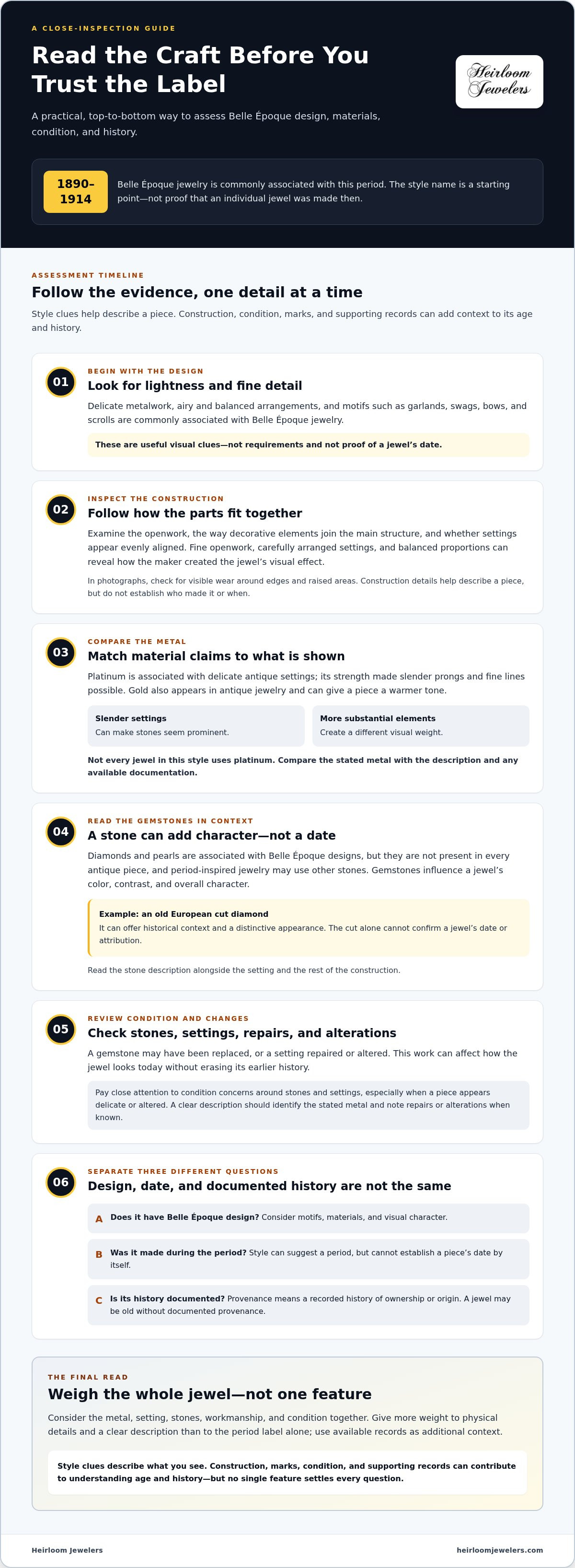
Belle Époque jewelry refers to jewels made during, or designed in the style of, the Belle Époque, a period commonly dated from about 1890 to 1914. The style is associated with delicate metalwork, light visual effects, and motifs such as garlands, bows, and scrolls. A period label is a starting point, not proof of a jewel’s age or origin.
When Was the Belle Époque, and What Does the Name Mean?
Belle Époque is French for “beautiful era.” In jewelry histories, the term commonly describes the years from around 1890 to the outbreak of the First World War in 1914, though boundaries can vary by source and specialist. It names a historical period, not a quality grade or assurance that a surviving piece is finely made or in excellent condition.
A jewel made during those years is different from a later revival design inspired by the same aesthetic. Style can suggest a period, but it can’t establish a piece’s date by itself.
Which Design Details Are Commonly Associated With Belle Époque Jewelry?
Look for fine metalwork and settings that give diamonds a light, almost floating appearance. Platinum’s strength made delicate forms with slender prongs and fine lines possible. Garlands, swags, bows, and scrolling details are also associated with the style, often arranged in balanced, airy designs.
Diamonds and pearls were popular, and platinum became an important material. These are clues, not requirements. Individual jewels vary by maker, region, and materials, and some have been altered over time.
For a buyer, three questions are related but distinct: Does the jewel have Belle Époque design? Was it made during the period? Is its history documented? A later piece may echo period motifs without being antique. A jewel may be old without documented provenance, meaning a recorded history of ownership or origin. Design clues help describe a piece, while construction, marks, condition, and supporting records can contribute to assessing its age and history.
When considering Belle Époque jewelry for sale, give more weight to physical details and the clarity of the description than to the label alone. Look closely at how the metalwork is constructed, whether the stated materials appear consistent with the piece, and whether photographs show the details clearly. Each jewel should be assessed on its own merits.
How Belle Époque Craftsmanship, Metals, and Gemstones Shape Each Piece
A jewel’s construction can reveal more than a style name. Fine openwork, carefully arranged settings, and balanced proportions show how a maker created a particular visual effect. These details help explain a piece’s character, but they don’t establish who made it or when. A period feature can support a style identification, but it isn’t a guarantee of a jewel’s age.
How to Read Metalwork, Settings, and Decorative Motifs
Inspect the details closely. In photographs, look at how decorative elements join the main structure, whether settings appear evenly aligned, and whether wear is visible around edges or raised areas. A clear description should identify the stated metal and note repairs or alterations when known. GIA’s overview of historical jewelry styles discusses the Edwardian or “Garland” style, including platinum and floral motifs that help explain the period’s light, intricate appearance.
Platinum is associated with delicate antique settings, while gold also appears in antique jewelry and can add a warmer tone. Metal affects both appearance and construction: a slender setting can make stones seem prominent, while more substantial elements create a different visual weight. Don’t assume every jewel in this style uses platinum. Compare material claims with the description and any available documentation.
What Gemstone and Cut Details Can, and Cannot, Tell You
Gemstones influence a jewel’s color, contrast, and overall character. Diamonds and pearls are associated with Belle Époque designs, but period-inspired jewelry may use other stones, and not every antique piece contains either. An old European cut diamond, for example, can provide historical context and a distinctive appearance. The cut alone can’t confirm a jewel’s date or attribution.
Read the stone description alongside the setting and the rest of the construction. A gemstone may have been replaced, or a setting repaired or altered. Such work can affect how the jewel looks today without erasing its earlier history. Pay close attention to any noted condition concerns around stones and settings, especially where the piece appears delicate or altered.
When assessing Belle Époque jewelry for sale, consider the metal, setting, stones, workmanship, and condition together rather than treating any single feature as proof. Heirloom Jewelers offers curated, authenticated estate and vintage fine jewelry, including vintage platinum and white gold pieces. Explore curated estate and vintage jewelry with these details in mind.
Belle Époque vs. Art Nouveau, Edwardian, and Art Deco: How to Compare
Neighboring jewelry styles share materials and motifs, so a single detail rarely settles a jewel’s classification. Use visual cues to describe what you see, then consider them alongside construction, condition, and supporting documentation. Style labels can overlap, and specialists may classify the same piece differently.
| Style | Common visual cues | Broad context |
|---|---|---|
| Belle Époque | Delicate settings, light visual effects, garlands, bows, and scrolls | Commonly associated with about 1890 to 1914 |
| Art Nouveau | Organic forms, flowing lines, and an often asymmetrical composition | A neighboring movement with overlapping years |
| Edwardian | Fine metalwork, diamonds, platinum, and garland-like motifs | Often used interchangeably with Belle Époque in jewelry descriptions |
| Art Deco | Geometric forms, symmetry, and a more structured visual character | A later style that contrasts with the Belle Époque’s characteristic delicacy |
Belle Époque and Art Nouveau: Shared Nature Motifs, Different Visual Emphasis
Both styles may draw on flowers, leaves, and other natural forms. The overall effect can help distinguish them: Belle Époque jewelry tends toward balanced, airy arrangements, while Art Nouveau designs may emphasize sinuous lines and asymmetry. These are visual tendencies, not strict rules. A floral motif alone can’t authenticate a jewel or establish its date.
Belle Époque and Edwardian or Art Deco Jewelry
Edwardian and Belle Époque are closely related terms in jewelry descriptions. Both may refer to delicate platinum work and light-catching settings from the turn of the twentieth century, so the labels can overlap. Art Deco, by comparison, is often more geometric and structured. This contrast can help describe a jewel, but it isn’t enough on its own to date it.
As you compare Belle Époque jewelry for sale, treat motifs and materials as clues within a larger picture. Platinum, diamonds, garlands, or geometric details can appear in different contexts, and later pieces may borrow earlier design language. Look at how the lines, settings, and proportions work together rather than relying on one feature.
For a closer look at a neighboring style, continue with our Art Deco jewelry guide. It offers another point of comparison as you develop an eye for period design.
A Practical Checklist for Buying Belle Époque Jewelry Online
A period label alone doesn’t establish a jewel’s age or authenticity. A useful listing gives you enough detail to assess what’s being represented, the piece’s condition, and whether it suits your intended use. Documentation can strengthen the picture, but not every antique has a complete ownership history or surviving original receipt.
What to Look for in Descriptions, Photographs, and Documentation
Use this checklist to review a listing before deciding whether to pursue a piece:
- 1. Read the description closely. Look for stated materials, gemstone details, measurements, and a specific condition description. Note whether the date is presented as confirmed, approximate, or a style attribution.
- 2. Study multiple photographs. Clear views of the front and back, clasp, settings, and visible marks can reveal construction details and areas that deserve closer attention. Zoom in where possible, and check that the images show the piece from useful angles.
- 3. Review condition notes. Look for mention of worn areas, loose stones, repairs, replacements, or alterations. Compare these notes with what you can see in the photographs.
- 4. Consider the documentation provided. Provenance information, prior records, or a relevant report may support a listing’s claims. Hallmarks can offer useful evidence about metal or maker, but interpreting a mark alone doesn’t prove a jewel’s age.
- 5. Match the piece to your purpose. Consider whether you want an occasional-wear jewel, a collection piece, or a meaningful gift. Measurements and clear images help you judge scale and how the piece may sit or fasten.
How to Judge Condition and Everyday Wearability
Condition is specific to each jewel. Pay particular attention to prongs or other settings that hold gemstones, joins in delicate metalwork, clasps, and components that may have been repaired. Check whether the listing mentions loose stones, repairs or replacements, and visible wear. These details help you understand what the photographs show and what may remain unclear.
Wearability also depends on the piece’s design and your habits. A fine, intricate jewel may be better suited to occasional use than frequent activity, but no broad rule can replace an item-specific condition assessment. Look for a description that distinguishes original features from later work and explains known concerns plainly.
As you compare Belle Époque jewelry for sale, weigh the listing’s evidence as a whole rather than relying on a single hallmark, motif, or period label. For a considered next step, browse curated, authenticated estate and vintage jewelry.
Explore Curated Estate Jewelry With a More Informed Eye
A confident search for Belle Époque jewelry for sale begins with more than recognizing a motif. Consider the design alongside the materials, construction, condition, and available documentation. Compare neighboring styles without treating one feature as proof of age. Together, these steps help you judge what a listing tells you and whether a jewel suits your taste and intended wear.
Why Curated Estate Jewelry Appeals to Period-Style Buyers
Estate and vintage jewelry offers the character of individual pre-owned pieces, each with its own materials, workmanship, and history. That individuality can appeal to buyers drawn to period design, even when a particular jewel isn’t identified as Belle Époque. Heirloom Jewelers specializes in curated, authenticated estate and vintage fine jewelry, including vintage platinum jewelry and old European cut diamond earrings. These pieces offer examples of historic materials and craftsmanship, but each should be considered on its own details rather than assumed to belong to a specific period.
Curated estate jewelry can make browsing more focused. Compare individual pieces by construction, gemstones, condition information, and documented details instead of relying on a broad style label. This approach respects both the appeal of historical character and the importance of accurate descriptions.
Choose Your Next Step With Confidence
Take time with each listing. Review the stated metal and gemstones, examine photographs from multiple angles, and read condition notes for details about wear, repairs, or alterations. For a ring, look closely at the setting and band as well as the central design. If you’d like more context on ring construction, read our antique rings guide.
There’s no need to rush toward a label. Let the jewel’s features, condition, and history guide your decision. Heirloom Jewelers brings a focused approach to authenticated estate and vintage jewelry, with a curated selection to explore. Explore Heirloom Jewelers’ estate jewelry selection and browse with a more informed eye.
Choose a Jewel for Its Craftsmanship and Character
A confident search for Belle Époque jewelry for sale starts with looking beyond the label. Design motifs can suggest a period, while materials, workmanship, condition, and available documentation provide a fuller picture. Comparing neighboring styles helps sharpen your eye, but no single feature proves a jewel’s age.
Heirloom Jewelers specializes in authenticated estate and vintage fine jewelry, curating pre-owned pieces with distinctive materials and character rather than mass-produced jewelry. The collection includes vintage platinum and white gold jewelry, old European cut diamond earrings, and estate gemstone pieces. Each item has its own details to consider, so assess its description and condition on their merits.
When you’re ready to continue exploring, explore Heirloom Jewelers’ curated estate and vintage jewelry. Take your time, review the details, and enjoy finding a piece that feels meaningful to you.
Frequently Asked Questions
What is Belle Époque jewelry?
Belle Époque jewelry describes pieces made during, or designed in the style of, the Belle Époque period. Its characteristic look often includes delicate metalwork, light-catching settings, and motifs such as garlands, bows, and scrolls. Platinum and diamonds are associated with the style, but neither is essential to every piece. A design may evoke the period without being antique, so consider style and verified age separately.
When was the Belle Époque period?
The Belle Époque is commonly dated from about 1890 to 1914, ending with the outbreak of the First World War. The French phrase means “beautiful era” and refers to a historical period, not a quality grade for jewelry. A piece described as Belle Époque may date from those years or may be a later design inspired by them. Look for details that support the stated date rather than relying on the name alone.
How can I tell if Belle Époque jewelry is authentic?
No single motif, gemstone, metal, or hallmark proves that a jewel is an authentic period piece. Assess the construction, setting, materials, condition, visible marks, and any available provenance or supporting documentation together. Clear photographs and a precise description can help you evaluate the claim. If a listing identifies a date as approximate or describes the item as Belle Époque style, treat that wording differently from a verified period attribution.
Is Belle Époque jewelry the same as Art Nouveau jewelry?
No, though the styles can overlap in date and share nature-inspired motifs. Belle Époque jewelry often emphasizes delicate, balanced arrangements and a light visual effect. Art Nouveau designs may feature more flowing lines, organic forms, and asymmetry. These are general visual tendencies, not strict rules for classifying or dating an individual jewel. A flower motif alone, for example, can’t establish that a piece belongs to either style.
What gemstones and metals are common in Belle Époque jewelry?
Diamonds and pearls are commonly associated with Belle Époque jewelry, and platinum was valued for delicate settings that could create an airy appearance. Gold also appears in antique jewelry. These materials are clues, not requirements: individual pieces vary by maker, region, and design. An old European cut diamond can offer historical context, but a gemstone type or cut by itself can’t establish a jewel’s date or authenticity.
Can Belle Époque jewelry be worn every day?
Some pieces may suit regular wear, while delicate construction, condition, and the security of the settings can make others better suited to occasional use or collecting. There’s no blanket rule for antique jewelry. Review condition details for worn areas, repairs, or loose stones, and consider how the piece will be worn. Practical suitability depends on an individual jewel’s structure and condition, not just its period or materials.
What should I check before buying Belle Époque jewelry online?
Before purchasing, review the description for materials, gemstone details, measurements, and condition notes. Examine clear photographs of the front, back, clasp, settings, and visible marks. Look for information about repairs, replacements, and any available provenance, while remembering that not every antique has extensive records. A period label alone doesn’t establish authenticity. Compare the listing’s claims with the visible details and consider whether the jewel suits your intended use.