
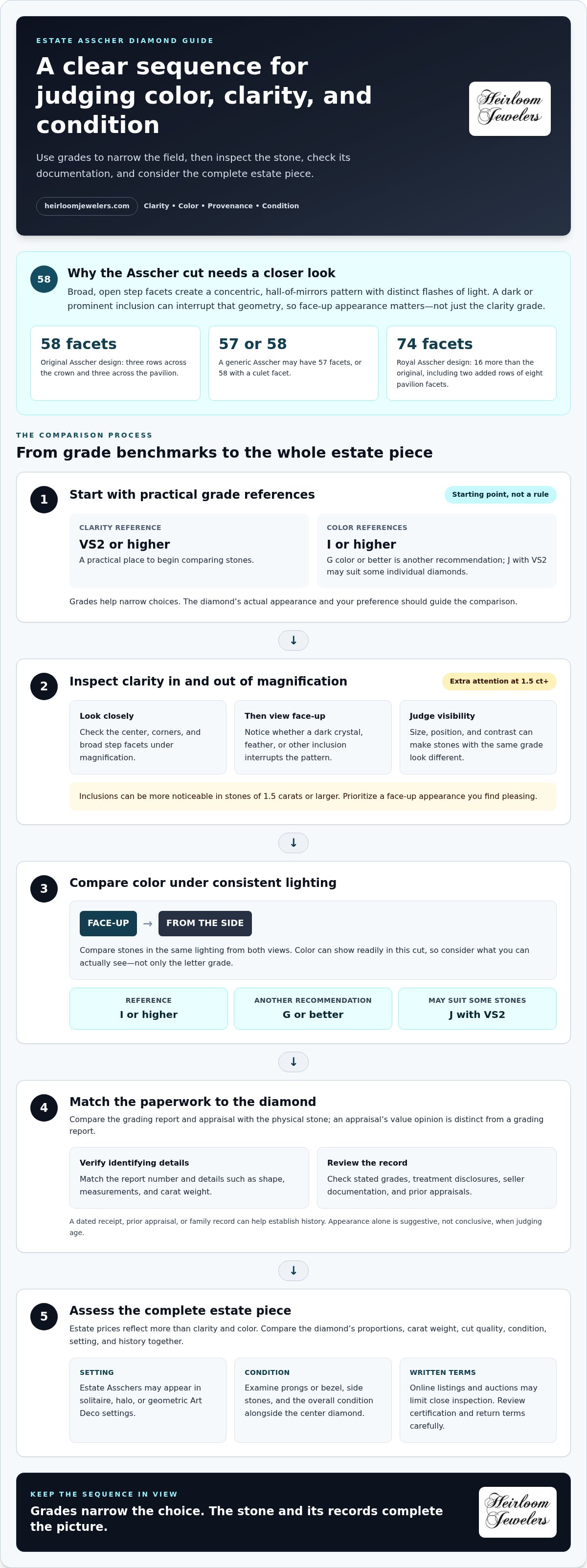
The highest clarity grade isn’t automatically the best value in an Asscher diamond. For Estate Asscher cut diamonds, VS2 clarity or higher and I color or higher are practical starting points, though visible inclusions deserve particular attention in stones of 1.5 carats or larger. The step-cut facets make clarity and color important parts of the comparison.
It’s natural to focus on grades first, but price also reflects a diamond’s proportions, carat weight, condition, setting, and history. This guide explains how to assess clarity and color, outlines the Asscher cut’s origins, and shows which details help you compare estate prices. You’ll learn how its distinctive geometry affects what you see and why two diamonds with similar grades can still differ in value.
Key Takeaways
- Learn why an Asscher diamond’s broad, step-cut facets make careful clarity inspection especially useful.
- Use color and clarity grades as a starting point, then consider how the individual stone appears.
- Trace the cut’s history from its early-20th-century origins to its Art Deco appeal.
- Compare estate prices by weighing carat, grading, cut quality, condition, and setting together.
What is the best clarity for an Asscher-cut diamond?
For many Asscher diamonds, VS2 clarity is a practical starting point, not an absolute rule. Look for a stone whose inclusions are difficult to see without magnification and don’t interrupt its crisp pattern. At 1.5 carats or larger, inclusions can be more noticeable, so examine the diamond closely.
The Asscher cut uses broad, step-cut facets rather than the brilliant facets found in a round diamond. Its concentric squares create a hall-of-mirrors effect, reflecting light in distinct flashes rather than scattered sparkle. Clipped corners and a square outline distinguish it from the rectangular emerald cut. Viewed face-up, the facets form a windmill-like pattern that draws the eye toward the center. A dark or prominent inclusion can interrupt this geometry, making face-up appearance especially useful when judging clarity.
The original Asscher cut has 58 facets, arranged in three rows across the crown and three across the pavilion. A generic Asscher may have 57 facets, or 58 with a culet facet. The Royal Asscher diamond has 74 facets, 16 more than the original design. Edward Asscher added two rows of eight facets each to the pavilion. Those extra facets change how light moves through the stone, but they don’t remove the need to assess clarity individually.
To assess provenance, compare the seller’s documentation, prior appraisals, and any gemological report. Check that the report’s identifying details match the diamond, and look for clear disclosure of treatments or alterations.
Estate Asscher diamonds may appear in solitaire, halo, and geometric Art Deco settings. Examine the prongs or bezel, side stones, and overall condition alongside the center diamond.
Online listings and auctions can limit close inspection. Images may not reveal inclusions, color, condition, or whether a report matches the stone. Before bidding or buying, compare the documentation and written terms carefully.
In the United States, estate jewelry retailers and auction houses sell Asscher cut diamonds. Sellers set their own certification and return terms, so read the written policy and match any grading report to the diamond before purchase.
Asscher diamond clarity and color recommendations
When comparing Estate Asscher cut diamonds, use color and clarity grades as a starting point, then judge each stone’s appearance in person. The Asscher’s square shape and open step cut make a balanced assessment more useful than choosing a grade in isolation.
Visible Inclusions
Inspect the center, corners, and broad step facets under magnification, then view the diamond without it. Note whether a dark crystal, feather, or other inclusion interrupts the pattern. Stones with the same clarity grade can look different because an inclusion’s size, position, and contrast affect its visibility. With Estate Asscher cut diamonds, prioritize a face-up appearance you find pleasing rather than relying on the grade alone.
Color and Clarity Selection
Compare stones under consistent lighting, first face-up and then from the side. I color or higher and VS2 clarity or higher offer a practical reference point; G color or better is another recommendation because color can show readily in this cut. J color with VS2 clarity may also suit some individual diamonds. These benchmarks help narrow choices, but personal preference and the stone’s appearance should guide the final selection.
Color and Clarity Grades
Color grades describe the degree of body color, while clarity grades assess internal and surface characteristics. Compare the grades on the report with what you see, especially near the center and corners. A higher grade may not create a visible difference that matters to every buyer, so consider whether you can see the improvement before prioritizing it. This keeps grades useful without letting them make the decision for you.
When reviewing an estate diamond’s grading report and appraisal, match the report number and identifying details, including shape, measurements, and carat weight, to the stone. Review the stated grades and treatment disclosures. An appraisal’s value opinion is distinct from a grading report.
To compare how color and setting work together in fine jewelry, explore the estate jewelry collection.
Asscher cut history and origins
The Asscher story links a Dutch diamond-cutting family with a distinctive square shape. The cut’s development also reflects changing jewelry tastes, from early twentieth-century craftsmanship to Art Deco engagement rings.
Origins of the Asscher Cut
Joseph Isaac Asscher founded the IJ Asscher Diamond Company in 1854. The Asscher cut was developed in 1902, bringing a formal, step-cut design to the diamond shapes of its era. In 1903, Abraham Asscher was hired to cut the 995-carat Excelsior Diamond. That commission illustrates the family’s standing among skilled cutters and the scale of work associated with its name.
In 1908, Joseph Asscher cut the Cullinan diamond after studying it for about a year and developing new tools. The rough weighed 3,105 carats and yielded 96 smaller stones left with the Asscher family as payment. Those landmark commissions placed precision cutting at the center of the company’s history.
Antique and Modern Asscher Cuts
To assess whether a diamond is antique or modern, start with its documented history. A dated receipt, prior appraisal, or family record can help establish when the stone or ring was made. Then examine the setting and craftsmanship for period clues, treating appearance alone as suggestive rather than conclusive.
The Asscher cut has a distinctive history in diamond cutting. The design became especially associated with Art Deco jewelry in the 1920s and 1930s, when geometric forms suited the period’s engagement rings. A modern stone can use an Asscher-style shape without being an antique; age belongs to the individual diamond or finished piece, not simply its cut name.
For context, Queen Juliana of the Netherlands bestowed the Asscher Diamond Company with a Dutch Royal Predicate in 1980. That recognition followed a difficult period for the Asscher family: during World War II, the company had a few hundred employees, and ten family members survived the war and returned to Amsterdam. These details help explain why documented provenance matters alongside the distinctive cut.
When considering a vintage ring, compare its paperwork with the setting’s construction and the diamond’s characteristics. A consistent account of the piece’s history is stronger evidence than a style label alone.
Asscher diamond prices
Asscher prices depend on more than carat weight. For Estate Asscher cut diamonds, color, clarity, cut quality, condition, setting, and documented history all shape a comparison. A square Asscher may attract different demand from a rectangular emerald cut, while cutting yield can affect availability. Beauty and brilliance matter, but they don’t replace a careful review of grading and condition.
As a broad market reference, natural or unspecified-origin Asscher diamonds typically range from $3,500 to $40,000, with a median of about $5,400. This range reflects 37 price samples from four sources collected October 28, 2026, and is valid until November 27, 2026. Treat it as a snapshot, not a valuation for a particular stone or a promised price.
To compare listings, first match carat weight and grading, then examine each diamond’s face-up appearance and proportions. Check whether the price covers a loose stone or a complete ring. For an estate piece, also consider the setting, condition, craftsmanship, and provenance. A well-preserved antique setting may add appeal, while wear or needed work can affect overall value. Cutting quality matters too: a heavier stone may appear smaller face-up if its proportions differ.
Estate and modern Asscher prices don’t follow a simple rule: age alone doesn’t make an estate diamond cheaper or more valuable. When comparing Estate Asscher cut diamonds, weigh condition, setting, and verifiable history against a modern stone’s cut and presentation.
Before deciding, record each candidate’s carat weight, color, clarity, cut description, and whether the setting is included. This side-by-side comparison makes price differences easier to understand and keeps a striking square or rectangular shape from distracting you from the details.
Explore estate jewelry with an eye for setting, condition, and period character.
Heirloom Jewelers: Lugano Emerald & Diamond Necklace 18K White Gold
Heirloom Jewelers offers the Lugano Emerald & Diamond Necklace 18K White Gold as one example of the craftsmanship found in estate fine jewelry. If you’re comparing antique diamond character with other vintage pieces, the Vintage Platinum 0.5 Carat Diamond Engagement Ring and Vintage White Gold Old European Cut Diamond Stud Earrings offer distinct settings and diamond styles to consider.
These pieces provide a chance to explore how metal, setting, and cut shape the look of pre-owned jewelry. The collection also includes the Estate Peridot & Quartz Dangle Earrings 14K Yellow Gold, illustrating a different use of gemstones in an estate design. Explore the pieces that suit your interest in jewelry with history and individual character.
Contact Heirloom Jewelers to learn more about its estate jewelry.
Choose the Diamond That Feels Right for You
Turn your preferences into a focused shortlist. Decide which qualities matter most for daily wear, then compare individual stones against those priorities instead of chasing a grade or style label alone. Each Estate Asscher cut diamond can offer a different balance of character, condition, and craftsmanship. A thoughtful choice is one whose documented details and appearance make sense to you together.
Keep notes as you compare. Record what draws your eye, what questions remain about a stone’s history, and which setting suits your intended use. This simple process can make a considered decision clearer, especially when weighing an heirloom’s character alongside practical details.
For a personal next step, explore Heirloom Jewelers’ estate jewelry and continue your search with a clear sense of what matters most.
Frequently Asked Questions
History of the Asscher Cut?
The Asscher cut was developed in Amsterdam in 1902 and became associated with geometric jewelry designs of the Art Deco era. Joseph Asscher patented the original design, making it the first patented diamond cut. That patent and the family’s diamond-cutting history distinguish the Asscher name from a general description of a square, step-cut stone.
Is an Asscher cut rare?
Yes. The Asscher cut is relatively rare compared with many diamond shapes. The square shape and clipped corners can affect how efficiently rough material is used and how many suitable stones are produced. Rarity alone doesn’t determine value, so compare each stone’s grades, proportions, condition, and setting.
What Does Asscher Cut Symbolize?
The Asscher cut has no single established symbolic meaning. Its symmetry and architectural lines may suggest order, balance, or enduring style to an individual wearer, but those associations are personal rather than a gemological standard. For an engagement ring, the stone’s history, the giver’s intention, or a family connection can provide a more specific meaning than the cut alone.
What are the characteristics of an Asscher cut?
An Asscher has a square outline, clipped corners, and a step-cut arrangement that creates a clear, geometric appearance. Traditional proportions are close to square, with a length-to-width ratio from 1:1 to 1:1.1. A one-carat stone typically measures around 5.5 mm across, so compare face-up measurements as well as carat weight when assessing size.
What is the Best Ratio for Asscher Cut?
For a square Asscher, a length-to-width ratio of 1.00 to 1.05 is recommended. Traditional Asscher proportions may extend from 1:1 to 1:1.1. Compare the outline face-up: values nearer to 1.00 appear more square, while a higher ratio makes the shape look slightly elongated. Choose according to the silhouette you prefer, not the ratio alone.
What is the difference between an asscher cut and an emerald cut?
The main distinction is the outline: an Asscher cut is square with clipped corners, while an emerald cut is rectangular with clipped corners. Both use step-cut facets, but their proportions create different face-up impressions. The Asscher’s compact square shape can emphasize a concentrated pattern of light, while the emerald cut presents a longer, rectangular visual field.