
The brighter diamond isn’t always the one that feels most captivating. In an old European cut vs modern brilliant diamond comparison, the difference is not simply age or quality. It’s how each stone handles light and the kind of sparkle you prefer. If technical descriptions make the visual contrast hard to picture, compare the diamonds face-up and watch how their patterns change as you move them. An antique cut can look softer than a modern brilliant, but softer doesn’t mean less desirable.
Old European cuts, made primarily from the 1890s through the 1930s, are known for a high crown, small table, and open culet. They tend to show warm, broad flashes of colored light. Modern brilliants are proportioned to return more white light, creating a crisp, bright sparkle. Neither is universally superior. The right choice depends on the individual stone’s appearance and your own taste.
Here, we’ll compare their history, proportions, light performance, and visual character, then explain what to look for when viewing real diamonds side by side. Heirloom Jewelers’ vintage white gold Old European cut diamond stud earrings offer one example of the enduring appeal of this historic cut. By the end, you’ll have a clearer sense of what draws you to each style.
Key Takeaways
- The old European cut vs modern brilliant diamond comparison comes down to proportions, facet arrangement, and the character of the light, not age alone.
- Learn how the table, crown, pavilion, and culet influence a diamond’s face-up appearance and sparkle pattern.
- Use typical characteristics as a guide, then compare individual stones in person since antique and modern diamonds can vary.
- Choose by identifying the sparkle you prefer and assessing how each diamond looks in its setting, rather than assuming one cut is always brighter.
- Explore how the history and individuality of Old European cuts contribute to the appeal of authenticated estate jewelry.
Old European Cut vs. Modern Brilliant: Two Distinct Diamond Traditions
Both cuts give a diamond a round outline, but they organize its facets differently. An Old European cut is an antique style shaped by earlier cutting methods, while the modern round brilliant is a contemporary design developed to return light efficiently. In the old European cut vs modern brilliant diamond comparison, the central distinction is not round versus another shape. It is the pattern beneath the surface and the character that pattern gives the stone.
Neither name guarantees that a diamond will look beautiful or perform well. An Old European cut may show pleasing life and balance, while a modern brilliant may vary in brightness and symmetry. Proportions, craftsmanship, condition, and the individual stone all matter. Understanding the traditions gives you a useful starting point, not a verdict on which diamond is better.
What defines an Old European cut diamond?
An Old European cut has a round outline and is commonly associated with a high crown and a smaller table, the flat facet on top. Many examples also have a large, visible culet, the facet at the bottom tip of the pavilion. These are typical features, not a fixed template. Antique stones were hand cut, so they can differ in symmetry and proportion. When comparing one, look at the outline and facet pattern together instead of using a single feature as a definitive test.
What does modern brilliant mean?
The modern round brilliant is a contemporary round cut designed to return light strongly through the crown. Precision cutting techniques allow cutters to shape and align facets with greater consistency, but precision alone does not guarantee an attractive result. Shape describes a diamond’s outline; cut style describes how its facets and proportions are arranged.
Old European cuts were primarily made from the 1890s through the 1930s. They belong to a period when diamond cutters worked with different tools and visual aims than those used for today’s standardized round-brilliant designs. That history helps explain why an antique diamond may have a less uniform outline or facet arrangement. Such variation is part of the stone’s individual character, rather than proof that every old cut follows one exact pattern. The History and Evolution of Diamond Cuts offers broader context for how cutting styles developed.
The term “modern brilliant” refers to a cut tradition, not a guarantee of superior beauty. Its proportions are intended to support strong light return, but the result depends on how the individual diamond is cut and how it appears in real viewing conditions. Likewise, an Old European cut should not be judged only against modern standards. Its historical proportions create a distinct appearance that some people value precisely because it differs from a more uniform contemporary look.
Keep the distinction clear as you compare: the round outline is shared, while the facet arrangement, proportions, and resulting visual character set the cuts apart. Look at actual stones rather than relying on labels alone. Heirloom Jewelers’ vintage white gold Old European cut diamond stud earrings make the historic style tangible in a finished piece. Notice the diamond’s pattern and how the setting frames it. The preference is personal, and careful attention to the individual diamond matters more than choosing a side in a contest between eras.
How Facets and Proportions Shape Each Diamond’s Light
A diamond’s sparkle comes from more than its label. The table, crown, pavilion, and culet work together to shape how light enters, reflects inside the stone, and returns to the viewer. The table is the flat facet on top; the crown slopes from it toward the stone’s widest edge. Below that edge, the pavilion directs light through the bottom. The culet is the facet at the pavilion’s tip.
These features affect the pattern you see face-up. A smaller table and higher crown, often associated with Old European cuts, can contribute to larger, more distinct flashes. A modern brilliant’s facet arrangement is designed for strong light return and often creates a more finely patterned sparkle. Proportions interact, though. A deeper pavilion, for example, can affect how much light returns to the eye, while a visible culet may appear as a small point or open circle at the center.
Three terms help describe the effect. Brightness is the white light reflected back to the viewer. Fire is the colored light created when a diamond disperses white light. Scintillation is the changing pattern of light and dark flashes as the diamond or viewer moves. A stone can show all three, but their balance and appearance vary.
Why Old European cuts can appear to have a deeper, softer glow
On some Old European cuts, larger facets create broad flashes rather than many small points of sparkle. A visible culet can add a distinctive feature to the face-up pattern, and the stone may appear deeper because of its proportions. This can read as a warm, measured glow, not necessarily a dim one. Color grade and surrounding light also affect perceived warmth, so the impression isn’t the same in every diamond.
Why modern brilliants often show crisp, lively sparkle
Modern brilliant proportions and facet placement aim to return light toward the viewer, often producing a crisp pattern of bright reflections and changing flashes. Yet the design goal isn’t a guarantee of the result. A cut describes a diamond’s design; only the individual stone reveals how that design performs. Differences in proportions, symmetry, condition, and viewing light can all shape the appearance.
That variation matters in the old European cut vs modern brilliant diamond comparison. Two diamonds with the same cut label may not look alike, and lighting can change what stands out. A stone that seems lively in bright, direct light may show a different balance of brightness and fire in softer illumination. The Gemological Institute of America discusses the distinctions in its guidance on older-style round diamonds. Use labels as context, then assess the actual light pattern rather than assuming every antique cut is subdued or every modern brilliant is equally bright.
For a useful comparison, view each stone in more than one lighting environment and notice how its flashes change as you tilt it. If the broader pattern and historic character appeal to you, explore authenticated estate jewelry to see Old European cuts in finished pieces.
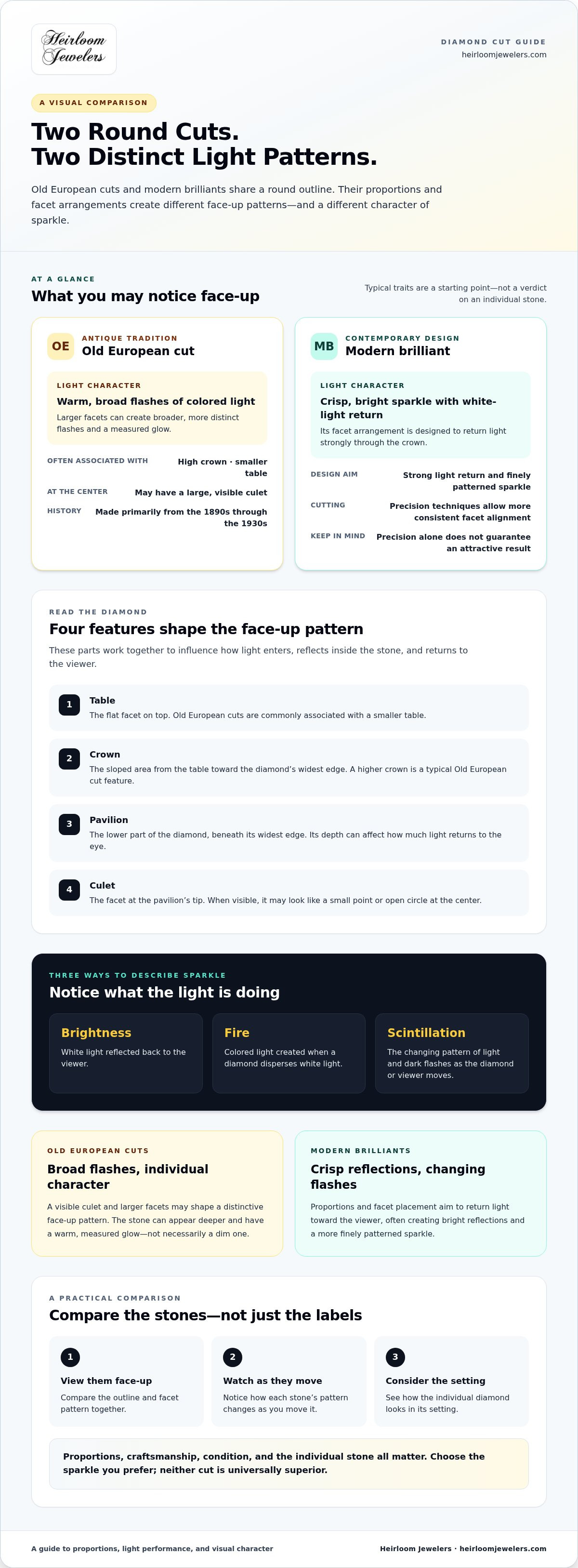
Old European Cut vs. Modern Brilliant: A Side-by-Side Comparison
A side-by-side view makes the differences easier to judge than a cut name alone. The table summarizes common tendencies, not rules. Antique diamonds were individually cut, and modern stones also vary in proportion and appearance. Use these traits to guide your comparison, then look closely at the specific diamonds in front of you.
| Feature | Old European cut | Modern brilliant |
|---|---|---|
| Typical era | Primarily cut from the 1890s through the 1930s | Contemporary round-brilliant tradition |
| Typical proportions | Often a higher crown and smaller table; depth and outline vary | Proportions shaped to support strong light return; individual measurements vary |
| Facet pattern | Often broader, more distinct flashes | Often a finer, more even-looking pattern of sparkle |
| Culet | May show as a noticeable open facet at the center | Often small or not readily visible face-up |
| Visual impression | Can appear softly glowing, with defined flashes | Can appear crisp and bright, with lively sparkle |
| Beauty or quality | Neither cut guarantees greater beauty or quality | Assess the individual diamond, not the label alone |
For a closer look at the historic character described here, explore authenticated estate and vintage jewelry.
Which visible details make the biggest difference?
Start with the face-up pattern. Notice whether the facets create broad flashes or a finer arrangement of light and dark. Then look at the table and crown proportions, whether the culet is visible, and how balanced the outline appears. Check the diamond from more than one angle. A slight tilt can reveal features that aren’t obvious when viewed straight on.
Distance and lighting matter. Close inspection can make facet boundaries and the culet easier to see, while normal viewing distance shows the diamond’s overall presence. Bright direct light may emphasize sparkle; softer ambient light can reveal a subtler pattern. If possible, compare actual stones side by side under the same conditions. This makes differences easier to distinguish than viewing each diamond in separate settings.
What should a fair comparison leave out?
Equal carat weight doesn’t mean equal face-up size. Depth, girdle thickness, and other proportions affect how much of a diamond’s weight is visible from above. Compare dimensions and appearance, not carat weight alone. Keep cut style separate from color, clarity, and condition, especially for estate diamonds, where wear or prior repairs may also influence what you see.
Finally, avoid assuming that one style carries a fixed value premium. Price depends on multiple factors, and a general comparison without current, reliable evidence can mislead. The fairest answer to old European cut vs modern brilliant diamond is found in the individual stone: its visible pattern, proportions, condition, and the qualities you personally value.
How to Choose Between an Old European Cut and a Modern Brilliant
Let your eye lead, then use the diamond’s details to check that first impression. An antique cut isn’t automatically dull, and a modern brilliant isn’t automatically brighter in every setting or lighting condition. Each label describes a design tradition, not a promise about how a particular stone will look.
- Identify the sparkle you prefer. If you’re drawn to a visible culet and broad, distinct flashes, begin with Old European cuts. If you prefer a crisp, finely patterned look, start with modern brilliants. Treat these as starting points, then judge the actual diamond.
- Inspect the proportions. Look at the table, crown, depth, and overall balance. Notice whether the center appears open or defined, and whether the facets seem even to your eye. Measurements help describe a stone, but don’t replace seeing it.
- Compare appearance fairly. View both diamonds under the same lighting and from similar distances. Turn each slowly and observe how its pattern changes. A diamond that looks lively in direct light may have a different character in softer surroundings.
- Consider the setting. A ring’s prongs, bezel, or surrounding design can frame the center stone and influence the impression of its outline. Stud earrings place more emphasis on the diamonds themselves, while a ring setting also brings the band and its proportions into view. For more on how setting and era relate, see this vintage engagement ring buying guide.
Which cut suits your preferred look?
How to assess a specific diamond fairly
Compare stones under consistent lighting and viewing conditions, and review grading information alongside any disclosed condition details. Keep measurable qualities, such as proportions and clarity, separate from personal taste. A feature you can describe objectively may or may not be one you value aesthetically. This distinction helps you decide with clear expectations, especially when comparing an antique diamond with a modern one.
The right choice is the stone whose appearance feels compelling to you, with proportions and condition you understand. If historic character is part of that appeal, explore authenticated estate and vintage jewelry as you consider which diamond tradition feels most at home in a piece you’ll wear.
Discover Old European Cut Diamonds in Estate Jewelry
An Old European cut in estate jewelry brings together two kinds of character: the design of the diamond and the history of a piece that has been owned before. Its distinctive facet pattern and, in some stones, visible culet offer details to appreciate up close. Those features can make an antique diamond feel individual, but they don’t by themselves establish its condition, quality, or rarity. Consider each piece on its own merits.
Heirloom Jewelers is a retailer of authenticated, curated estate and vintage fine jewelry. Its vintage white gold Old European cut diamond stud earrings offer a tangible example of this historic style in a finished piece. Seeing diamonds set as earrings also lets you consider how the setting frames them and how the stones appear together, rather than judging the cut only by technical descriptions.
What makes an estate Old European cut distinctive?
Look for the stone’s face-up pattern, the relationship between its table and crown, and whether a culet is visible. These features reflect the cutting choices behind the diamond and can give an estate piece a character unlike a more standardized modern design. For related context on historic styles and artisanal cuts, explore this guide to antique diamond earrings.
Age alone doesn’t tell you how well a diamond has been preserved. Condition depends on the individual stone and setting, so consider disclosed details about wear, repairs, or damage alongside its appearance. A historic cut is not automatically rare, and an antique label is not a substitute for information about quality. Separating these ideas helps you appreciate a diamond’s history without assuming that history answers every practical question.
This distinction also makes the old European cut vs modern brilliant diamond comparison more grounded. The cut tells you about design and visual character; the piece’s condition and grading information offer other parts of the picture. In estate jewelry, craftsmanship can be appreciated in the diamond’s facet arrangement as well as in how the setting holds and presents it. Take time to observe both.
Where to continue your diamond comparison
Continue at your own pace. Look through estate and vintage pieces with the differences you’ve learned in mind, and notice which details draw your attention. Compare the diamond’s visible pattern with the way its setting frames it. A considered look can turn technical terms into a clearer sense of personal preference.
If historic cuts appeal to you, explore Heirloom Jewelers’ estate and vintage jewelry. The aim is not to choose by age alone, but to find a piece whose character, appearance, and known condition feel right to you.
Let Your Preference Guide the Next Step
The most useful outcome of an old European cut vs modern brilliant diamond comparison is knowing what you want to see each time you look at a stone. Keep that preference in mind as you consider a diamond in the context of how you’ll wear it. A ring and a pair of earrings frame their stones differently, and the piece as a whole should feel right to you.
For a closer look at historic diamonds in finished jewelry, browse Heirloom Jewelers’ curated selection of authenticated estate and vintage fine jewelry, including vintage white gold Old European cut diamond stud earrings. Take your time and let the details guide you.
Explore Heirloom Jewelers’ authenticated estate and vintage jewelry, and continue your search with confidence in the qualities you value most.
Frequently Asked Questions
Is an Old European cut diamond less brilliant than a modern round brilliant?
Not necessarily. An Old European cut may show less crisp white brightness than a well-performing modern brilliant, yet display appealing colored flashes and a distinctive pattern. The individual diamond matters more than the label. If you’re comparing stones, view them under the same lighting and tilt each gently. A stone’s sparkle can change with movement, so one quick look in bright light won’t show its full character.
Can an Old European cut diamond look larger than a modern brilliant of the same carat weight?
It can, but carat weight alone can’t predict face-up size. Different depth and proportions affect how much of a diamond’s weight is visible from above. Compare the stones’ measurements and look at them side by side, face-up, rather than assuming the same weight means the same visual spread. Setting design can also affect perceived size by changing how much of the diamond’s outline remains visible.
What is the difference between an Old European cut and an Old Mine cut?
Both are historic diamond cuts, but they’re generally recognized by different outlines and facet patterns. Old European cuts are typically round, while Old Mine cuts often have a squarer, cushion-like outline. Individual stones can vary, so shape alone may not settle the identification. For a specific diamond, consider its proportions and facet arrangement together, and use any available documentation as supporting information rather than relying on one visual clue.
How can you tell an Old European cut diamond from a modern brilliant?
Are Old European cut diamonds always antique?
No. The term can describe a cutting style, not necessarily the age of the stone. While Old European cuts are strongly associated with antique diamonds, modern cutters may produce diamonds in an Old European style. If age matters to your purchase, distinguish the cut designation from the diamond’s documented history. Appearance alone can suggest a style, but it doesn’t establish when a particular stone was cut.
Do Old European cut diamonds have a visible culet?
Often, but not always. A culet is the small facet at the bottom of a diamond’s pavilion, and in some Old European cuts it appears as a visible opening or point at the center when viewed face-up. Its size and visibility vary. A setting, lighting, or viewing angle can make it harder to see, so don’t use the culet as the sole test of a diamond’s identity.
Which diamond cut is better for an engagement ring, Old European or modern brilliant?
Neither is universally better. For the old European cut vs modern brilliant diamond choice, consider which stone’s appearance you enjoy and how it works with the ring’s design. Compare the actual diamonds, then consider the setting’s condition and how securely it holds the center stone. A vintage platinum engagement ring and a contemporary-style setting can frame a diamond differently. Your preference and the specific ring should guide the decision.