
The colors alone don't prove a jewel was made for the suffrage movement. Suffragette movement jewelry is commonly associated with the Women’s Social and Political Union’s purple, white and green, adopted in 1908, but a period jewel’s history depends on more than its palette. Amethyst, pearls and green stones can evoke the cause without establishing a direct connection.
That distinction matters when considering a pendant or necklace. A pendant is the focal ornament; a necklace is the piece worn around the neck. Some designs combine both. An antique Edwardian jewel was made during that period, while an Edwardian-style piece borrows its design language but comes from another time.
This guide explains how to interpret suffragette colors and motifs, distinguish pendants from necklaces, and understand what provenance can reveal about a piece’s connection to the movement. It also compares antique Edwardian jewelry with later Edwardian-style designs, helping you assess each piece’s history, craftsmanship, and meaning with care.
Key Takeaways
- Look beyond color when assessing a jewel’s history; documented provenance is more meaningful than a palette that echoes the movement.
- Learn how the period’s pendants and necklaces used symbolic motifs, including designs associated with Sylvia Pankhurst.
- Compare antique Edwardian craftsmanship with later pieces inspired by Edwardian design, and understand what that distinction means for a jewel’s history.
- Place the movement’s jewelry in its wider context: the 19th Amendment to the U.S. Constitution was adopted on Aug. 26, 1920, according to the U.S. National Archives and Records Administration.
Suffragette pendants and necklaces
A pendant is the ornament; a necklace is the piece worn around the neck. A pendant may hang from a chain, while a necklace can have its decoration built into its design. This distinction helps describe historic jewelry accurately, but does not establish a piece’s connection to the suffrage movement.
Suffragettes wore brooches, pins, pendants, necklaces, and other jewelry. Some pieces displayed movement colors or symbolic designs; badges could also feature photographs of WSPU leaders. The form shows how a jewel was worn, while its design and history provide further context.
The Women’s Social and Political Union first used purple, white and green at a Hyde Park rally in June 1908. These colors became associated with dignity, purity and hope. Pendants combining amethyst, pearls and green stones therefore echo the movement’s palette. Color alone, however, is not proof of a direct historical connection.
Named designs offer more specific clues. Ernestine Mills created the Angel of Hope pendant to commemorate Louise Mary Eates’s release from Holloway Prison in 1909. Sylvia Pankhurst designed a pendant in purple, white and green enamel. She also designed the Holloway Prison brooch in 1909. Such named examples connect jewelry to identifiable makers, designs or events, rather than relying only on color.
Necklaces could carry the same palette in a different arrangement. A suffragist necklace made by Child & Child is dated circa 1908. That example shows how the movement’s colors could appear in a necklace, not only a pendant or brooch. In the United States, the 19th Amendment to the U.S. Constitution was adopted on August 26, 1920, according to the U.S. National Archives and Records Administration. That date provides American political context, while British WSPU designs have their own history. For a particular jewel, its maker, design, date and documented provenance help distinguish a movement-related piece from one that simply uses similar colors.
Antique Edwardian suffragette jewelry
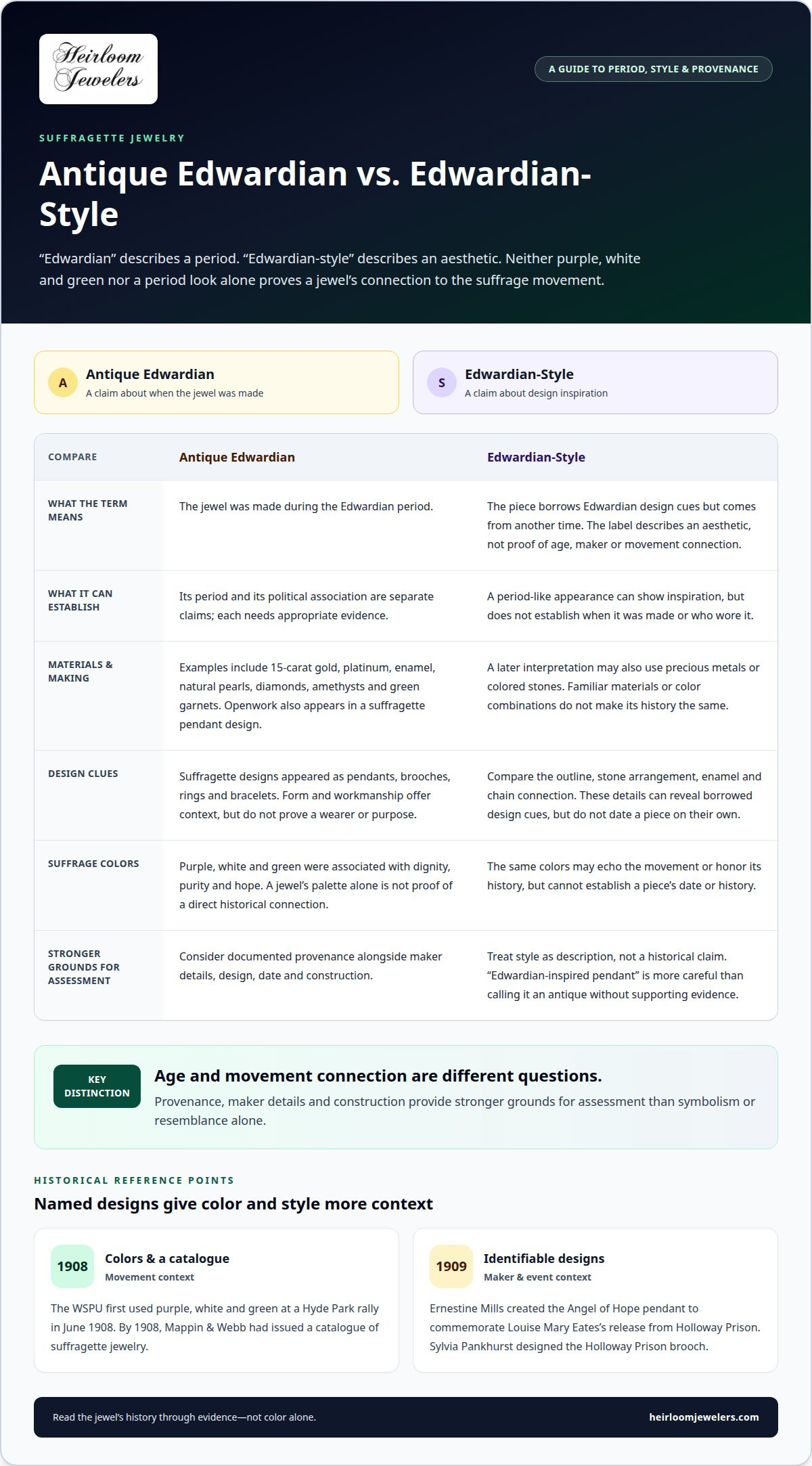
Antique Edwardian suffragette jewelry combines period craftsmanship with designs connected to the campaign. Its age and political association are separate claims, each requiring different evidence.
Materials and Making Techniques
Materials and making techniques describe the metals, stones and decorative methods used in a jewel. They matter because they help explain its appearance and construction. Examples include 15-carat gold, platinum, enamel, natural pearls, diamonds, amethysts and green garnets. Openwork also appears in a suffragette pendant design. Enamel could bring purple, white and green into one piece, while gemstones offered those colors through their natural hues. Material and workmanship can inform an assessment, but neither alone proves a political connection.
Popularity and Changing Styles
Popularity describes how widely a style was adopted, while changing styles show how its motifs appeared across different jewelry forms. By 1908, suffragette jewelry had become fashionable enough for Mappin & Webb to issue a catalogue. Designs included pendants, brooches, rings and bracelets. That range shows the movement’s colors extending beyond a single type of ornament. A period piece’s form and workmanship help place it in context, but do not establish its wearer or purpose.
Purple, white, and green represented dignity, purity, and hope. Later suffragist or feminist jewelry may honor related causes, but it is not automatically an antique movement piece. Authenticity depends on evidence connecting an object to its period and history, especially documented provenance. Color alone is not enough.
There is no single price for authentic pieces. Value depends on materials, workmanship, condition, maker, rarity, and provenance. In Britain, Ernestine Mills made suffrage jewelry, Sylvia Pankhurst designed movement-related pieces, and Child & Child made a suffragist necklace. The examples here identify no U.S. jewelry designer or seller. Suffrage buttons, however, were widely distributed and worn in the United States.
To study museum examples, consult catalogues and documented collections that identify individual objects. Attribution requires care: later pieces can reuse movement colors, and an appealing historical story may go beyond the evidence. Provenance, maker details, and construction provide stronger grounds for assessment than symbolism alone.
Edwardian-style suffragette jewelry
Edwardian-style suffragette jewelry borrows visual cues from period designs but does not necessarily date from the Edwardian era. The phrase describes an aesthetic, not proof of age, maker, or connection to the movement. A later pendant may echo historic forms while having a separate production history.
The distinction matters because resemblance and provenance answer different questions. A piece may use purple, white, and green yet have been made much later. Its colors can express admiration for suffrage history, but cannot establish when it was created or who wore it. Treat style as a description, not a historical claim.
Compare the overall design before drawing conclusions. Look at the pendant’s outline, the arrangement of stones, the use of enamel, and the chain connection. These details can show what the maker borrowed from earlier jewelry, but they do not date the piece on their own. A careful description might call it an “Edwardian-inspired pendant” rather than an antique.
Materials can also differ between an antique and a later interpretation. Both may use precious metals or colored stones, but a familiar combination does not make their histories the same. For example, amethyst paired with green stones may recall a suffrage palette. The materials describe the jewel; dating and provenance establish its place in history.
For a clear comparison, separate three questions: Does the design evoke Edwardian jewelry? Is the object genuinely from that period? Is there evidence connecting it to the suffrage movement? Each question calls for different support. Visual features address the first; construction and documented history help address the others. Keeping these judgments separate prevents an attractive style from being mistaken for documented political significance.
Edwardian-inspired jewelry can have aesthetic value without an activist connection. A modern wearer may appreciate its craftsmanship, historical references, or symbolic colors. The distinction keeps the description accurate: use “inspired” for a later design, and reserve “antique” for a period piece supported by evidence of age.
These asking prices do not establish age or provenance.
What jewelry styles and symbols were associated with the suffragette movement?
Suffragette movement jewelry included more than colored gemstones. WSPU supporters wore badges, brooches, pendants, and hatpins. Designs made political identity visible at meetings and demonstrations. Some badges carried photographs of WSPU leaders, connecting wearers with recognizable campaign figures. An object’s shape and imagery could communicate affiliation as clearly as its colors.
Some motifs referred directly to imprisonment. Arrow-shaped hatpins evoked the arrow worn by prison convicts, turning a mark of punishment into a symbol of resistance. Sylvia Pankhurst designed the Angel of Freedom, another named design associated with the cause. These examples show how campaign objects could mean more than decoration. A motif may suggest a political reference, but its presence alone does not establish an object’s date or ownership.
Different organizations used different palettes. The National Union of Women’s Suffrage Societies used red, white, and green, distinguishing its colors from the WSPU’s purple, white, and green. This matters when interpreting a jewel: a green stone or enamel detail may fit more than one suffrage context. The organization, design, and evidence surrounding a piece help refine its interpretation. These distinctions help describe suffragette movement jewelry without assuming every similarly colored jewel was connected to a campaign.
In the United States, suffrage buttons offered another form of campaign jewelry. One button used 12 stars to represent states where women had full suffrage. Newly perfected celluloid buttons became feasible for political use in 1896. These wearable emblems differed from fine gemstone jewelry, but both made political ideas visible through objects worn on the body.
WSPU medals recognized women jailed for participating in the movement. Some included additional bars for each action in which the recipient participated. Artist-craftswomen, including Ernestine Mills, also made jewelry for suffragette fundraising bazaars. Medals, badges, and crafted jewels served different purposes: recognition, identification, and fundraising. Their forms offer clues about function, while documented history supports careful attribution.
For a contemporary interpretation of colored-stone adornment, explore estate gemstone earrings.
Heirloom Jewelers: Lugano Emerald & Diamond Necklace 18K White Gold
The Lugano Emerald & Diamond Necklace 18K White Gold offers a contemporary way to appreciate emerald jewelry after exploring suffragette-era designs. Its emerald and diamond combination may appeal to readers drawn to green gemstones, though color alone does not establish a historical connection to the suffrage movement. For another example of estate jewelry featuring green stones, consider the Estate Peridot & Quartz Dangle Earrings 14K Yellow Gold.
Heirloom Jewelers specializes in authenticated estate and vintage fine jewelry, including antique pieces that can be appreciated for their history and craftsmanship. For a piece with documented suffragette connections, provenance is essential; a modern design inspired by the movement is not historical evidence. Explore Heirloom Jewelers’ estate and vintage collection, available by appointment.
Carry the history forward with care
A jewel can reflect personal taste without claiming a political past. If you’re drawn to suffragette movement jewelry, distinguish historical association from a later design. Provenance and craftsmanship give a piece context, while its colors and motifs can remain meaningful in their own right.
For those interested in estate and vintage jewelry, Heirloom Jewelers offers the Lugano Emerald & Diamond Necklace 18K White Gold, Vintage White Gold Old European Cut Diamond Stud Earrings, and Vintage Platinum 0.5 Carat Diamond Engagement Ring. Each offers a different way to appreciate fine jewelry beyond the specific story of the suffrage movement.
Let your next choice reflect the history, materials, and design that matter most to you. Contact Heirloom Jewelers about suffragette jewelry to continue the conversation with care.
Frequently Asked Questions
How much does authentic suffragette jewelry cost today?
There is no single price: value depends on materials, workmanship, condition, maker, rarity, and provenance.
Where can museums or collections be found with examples of suffragette jewelry?
Look for museum catalogues and documented collections that identify individual suffragette jewelry objects.