
A common misconception suggests that a piece of jewelry crafted a century ago is too delicate for daily wear. In reality, the hand-forged construction of vintage wedding bands often surpasses the structural integrity of modern, mass-produced castings. These rings have already proven their durability through decades of history. They offer a level of artistry and character, from intricate filigree to old European cut diamonds, that today's retail market cannot replicate.
You likely want a symbol of commitment that feels as unique as your own story. It's understandable to feel hesitant about navigating historical eras or worrying if an antique piece will complement a modern engagement ring. We provide clarity on these concerns. You'll discover the historical artistry, material superiorities, and ethical advantages of choosing a curated vintage band for your lifetime commitment. We'll examine the distinct hallmarks of Art Deco and Victorian styles, the investment value of authenticated 18K gold and platinum estate jewelry, and practical tips for ensuring your ring remains a lasting heirloom.
Key Takeaways
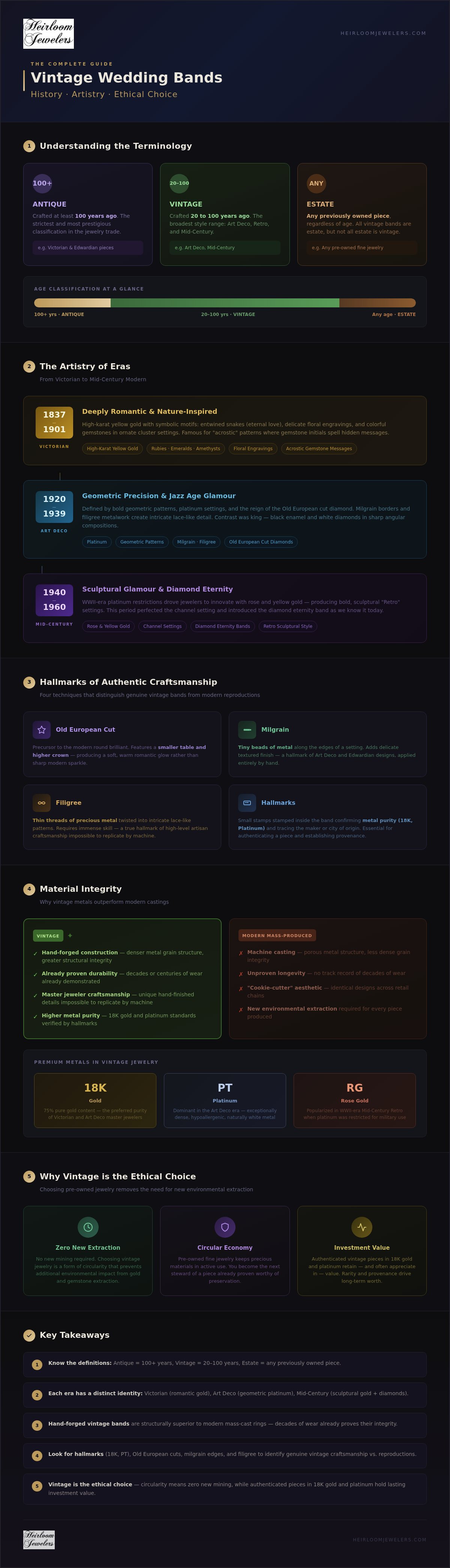
- Distinguish between antique and vintage designations to understand the technical age and heritage of your piece.
- Identify the distinct artistry of the Victorian and Edwardian eras to choose a design that resonates with your personal style.
- Learn why the hand-forged integrity of vintage wedding bands offers a level of durability that modern mass-production often lacks.
- Master the techniques of era-mixing and metal harmony to pair a curated estate band with your existing engagement ring seamlessly.
- Explore the ethical advantages of circularity and how choosing pre-owned jewelry removes the need for new environmental extraction.
Understanding Vintage vs. Antique Wedding Bands
The distinction between antique and vintage is more than a matter of semantics. In the jewelry trade, we follow the 100-year rule. A wedding band is technically "antique" only if it was crafted at least a century ago. Pieces created between 20 and 100 years ago are classified as vintage. This "Era of Elegance" covers a vast range of design movements, from the geometric precision of Art Deco to the bold gold styles of the late 20th century. This window offers the most diverse style options for modern couples because it bridges the gap between historical tradition and wearable, contemporary aesthetics.
Many clients use the term "estate" interchangeably with vintage, but there is a subtle difference. Estate jewelry refers to any piece that has been previously owned, regardless of its age. While all vintage wedding bands are technically estate pieces, a ring purchased last year and then sold would also be considered estate. Understanding these definitions helps you evaluate rarity and provenance. Older pieces often command higher values due to their limited survival and the specific hand-tooling techniques used by master jewelers of the past. When we assess a band's value, we look at the metal purity, the cut of the stones, and the presence of original hallmarks. These elements confirm the piece's authenticity and its place in history.
The Appeal of Pre-Owned Fine Jewelry
Choosing pre-owned jewelry is a deliberate shift away from mass-produced retail. In the luxury market, "pre-owned" doesn't imply a compromise in condition. Instead, it signifies a piece that was significant enough to be preserved. These rings carry a historical narrative that modern collections lack. You aren't just buying a band; you're becoming the next steward of a story. This choice ensures your ring avoids the "cookie-cutter" aesthetic found in mall-store displays. Every hand-finished detail represents a unique moment in design history that cannot be replicated by a machine.
For those who appreciate this level of artistry in contemporary designs, kamilafj.com offers a modern alternative with their range of handcrafted fine jewelry that honors traditional, non-mass-produced techniques.
Key Terminology for the Discerning Buyer
To find the perfect ring, you should recognize the markers of historical craftsmanship. Familiarity with these terms allows you to speak the language of the trade and ensures you can identify genuine vintage wedding bands from modern reproductions.
- Old European Cut: These diamonds were the precursor to the modern round brilliant. They feature a smaller table and a higher crown, creating a soft, romantic glow rather than a sharp, modern sparkle.
- Milgrain: This decorative technique involves creating tiny beads of metal along the edges of a setting. It adds a delicate, textured finish common in Art Deco and Edwardian designs.
- Filigree: This involves twisting thin threads of precious metal into intricate, lace-like patterns. It's a hallmark of high-level craftsmanship that requires immense skill.
- Hallmarks: These small stamps inside the band are vital. They identify the metal's purity, such as 18K or Platinum, and often help trace the maker or city of origin.
The Artistry of Eras: From Victorian to Mid-Century
Every jewelry era tells a specific story through its choice of materials and motifs. When selecting vintage wedding bands, understanding these historical periods allows you to find a piece that aligns with your personal aesthetic and values. These eras aren't just dates on a timeline; they represent shifts in technology, social culture, and artistic philosophy. Choosing a ring from a specific decade ensures your commitment is represented by a design that resonates with your own style.
Victorian bands (1837–1901) are deeply romantic and often influenced by the natural world. This era favored high-karat yellow gold and symbolic motifs like entwined snakes, which represented eternal love, or delicate floral engravings. While diamonds were used, this period is famous for incorporating colorful gemstones. Rubies, emeralds, and amethysts were frequently set in ornate clusters or "acrostic" patterns where the first letter of each stone spelled out a hidden message of affection. These pieces feel substantial and warm, offering a sense of history that is tangible on the hand.
Mid-Century designs (1940s–1960s) reflect a shift toward modern simplicity and the rise of the diamond eternity band. This period introduced the "Retro" style, characterized by bold, sculptural yellow gold settings. During the early 1940s, platinum was restricted for military use, leading jewelers to innovate with rose and yellow gold. The result was a series of substantial, polished bands that feel both sturdy and glamorous. This era also saw the perfection of the channel setting, which allowed for a seamless row of diamonds that remains a classic choice today.
Art Deco and the Jazz Age Aesthetic
The 1920s brought a radical shift toward symmetry and architectural lines. Art deco jewelry remains the gold standard for many collectors because of its uncompromising geometric precision. These bands often utilize baguette-cut diamonds and bold 18K white gold or platinum settings. You'll frequently see vibrant contrasts, such as sapphires or emeralds paired with diamonds to create striking visual patterns. The influence of skyscrapers and industrial design is evident in every straight line and repeating pattern. It's a style that feels remarkably contemporary despite being a century old. If you appreciate order and bold contrast, this era offers unparalleled options.
Edwardian Sophistication and Platinum Filigree
The Edwardian era (1901–1915) is defined by its ethereal, lace-like appearance. This period saw the first widespread use of platinum in fine jewelry. Because platinum is significantly stronger than gold, jewelers could create incredibly thin, detailed designs without sacrificing durability. The "garland style," featuring ribbons, laurel leaves, and feathers, is a hallmark of this time. Transitioning from heavier antique rings to these delicate bands offers a sophisticated, feminine look. The intricate milgrain and filigree work of this period is almost impossible to replicate with modern casting methods. If you're looking for a piece with this level of historical detail, exploring an authenticated collection of estate jewelry can reveal options that modern jewelry stores simply don't carry.
Material Integrity: Why Vintage Metals Outperform Modern Castings
A frequent concern among buyers is the perceived fragility of older jewelry. However, the construction methods of the past often provide superior durability compared to modern mass-production. Most contemporary rings are created through casting, where molten metal is poured into a mold. While efficient, this process can introduce microscopic porosity or air bubbles. In contrast, many vintage wedding bands were hand-forged. This labor-intensive process involves hammering and pulling the metal, which "work-hardens" the material. The result is a denser, more resilient structure that resists bending and thinning over decades of wear.
This structural density is why the fragility myth is largely unfounded. If a ring has survived daily wear for eighty years, it has already passed a rigorous durability test. It's likely to last another eighty years with minimal maintenance. Early 20th-century 18K white gold also offers a unique aesthetic advantage. These historical alloys often contain different proportions of palladium or nickel than modern versions. This results in a naturally white metal that develops a soft, warm patina. It avoids the stark, artificial brightness of modern rhodium plating, maintaining an authentic character that matures beautifully alongside the wearer.
The Durability of Platinum in Estate Jewelry
Platinum is the premier choice for those seeking absolute longevity. Its most remarkable property is displacement. When gold is scratched, a microscopic amount of metal is actually lost. When platinum is scratched, the metal merely shifts to the side. This means a vintage platinum band retains its original weight and volume for centuries. This inherent strength allowed jewelers to create the incredibly fine, lace-like details seen in a Vintage Platinum 0.5 Carat Diamond Engagement Ring. To maintain its characteristic luster, a simple cleaning with a soft brush and mild solution is usually all that is required.
Hallmarks and Authentication
Identifying the purity and origin of a piece requires a keen eye for hallmarks. These small stamps, usually found on the interior of the band, act as a jeweler's signature and a guarantee of quality. You might see "PLAT" for platinum or "18K" for high-purity gold. These marks are essential for tracing a band's history and verifying its value in the estate market. We prioritize the authentication of every piece, focusing on high-value, pre-owned items such as 18K white gold or 14K yellow gold settings. This rigorous process ensures that every vintage wedding bands selection in our collection meets the standards of a discerning collector.
The Art of the Pair: Matching Your Band to Your Ring
Pairing a wedding band with an engagement ring is a highly personal exercise in curation. While some prefer a perfectly matched set, others find beauty in the contrast of different eras and textures. Curation allows you to tell a broader story. Many collectors wonder if they can mix styles, such as pairing a geometric Art Deco band with a romantic Victorian engagement ring. This combination is entirely possible and often creates a sophisticated, eclectic look. The key is to find a common thread, such as a shared diamond cut or a similar metal tone, to anchor the pairing.
Metal harmony is another significant consideration. Mixing metals, such as pairing a platinum band with an 18K yellow gold engagement ring, creates a modern and intentional contrast. You should be aware that platinum is a much denser metal than gold. Over decades of constant contact, a platinum band may cause slight wear on the softer gold prongs or shank of an engagement ring. If you choose to mix metals, regular inspections by a professional are a wise precaution. Stacking multiple vintage wedding bands has also become a popular way to build a unique narrative. This trend allows you to add bands over time to mark anniversaries or milestones, creating a rich, layered aesthetic on your hand.
Matching Styles and Silhouettes
The profile of your engagement ring often dictates the type of band that will sit comfortably against it. Low-set engagement rings, common in the early 20th century, often require a contoured or "curved" vintage band to avoid a large gap. If you prefer a flush fit, look for bands specifically designed with a slight arc. Conversely, a simple white gold diamond band provides a clean, elegant border for a classic solitaire. To ensure a cohesive look, try to match the diamond cuts in your band to those in your engagement ring. Using baguette or old European cut stones in your band can beautifully complement the center stone without competing for attention.
Choosing the Right Width
Proportionality is essential for a balanced look. A thin "whisper" band, typically under 1.5mm, suits those with delicate fingers or very small center stones. Wider cigar-style bands, which can exceed 5mm, offer a bold, substantial presence that works well as a standalone piece or with a very high-set ring. You must also consider the height of the band; it should not sit so high that it overshadows the engagement stone. A 2mm band offers the most versatility for stacking because it provides enough presence to stand alone while remaining slim enough to layer with multiple rings. If you are ready to find a piece that perfectly complements your engagement ring, explore our curated selection of authenticated estate jewelry today.
Finding the right vintage wedding bands requires patience and a keen eye for detail. Whether you choose to match your metals or mix your eras, the goal is to create a set that feels authentic to your personal history. By focusing on the width, profile, and craftsmanship of each piece, you ensure that your rings will look as beautiful together in fifty years as they do today.
Why Vintage is the Ethical Choice for 2026
Modern luxury consumers are increasingly prioritizing transparency and environmental impact. Selecting vintage wedding bands is perhaps the most significant step a couple can take toward a sustainable commitment. Every new piece of jewelry requires fresh extraction. This process often involves heavy machinery and chemical refining that leaves a lasting footprint on the landscape. By choosing a pre-owned ring, you bypass the need for new mining entirely. You are opting for a circular economy where the value of the materials is preserved and passed forward. This choice avoids the social and environmental costs associated with modern extraction while celebrating the precious metals that are already in circulation.
Purchasing vintage also serves as a vital act of cultural preservation. Every piece in our collection represents the legacy of master craftsmen who worked without the aid of modern computer-aided design. These artisans relied on their eyes and hands to create intricate details that machines simply cannot replicate with the same soul. When you choose an estate band, you are protecting a piece of history from being melted down or lost to time. You become the steward of a one-of-a-kind treasure. This "one-of-a-kind" guarantee is something mass-production can never offer. Your ring will never be a cookie-cutter design found in every shopping mall; it is a distinct artifact with its own unique charm.
The Sustainability of Estate Fine Jewelry
The carbon footprint of a vintage ring is negligible compared to a newly manufactured one. High-quality materials like 18K gold and platinum are infinitely recyclable. They retain their purity and value regardless of how many times they are repurposed. However, there is a distinct beauty in keeping these metals in their original, hand-forged forms rather than melting them into new castings. Investing in a "future heirloom" means you are choosing a piece that has already stood the test of time. It has proven its durability through decades of wear. This longevity is the ultimate form of sustainability. You are not buying a temporary fashion accessory, but a permanent symbol of history that requires no new resources to exist.
Heirloom Jewelers: Your National Guide to Vintage Excellence
We act as a bridge for those seeking this ethical and artistic alternative. Our commitment to authenticating every piece in our curated collection ensures that you receive a genuine artifact of history. We focus exclusively on unique vintage finds. We intentionally avoid the repetitive nature of mass-produced jewelry. This focus allows us to provide a level of expertise that modern retailers lack. Whether you are looking for an 18K white gold band or a rare platinum setting with old European cut diamonds, our national collection is designed to help you find a piece that reflects your values. Browsing our inventory allows you to discover the charm and artistry that only authenticated estate jewelry can provide. We invite you to find a vintage wedding bands selection that honors both your past and your future.
Finding Your Forever Heirloom
Selecting a ring is a significant decision that bridges your personal history with your future. You've seen how the hand-forged construction of these curated pieces offers a level of durability and density that modern casting simply can't match. By choosing a piece from the Victorian, Edwardian, or Art Deco eras, you're investing in a one-of-a-kind artifact that reflects both historical artistry and a commitment to sustainable, ethical consumption.
This appreciation for bespoke quality often extends to the wedding attire, where a gown from Guillermo Pharis Bridal can provide the same sense of luxury and unique craftsmanship as a century-old ring.
We specialize in 18K gold and platinum heritage jewelry that has been meticulously curated for its quality and character. Every estate piece in our inventory undergoes expert authentication to ensure its provenance and material purity. Whether you're searching for a delicate filigree band or a bold geometric design, our collection is available for national shipping. We prioritize integrity and long-term relationships, acting as your trusted guide through the complexities of the secondary market.
Explore our curated collection of authenticated vintage wedding bands to find a piece that truly resonates with your story. We're here to help you discover a symbol of commitment that is as enduring as it is beautiful.
Frequently Asked Questions
Are vintage wedding bands durable enough for everyday wear?
Yes, most vintage wedding bands are exceptionally durable because they were hand-forged rather than cast. This labor-intensive process creates a denser metal structure that resists thinning over time. While they are suitable for daily wear, you should avoid wearing them during heavy manual labor or contact with harsh chemicals to preserve the fine detail. Periodic inspections by a professional help ensure the settings remain secure for another lifetime of use.
How do I know if a vintage wedding band is authentic?
Professional authentication is the only definitive way to confirm a piece's origin. We examine hallmarks, metal purity, and specific stone cutting styles, such as the old European cut, to verify age. Authenticated pieces from a trusted specialist provide a guarantee that the ring is a genuine artifact of its era rather than a modern reproduction. This process protects the investment value of your vintage wedding bands.
Can vintage wedding bands be resized?
Most plain or lightly engraved bands can be resized by a skilled jeweler without difficulty. However, full eternity bands with diamonds encircling the entire finger or rings with complex filigree require specialized care. In some cases, resizing might disrupt the lace-like pattern or structural integrity of the piece. It's best to consult with a curator before purchasing to determine if a specific band is a candidate for adjustment.
What is the difference between an antique and a vintage wedding band?
The distinction is based strictly on the age of the piece. An antique band is at least 100 years old, while a vintage band is between 20 and 100 years old. Both categories offer exceptional craftsmanship, but antiques often feature Victorian or Edwardian motifs. Vintage pieces frequently showcase Art Deco or Mid-Century aesthetics, providing a broader range of styles for modern collectors.
Will a vintage band damage my modern engagement ring?
A vintage band can cause wear if the metals have different hardness levels. For instance, a platinum band is much denser than an 18K gold ring. Constant friction between the two can gradually wear down the gold prongs or shank of your engagement ring. Using a thin spacer band or choosing matching metals can prevent this physical degradation and ensure both pieces remain in pristine condition.
Why are vintage wedding bands considered more sustainable?
Vintage jewelry is the most sustainable option because it requires zero new mining. Choosing pre-owned pieces prevents the environmental disruption and carbon emissions associated with modern gold and diamond extraction. It utilizes resources already in circulation, making it a responsible choice for those prioritizing an ethical commitment. It's a circular approach to luxury that honors the planet as much as the past.
What should I look for in a vintage platinum hallmark?
Look for stamps such as "PLAT," "900 PLAT," or "950 PLAT" on the interior of the band. These marks indicate the percentage of pure platinum used in the alloy. Older pieces from the early 20th century may also feature maker's marks or city hallmarks that help trace the ring's specific origin. These stamps are vital for verifying the metal's purity and the ring's historical significance.
Can I mix metals when pairing a vintage band with my engagement ring?
You can certainly mix metals to create a unique, curated look. Pairing a yellow gold band with a platinum engagement ring is a classic way to highlight the contrast between the two pieces. This choice feels intentional and sophisticated. Just ensure the widths and profiles are complementary so one ring doesn't physically overshadow the other, maintaining a balanced aesthetic on your hand.