
An emerald is never just a gemstone; it's a three-thousand-year-old witness to the heights of human ambition. From the deep mines of ancient Egypt to the modern auction block, these stones have consistently represented the pinnacle of luxury and status. The history of emerald jewelry isn't merely a timeline of fashion. It's a record of craftsmanship that connects the mystical talismans of the past with the sophisticated estate pieces we cherish today.
You may find it difficult to distinguish a genuine historical design from a modern reproduction, or perhaps the technical jargon of gemstone origins feels confusing. It's natural to want certainty when investing in a piece of heritage. This article clarifies the journey of the emerald, promising to lead you from Cleopatra’s legendary collections to the structured elegance of Art Deco designs. You'll learn to identify key characteristics of different eras and understand why the origin of a stone impacts its lasting value. We'll examine how the evolution of design allows a Lugano emerald and diamond necklace to stand as a bridge between historical grandeur and contemporary refinement.
Key Takeaways
- Trace the origins of emeralds back to 330 BC in Egypt. You'll learn how the term 'smaragdus' defined the early legacy of these green stones.
- Understand how the 16th-century discovery of Colombian mines changed the history of emerald jewelry by introducing stones of superior clarity.
- Identify the specific design hallmarks of the Victorian and Edwardian eras. This includes the shift toward the delicate platinum settings that define early 20th-century styles.
- Explore the symbolic power of emeralds as traditional birthstones. Discover their historical reputation for revealing truth and providing protection to the wearer.
- Gain confidence in evaluating estate pieces by understanding the role of provenance in authenticated items like the Lugano Emerald & Diamond necklace.
Ancient Origins and the 'Smaragdus' Legacy
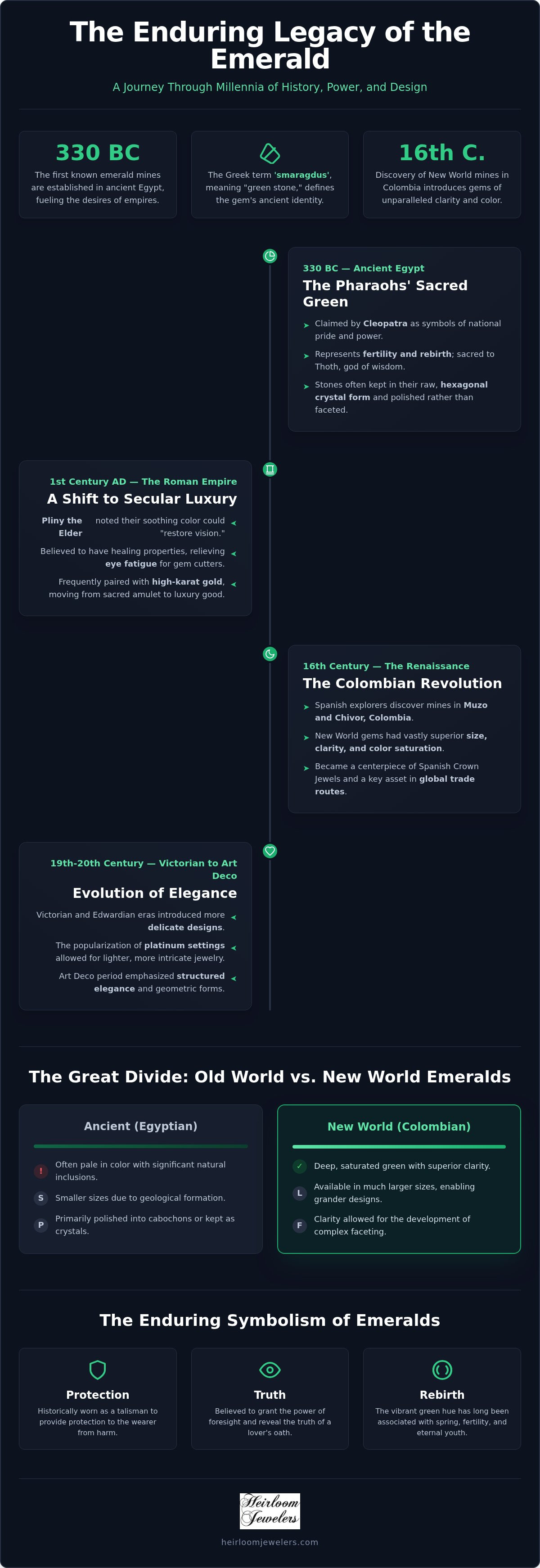
The word emerald finds its roots in the Greek term smaragdus, which translates simply to green stone. This linguistic origin highlights how the stone's color has been its most defining characteristic for millennia. When we examine the history of emerald jewelry, the journey begins in the rugged landscapes of Egypt. Mining operations in the Eastern Desert date back to at least 330 BC. These mines served as the world's primary source of emeralds for over a thousand years, fueling the appetites of empires from the Mediterranean to the Near East.
No historical figure is more closely linked to these stones than Cleopatra. She didn't just wear emeralds; she claimed the mines as her own property. To the Queen of the Nile, these gems were symbols of national pride and divine power. She frequently gifted high-ranking dignitaries emeralds engraved with her likeness, establishing a precedent for the gem as a tool of political influence and elite status. This early association with royalty helped cement the emerald's reputation as a stone of incomparable value.
The Pharaohs’ Sacred Green
In ancient Egyptian culture, the emerald represented fertility and rebirth. It was considered the stone of Thoth, the god of wisdom and writing. Jewelers crafted protective amulets and talismans to accompany the deceased into the afterlife, believing the vibrant green hue ensured eternal youth. Early lapidary techniques were limited by the tools of the era. Ancient jewelers often kept the stones in their natural hexagonal crystal form. They preferred polishing the surface rather than attempting complex facets. This preserved the stone's raw weight and organic presence.
Roman Luxury and the Pliny Records
The Romans expanded the appeal of the stone beyond religious talismans. Pliny the Elder, a Roman scholar and naturalist, famously described them in his first-century AD work, Natural History. He wrote that "no green is greener," noting that the stone's color was so soothing it could restore vision and relieve eye fatigue. Roman gem cutters often kept an emerald on their workbenches to rest their eyes after hours of intricate work. This belief in the stone's healing properties added a layer of practical value to its aesthetic allure.
Roman jewelry styles began pairing emeralds with high-karat gold. This shifted the stone's role from a sacred artifact to a secular luxury good. These early designs laid the groundwork for the structured elegance found in authenticated estate pieces today. While the mines of antiquity were eventually exhausted, the design principles of the era remained. They prioritized the stone's natural intensity and historical significance, a tradition that continues to guide serious collectors in the modern market.
The Renaissance of Green: The New World Discovery
The 16th century marked a definitive turning point in the history of emerald jewelry. As Spanish explorers reached the shores of South America, they encountered the Muzo and Chivor mines in modern-day Colombia. These locations yielded stones that were fundamentally different from the Egyptian specimens of the ancient world. They possessed a size, clarity, and deep saturation that had never been seen before. This discovery immediately shifted the global market. The pale, heavily included emeralds of Cleopatra’s era were quickly rendered obsolete by these superior New World gems.
Emeralds became a central focus of the Spanish "Age of Exploration." While the initial quest was for gold, the emerald provided a unique and concentrated form of wealth that was easier to transport. These stones didn't merely serve as currency; they became the centerpiece of the Spanish Crown Jewels. The Spanish established vast trade routes that carried Colombian treasures across the Atlantic and into the distant markets of the Mughal Empire and the royal courts of Europe. This global movement transformed the emerald into the preferred gemstone of the Renaissance elite, symbolizing both immense wealth and colonial reach.
Spanish Plunder and Global Trade
The impact of New World emeralds extended far beyond Spain. Merchants traded these stones in India, where the Mughal emperors valued them above almost all other gems. The Mughals often commissioned artisans to carve these large stones with intricate floral patterns or sacred inscriptions. This created a distinct style of jewelry that blended Colombian material with Eastern craftsmanship. In the Middle East and India, the sheer clarity of these imports set a new standard for what a high-quality gemstone should look like, influencing jewelry design for centuries to come.
Emeralds in the Courts of Europe
In Europe, the availability of larger and clearer stones allowed jewelers to move away from heavy, protective settings. They began experimenting with more complex and delicate metalwork that allowed more light to enter the stone. Emeralds became the primary choice for royal coronations and high-stakes wedding dowries. Monarchs used these vibrant green gems to project an image of absolute authority. Colombian emeralds remain the gold standard for estate collectors in 2026 due to their incomparable saturation and the historical prestige of their Muzo and Chivor origins.
Appreciating the heritage of these stones is a cornerstone of our work. We invite you to view our collection of authenticated estate emerald jewelry to see how this 16th-century legacy continues to influence modern elegance. Each piece serves as a bridge between the craftsmanship of the past and the sophisticated tastes of the present collector.
Emeralds Through the Eras: From Victorian to Art Deco
The history of emerald jewelry entered a period of rapid aesthetic evolution during the 19th and early 20th centuries. As jewelry moved from the private collections of monarchs to the broader elite, design movements began to define the stone's presentation. Each era introduced specific metalworking techniques and symbolic meanings that continue to influence the value of estate pieces today. Understanding these shifts helps collectors identify the heritage of a piece beyond its carat weight.
Victorian Symbolism and Nature
Victorian Era (1837–1901) designers viewed emeralds as romantic symbols of hope and the natural world. Early pieces from this period often utilized yellow gold or silver-topped gold settings to secure the stones. One of the most influential designs of the time was the snake motif; Queen Victoria’s engagement ring featured a serpent with emerald eyes, signifying eternal love. This sparked a trend for nature-inspired jewelry that favored organic shapes. You can identify these era-specific hallmarks and metal types by exploring our educational guide to antique rings.
Edwardian Elegance and the Rise of Platinum
The Edwardian Era (1901–1910) brought a shift toward lightness and airy sophistication. This period saw the widespread introduction of platinum in fine jewelry. The strength of this metal allowed artisans to create "garland" styles that were as delicate as lace. Emeralds were frequently paired with diamonds in these intricate white metal settings to create a sense of ethereal luxury. This era established the preference for white metals that remains prevalent in high-end estate collections today.
Art Deco and the Modern Emerald Cut
The 1920s and 1930s prioritized geometric precision and high contrast. Art Deco designers moved away from the flowing lines of the past in favor of architectural symmetry. This era saw the refinement of the "emerald cut." This stepped, rectangular cut was specifically engineered to highlight the stone’s vivid color while protecting its corners from chipping. Jewelers often paired emeralds with black onyx or baguette diamonds to create a striking visual impact. The transition to 18K white gold and platinum settings became the standard for enhancing the stone’s cool, green depth.
The Bold Retro Era
By the 1940s, the Retro Era introduced a return to bold, sculptural yellow gold. Due to wartime restrictions on platinum, jewelers became creative with heavy gold designs. Emeralds were often used as smaller, vibrant accents in large, polished gold brooches or cocktail rings. These pieces feel more substantial and tactile than the delicate Edwardian styles. This era proves that while the stones remain constant, the metals and forms surrounding them tell the story of their time.
The Symbolism and Lore of Emerald Jewelry
The allure of the emerald extends far beyond its physical beauty. Throughout the history of emerald jewelry, these gems have been imbued with mystical properties and profound symbolism. While previous sections detailed the shift from ancient mines to architectural Art Deco settings, the emotional weight of the stone has remained a constant draw for collectors. It isn't just a green beryl; it's a vessel for lore that spans continents and centuries. These stories often define the value of a piece as much as the quality of the stone itself.
The Stone of Truth and Eloquence
Ancient civilizations believed the emerald possessed the power to strip away deception. One of the most enduring legends suggests that placing an emerald under the tongue granted the wearer the gift of prophecy. This belief made the stone a favorite among orators, lawyers, and politicians who sought to speak with both truth and persuasion. It wasn't uncommon for historical figures to carry emeralds as talismans during important negotiations. They believed the stone would reveal the true intentions of their counterparts.
Beyond public life, the emerald has long been associated with domestic bliss. It's often cited as a stone that promotes loyalty and provides clarity within a marriage. This reputation for fostering faithfulness makes antique emerald rings particularly meaningful as family heirlooms. When you hold an estate piece, you're connecting with a tradition that values enduring commitment over fleeting trends. The stone's vibrant green color, as the traditional birthstone for May, further reinforces themes of renewal and the lush growth of spring.
For those looking to start their own traditions with high-quality pieces, Great American Jewelry offers a wide selection of fine jewelry and engagement rings that honor the legacy of expert craftsmanship.
Understanding the 'Jardin' in History
Unlike diamonds, where clarity is often the primary metric of value, emeralds are celebrated for their internal characteristics. Historical collectors didn't view inclusions as flaws; instead, they saw them as proof of the stone's natural origin. By the 19th century, these patterns were poetically referred to as the "jardin," or garden. This shift in perspective allowed jewelers to focus on the stone's unique personality rather than seeking impossible transparency.
The term 'jardin' refers to the natural internal inclusions within an emerald, which serve as a unique geological fingerprint that helps experts distinguish authentic estate pieces from the sterile perfection of modern synthetics. These moss-like structures are a hallmark of the stone's journey through the earth. In the secondary market, a well-defined jardin is often a point of pride. It provides a visual narrative of the gem's authenticity and historical depth. Royal emeralds have frequently been passed down through generations for this reason, serving as symbols of a lasting legacy and the continuity of family lines.
If you're looking to start your own legacy with a piece that carries this rich symbolism, we invite you to explore our collection of authenticated estate jewelry. Each piece offers a chance to own a fragment of this storied history.
Collecting History: The Appeal of Estate Emerald Jewelry
The three-thousand-year history of emerald jewelry culminates in the hands of the modern collector. While ancient talismans and Renaissance treasures are largely held in museums, the secondary market offers a rare opportunity to own a piece of this enduring legacy. Authenticated estate emeralds hold a unique position in the 2026 market because they represent a finite resource. Unlike modern mass-produced items, these pieces carry a documented narrative of craftsmanship and origin that cannot be replicated. Choosing an estate piece isn't just an aesthetic preference; it's a commitment to preserving a fragment of jewelry heritage.
The appeal of these items also aligns with the growing demand for sustainable luxury. By selecting pre-owned heritage jewelry, collectors bypass the environmental impact of modern mining. This ethical choice adds a layer of modern relevance to the stone's ancient allure. For the serious enthusiast, the value of an estate emerald lies in its rarity and the distinct character of its setting, which often reflects the specific design movements discussed in previous sections of this guide.
Designer Curation and Provenance
Provenance serves as the primary safeguard for value in high-end collecting. Much like the specialized expertise required when acquiring a historic estate through VHI Historische Immobilien, jewelry collectors prioritize verified origins to safeguard their investments. When purchasing an estate piece, professional authentication ensures that the stone's origin and the metal's quality are verified. Designer curation plays a critical role here. Specific items, such as the Lugano Emerald & Diamond Necklace, represent the pinnacle of modern estate curation. These pieces combine exceptional stones with the structural integrity of 18K white gold or platinum. Identifying genuine hallmarks and ensuring the setting hasn't been compromised by poor repairs is essential for maintaining the item's long-term worth.
The Future of Heritage Collecting
Estate emeralds are increasingly viewed as wearable investments. Their value is tied to the historical aesthetic they represent, from the lace-like platinum of the Edwardian era to the bold geometry of Art Deco. Owning a piece with a documented history provides an emotional satisfaction that new jewelry rarely matches. It's a tangible connection to the past that remains perfectly suited for contemporary life.
At Heirloom Jewelers, we act as a bridge between this historical artistry and modern sophistication. We carefully select pieces that exhibit the best characteristics of their respective eras, focusing on material quality and historical significance. Our role is to guide you through the complexities of the secondary market, ensuring you feel confident in the heritage of your collection. By prioritizing integrity and craftsmanship, we help you find an emerald piece that will continue its journey as a cherished heirloom for generations to come.
Preserving the Legacy of the Emerald
Emeralds have traveled from the mines of ancient Egypt to the sophisticated collections of modern enthusiasts. This 3,000-year history of emerald jewelry proves that while styles shift from Victorian romance to Art Deco precision, the stone’s intrinsic value remains constant. You now understand how origin, symbolism, and craftsmanship define the rarity of these green gems. It's this deep connection to the past that makes estate collecting so rewarding for those who value heritage over the temporary nature of modern retail.
Finding a piece that fits your personal narrative requires a partner who values authenticity. Heirloom Jewelers specializes in authenticated estate pieces; we are experts in vintage 18K white gold and platinum settings. We provide nationwide shipping on all high-value heritage items to ensure your investment is handled with care. Explore our curated collection of authenticated estate emerald jewelry to find a gem that resonates with your aesthetic. We look forward to helping you secure a piece of history that will be cherished for generations.
Frequently Asked Questions
What is the most famous emerald jewelry piece in history?
Elizabeth Taylor’s Bulgari emerald and diamond suite is often cited as the most famous collection in modern history. The necklace alone featured sixteen Colombian emeralds of exceptional quality. Historically, the Chalk Emerald and the Hooker Emerald are also legendary for their size and clarity. These pieces represent the enduring prestige that has characterized the history of emerald jewelry for centuries.
Why were emeralds so popular in the Art Deco era?
Emeralds were popular during the Art Deco era because their vibrant green provided a stark, sophisticated contrast to black onyx and white diamonds. The period’s focus on geometric symmetry and architectural lines made the emerald’s rectangular step-cut a perfect fit. Designers favored the stone’s intense color to create the bold, high-contrast looks that defined 1920s luxury and modernism.
How can I tell if my estate emerald jewelry is antique or vintage?
Jewelry is considered antique if it's at least 100 years old, while vintage pieces are generally between 20 and 100 years old. To distinguish between them, experts examine hallmarks, metal composition, and construction techniques. For example, Victorian pieces often use silver-topped gold, whereas Edwardian and Art Deco items frequently feature platinum or 18K white gold settings with more refined, machine-assisted precision.
Are Colombian emeralds historically more valuable than others?
Colombian emeralds are historically considered the most valuable due to their exceptional color saturation and superior clarity compared to stones from other regions. The mines of Muzo and Chivor established a global standard in the 16th century that remains the benchmark for quality. These stones typically exhibit a pure, vivid green that is highly sought after in the high-value secondary and vintage markets.
Why is the 'emerald cut' named after this specific gemstone?
The "emerald cut" was named after this gemstone because it was specifically developed to address the stone's physical vulnerabilities. Emeralds are naturally brittle and prone to chipping at the corners. This rectangular step-cut protects the corners while the large, flat table showcases the stone’s depth of color and internal "jardin." It has since become a classic choice for many different types of high-value gemstones.
How should I care for historical emerald jewelry to preserve its value?
Preserving historical emerald jewelry requires avoiding harsh chemicals, ultrasonic cleaners, and steam treatments. These stones are often treated with natural oils to fill surface-reaching inclusions, and heat or vibrations can remove these oils or cause the stone to crack. It's best to clean them with a soft brush and lukewarm, soapy water, ensuring they're stored separately from harder gems like diamonds to prevent scratches.
What does the term 'estate jewelry' mean in the context of emeralds?
Estate jewelry refers to any piece that has been previously owned, regardless of its age or the era it represents. In the context of emeralds, this term often signals a high-value item with a documented provenance. Authenticated estate pieces allow collectors to own a fragment of the history of emerald jewelry while ensuring the material quality and historical significance of the item are professionally verified.
Did Cleopatra really own emerald mines?
Cleopatra did indeed claim the emerald mines of Egypt as her personal property during her reign. These mines, located in the Eastern Desert, were the primary source of emeralds for the ancient world for over a millennium. Her obsession with the stone helped establish it as a symbol of divine royalty and national pride, a reputation that continues to influence the gem's elite status in the modern world.