
What if the most beautiful diamond in the room isn't the one with the most aggressive sparkle, but the one with the deepest soul? Many couples find that modern, mass-produced jewelry feels hollow and lacks the character required for a lifelong commitment. You likely want a piece that feels as unique as your own story. Selecting an old european cut solitaire engagement ring allows you to step away from the clinical precision of modern cuts and embrace a stone shaped by human hands.
In this article, you'll learn why these antique diamonds are considered the gold standard for vintage elegance and how to verify their authenticity. We will explain the "inner fire" that sets these stones apart and provide clear guidance on grading hand-cut diamonds. You will also discover how to identify high-quality estate settings. This guide ensures you find a sustainable, one-of-a-kind heirloom that reflects your personal style and appreciation for history without the confusion often found in the secondary market.
Key Takeaways
- Learn why the old european cut solitaire engagement ring is the preferred choice for those seeking hand-carved character over modern mass production.
- Understand the technical nuances of antique diamonds, including how high crowns and open culets create a distinct "inner fire" unlike modern brilliant cuts.
- Compare the durability and historical significance of platinum and 18K white gold settings to ensure your heirloom lasts for generations.
- Gain the expertise to distinguish authentic Old European cuts from transitional styles and appreciate why warmer color grades are highly valued in vintage pieces.
- Discover the environmental and financial benefits of choosing authenticated estate jewelry as a sustainable investment in fine craftsmanship.
The Timeless Appeal of the Old European Cut Solitaire Engagement Ring
The Old European cut (OEC) represents a pivotal chapter in the history of diamond cutting. It served as the primary precursor to the modern round brilliant cut, dominating the jewelry landscape from the late 19th century through the early 1900s. Unlike modern stones shaped by lasers and computer algorithms, each old european cut solitaire engagement ring features a diamond shaped entirely by hand. This artisan approach results in a stone with a distinct personality. It doesn't just reflect light; it draws the eye into its depths.
Why the Solitaire Setting is the Ultimate Canvas
A minimalist solitaire design acts as a quiet stage for the diamond. By elevating the stone, the setting allows light to enter from all angles. This exposure is vital for showcasing the OEC’s unique geometry. These stones are known for their distinct face-up pattern. The facets appear as larger, blockier flashes of light rather than the needle-like sparkle found in modern jewelry. A simple band in 18K white gold or platinum preserves the era's aesthetic without distraction. These metals were favored for their durability and neutral color, ensuring the diamond remains the focal point.
Character Over Symmetry: The Vintage Philosophy
The vintage philosophy prioritizes character over the sterile symmetry of machine-cut stones. Modern diamonds are often cut for maximum brilliance, but the OEC was cut for inner fire or dispersion. An artisan’s hand guided the creation of each of the 58 facets. This human element means that no two stones are identical. Small variations are actually hallmarks of authenticity. They prove that the stone was hand-carved by a master jeweler who understood how to work with the natural crystal. In the world of an old european cut solitaire engagement ring, these unique traits are celebrated as part of the ring's individual story.
Anatomy of Elegance: Old European vs. Modern Round Brilliant Solitaires
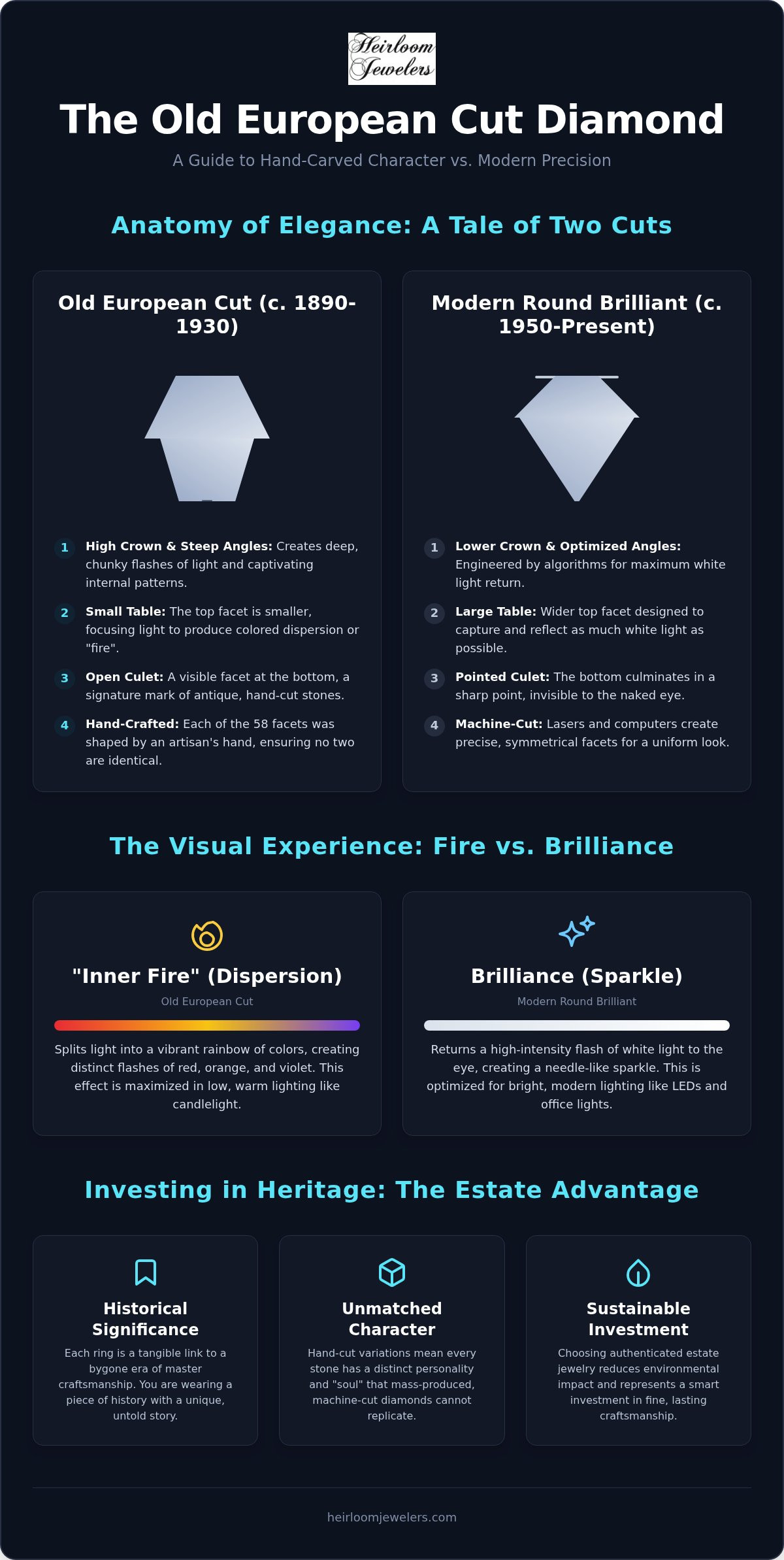
Modern diamonds prioritize brilliance, which is the high-intensity return of white light to the eye. An old european cut solitaire engagement ring offers a different visual experience: dispersion, often called "fire." This is the separation of light into spectral colors. When you look at an OEC, you see distinct flashes of red, violet, and orange. These stones were designed to perform under the warm, flickering glow of candlelight. Modern round brilliants are often optimized for the high-lumen glare of LEDs and fluorescent office lighting, which can make them look sterile by comparison.
Technically, the OEC is defined by its high crown and small table. The table is the flat facet on top of the diamond. In modern cuts, the table is intentionally large to enhance white light return. In a vintage stone, the small table and steep crown angles work together to produce chunky, rainbow-like flashes. This geometry creates a sense of movement within the stone that feels organic and deliberate. It's a testament to the artisan's ability to maximize a diamond's natural beauty without the aid of modern technology.
The Open Culet: A Vintage Diamond’s Secret Signature
One of the most recognizable features of an antique stone is the open culet. In modern diamonds, the culet is pointed and virtually invisible. In an OEC, it's a flat facet. This creates a small, dark circle visible through the center of the stone when viewed from above. It adds a unique "checkerboard" appearance and a sense of depth that modern stones lack. You can find more details on these technical nuances in GIA's guide to antique diamond cuts.
Proportions and Performance Under Different Lighting
The profile of an old european cut solitaire engagement ring is also distinct. These stones feature deep pavilions and high crowns. This height gives the ring a presence that feels more substantial than its carat weight might suggest. In low-light evening environments, the OEC truly shines. While modern stones offer rapid, needle-like scintillation, the OEC provides slower, broader flashes. This creates a rhythmic, hypnotic quality that feels sophisticated and timeless.
A 0.5 carat diamond in a vintage solitaire setting illustrates this perfectly. Because the stone sits higher, it occupies a three-dimensional space that modern, flatter cuts don't always achieve. If you appreciate this level of historical detail, our collection of vintage platinum engagement rings showcases these unique anatomical signatures beautifully.
Evaluating the Setting: Platinum and Gold Solitaire Styles
While the diamond provides the fire, the setting provides the structure and historical context. An old european cut solitaire engagement ring is often defined as much by its metal as by its stone. The choice of metal doesn't just affect the ring's appearance; it determines how the piece will age over the next century. Understanding the difference between platinum and gold is essential for anyone looking to invest in a piece of history that remains wearable for daily life.
Platinum Solitaires: The Choice of the 1920s and 30s
Platinum became the hallmark of high-end jewelry during the Edwardian and Art Deco periods. Its natural white color doesn't cast a yellow tint onto the diamond. This was crucial for maintaining the stone's visual integrity. Platinum is also incredibly dense. This density ensures that a Vintage Platinum 0.5 Carat Diamond Engagement Ring remains secure for decades. Unlike gold, which wears away over time, platinum simply displaces when scratched. This makes it the superior choice for heirloom longevity. Many enthusiasts appreciate the soft, matte patina that platinum develops. This aged finish highlights the diamond’s warmth rather than competing with it for attention.
Yellow and White Gold: Victorian to Mid-Century Aesthetics
Before platinum's rise, yellow gold was the standard. Victorian "buttercup" settings used deep, scalloped metal to hold the stone securely. As styles transitioned into the mid-century, 14K and 18K white gold became more common. White gold is often rhodium-plated to achieve a bright finish. However, many estate pieces have lost this plating, revealing a warm, creamy undertone. This often complements the J, K, or L color grades frequently found in stones that meet GIA's official definition of an Old European cut. Matching a warmer diamond with a yellow gold band can create a harmonious, antique look that feels intentional.
The way a diamond is held in place is a key indicator of its era. These period-correct prong styles each offer a different visual impact for an old european cut solitaire engagement ring:
- Fishtail Prongs: These feature a triangular, split design. They were popular in the 1930s and 1940s to make the diamond appear larger and more square.
- Claw Prongs: These are tapered to a fine point. They offer a refined, delicate look that minimizes the appearance of metal on the stone's surface.
- Belcher Settings: Common in the late 19th century, the prongs are carved directly into the shank of the band. This creates a secure, low-profile ring.
Identifying these details helps you confirm the authenticity of an estate piece. It ensures the setting is an original partner to the stone rather than a modern reproduction.
The Collector’s Guide: Assessing Quality and Authenticity in Estate Diamonds
Distinguishing a true OEC from its predecessors is the first step for any serious collector. While an Old Mine cut has a squarish, cushion-like perimeter, the Old European cut is distinctly round. Transitional cuts, which appeared around the mid-20th century, began to lower the crown and enlarge the table. A true old european cut solitaire engagement ring maintains that iconic high crown and deep pavilion. These proportions are essential for the stone's specific light performance. Understanding these nuances helps you avoid modern reproductions that lack historical accuracy.
In the modern market, color grades like K, L, or M are often dismissed. In the world of vintage solitaires, these warmer tones are highly prized. The hand-cut facets of an OEC are designed to draw in light and emphasize the diamond's natural body color. This results in a soft, candlelit glow that feels romantic and authentic. A stark, colorless D-grade diamond can sometimes look out of place in a genuine 100-year-old setting. These warmer grades often offer a more harmonious look when paired with aged metals.
Understanding Vintage Diamond Grading
Modern GIA standards were developed for the round brilliant, so they don't always capture the charm of an OEC. Clarity is evaluated differently here. Antique stones were cut before the advent of modern laser drilling or clarity enhancement. Any inclusions found within are natural characteristics of the crystal. Additionally, the "face-up" size of a vintage stone can be deceptive. A 0.5 carat antique diamond often has a larger diameter than a modern stone of the same weight. This "spread" allows the ring to have a more significant visual impact on the finger while maintaining its delicate vintage proportions.
Spotting True Estate Craftsmanship
Authentic heritage pieces reveal their history through the quality of their metalwork. Look closely at the inner band for hand-engraving rather than machine-stamping. Hand-carved patterns show slight variations in depth and width that mass-produced rings cannot mimic. Hallmarks and maker's marks are also vital clues. These small stamps identify the metal purity and often the jeweler who created the piece. Milgrain is a decorative technique where tiny beads of metal are applied to the edges of a setting to create a delicate, textured border. This detail is a hallmark of high-quality early 20th-century jewelry.
This dedication to period-accurate detail is also found in other types of estate jewelry; for example, Vintage Times features this same level of historical craftsmanship in their collection of antique gold signet rings.
Beware of "vintage-inspired" rings found in modern retail. These are new creations designed to look old but lack the structural integrity and soul of a true estate piece. They often use modern brilliant diamonds in settings that mimic antique styles. To ensure you are investing in a genuine piece of history, view our collection of authenticated estate engagement rings. Authenticity is the only way to guarantee that your ring will hold its value and character for another century.
Investing in Heritage: Why an Estate Solitaire is the Ultimate Choice
Choosing an old european cut solitaire engagement ring is a decision to invest in a finite resource. Unlike modern round brilliants, which are produced in vast quantities using standardized technology, antique diamonds are no longer being cut in this style. This scarcity creates a natural preservation of value. In the secondary market, rare vintage cuts often hold their worth better than contemporary mass-market stones. Collectors and enthusiasts specifically seek out the hand-carved geometry that defines these pieces, recognizing that history cannot be mass-produced.
Beyond the financial aspect, there is the undeniable appeal of a ring with a proven history. An estate solitaire has already stood the test of time. It has survived decades, often a century or more, while maintaining its structural integrity and beauty. This longevity is a testament to the superior craftsmanship of the early 20th century. By selecting a vintage piece, you are choosing a ring that bridges the past with your own future story. It is a symbol of endurance and timeless elegance.
The Circular Economy of Fine Jewelry
The most sustainable diamond is the one that already exists. Choosing estate jewelry is an eco-conscious investment that avoids the environmental impact associated with modern mining operations. This circular economy respects the earth while honoring the artisans who originally shaped the stone. In the world of fine jewelry, "pre-owned" translates to proven quality. These pieces were built to last for generations. Preserving history through the retail sale of authenticated estate pieces ensures that these works of art continue to be appreciated rather than lost to time.
Finding Your Unique Heirloom at Heirloom Jewelers
At Heirloom Jewelers, we act as a dedicated bridge between historical eras and modern buyers. Our curated approach focuses on uniqueness. We intentionally exclude mass-produced items from our inventory to ensure every client finds a truly singular piece. Our expertise as a specialized boutique allows us to identify rare old European cuts and verify their historical accuracy. Whether you are looking for a Vintage Platinum 0.5 Carat Diamond Engagement Ring or a specific gold setting, our collection is built on a foundation of integrity and deep industry knowledge.
We invite you to find a piece that reflects your appreciation for heritage and craftsmanship. Explore our authenticated collection of vintage engagement rings to discover a one-of-a-kind heirloom that speaks to your personal style.
Start Your Journey with a Piece of History
Choosing an old european cut solitaire engagement ring is an act of preserving craftsmanship that modern machines can't replicate. You've seen how the high crown and open culet create a unique inner fire, and why authenticated platinum settings offer unmatched durability for a lifetime of wear. These rings represent more than just jewelry. They are sustainable investments in a circular economy that honors the past while celebrating your future.
At Heirloom Jewelers, we act as authenticated estate jewelry specialists. Our collection is composed of unique pre-owned items that are never mass-produced. We use our deep expertise in vintage platinum and 18K gold settings to help you navigate the secondary market with confidence. Whether you prioritize historical significance or eco-conscious luxury, we're here to act as your trusted guide.
Discover the Timeless Elegance of Our Curated Solitaire Collection and find the ring that perfectly tells your story. Your search for a one-of-a-kind heirloom ends with a piece that has already stood the test of time.
Frequently Asked Questions
What is the difference between an Old European cut and an Old Mine cut?
The primary difference lies in the shape of the diamond's perimeter. An Old Mine cut has a squarish, cushion-like shape, while the Old European cut is round. Both feature hand-cut facets and high crowns, but the Old European represents the historical transition toward the modern circular brilliant style common today.
Are Old European cut diamonds more expensive than modern round brilliants?
Pricing typically aligns with the traditional 4Cs of natural diamonds, though rarity and historical significance can influence the final cost. An old european cut solitaire engagement ring is often priced similarly to a modern natural diamond of comparable quality. Many buyers find superior value in the stone's unique character and artisanal origin.
Can I put an Old European cut diamond in a modern solitaire setting?
It's possible to mount an antique stone in a modern setting, but you must account for its specific proportions. These diamonds feature deeper pavilions and higher crowns than modern stones. A skilled jeweler will need to ensure the prongs are positioned correctly to secure the stone without compromising its distinct light performance.
How do I care for a vintage platinum diamond engagement ring?
Maintenance for a vintage platinum ring is straightforward but requires consistency. Use a soft brush with mild soap and warm water to remove daily buildup. Platinum is exceptionally durable, but it will develop a soft patina over time. Periodic professional inspections ensure the prongs remain secure for your old european cut solitaire engagement ring.
Why do Old European cut diamonds often have lower color grades?
These diamonds were cut to perform under the warm, flickering light of candles rather than the clinical brightness of modern bulbs. Master cutters prioritized fire and dispersion over a colorless appearance. As a result, warmer grades in the J to M range are common and are now highly sought after for their romantic, antique glow.
Is it possible to find a GIA-certified Old European cut diamond?
Yes, the Gemological Institute of America (GIA) offers formal grading reports for antique stones. A GIA report will specifically identify the diamond as an Old European cut if it meets their technical criteria. This certification provides an essential layer of transparency and confidence when you're navigating the complexities of the estate market.
Are solitaire rings with diamonds still in style for 2026?
Antique solitaire styles are a leading engagement ring trend for 2026. Consumers are moving away from mass-produced designs in favor of pieces with a "soft glow" and "chunky facets." The minimalist solitaire remains the most popular way to showcase these unique, hand-cut stones while maintaining a timeless and sophisticated aesthetic.
What should I look for when buying an authenticated estate ring online?
Prioritize sellers who specialize in authenticated estate jewelry and provide clear documentation of the stone's characteristics. Verify the metal purity through hallmarks and look for detailed photography of the diamond's culet and crown. A reputable boutique will offer a transparent history of the piece and exclude mass-produced items from their inventory.