
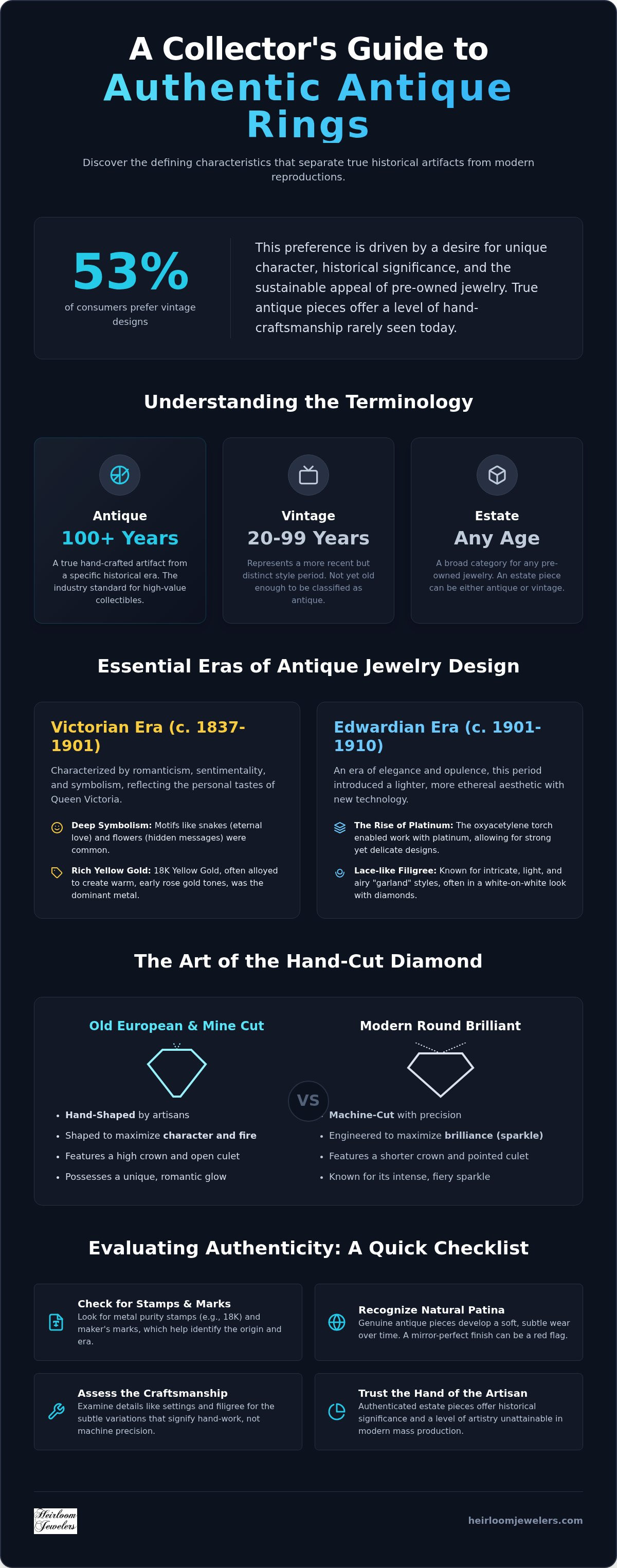
A modern ring is a product of industrial manufacturing, but a true antique ring is a hand-crafted artifact that preserves the artistic soul of its era. This distinction is vital for collectors, as 53% of consumers now prefer vintage designs for their unique character and sustainable appeal. You likely appreciate the history behind these pieces but feel hesitant about the risk of purchasing a modern reproduction. It's difficult to distinguish between a genuine Victorian heirloom and a "vintage-style" imitation without a trained eye.
This guide will provide you with the knowledge to identify authentic antique rings with complete confidence. We'll explore the specific hand-crafted techniques and era-specific details that define high-value estate jewelry. You will learn the difference between various historical periods and understand why Old European cut diamonds offer a unique fire that modern round brilliant cuts lack. We'll also cover the essential standards for authentication, ensuring you can build a collection that truly honors the past.
Key Takeaways
- Learn the strict criteria that define true antique rings, including the 100-year age requirement that separates them from vintage and estate pieces.
- Identify the specific design signatures of the Victorian and Edwardian eras, ranging from romantic symbolism in yellow gold to delicate platinum garland styles.
- Understand the unique value of Old European and Old Mine cut diamonds, which were hand-shaped by artisans to maximize character and fire.
- Gain practical skills for evaluating authenticity by examining metal purity stamps and recognizing the natural patina found on genuine historical jewelry.
- Discover how to source authenticated estate pieces that offer a level of craftsmanship and historical significance unattainable in modern mass-produced jewelry.
Defining the Antique Ring: More Than Just a Pre-Owned Piece
An antique ring is a physical connection to a specific moment in history. While many use the term "old" as a synonym for "antique," the jewelry industry adheres to a much stricter chronological definition. For serious collectors, understanding the nuances of Defining the Antique Ring is the first step toward building a collection of lasting value. True antique rings are not merely pre-owned. They are artifacts created during a period when jewelry was a labor of individual artistry rather than a result of high-speed manufacturing. This distinction gives these pieces a quiet confidence that modern, mass-produced jewelry simply cannot replicate.
Antique vs. Vintage: Understanding the Timeline
The Value of Authenticity in Curated Collections
Heirloom Jewelers focuses exclusively on authenticated pieces because we believe in the integrity of original craftsmanship. Modern "vintage-style" rings often attempt to mimic the look of the past, but they rely on machine-aided precision that lacks soul. A machine can create a perfectly symmetrical pattern, but it cannot replicate the subtle variations of a hand-pierced setting or the unique character of a hand-cut stone. Every authentic antique ring possesses a distinct personality. This individuality comes from the jeweler's hands and the natural wear the piece has experienced over a century. When you choose an authenticated antique, you are acquiring a one-of-a-kind story. We prioritize these pieces because they represent a level of detail and material quality that has largely vanished from the contemporary market. Our collection is built on the idea that true luxury is found in heritage and the steady hand of a master jeweler.
A Journey Through Time: Essential Eras of Antique Jewelry Design
The evolution of jewelry is a narrative of shifting societal values and technological breakthroughs. To understand the Essential Eras of Antique Jewelry Design, one must look at the available materials and the cultural mood of each period. These distinct windows into the past define the character of authentic antique rings. From the sentimental motifs of the 19th century to the bold, architectural lines of the 1930s, every era offers a unique aesthetic that collectors prize for its historical integrity.
Victorian Symbolism and 18K Gold
The Victorian era was deeply influenced by the personal tastes and life stages of Queen Victoria. It was a time of intense romanticism and symbolism. Jewelers frequently incorporated motifs like snakes to represent eternal love or flowers to convey hidden messages. During this period, 18K yellow gold was the preferred metal, often alloyed with copper to create the warm, early rose gold tones seen in many heirlooms. Collectors often seek out Victorian pieces for their unusual gemstone pairings. It isn't uncommon to find Estate Peridot & Quartz Dangle Earrings 14K Yellow Gold or rings that utilize these stones in symbolic arrangements that modern designers rarely explore, as detailed in the history of color symbolism at nicholaswells.com.
Edwardian Elegance and the Rise of Platinum
Following the turn of the century, the Edwardian era introduced a lighter, more ethereal aesthetic. This shift was made possible by the introduction of the oxyacetylene torch, which allowed jewelers to work with platinum for the first time. Because platinum is significantly stronger than gold, craftsmen could create incredibly delicate, lace-like filigree and "garland" styles. The era favored a white-on-white look, typically featuring diamonds set in platinum. These pieces are celebrated for their feminine detail and remarkable lightness, appearing almost weightless despite their intricate construction.
Art Deco: The Pinnacle of Geometric Design
The transition into the 1920s brought the Art Deco movement, a sharp departure from the flowing lines of the past. This era embraced the machine age with bold geometry and strict symmetry. Baguette-cut diamonds and colorful gemstones like emeralds were used to create high-contrast, architectural designs. While platinum remained the elite choice, white gold became a popular and accessible alternative. A classic example of this era's enduring appeal is the Vintage Platinum 0.5 Carat Diamond Engagement Ring, which showcases the clean lines and structural confidence that define the period.
The journey through these eras concludes with the Retro era of the 1940s. This period reflected post-war optimism through large, bold cocktail rings and the return of rose gold. Collectors often find that these historical nuances are best appreciated in person. Our curated collection of authenticated estate jewelry offers a tangible connection to these storied eras, ensuring that every antique rings enthusiast finds a piece that resonates with their personal sense of history.
The Art of the Hand-Cut: Understanding Old European and Mine Cut Diamonds
The transition from hand-craftsmanship to industrial mass production changed more than just the speed of jewelry making; it altered the way diamonds interact with light. While modern machines prioritize mathematical precision and brilliance, the artisans who created antique rings focused on character and "fire." Before the advent of electric lighting, diamonds were faceted to perform under the warm, flickering glow of candlelight. This resulted in stones with a distinct optical personality that modern, machine-cut diamonds cannot emulate.
The Old Mine cut serves as the primary precursor to the modern brilliant. These stones are typically cushion-shaped with high crowns and deep pavilions. Because they were shaped by hand, cutters often followed the natural octahedron shape of the rough diamond to maximize its weight. By the late 19th century, this style evolved into the Old European cut. This refined version features a more circular girdle while maintaining the high crown and small table characteristic of Historic Jewelry Styles. These diamonds are celebrated for their "chunky" facets, which produce broad flashes of light rather than the tiny, needle-like sparkles found in contemporary jewelry.
Old European Cut vs. Modern Brilliant
Both the Old European cut and the modern round brilliant feature 58 facets, but their proportions differ significantly. An Old European cut diamond possesses a much smaller table and a higher crown, which draws the eye deep into the stone. One of the most recognizable hallmarks of these antique stones is the culet. This is the flat facet at the very bottom of the diamond. In an antique piece, the culet is often large enough to be seen through the top of the stone as a small dark circle. This "hole" is not a flaw. It's a signature of a stone faceted entirely by a human eye and hand, reflecting a period before standardized machine cutting took over the industry.
Why Antique Diamonds Retain Their Value
Antique diamonds are increasingly rare because many have been removed from their original settings and recut into modern shapes. Finding untouched stones in their original 19th or early 20th-century mountings is a priority for serious collectors. At Heirloom Jewelers, we specialize in sourcing authenticated pieces like Vintage White Gold Old European Cut Diamond Stud Earrings. These items offer a level of rarity that mass-produced jewelry lacks. Beyond their scarcity, these stones are an inherently sustainable choice. Choosing an estate diamond is an ethical investment that bypasses the environmental impact of modern mining by repurposing a beautiful piece of history. This combination of rarity, sustainability, and unique "inner fire" ensures that these hand-cut stones remain highly coveted in the secondary market.
Evaluating Authenticity: What to Look for in a Genuine Antique Piece
Identifying genuine antique rings requires a disciplined eye and an appreciation for the physical evidence of history. While modern reproductions can be visually convincing, they often lack the subtle "tells" of age and manual production. Authenticity is found in the intersection of metallurgical evidence, signs of honest wear, and the specific techniques used by the jeweler. A true antique isn't just old. It's a record of a specific manufacturing period that modern machines cannot perfectly replicate.
Deciphering Hallmarks and Maker's Marks
Hallmarks serve as the primary source of truth for a ring's origin and date. These small stamps, usually found on the inside of the shank, indicate metal purity and often the maker's identity. For high-value estate pieces, such as a Lugano Emerald & Diamond Necklace 18K White Gold, a maker's mark is essential for establishing provenance. You should look for stamps like "750" or "18K" for gold, but pay close attention to the font and shape of the surrounding shield. These styles changed over decades. Early 20th-century platinum pieces might simply be stamped "PLAT," whereas modern items follow more standardized numerical codes. If a mark looks too crisp or perfectly centered, it might be a sign of a modern laser-engraved reproduction rather than a hand-struck antique stamp.
The Nuances of Metalwork: Filigree and Milgrain
Filigree and milgrain are signatures of hand-finishing that are difficult to forge. Filigree refers to the delicate, lace-like openwork typical of the Edwardian and Art Deco eras. In an original piece, this was created by painstakingly twisting and soldering tiny wires. Modern cast versions often look "mushy" or rounded at the joints because the molten metal cannot reach the same level of sharpness as hand-drawn wire. Milgrain is the "beaded" edge detail found on many antique rings. When viewed under a loupe, hand-applied milgrain shows slight irregularities in the size and spacing of the beads. This human touch is a hallmark of quality. Perfectly identical beads usually indicate a machine-rolled or cast imitation.
Authenticity is also found in "honest wear." A ring that has existed for over a century should show a soft patina. This is a satiny finish that develops on metal from decades of contact with skin and cloth. Look at the bottom of the shank. Antique rings often show thinning in this area due to a century of friction. If the metal is uniform in thickness and has a high-gloss, mirror-like finish, it's likely a modern piece. To ensure you are investing in a piece with true historical integrity, we invite you to browse our authenticated collection of estate jewelry, where every item is vetted for these critical markers of age and craftsmanship.
Finally, always verify the setting technique and independent certifications. We rely on GIA and AGL standards to confirm stone quality and origin, providing an extra layer of security for your collection. Hand-engraving should have a certain "bite" and depth that laser tools cannot achieve, further separating a curated antique from a mass-produced copy.
Why Collectors Choose Heirloom Jewelers for Curated Estate Rings
Heirloom Jewelers operates as a bridge between the craftsmanship of the past and the collectors of the present. We don't prioritize inventory volume or high-pressure sales tactics. Instead, we focus on the quiet confidence that comes from owning a piece with undeniable historical integrity. Our collection of antique rings is hand-selected by experts who value the story behind the stone as much as the quality of the setting. This steady approach allows the history of each piece to take center stage, creating an emotional connection rooted in appreciation for a bygone era.
The Heirloom Jewelers Curation Process
Our selection process is methodical and rooted in specialized expertise. We look for items that represent the pinnacle of their respective eras. This includes unique finds like Estate Peridot & Quartz Dangle Earrings 14K Yellow Gold, which showcase the symbolic gemstone pairings favored during the Victorian period. We strictly avoid modern custom manufacturing and mass-produced jewelry. Every piece in our inventory is a pre-owned, high-end artifact that has already stood the test of time. This commitment ensures that our clients receive a professional and welcoming experience while navigating the complexities of the high-value secondary market.
Our national reach allows us to source rare, high-value pieces that are often unavailable in local markets. Whether it's a Lugano Emerald & Diamond Necklace 18K White Gold or a rare Edwardian engagement ring, our curation favors rarity and material excellence. We act as knowledgeable curators for those who understand that a true heirloom cannot be manufactured on demand. By focusing on authenticated estate jewelry, we provide a reliable guide for collectors who prioritize quality over quantity.
Investing in a Piece of History
Acquiring an antique ring is more than a purchase; it's an investment in heritage. These pieces are considered investment-grade because their supply is finite. As more original settings are lost to recutting, the value of authenticated, untouched pieces continues to rise. The enduring nature of 18K white gold and platinum settings from the early 20th century ensures these rings remain wearable for another hundred years. These materials were chosen for their longevity and their ability to hold intricate detail, such as the hand-applied milgrain and filigree we've examined in this guide.
We believe that a ring should offer a sense of personal connection. Our role is to provide the expert guidance needed to find a piece that resonates with your personal history and aesthetic preferences. We invite you to explore our curated collection of antique and vintage rings to find an authentic artifact that reflects your unique style and values.
Begin Your Journey as a Knowledgeable Collector
Choosing a historical piece is a commitment to quality that transcends modern trends. You now understand that authentic antique rings are defined by a strict 100-year timeline and the irreplaceable touch of human hands. These artifacts offer a level of detail, from delicate Edwardian filigree to the unique fire of Old European cut diamonds, that machine-aided manufacturing cannot replicate. Identifying these markers of craftsmanship allows you to build a collection with lasting value and integrity.
Heirloom Jewelers serves as a trusted national authority for those navigating the high-end vintage market. We specialize in authenticated estate jewelry, offering a curated selection that prioritizes historical significance over mass production. Our expertise in rare hand-cut stones ensures that every piece you acquire is a genuine artifact with a documented story. We invite you to take the next step in your collecting journey with confidence.
Discover Your Own Piece of History at Heirloom Jewelers. We look forward to helping you find a ring that carries the quiet confidence and timeless elegance of the past into your future.
Frequently Asked Questions
What is the difference between an antique ring and a vintage ring?
An antique ring must be at least 100 years old to meet the official industry definition. In contrast, vintage jewelry refers to pieces that are between 20 and 99 years old. While both categories fall under the broader "estate" label, true antiques are prized for their pre-industrial craftsmanship and the specific historical eras they represent.
Are antique rings durable enough for daily wear as engagement rings?
Most antique rings are remarkably durable because they were hand-crafted from high-quality materials like platinum and 18K gold. Their longevity depends on the specific setting and the hardness of the center stone. While diamonds and sapphires are excellent for daily wear, softer stones like opals or emeralds require more delicate handling to prevent chips over time.
How can I tell if a diamond in an antique ring is real?
Identifying a genuine antique diamond involves looking for hand-cut characteristics like a visible culet or broad, "chunky" facets. Unlike modern machine-cut stones, these diamonds show subtle irregularities that signal human artistry. For absolute certainty, we recommend professional authentication through GIA or AGL standards to verify the stone's natural origin and quality.
What should I look for in an Art Deco engagement ring?
You should look for bold geometric patterns, strict symmetry, and the use of white metals like platinum or white gold. These rings often feature architectural lines and accent stones like baguette-cut diamonds. A classic example is the Vintage Platinum 0.5 Carat Diamond Engagement Ring, which captures the structured elegance and machine-age influence of the 1920s.
Why are Old European cut diamonds more expensive than modern ones?
Old European cut diamonds are often more expensive due to their increasing rarity in the high-end secondary market. Many of these stones were recut into modern brilliant shapes during the mid-20th century, leaving few original examples. High-quality Old European cuts can be 10% to 15% more expensive than modern counterparts because collectors value their unique "fire" and hand-crafted history.
Can antique rings be resized without damaging the setting?
Most antique rings can be resized by a specialist who understands historical jewelry construction. However, rings with continuous patterns, such as full-circle filigree or deep hand-engraving, require extreme care to ensure the design remains seamless. It's essential to work with a jeweler who uses traditional techniques to avoid disrupting the metal's natural patina or structural integrity.
What are the hallmarks of a genuine Edwardian ring?
A genuine Edwardian ring is characterized by a "white-on-white" aesthetic, typically featuring diamonds set in delicate platinum. These pieces are famous for their lace-like filigree and fine milgrain detailing that creates a light, feminine appearance. You'll often see "garland" motifs like wreaths or ribbons, which were made possible by the strength and versatility of early platinum settings.
How do I care for an 18K white gold antique ring?
Care for an 18K white gold ring involves gentle cleaning with mild soap and warm water to preserve its finish. You should avoid harsh chemicals or ultrasonic cleaners, which can be too aggressive for older settings and delicate stones. It's also wise to have a professional check the prongs annually to ensure your stones remain secure after decades of wear.