
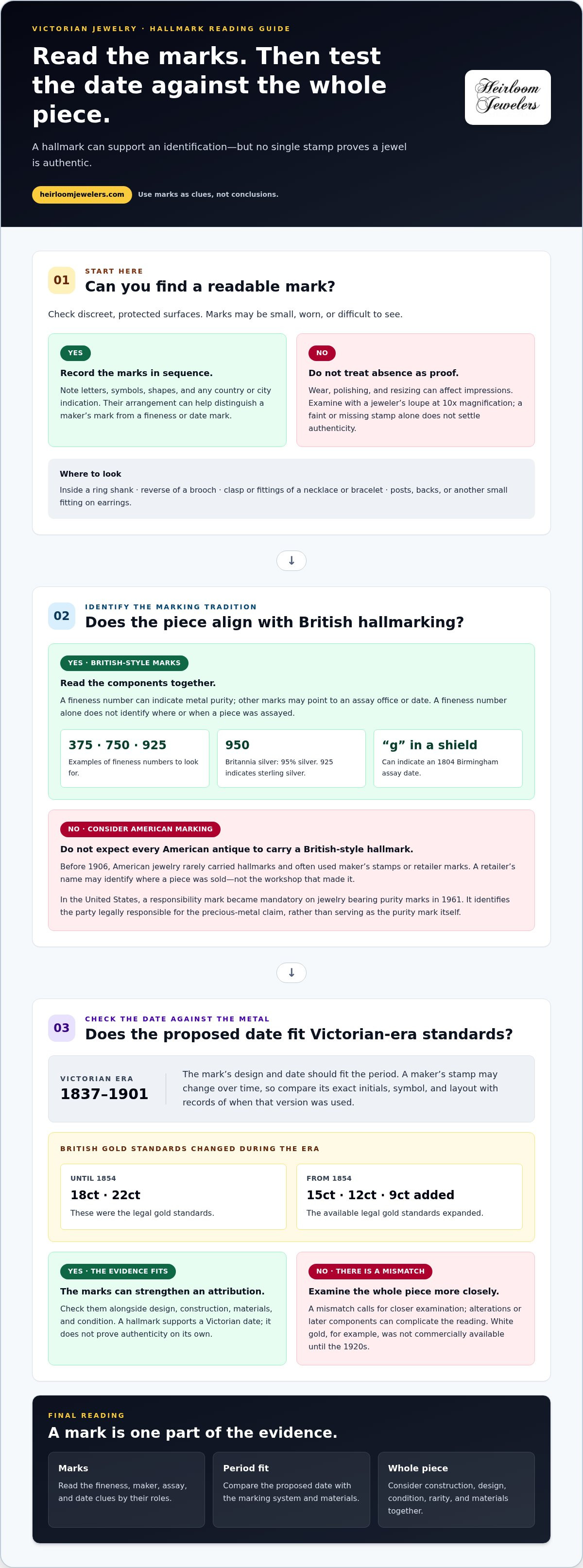
A hallmark can support a Victorian date, but no single stamp proves a jewel is authentic. Victorian era jewelry hallmarks can identify metal purity and sometimes point to where and when a piece was assayed. The Victorian era ran from 1837 to 1901, so a mark’s design and date must fit the period to strengthen an identification.
A clear stamp can seem like a reliable answer, but marks may be worn, altered, or mistaken. British and American jewelry also followed different marking systems. A careful assessment considers hallmarks alongside a piece’s construction, materials, and design.
This guide explains how to read British and American marks, recognize period materials, and use Victorian-era dates when assessing authenticity. It also covers the factors that shape value, helping you distinguish a useful clue from a conclusion the evidence cannot support.
Key Takeaways
- Read a maker’s mark as a clue to the craftsperson or company, then narrow searches with descriptive details such as initials, symbols, and country.
- British hallmarks can identify metal fineness and may show the assay office and date; interpret the marks together rather than relying on one stamp.
- American antique jewelry may carry a maker’s or retailer’s mark instead of a British-style hallmark, so account for the different marking traditions.
- Compare metal marks and materials with the piece’s proposed period. White gold, for example, was not commercially available until the 1920s.
- Use Victorian period dates alongside construction, condition, rarity, and materials to assess authenticity and understand what may influence value.
What makes Victorian jewelry valuable today?
Value depends on more than a stamp. Rarity, condition, materials, and credible dating all matter. Marks can help establish a piece’s origin, but their meaning depends on the country and the other evidence available.
Check inside a ring band and on the reverse of a brooch. Other jewelry may carry marks on a clasp, fitting, or inconspicuous underside, where wear can make small impressions difficult to read.
Searching for makers’ marks
A maker’s mark identifies the craftsperson or company behind a piece of jewelry, often with initials and a distinctive symbol. To search effectively, describe the visible details together: the letters, image, shape of the frame, and any country or city indicated by companion marks.
Specific descriptive terms narrow search results better than “maker’s mark” alone. For example, combine “initials,” “bird symbol,” and “France” if those details appear on the piece. In countries with mandatory hallmarking traditions, registered marks and guild records can help connect a mark with its origin.
Using makers’ marks to date jewelry
A maker’s mark may help date jewelry because a company’s stamp can change over time. Compare the exact initials, symbol, and layout with records showing when that version was used. Then consider whether the result fits the piece’s design and construction.
One mark is a clue, not a complete date. A Victorian piece should align with the era’s dates, 1837-1901, while alterations or later components can complicate the reading. Matching a mark to its documented period can strengthen an attribution; a mismatch calls for closer examination of the whole piece.
Responsibility marks and maker marks
A maker’s mark names the producer, while a responsibility mark identifies the party legally responsible for a precious-metal claim. In the United States, a responsibility mark became mandatory on jewelry bearing purity marks in 1961. That requirement helps distinguish a metal-purity stamp from an identifier tied to accountability.
Older American pieces need different interpretation. Before 1906, American jewelry rarely carried hallmarks and instead often relied on maker’s stamps or retailer marks. A retailer’s name can point to where a piece was sold, rather than identify the workshop that made it. Read each stamp according to its role.
Hallmark locations on jewelry
Hallmarks are usually placed on discreet, relatively protected surfaces. Check inside a ring’s shank, on the reverse of a brooch, and on the clasp or fittings of a necklace or bracelet. Depending on their construction, earrings may be marked on posts, backs, or another small fitting.
Use a jeweler’s loupe with 10x magnification to examine worn impressions without assuming that a faint or absent stamp proves anything by itself. Resizing, polishing, and long wear can affect marks. Record the visible letters and symbols in their sequence, since their arrangement can help distinguish a maker’s mark from a fineness or date mark.
British hallmark components and assay offices
British hallmarks combine clues about metal fineness with possible information about assay location and date. Reading the components together helps distinguish a metal standard from evidence about a piece’s history.
Elements of British hallmarks
Hallmarks can offer clues about a piece’s metal purity and, in some cases, where it was assayed or when it was made. The system dates to 1300, when the Goldsmiths’ Company Assay Office was established in London.
Look for a fineness number, such as 375, 750, or 925, alongside any office or date marks. A lowercase “g” inside a shield can indicate an 1804 Birmingham assay date. A 950 silver mark denotes Britannia silver with 95% silver. These components answer different questions, so a fineness number alone does not identify the assay office or date.
On an antique brooch, for example, office and date marks can add context to the silver standard. Their sequence and shape matter. Wear may leave only part of a mark legible, so read visible characters together rather than treating one number as a complete identification.
Hallmarking standards and exemptions
British gold standards changed during the Victorian era, so the fineness shown on a piece should be considered alongside its proposed date. Until 1854, the legal gold standards were 18ct and 22ct. In 1854, standards expanded to include 15ct, 12ct, and 9ct.
That change helps explain why an older piece may carry a standard absent from later jewelry. A 950 silver mark identifies Britannia silver, while 925 indicates sterling silver. For mourning jewelry, the material mark can help identify the metal, but it does not by itself establish when the piece was made.
Do not infer an exemption from a missing impression alone. Polishing, wear, or a small marking surface can make a hallmark difficult to find or read. Consider the construction and surviving marks together, and do not apply a later standard automatically to an earlier antique.
British hallmarking requirements
The British Hallmarking Act of 1973 regulates hallmarking in Great Britain. Makers’ marks must be registered at an assay office, although manufacturers strike the marks themselves. This distinction matters: a maker’s mark identifies the responsible producer, while other hallmark components can indicate fineness, assay location, or date.
When examining a piece, first sort the marks by their apparent function. Record the fineness number, any maker’s initials or symbol, and impressions that may indicate an assay office or date. Then compare the combination with the piece’s proposed period. A single stamp rarely explains every detail.
These requirements provide a framework for reading British marks, not a shortcut to authenticity. A consistent set of impressions can support an identification, while inconsistencies deserve closer attention. For a Victorian piece, compare the metal standard and date clues with the design and construction before reaching a conclusion.
Differences between British and American marking systems
A British hallmark and an American stamp can answer different questions. British marks commonly combine metal fineness with assay and date clues, while American pieces often rely on maker’s or retailer’s marks. When comparing designs across the Atlantic, remember that the country of origin changes how a mark should be read.
Jewelry manufacturing in the United States began around 1840. American pieces from the Victorian era may therefore carry a maker’s stamp or retailer’s name rather than a British-style group of assay marks. A retailer’s stamp identifies the seller, not necessarily the workshop. Treat the letters as evidence of a commercial connection, then compare them with the piece’s metal and construction.
The United States National Gold and Silver Stamping Act of 1906 regulates stamping jewelry made from precious metals. It gives context to American purity marks, but it does not make every older piece look British. Before 1906, American jewelry rarely carried hallmarks and instead relied on maker’s stamps or retailer marks. A sparse stamp pattern can reflect that tradition, not automatically indicate a later alteration.
American silver marks also require period awareness. Before 1870, U.S. coin silver had a fineness of 900/1000. That differs from the 925/1000 sterling standard often encountered on British silver. A “900” mark on an American piece should be interpreted in its national context; comparing it directly with British silver marks can lead to a mistaken metal identification.
Gold marks offer another contrast. In the United States, 10k and 14k are the most common gold purity marks. British gold standards were different during and after the Victorian era. The British 12ct and 15ct standards were abolished in 1932 in favor of the 14ct mark. Since that change came after the Victorian era, a 14ct mark alone cannot establish a Victorian date.
Makers’ marks add a further distinction. In the United States, makers’ marks became mandatory in 1961, and a responsibility mark became mandatory on jewelry bearing purity marks in 1961. These requirements belong to a much later period than Victorian jewelry. They should not be projected onto an earlier piece as though every Victorian item must carry the same identifiers.
For a practical comparison, note the country, exact wording, number, and mark shape before interpreting the stamp. Then ask what it identifies: purity, maker, retailer, or responsibility. A British assay sequence and an American retailer stamp carry different meanings, even when both appear on fine jewelry. Start with that distinction to keep the piece’s origin and proposed date in perspective.
Gold karats and other period materials
Metal marks describe purity, but their meaning depends on the marking system and proposed date. A number such as 750 expresses fineness in parts per thousand, while a karat mark describes gold content. Reading both forms helps compare vintage jewelry without treating different systems as interchangeable.
An 18K mark denotes 75% gold, and 750 is its European equivalent. A 14K mark denotes 58.5% gold; 10K denotes 41.7%. At the higher end, 22K denotes 91.6%, while 24K denotes 99.9% gold. Because 24K gold is typically too soft for rings, its presence on a ring would deserve careful interpretation alongside construction and condition.
Victorian gold standards changed during the era. Early Victorian jewelry typically used 15-karat gold or 18-karat gold, and Romantic-period pieces from 1837-1860 tended to use 18-karat gold. Lower-karat gold jewelry began appearing during the Victorian era after 1854. These period details help assess whether a purity mark fits the proposed date.
Silver marks offer another useful comparison. A 925 mark denotes sterling silver with 92.5% silver, while an 800 mark denotes 80% silver. In France, a boar’s head or crab hallmark indicates silver with a minimum fineness of 800/1000 since 1838. The French eagle’s head has indicated gold purity of at least 18 karat since 1838.
Platinum marks include 900, 950, and 999. These figures describe fineness, not a Victorian date by themselves. Compare the mark with the setting, gemstones, and the piece’s overall design. A diamond mounted in platinum, for example, requires the same careful separation of material evidence from date evidence.
White gold is a notable dating clue: it was not commercially available until the 1920s. A piece presented as Victorian but made in white gold therefore contains a feature inconsistent with that proposed period. The discrepancy calls for examination of whether the setting is later, altered, or incorrectly dated.
For a practical reading, record the exact stamp before interpreting it. Distinguish karat figures such as 18K from fineness figures such as 750, then compare the result with the metal’s period use. A Victorian attribution gains support when purity, material, and construction align; one mark alone cannot establish the whole history of a jewel.
Victorian jewelry periods and dates
The Victorian era spans 1837-1901, but jewelry from those years reflects changing tastes. Period labels help anchor an identification to a narrower date range. Compare a piece’s design, gemstone choices, and construction with its proposed period, rather than relying on a date mark alone.
The Romantic period, 1837-1860, is the opening phase. Acrostic jewelry offers a specific clue to Victorian taste: the first letter of each gemstone spells a word or message. A ring set with lapis lazuli, opal, verdite, and emerald in that order spells “love.” The sequence is meaningful, but it does not establish a precise year.
The Grand period, 1861-1880, followed the Romantic phase. Mourning jewelry commemorated deceased loved ones and could incorporate the person’s hair. Cameos provide another recognizable example: a cameo is a stone carved so that a silhouette rises out of its surface. These features help describe style and purpose, then guide comparison with marks and materials.
Period names and date ranges sometimes overlap. The High Victorian Period lasted from 1860 to 1885, spanning the final year of the Romantic period and extending beyond the Grand period’s dates. The Aesthetic period ran from 1880 to 1901, overlapping the final years of the Grand period and the High Victorian Period. Treat these labels as useful style groupings, not as separate, perfectly bounded timelines.
The Late Victorian Period lasted from 1885 to 1901. The Aesthetic period also covers 1880-1901, so a piece from the 1880s or 1890s can fall under both descriptions. In practice, record the proposed date range and the visual details supporting it. A gemstone arrangement, motif, or carving technique can narrow the comparison, while a hallmark supplies a separate line of evidence.
Nearby movements provide useful boundary checks. Art Nouveau dates to 1890-1910, so it overlaps the final years of the Victorian era and continues beyond 1901. The Edwardian era is dated 1901-1915, beginning in the year the Victorian era ends. Art Deco follows later, dated 1920-1935. These dates help identify pieces assigned to the wrong era, especially when a design spans a transition.
For a sound date assessment, use the era as an anchor, then compare the piece’s style and marks with its proposed range. If you’re drawn to period gemstones and historic settings, explore vintage and estate jewelry for examples of how heritage materials appear in wearable pieces.
Heirloom Jewelers: Lugano Emerald & Diamond Necklace 18K White Gold
The Lugano Emerald & Diamond Necklace 18K White Gold offers a next step for readers drawn to fine jewelry beyond the history of Victorian marks. Its emerald, diamonds, and 18K white gold setting illustrate how gemstones and metal remain central to a piece’s character, even when its marks tell a different story from Victorian hallmarks.
Heirloom Jewelers offers vintage diamond earrings, a vintage platinum engagement ring, and estate peridot and quartz earrings. These pieces illustrate the range of materials and settings found in estate and vintage jewelry. The necklace is not identified as Victorian, and its white gold setting should not be mistaken for a Victorian-period feature.
Explore estate and vintage jewelry with Heirloom Jewelers. Contact us to take the next step.
Let the Story Guide Your Next Choice
Let your interest in Victorian era jewelry hallmarks lead to a broader appreciation of how age, materials, and craftsmanship shape a jewel’s character. When considering a piece, note its marks and the details that matter to you. This perspective can help you choose jewelry for its design, history, or place in your collection.
Heirloom Jewelers offers the Lugano Emerald & Diamond Necklace 18K White Gold, Vintage White Gold Old European Cut Diamond Stud Earrings, and Vintage Platinum 0.5 Carat Diamond Engagement Ring. Each offers a distinct combination of gemstone, setting, and period character for those drawn to fine estate and vintage jewelry.
Explore the collection and take the next step at contact Heirloom Jewelers. A thoughtful choice can begin with a single detail that speaks to you.
Frequently Asked Questions
How can you tell if a piece is authentic Victorian jewelry?
Assess the marks, materials, construction, and design as a group. For example, a Victorian attribution conflicts with white gold, which was not commercially available until the 1920s. Look for whether the piece’s metal and decorative details make sense together, and consider signs of later alteration. Victorian era jewelry hallmarks can support an identification, but a stamp alone doesn’t establish a piece’s full history.
What Are Hallmarks and Identification Marks?
Hallmarks provide information about precious-metal fineness and, in some systems, assay location or date. Identification marks may also include a maker’s initials, symbol, or retailer’s name. These marks answer different questions: a fineness stamp describes metal content, while a maker’s mark points to a producer. On an American piece, a retailer’s stamp may identify the seller rather than the workshop.
What is a makers mark?
A maker’s mark identifies the craftsperson or company associated with producing a piece of jewelry. It may use initials and a pictorial symbol, and its design can change over time. When comparing pieces, note the exact letters, image, and surrounding shape. Similar initials alone do not establish that the same maker created both.
What hallmarks were used on Victorian-era jewelry?
Marking depended on the piece’s country of origin. British jewelry may carry a fineness mark, such as 375, 750, or 925, alongside marks that indicate an assay office or date. American jewelry from before 1906 often relied on maker’s stamps or retailer marks instead. Read the mark pattern in its national context, since a British-style set of impressions isn’t required to identify every Victorian piece.
How can you identify Victorian jewelry hallmarks by date or reign?
First establish whether the mark belongs to a known date-letter system, then compare its shape and surrounding impressions with the relevant assay-office sequence. English date letters were first introduced in London in 1478, so the system predates the Victorian era. A date letter needs its punch design and other marks interpreted together; the letter by itself may not identify a unique year.
What do gold purity marks on Victorian jewelry mean?
Gold purity marks express the proportion of gold in an alloy. An 18K mark means 75% gold, while 750 expresses the same fineness in parts per thousand. A 14K mark means 58.5% gold. These figures describe composition, not the age or maker of a piece, so compare them with its construction and proposed period before treating them as dating evidence.
How were silver hallmarks and assay office symbols used in Victorian Britain?
Silver marks helped distinguish fineness and could appear with impressions identifying the assay office or date. A 925 mark denotes sterling silver with 92.5% silver; 950 denotes Britannia silver with 95% silver. The combination is more informative than a single number. On a worn piece, record every legible symbol and its position, since incomplete impressions can change how the group is read.
What makers' marks and sponsor's marks appear on Victorian jewelry?
Victorian pieces may bear a maker’s initials or pictorial identifier, but the specific mark depends on the country and maker. In British hallmarking, makers’ marks were registered at an assay office, while manufacturers struck the marks themselves. Search for the exact initials and symbol alongside a country or city clue. Do not assume that a retailer’s name identifies the manufacturer.