
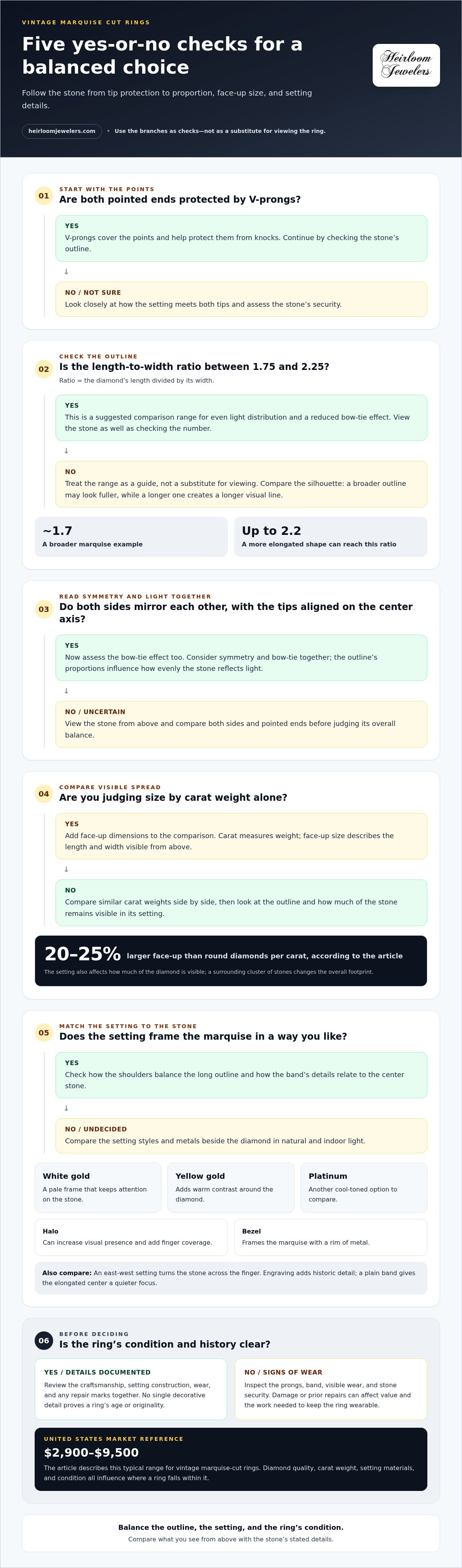
Vintage marquise cut rings make an engagement ring feel distinctive through their long, pointed silhouette and sense of history. The shape can look graceful and expressive, but its appeal depends on more than carat weight. A length-to-width ratio between 1.75 and 2.25 offers a useful starting point for assessing proportion and symmetry.
A vintage marquise cut ring has a distinctive outline that makes a strong impression on the hand. Choosing one means balancing the stone’s shape with the setting’s character and the metal’s warmth or contrast.
This guide explains what to consider when choosing a vintage marquise cut ring, from metal and face-up size to symmetry and length-to-width ratio. Learn how proportions shape the stone’s appearance and which setting details can make the design feel balanced and enduring.
Key Takeaways
- Look for protective V-prongs at the pointed ends to help guard the marquise diamond’s tips.
- Compare metal options by how their color complements the stone and the character you want from the setting.
- Consider face-up dimensions as well as carat weight: a marquise can appear larger than a round diamond of equal weight.
- Assess symmetry and the bow-tie effect together; the outline’s proportions influence how evenly the stone appears to reflect light.
Why Choose a Vintage Marquise Engagement Ring?
A vintage marquise engagement ring combines a distinctive pointed outline with the character of an earlier design. The setting matters as much as the stone: it shapes the ring’s appearance and helps protect the diamond’s tips.
Vintage Eras and Authenticity
The marquise shape traces to an 18th-century French navette design, with popularity booms in the 1960s and ’80s. Vintage-inspired details may include floral motifs, hand engraving, or Art Deco geometry. Halo and bezel settings offer different ways to frame the stone. To assess authenticity, examine the craftsmanship, setting construction, wear, and any repair marks together. No single decorative detail proves a ring’s age or originality.
Price, Diamond Quality, and Condition
On the United States market, vintage marquise-cut rings typically range from $2,900 to $9,500. Diamond quality, carat weight, setting materials, and condition all influence where a ring falls in that range. Compare the stone’s appearance and stated weight, then inspect the prongs, band, and visible wear. Damage or prior repairs can affect value and the work needed to keep the ring wearable.
Marquise engagement rings stand out for their elongated outline and pointed ends. A halo can increase the stone’s visual presence and add finger coverage, while a bezel traces its outline with a rim of metal. In either style, examine how the setting meets both tips. V-prongs cover the points and help protect them from knocks.
Compare carat weight with the ring’s face-up appearance, then narrow your choices by setting and metal. A horizontal, or east-west, setting turns the stone across the finger for a different look. Before buying, inspect the symmetry, tip protection, stone security, and band condition. Clean the ring gently and have a qualified jeweler inspect its setting. Use the ring’s documented details when arranging insurance.
Precious metal choices
Metal shapes the ring’s character and how its elongated diamond reads against the finger. White gold creates a pale frame that keeps attention on the stone, while yellow gold adds warm contrast. Platinum offers another cool-toned option. Compare the metals beside the diamond in natural and indoor light, since surrounding colors can affect how the setting looks. The best match depends on whether you prefer a subtle outline or a more visible metal presence.
Examine the complete setting, not just the band. A marquise stone’s pointed ends and long outline make its prongs and shoulders especially visible from above. Look at how the metal holds the diamond, whether the shoulders feel visually balanced, and how any engraving relates to the stone’s shape. An engraved band adds historic detail, while a plain band gives the elongated center a quieter, classic focus.
For a practical comparison, view similar designs in white gold, yellow gold, and platinum. Notice whether the metal makes the diamond look warmer or cooler, and whether the band’s color suits the jewelry you wear regularly. Check the inside of the band and the setting for wear or repair marks. In a vintage ring, craftsmanship shows in the finish, the continuity of the design, and how the center stone sits in its mount.
Choose a metal by balancing appearance with the ring’s existing condition and construction. A vintage setting should feel visually cohesive, rather than pairing an ornate, engraved band with a mount that seems unrelated. If you’re drawn to a cool-toned setting, consider this vintage platinum diamond engagement ring as a concrete reference. Compare its metal choice with the details that matter most to you, including the band’s profile and the setting’s visible lines.
Marquise cut shape and face-up size
A marquise diamond has an elongated outline that ends in two pointed tips. Its face-up size describes the dimensions visible from above, while carat measures weight. Those details answer different questions: carat helps compare weight, and face-up appearance shows how much of the finger the stone covers. Marquise cuts face up about 20 to 25% larger than round diamonds per carat, making outline and spread useful comparison points.
Compare stones of similar carat weight side by side, then look at their length and width. A longer outline can create a more dramatic appearance, while a broader one may look fuller across the finger. The familiar 1.5-carat, 2-carat, and 2.5-carat sizes offer useful comparison examples, but the setting also affects how much of the diamond remains visible. A cluster of surrounding stones, for instance, changes the overall footprint.
Follow a simple viewing sequence when selecting an engagement ring: note the stone’s visible length and width, compare its outline with the band, then assess how the setting frames both tips. A platinum mount can provide a cool-toned border, while a halo adds a surrounding line that changes the stone’s apparent size. Examine the ring from above and at an angle to judge its proportions in context.
Carat details can also be read more precisely. According to the Federal Trade Commission, a point is one one-hundredth (1/100) of a carat, which helps interpret a stated diamond weight. That figure describes weight, not the face-up dimensions. For a balanced choice, compare the stated carat weight with the stone’s visible spread and the complete design. This helps distinguish a larger-looking marquise from a heavier diamond with a different outline.
Symmetry and length-to-width ratios
A marquise diamond’s length-to-width ratio describes its outline: divide its length by its width. A ratio between 1.75 and 2.25 is suggested for even light distribution and a reduced bow-tie effect. Treat this range as a comparison guide, not a substitute for viewing the stone. Symmetry matters too. Check whether both sides mirror each other and whether the pointed ends align along the center axis.
A broader marquise may have a ratio around 1.7, while a more elongated shape can reach 2.2. Those proportions create different impressions, even when diamond weight is similar. A broader outline may feel fuller; an elongated one gives the finger a longer visual line. Compare the silhouette face-up, then view it from a slight angle. Look for uneven shoulders, mismatched tips, or a dark bow-tie area across the center.
Use this practical sequence when assessing a vintage engagement ring:
- Compare the stone’s length and width, then note its ratio.
- Check the pointed ends and side curves for visual balance.
- Observe the center for a bow-tie shadow as the light changes.
- View the diamond in its setting, including a solitaire or cluster design.
Setting style can affect how the proportions look. An Art Deco mount may emphasize crisp geometry, while yellow gold creates a warmer frame around the brilliant center. Neither changes the diamond’s ratio, but both affect the overall composition. Consider the band’s width and the setting’s visible lines alongside the stone. A balanced design keeps the diamond in focus without making one side look heavier.
To compare these details with a real vintage setting, explore the vintage platinum engagement ring and observe how its center stone relates to the mount. Use that view to refine what proportions and setting presence you prefer.
Heirloom Jewelers: Lugano Emerald & Diamond Necklace 18K White Gold
Heirloom Jewelers offers the Lugano Emerald & Diamond Necklace 18K White Gold as an example of estate jewelry where metal and gemstone color work together. For readers comparing the character of vintage pieces, the Vintage Platinum 0.5 Carat Diamond Engagement Ring offers a relevant engagement-ring reference. These pieces can help clarify whether you’re drawn to a cool-toned metal, a historic design, or the distinct presence of a center stone. Heirloom Jewelers’ collection also includes vintage diamond earrings and estate gemstone jewelry, each with its own materials and design details. If you’re weighing a vintage marquise ring against other estate styles, consider which features matter most: the metal, the stone’s outline, or the setting’s overall character. Contact Heirloom Jewelers to discuss your interest in estate and vintage jewelry.
Choose a Ring That Feels Like Your Own
The final choice is personal, so consider which details you’ll value each time you wear the ring. Vintage marquise cut rings have a distinctive silhouette, but the right piece should also feel comfortable and reflect your taste. Let your priorities guide the search, whether you’re drawn to a particular metal, a balanced outline, or the quiet detail of an older setting.
Heirloom Jewelers offers the Lugano Emerald & Diamond Necklace 18K White Gold, Vintage White Gold Old European Cut Diamond Stud Earrings, and Vintage Platinum 0.5 Carat Diamond Engagement Ring. These estate and vintage pieces offer different ways to appreciate fine jewelry, from gemstone color to historic diamond cuts and platinum settings.
When you’re ready to continue exploring, contact Heirloom Jewelers. Take your time, follow the details that matter to you, and choose a ring whose character feels enduring.
Frequently Asked Questions
Are marquise diamonds prone to chipping?
Yes. The pointed ends need particular protection because they’re exposed parts of the stone. V-prongs are designed to cover the tips and help shield them from knocks. When examining a ring, look closely at both points and their prongs. If a tip is uncovered or a prong appears bent, address the issue before regular wear.
Can a marquise diamond be set east-west instead of north-south?
Yes, a marquise diamond can be set east-west, with its long axis running across the finger. This orientation changes the ring’s overall impression, making the setting’s shoulders important to assess. View the ring from above and check that the stone sits securely across the band. Compare its profile with a north-south design to decide which orientation you prefer.
What is the best length-to-width ratio for a marquise diamond?
A ratio between 1.75 and 2.25 is a useful range to consider. For example, a ratio of 2.0 falls within it, but the number alone can’t show how the diamond appears in person. Compare the outline with the stone’s symmetry and look for a bow-tie shadow. Choose the proportion that gives you the shape and light pattern you prefer.
How does a vintage marquise-cut ring compare with a new marquise-cut ring?
A vintage ring can carry a sense of history, while a new ring offers a fresh starting point. The vintage option has an existing design, with its own history, wear, and construction details; a new ring reflects a contemporary design and finish. Compare the band’s engraving and setting style, then consider whether you prefer an older piece’s character or a fresh design.
Where can I buy vintage marquise-cut rings online and in the United States?
Heirloom Jewelers offers vintage engagement-ring references and estate jewelry, and you can contact them to discuss vintage pieces. The article also notes that vintage marquise-cut rings are available on the United States market.