
Why does a diamond cut nearly a century ago still capture the light more soulfully than a modern precision-cut stone? The answer lies in the deliberate, geometric revolution of the 1920s. Collecting authentic art deco jewelry often feels like a balancing act between appreciating historical beauty and fearing a costly mistake. It's understandable to feel overwhelmed by specialized terms like calibré or find it difficult to distinguish these bold lines from the delicate lace of earlier Edwardian styles.
We believe that building a personal collection should be a journey of discovery, not a source of stress. This guide provides the clarity you need to identify genuine estate pieces and understand their enduring value. We will explore the core design principles of the era, explain how to recognize the soft glow of Old European Cut diamonds, and show you how to evaluate the craftsmanship of platinum and white gold settings. By the end, you'll feel prepared to select pieces that are not just accessories, but true historical legacies.
Key Takeaways
- Recognize the defining geometric precision and linear aesthetics that distinguish authentic art deco jewelry from other vintage eras.
- Identify why platinum and 18K white gold became the standard for Jazz Age elegance and how to verify these materials.
- Understand the unique characteristics of the Old European Cut diamond and its distinct light profile.
- Distinguish between hand-pierced filigree and modern cast reproductions to protect your investment.
- Evaluate hallmarks and maker's marks with confidence to ensure every piece in your collection is a genuine historical artifact.
What is Art Deco Jewelry? Defining the Jazz Age Aesthetic
The design period for art deco jewelry flourished between 1920 and 1935. It represented a sharp departure from the organic, flowing lines of the Art Nouveau era. While earlier styles looked to nature for inspiration, this new movement embraced the energy of the post-WWI industrial boom. It was an era defined by progress and the emergence of the "New Woman." Art Deco jewelry is a celebration of geometric symmetry and bold industrial materials.
This aesthetic wasn't just a trend; it was a cultural shift. The world was changing rapidly. Automobiles, airplanes, and skyscrapers influenced every aspect of design. Jewelry designers responded by creating pieces that felt fast, modern, and efficient. They moved away from the heavy, ornate styles of the past to embrace a streamlined look that complemented the changing fashions of the decade. This period prioritized a sense of order and structural integrity that still resonates with collectors today.
The Shift from Edwardian to Art Deco
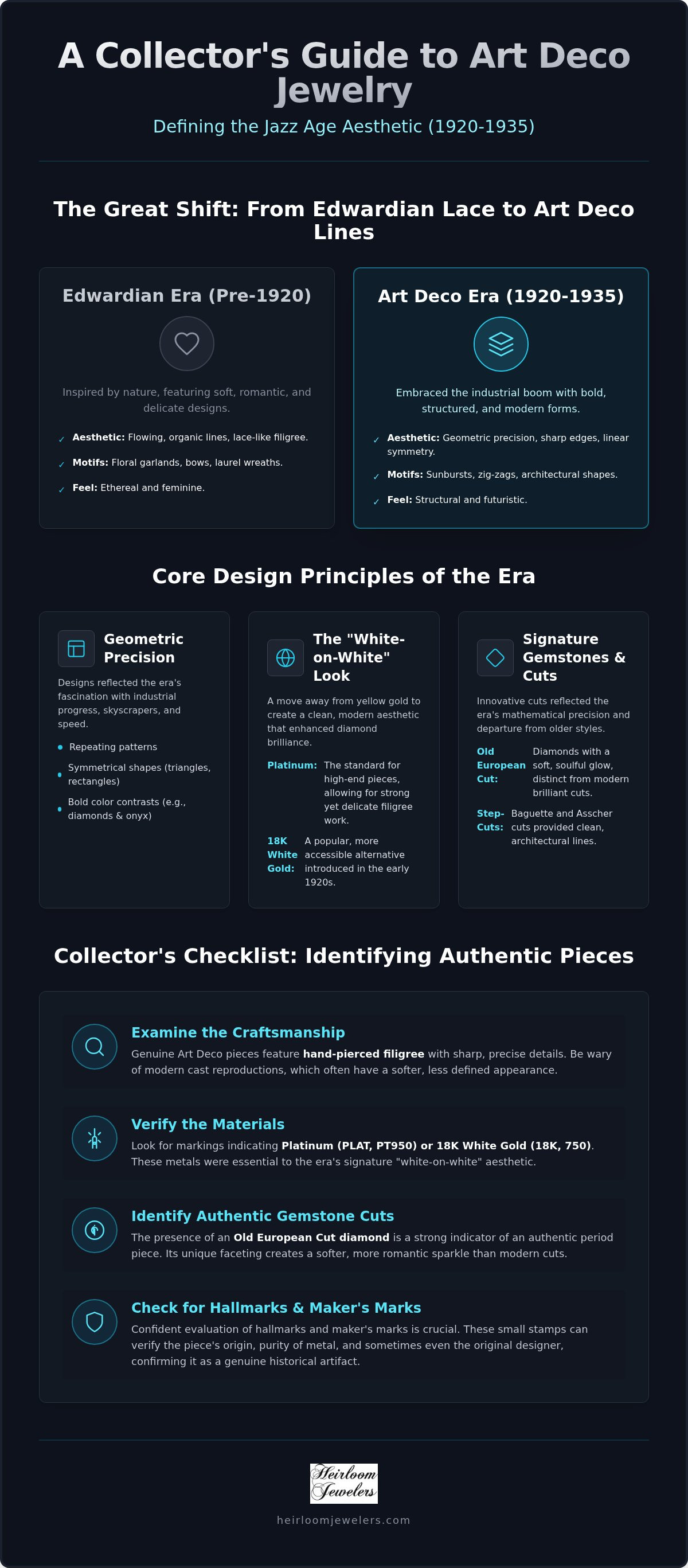
Prior to the 1920s, Edwardian jewelry dominated with its lace-like platinum work and soft, feminine motifs. These pieces often featured delicate floral garlands, bows, and laurel wreaths. As the 1920s progressed, designers abandoned these romantic curves in favor of harder edges and verticality. Architectural influences became prominent. You'll notice sunbursts and zig-zags replacing the traditional ribbons of the previous decade. This transition marked a move from the ethereal to the structural, reflecting a society that was looking toward the future rather than the past.
The Impact of the Roaring 20s Culture
The social shifts of the Roaring 20s fundamentally changed how jewelry was worn. The Flapper era introduced sleeveless dresses and lower waistlines. This change in fashion invited the use of longer necklaces, often called sautoirs, and stacks of narrow bracelets. There was a significant move away from traditional yellow gold. Designers preferred a "white-on-white" aesthetic for art deco jewelry, pairing diamonds with platinum or 18K white gold. Jewelry became a symbol of modernism and personal liberation for women who were entering the workforce and gaining the right to vote.
Collectors often look for specific indicators of this era, such as:
- Linear Geometry: The use of repeating patterns and symmetrical shapes like triangles and rectangles.
- Monochromatic Palettes: A focus on white metals and clear diamonds to create a clean, industrial look.
- Innovative Gemstone Cuts: The continued use of the Old European Cut alongside newer, mathematically precise step-cuts.
Understanding these cultural drivers helps collectors appreciate why these pieces look the way they do. Each ring or necklace tells a story of a world trying to reinvent itself through geometry and light. It's this combination of historical context and technical precision that gives the era its enduring appeal.
Geometric Precision: Signature Materials and Design Elements
The aesthetic of art deco jewelry is inseparable from its mathematical precision. Designers during this period moved away from the whimsical curves of the past. They favored rigid linear geometry, utilizing rectangles, triangles, and concentric circles to create a sense of balance. This structural approach mirrored the soaring skyscrapers and industrial progress of the era. The baguette rings style epitomizes the geometric rigor of the period by using long, rectangular step-cut diamonds to accentuate the piece's architectural silhouette.
While the shapes were often rigid, the color palettes were anything but subtle. Designers loved bold contrasts. They frequently paired white diamonds with deep black onyx to create a striking visual impact. Vibrant green emeralds and rich red rubies were often used in geometric patterns to break up the white space. This use of color was intentional and dramatic, intended to catch the eye in the dimly lit jazz clubs of the decade.
The Rise of White Metals
Platinum became the gold standard for high-end creations during this time. Its incredible strength allowed jewelers to pull the metal into wires as thin as silk. This made intricate filigree work possible without sacrificing durability. In the early 1920s, the jewelry industry introduced 18K white gold as a more accessible alternative to platinum. These white metals acted as a mirror, enhancing the brilliance of colorless diamonds. This created a "white-on-white" effect that felt clean, sophisticated, and distinctly modern compared to the yellow gold of previous generations.
Egyptian and Oriental Influences
Global discovery fueled design innovation throughout the 1920s. The 1922 discovery of King Tutankhamun’s tomb triggered a wave of "Egyptomania" across the West. Jewelry began to feature lotus flowers, scarabs, and pyramid shapes. Designers also drew inspiration from further east. Motifs from Persian rugs and the deep reds of Chinese lacquer appeared in necklaces and brooches. This fusion of ancient symbols with modern industrial lines created a style that felt both timeless and revolutionary. If you're interested in pieces that capture this historic craftsmanship, you might enjoy exploring our authenticated estate collection.
Understanding these materials is the first step in identifying true period pieces. The weight of platinum, the specific tint of vintage 18K white gold, and the sharp edges of geometric stone settings are all hallmarks of quality. These elements combined to create a look that was as much about engineering as it was about adornment. It's this dedication to structure that ensures these pieces remain as wearable today as they were a century ago.
Identifying Authentic Art Deco Gemstones and Cuts
The Old European Cut Explained
The Old European Cut serves as the predecessor to the modern round brilliant. You can identify these stones by their unique proportions: a small table on top, a high crown, and a large, visible culet at the base. The culet is the small facet at the bottom of the diamond. In an Old European Cut, this facet is large enough to look like a small dark circle when viewed through the top of the stone. These diamonds were hand-faceted specifically to perform under candlelight. In a dimly lit room, an Old European Cut diamond possesses a warmth and a broad flash of light that modern LED-optimized cuts often lack. Preserving these original stones within their estate settings is essential for maintaining the historical integrity and value of the piece.
The Art of Calibré and Baguette Cuts
Precision is the hallmark of calibré-cut gemstones. These stones were custom-cut to fit perfectly into the geometric channels of a setting, creating seamless borders of vibrant color. This technique was frequently used with emeralds, onyx, or sapphires to frame a center diamond. Baguette and other step-cut stones played a similar role, emphasizing the vertical and horizontal lines of the piece's architecture. When you evaluate a piece, look for signs of hand-setting. Authentic vintage items show the meticulous effort of a jeweler fitting each stone by hand. Modern reproductions often utilize machine-poured settings where the metal appears to melt around the stones. These lack the crisp, intentional edges found in true period craftsmanship. Understanding these nuances helps you appreciate the level of skill required to create art deco jewelry that has lasted a century.
The Collector’s Framework: Evaluating Art Deco Estate Jewelry
Evaluating art deco jewelry requires a discerning eye for craftsmanship that goes beyond surface-level aesthetics. One of the most critical elements to inspect is the filigree work. In authentic pieces, this is hand-pierced. A jeweler used a tiny saw to cut out the patterns from a solid piece of metal. When you look closely through a loupe, you'll see slight variations and sharp, crisp edges. Modern reproductions are often cast, where the metal is poured into a mold. These cast pieces usually have softer, rounded edges and lack the structural depth and crispness of hand-worked metal.
Hallmarks and maker's marks provide a roadmap to a piece's history. These tiny stamps, often found inside a ring shank or on a necklace clasp, indicate metal purity and identify the manufacturer. While some marks have worn away over time, their presence adds a layer of verification to the age of the item. A mark like "PLAT" or "18K" is standard. However, a recognizable maker's mark can significantly increase a piece's provenance and market value. A thorough condition report is also essential. You should check for worn prongs that may no longer securely hold a diamond. Enamel work, popular in the 1920s, is prone to chipping and is incredibly difficult to repair without devaluing the piece. Because of these complexities, antique rings from this era require specific expert authentication to ensure your investment is sound.
Authenticity vs. "Art Deco Style"
Many modern retailers sell "Art Deco style" items, which are new creations inspired by the period. It's important to understand that "estate" simply means pre-owned, while "antique" refers to items over 100 years old. A true vintage 1920s piece carries a history that a modern reproduction cannot replicate. We often recommend looking for unpolished, original patinas. On vintage platinum and white gold, this soft, aged finish is a badge of authenticity that many collectors prefer over a high-gloss modern polish. If you're ready to begin your collection with a piece that has been rigorously vetted, we invite you to view our authenticated estate jewelry.
Essential Care for Heritage Pieces
Caring for art deco jewelry is about preservation rather than restoration. Delicate filigree can trap dust and oils, but aggressive scrubbing can bend the fine metal wires. We suggest using a soft-bristled brush and mild soapy water for routine cleaning. Avoid ultrasonic cleaners, especially for pieces containing emeralds or enamel. The high-frequency vibrations can cause stones with internal inclusions to fracture or dislodge enamel. Professional inspections are the key to longevity, particularly for high-value items like a Lugano Emerald & Diamond Necklace 18K White Gold. A specialist can catch loose stones or thinning metal before they result in a loss.
The Enduring Legacy of Art Deco at Heirloom Jewelers
The allure of art deco jewelry remains steadfast because it represents a pinnacle of hand-crafted excellence. At Heirloom Jewelers, we act as a bridge between the vibrant history of the 1920s and the modern collector. We've built our reputation on a commitment to authenticating every piece of heritage jewelry that enters our care. We don't sell mass-produced replicas or modern imitations. Instead, we focus on unique, pre-owned items that possess a soul and a story. Owning a piece of history that has survived a century offers an emotional value that transcends simple adornment. We invite you to explore a curated selection of platinum and white gold treasures that embody the spirit of the Jazz Age.
Curating the Collection
Our sourcing process is methodical and driven by a passion for historical significance. We actively seek out rare items like a Vintage Platinum 0.5 Carat Diamond Engagement Ring, ensuring the setting is original and the metalwork is sound. Finding matched pairs of Vintage White Gold Old European Cut Diamond Stud Earrings is particularly rewarding; these stones provide a soft, romantic glow that modern precision cuts cannot achieve. Our curation also highlights the era's adventurous spirit through unique gemstone pairings. You might find Estate Peridot & Quartz Dangle Earrings 14K Yellow Gold that showcase the bold color contrasts so beloved by 1920s designers. Every item is chosen for its ability to represent the highest standards of the period.
Your Journey into the Jazz Age
We understand that entering the secondary market for fine jewelry requires trust and transparency. Our goal is to provide a steady and respectful atmosphere where you can learn about these historical artifacts without the pressure of a traditional retail environment. Whether you are seeking a one-of-a-kind heritage ring or a statement necklace, we offer personalized service tailored to your specific interests. Authenticated estate jewelry provides the peace of mind that your investment is both beautiful and genuine. Collecting is personal. We take pride in being a reliable guide for those seeking to acquire art deco jewelry with confidence. We invite you to explore our Art Deco Jewelry collection and find a piece of history to call your own.
Building Your Heritage Collection
Collecting art deco jewelry is an investment in a geometric revolution. You now understand how to distinguish hand-pierced filigree from modern cast reproductions. You've also learned to appreciate the unique light profile of Old European Cut diamonds. These technical details represent the difference between a simple accessory and a true historical artifact.
At Heirloom Jewelers, we act as authenticated estate experts to ensure every piece in our care meets these rigorous standards. We specialize in one-of-a-kind heritage pieces that have survived a century of change. Our role is to provide the expertise you need to collect with absolute confidence. Whether you're seeking a specific setting or simply exploring the era's elegance, we're here to help you navigate the secondary market. Browse Our Curated Collection of Authentic Art Deco Jewelry and discover a piece that speaks to your own sense of history. Your journey into the world of vintage fine jewelry starts with a single, well-chosen treasure.
Frequently Asked Questions
What is the main characteristic of Art Deco jewelry?
The primary characteristic of art deco jewelry is its commitment to geometric symmetry and bold, linear design. This aesthetic features repeating patterns of triangles, rectangles, and concentric circles. These structural elements replaced the soft, organic curves of previous eras. They reflect the industrial progress and architectural verticality of the 1920s.
How can I tell if my Art Deco ring is authentic?
You can identify an authentic piece by inspecting the craftsmanship and materials under magnification. Look for hand-pierced filigree with crisp, sharp edges rather than the rounded lines found in modern cast reproductions. The presence of an Old European Cut diamond or specific metal hallmarks like "PLAT" or "18K" also serves as a strong indicator of a genuine period piece.
Why is Art Deco jewelry so popular today?
This style remains popular because its architectural lines offer a timeless elegance that complements both modern and classic fashions. Collectors value the high-quality hand-craftsmanship of the era, which is rarely matched by contemporary mass-produced items. Each piece feels like a wearable fragment of history, providing a unique alternative to standard jewelry designs. For those who appreciate high-quality curation in contemporary jewelry, you can check out Nakshathra Gold & Diamonds to explore their modern diamond and gold collections.
What is the difference between Art Deco and Art Nouveau?
The main difference lies in the inspiration behind the shapes. Art Nouveau jewelry focuses on organic, flowing lines inspired by nature, such as flowers and feminine silhouettes. In contrast, art deco jewelry embraces modern industrialism. It utilizes rigid angles, symmetry, and mathematical precision to create a structured, streamlined appearance.
Is Art Deco jewelry considered "antique" or "vintage"?
Art Deco pieces are currently transitioning from vintage to antique status. In the jewelry industry, "vintage" refers to items at least 20 years old, while "antique" denotes pieces over 100 years old. Since the movement flourished between 1920 and 1935, many original items have now reached the century mark, qualifying them as true antiques.
Can Art Deco rings be resized?
Most rings from this era can be resized, though the complexity depends on the specific design. Rings with continuous filigree or engraved patterns around the entire shank require a specialist to ensure the pattern isn't disrupted. Platinum and 18K white gold settings are durable, but you should always consult a jeweler experienced in heritage pieces to protect the structural integrity.
What gemstones are most common in Art Deco pieces?
Diamonds are the most prevalent stones, often paired with vibrant colored gemstones to create high-contrast patterns. Designers frequently used black onyx, green emeralds, blue sapphires, and red rubies. Many pieces from this period also feature "synthetic" or lab-grown sapphires and rubies. These were highly prized during the 1920s for their intense and consistent color.
Is platinum better than white gold for Art Deco jewelry?
Platinum is generally preferred for intricate designs because its strength allows for finer filigree and more secure stone settings. It doesn't wear away as quickly as gold over decades of use. However, 18K white gold was a popular and authentic choice during the era. It offers the same sophisticated "white-on-white" aesthetic while remaining a valid historical material for serious collectors.