
What if building a capsule vintage jewelry collection had less to do with meeting a set item count and more to do with choosing pieces you’ll reach for often? A beautiful piece can still feel out of place if it doesn’t suit your wardrobe, routine, or the occasions you dress for. With vintage jewelry, condition and authenticity also matter, especially when you plan to wear a piece regularly.
A thoughtful collection doesn’t need to be large or follow an arbitrary checklist. It should feel personal, work across the outfits you actually wear, and bring a sense of history without sitting unworn in a jewelry box. Consider how each piece fits with the others and with your daily life.
This guide covers how to balance silhouettes, materials, and occasions, and what to consider when assessing a vintage piece’s condition and history. From earrings you wear often to a necklace that provides a focal point, each choice can have a clear place in your style.
Key Takeaways
- Start with the occasions you dress for, then choose vintage pieces that fill distinct everyday or occasional roles.
- When building a capsule vintage jewelry collection, look for cohesion through shared metals, shapes, scale, or a restrained colour palette.
- Assess visible wear, setting integrity, repairs, hallmarks, and available documentation before making a piece part of your regular rotation.
- Consider how often you’ll wear each piece and whether it adds a distinct role or personal meaning before adding another.
- Choose different pieces for different purposes, from earrings suited to frequent wear to a necklace that creates a focal point.
What Makes a Capsule Vintage Jewelry Collection Feel Personal and Wearable?
A capsule vintage jewelry collection is a deliberately chosen group of vintage pieces that suit your life, work with your wardrobe, and earn repeat wear. It isn’t defined by a required number of items or a matching set. Each piece should have a reason to be there, whether practical, aesthetic, or personal.
Building a capsule vintage jewelry collection is less about gathering examples from every era and more about choosing pieces you’ll enjoy wearing. Different periods and silhouettes can work together when they feel right for you. Old European cut diamond earrings might suit frequent wear, while an emerald and diamond necklace could bring focus to an evening outfit. The aim is a considered mix, not completeness.
Start with your routines, wardrobe, and preferred level of ornament
Think about where jewelry fits into your week. Consider whether you want pieces for daily wear, work, evenings, or occasional events. Then look at what you already wear. Your usual necklines, sleeve lengths, and habits, such as wearing earrings daily or rarely choosing necklaces, can all guide your choices.
- For frequent wear: Note which forms and scale feel comfortable for long stretches.
- For work and daily routines: Consider which pieces feel appropriate and pair easily with clothes you wear often.
- For expressive moments: Leave room for a distinctive piece you enjoy wearing to evenings or events.
This distinction helps keep a collection from becoming a row of beautiful pieces with no clear place in your life. Restrained earrings may suit frequent wear, while a gemstone necklace may be reserved for occasions when you want more presence. Neither role is more valuable. They simply answer different needs.
Set a collecting brief before looking at individual pieces
A short collecting brief can keep your choices connected without making them rigid. Describe the mood you’re drawn to, perhaps restrained, romantic, geometric, or eclectic. Then note preferences in metal, gemstone colour, and silhouette. Treat these as useful guides, not rules that disqualify a piece with a different look.
- Choose a mood that reflects how you want your jewelry to feel with your wardrobe.
- Record materials and colours you naturally wear, while staying open to considered contrasts.
- Decide what gives a piece lasting meaning, such as its craftsmanship, history, or personal association.
Jewelry carries histories of materials, design, and personal expression. Exploring the History and Materials of Jewellery can offer context for the traditions behind vintage pieces. Let that knowledge inform your brief, but let your own taste lead. A piece earns its place when you can picture wearing it, value what makes it distinctive, and feel a genuine connection to it.
How to Choose Vintage Jewelry Anchors for Everyday and Occasional Wear
An anchor piece answers a recurring need in your wardrobe. It might be a quiet design you wear often or a more noticeable piece that reliably completes certain outfits. Neither role is compulsory. Choose pieces for the occasions and combinations that matter to you, rather than selecting by category alone.
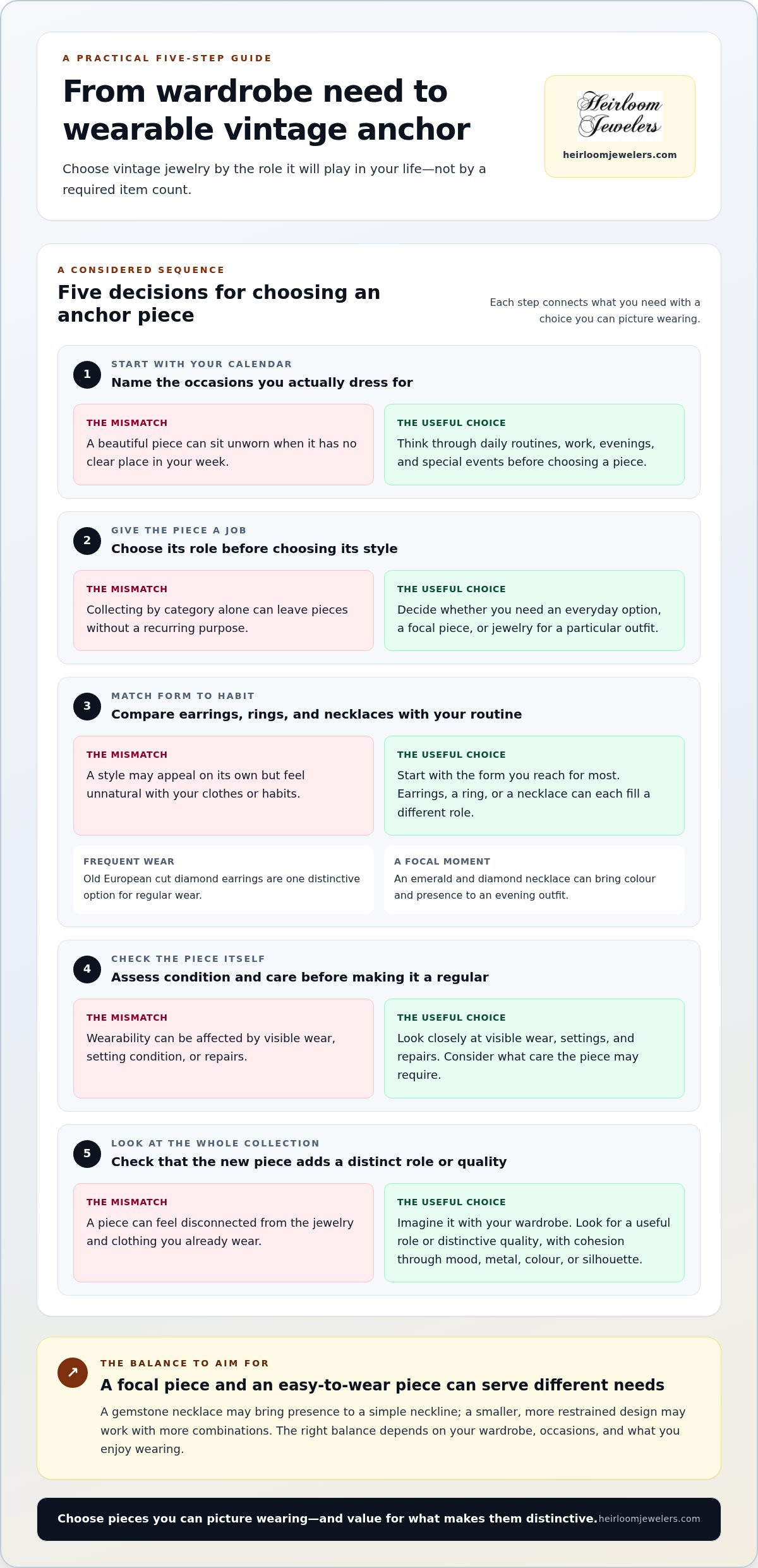
Use this five-step process to compare options and decide which pieces deserve a place in your collection:
- Identify wear occasions. Consider your typical week, from daily routines and work to evenings and special events.
- Choose roles. Decide whether you need an everyday option, a focal piece, or jewelry for a particular recurring outfit.
- Compare forms. Think about whether earrings, a ring, or a necklace feels natural with your clothing and habits.
- Assess condition. Look closely at visible wear, settings, and repairs, and consider what care the piece may require.
- Review cohesion. Imagine the piece alongside jewelry and clothing you already wear. It should add a useful role or distinctive quality.
This sequence makes building a capsule vintage jewelry collection more deliberate. It also helps distinguish a piece that appeals on its own from one you can picture wearing.
Choose roles before choosing specific styles
Start with the form you’re most likely to reach for. If earrings are part of your regular routine, old European cut diamond earrings offer a distinctive option. A ring may hold personal significance or suit a repeated styling preference, but an engagement ring isn’t a universal capsule requirement. For historic details and settings, explore this vintage engagement ring buying guide.
Balance statement pieces with jewelry that integrates easily
Compare a piece’s scale and visual weight with your usual clothing. A gemstone necklace can serve as a focal point with a simple neckline without needing to define every outfit. A smaller or more restrained piece may work with more combinations. The best balance depends on what you enjoy wearing and how often a design suits your wardrobe.
An emerald and diamond necklace can bring colour and presence, while a more understated piece may blend readily into daily dress. Consider how each option sits with your usual necklines and whether its scale feels comfortable for the occasions you have in mind. If historic ring design interests you, the antique rings collector’s guide offers further context.
Condition affects wearability, too. A piece intended for frequent use deserves careful attention to its setting and visible wear. Think realistically about its care needs; the GIA Jewelry Care Guidelines provide practical guidance. Once your priorities are clear, browse curated vintage jewelry and compare individual pieces by role, character, and fit with your routine.
How to Mix Vintage Eras, Metals, and Gemstones Without Losing Cohesion
A considered collection doesn’t need to follow one historical period. Pieces from different eras can sit comfortably together when they share a visual connection, such as metal tone, shape, scale, or colour. The goal isn’t to make every item match. Give the eye a point of continuity while letting each piece retain its character.
Repeating one visual element can connect jewelry from different eras without making the pieces feel like a set.
Use this comparison to find a connection that feels natural with your existing jewelry and wardrobe:
| Approach | Visual effect | Useful example |
|---|---|---|
| Shared metal tone | Creates a quiet sense of continuity. | Pair platinum with 18K white gold for a cool-toned look. |
| Repeated shape | Links distinct pieces through a recognizable motif. | Echo a round gemstone or curved outline in another design. |
| Consistent scale | Keeps pieces balanced when worn together. | Combine modestly sized earrings with a similarly restrained ring. |
| Restrained colour palette | Lets a gemstone provide colour without competing with every piece. | Repeat one colour note, or let a distinctive pairing stand on its own. |
Choose one or two of these approaches rather than trying to apply all four. If every piece shares the same metal, shape, scale, and colour, the result may feel overly coordinated. A deliberate contrast can feel more personal when there’s a clear reason for it.
Use silhouette and visual weight to connect different periods
Silhouette affects how jewelry reads as a group. Fine, intricate detailing creates a different impression from bold geometry, especially when the pieces are worn together. Compare their visual weight: a larger geometric design may work best as the main feature, while a more delicate piece can provide contrast without competing for attention. Art Deco jewelry offers one reference for strong geometry, but it need not become a collection theme. The Art Deco jewelry guide explores the period’s design language.
Combine metals and gemstones with intention
Metal and colour offer another way to bring variety into focus. Platinum and 18K white gold can create a cool-toned thread, while 14K yellow gold introduces a warmer contrast. Neither approach is a rule. Consider how each metal looks beside the pieces you already wear, then decide whether you prefer a consistent tone or a purposeful mix.
Gemstone colour can connect pieces subtly or create a focal point of its own. Estate peridot and quartz earrings, for example, bring a distinctive pairing that can stand apart from neutral-toned jewelry. Let that colour lead, then keep nearby pieces simple or repeat a related tone elsewhere. This is a practical way to build a capsule vintage jewelry collection that feels cohesive without limiting it to one era, metal, or gemstone.
How to Assess Vintage Jewelry Condition, Authenticity, and Care
A vintage piece may look beautiful at first glance, but condition and authenticity matter if it’s going to become part of your regular wardrobe. A loose setting, worn clasp, or previous repair can affect how a piece should be handled and worn. A careful review helps you understand what you’re considering before making it a staple.
Keep four questions distinct: How old is the piece? What materials does it contain? Is a maker attribution supported by evidence? Is there documentation of its ownership history or provenance? These details may overlap, but one doesn’t automatically prove another. Appearance alone can’t establish age, metal content, gemstone identity, maker, or provenance with certainty.
What to examine when considering an estate piece
Review the jewelry in good light without pulling or flexing delicate components. Look at the setting, clasp, joins, and areas that show signs of wear. Note repairs or changes that may affect appearance or use. A visual review can raise questions, but it cannot settle every question about condition or authenticity.
- Settings and joins: Look for visible movement, gaps, or signs that components have been altered.
- Clasps and closures: Check for apparent wear or damage that may affect fastening.
- Hallmarks: Record any marks you can see. They can guide further research, but shouldn’t be treated as standalone proof of metal content, age, or maker.
- Documentation: Note what records accompany the piece and what each record actually supports.
Hallmark interpretation, gemstone identification, maker attribution, and provenance all depend on evidence, not simply on resemblance to a known design. Read product descriptions and accompanying records carefully, and distinguish documented details from conclusions based only on appearance.
Care for vintage pieces according to their materials and construction
Gentle handling is a sound starting point. Store pieces so they don’t rub against one another, and take care around delicate settings and closures. Cleaning should suit the specific metal, gemstone, and construction. A method suitable for one piece may not be suitable for another, so don’t assume a universal cleaner or technique is safe.
If a piece is intended for frequent wear, consider whether its condition and care needs fit your routine. Note visible concerns and pay particular attention to pieces whose setting, materials, or repair history aren’t clear.
Thoughtful evaluation helps each piece earn its place in a lasting collection. Browse curated, authenticated estate and vintage jewelry with these condition and provenance questions in mind.
How to Complete a Capsule Vintage Jewelry Collection Thoughtfully
A capsule feels complete when its pieces serve your wardrobe, not when it reaches a particular size. Before adding anything, review what you own and how you actually wear it. Consider frequency, distinct roles, visual cohesion, condition, and personal meaning. A piece you wear often may contribute more to your collection than one that simply fills a category.
Review gaps before adding another piece
Look for a genuine gap in function, colour, scale, or occasion. Perhaps your jewelry works well for everyday outfits but offers little for evenings, or you reach for necklaces but rarely have earrings that suit your routine. Be specific about what’s missing. “Something different” is less useful than “a piece that brings colour to simple outfits.”
A short wear log can help separate a lasting need from a passing impulse. For a few weeks, note which pieces you reach for, which outfits feel unfinished, and what you leave unworn. Outfit notes can reveal patterns you might otherwise overlook. If a new piece appeals to you, ask whether it fills a recurring gap or duplicates a role already served by something you enjoy.
Pause before buying a near-duplicate. Two pieces can share a role and still feel distinct, but each should offer a reason to choose it, such as a different scale, colour, or setting. If you can’t name that difference, waiting may help clarify whether the addition belongs. Building a capsule vintage jewelry collection is an ongoing process, and leaving room for thoughtful choices is part of it.
Use a final review before adding a piece:
- Wear frequency: Can you picture when you’ll reach for it?
- Distinct role: Does it serve a need not already met?
- Visual cohesion: Does it sit comfortably with the rest of your jewelry?
- Condition: Is its state suitable for the way you expect to wear it?
- Personal meaning: Does its design, history, or character resonate with you?
Your capsule may be small or expansive. It may change as your wardrobe and routines do. There’s no prescribed number of pieces to collect, and no need to own an example from every era. Let repeat wear and personal significance guide your definition of “complete.”
Explore authenticated vintage pieces with your collecting brief in mind
Once you can describe what you’re looking for, use that brief to browse with purpose. Compare rings, earrings, necklaces, and gemstone jewelry by the role each could play, as well as its materials, character, and condition. Heirloom Jewelers offers curated, authenticated estate and vintage fine jewelry, including vintage platinum engagement rings, old European cut diamond earrings, an emerald and diamond necklace, and estate gemstone earrings.
Explore vintage and estate fine jewelry with your criteria in mind, and choose the piece that feels right for your collection.
Let Your Collection Grow With Intention
Building a capsule vintage jewelry collection is a personal practice, not a task to finish by following someone else’s rules. Let your choices respond to the life you lead now, while leaving room for your taste to change. A piece that feels right today can become part of your own history through the moments you wear it.
As you continue exploring, keep your collecting brief close. Heirloom Jewelers specializes in curated, authenticated estate and vintage fine jewelry, including old European cut diamond earrings and estate gemstone jewelry. Consider each piece for its craftsmanship and character, as well as how naturally it might find a place in your wardrobe.
Explore authenticated vintage and estate jewelry and find a piece that speaks to your style. Build at your own pace, choosing what feels meaningful and wearable.
Frequently Asked Questions
How many pieces should a capsule vintage jewelry collection have?
There’s no required number; choose enough pieces to serve the outfits and occasions you actually have. A useful starting point is to review what you wear over a typical week, then notice where you’d welcome another option. If your current jewelry already covers work, daily wear, and evenings, your capsule may feel complete. Building a capsule vintage jewelry collection is about useful variety, not reaching a quota.
What qualifies as vintage jewelry rather than antique jewelry?
“Antique” commonly refers to jewelry more than 100 years old, while “vintage” usually describes older jewelry that hasn’t reached that age. Usage can vary, so the label alone may not establish a piece’s date. If age matters to your decision, look for specific information about the period and the evidence supporting it. A design that appears old-fashioned isn’t, by itself, proof of when the jewelry was made.
Can you mix gold colors in a vintage jewelry collection?
Yes. Yellow, white, and rose gold can be worn together if the combination feels balanced with your clothing and other jewelry. Try repeating one tone in more than one piece, or let one contrasting item stand out while keeping the rest simple. For example, yellow-gold earrings can sit alongside a white-gold necklace without needing to match exactly. Consider the overall effect in natural light before settling on a combination.
How can you tell if vintage jewelry is authentic?
Appearance alone can’t confirm authenticity. Separate the questions: the piece’s age, metal and gemstone materials, maker attribution, and any documented ownership history each require their own evidence. Hallmarks can provide clues, but shouldn’t be treated as proof on their own. Review available records and descriptions, and rely on documented details rather than a piece simply resembling a known style.
Can vintage jewelry be worn every day?
Some vintage jewelry may suit frequent wear, but suitability depends on the individual piece’s construction and condition. Before making it part of a daily routine, consider its setting, closures, and any visible wear, along with the activities involved in your day. A piece worn occasionally may need less frequent handling. If you’re unsure how a particular design will hold up, consider its condition and construction carefully before choosing how often to wear it.
How should vintage jewelry be stored to prevent damage?
Store pieces separately so they don’t rub, tangle, or press against one another. Individual soft pouches or divided compartments can help keep chains from catching and harder components from scratching nearby pieces. Fasten clasps before storing necklaces, and avoid piling jewelry together. Since care needs differ by material and construction, keep a note of any specific guidance provided with a piece and follow it rather than assuming one storage or cleaning method suits all jewelry.