
Can you resize vintage diamond eternity bands without damaging their settings? Sometimes, but the answer depends on the band’s construction, condition, and how much the fit needs to change. A continuous circle of diamonds may leave no plain metal to alter, and changing the band can affect its settings and original character.
A secure, comfortable fit matters, but so does preserving a ring’s craftsmanship. This guide explains why full eternity bands can be difficult to resize, which features may allow more flexibility, and what alternatives to consider when cutting or reshaping the band isn’t a sensible choice. You’ll also learn how to assess fit, condition, and stone coverage before deciding.
Options such as a sizing insert, ring guard, or selecting a different size each have trade-offs. Looking closely at the individual ring helps you weigh comfort against preservation and choose an approach that respects the piece.
Key Takeaways
- Stone coverage and setting style help show whether a band has enough unadorned metal for a possible adjustment.
- Compare resizing, a ring guard or sizing insert, and choosing another size by their effects on appearance, comfort, and reversibility.
- Assess the fit, stone placement, and visible condition before choosing a solution for vintage diamond eternity bands.
- Measure the ring consistently and account for its width rather than relying on a remembered size.
- Consider the ring’s craftsmanship and structural integrity alongside immediate comfort.
Can You Resize a Vintage Diamond Eternity Band? Start With Its Construction
Some eternity bands may be adjusted, but a full circle of diamonds can make conventional resizing difficult or impractical. An eternity band has diamonds set around some or all of its circumference. The extent of stone coverage matters because resizing changes the band’s metal, and the location of the stones and settings determines whether there is suitable metal to work with.
Start by looking at the ring as an individual piece. Its construction, current condition, and the difference between its present size and the desired fit all affect what may be feasible. A small change can present different challenges from a larger one, but neither can be judged by the ring’s age or appearance alone.
In brief: A full-eternity band has diamonds around the entire circumference, often leaving no clear section of plain metal for conventional resizing. A partial-eternity band may have an unadorned section, but that doesn’t mean every example can be safely altered.
What makes a full-eternity band different from a partial-eternity band?
On a full-eternity design, stones continue around the shank, including the portion beneath the finger. This continuous coverage can limit access to metal that could otherwise be cut or adjusted. Changing the band’s circumference may also affect the spacing and alignment of the stones, their settings, and the overall pattern.
A partial-eternity design places diamonds across only part of the band, leaving a section without stones. That section may provide more room to consider an adjustment, depending on its width and how the ring is made. For an overview of these forms, see this guide to the eternity ring. Stone coverage is a useful first clue, not a guarantee that resizing is possible.
Why vintage construction deserves individual assessment
Vintage diamond eternity bands vary in setting style, metal condition, and history of alteration. Closely spaced stones, delicate settings, a worn shank, or signs of earlier sizing work may affect the options. Age alone doesn’t rule resizing in or out. A well-preserved ring may have different possibilities from one with weakened or uneven metal, even if both are from the same period.
A useful assessment starts with visual inspection and precise measurements. The ring’s current size and the proposed change should be considered alongside the stone layout and the band’s condition. This helps distinguish a design that may allow an adjustment from one where preserving the original structure should take priority.
Think of construction as the starting point, not the whole decision. Note where the diamonds end, whether the lower shank is plain, and whether the band appears worn or previously altered. These observations help frame the next question: which fit solution best balances comfort and craftsmanship?
How Settings, Metal, and Condition Affect Vintage Eternity Band Resizing
Resizing changes the circumference of a ring’s shank, not just the position of a plain strip of metal. If diamonds and settings extend around the band, an adjustment may affect how those elements sit together. Full diamond coverage can constrain conventional sizing because it leaves little or no unadorned metal to alter. The more continuous the stone arrangement, the more carefully the design and setting security need to be considered.
That doesn’t make every diamond band impossible to adjust. It does mean that the decision depends on more than the number of stones or the name of the setting style. The metal’s thickness and condition, each stone’s placement, and evidence of earlier work all contribute to the assessment.
How diamond settings influence the available adjustment
Channel, pavé, and shared-prong settings show different ways stones may be secured, but a style label alone can’t determine whether a band can be resized. Look at where the diamonds sit, whether the setting continues around the shank, and whether there’s a suitable area of metal to alter. Changing the circumference can affect stone spacing, alignment, and setting stability, so the design needs to be considered as a whole.
A close visual inspection can reveal whether settings look even and whether stones appear secure. For general background on diamonds and gemstones, the Gemological Institute of America (GIA) offers educational resources. That information can build familiarity with stones, but the ring’s physical construction and condition remain central to evaluating a possible size change.
How age and prior alterations affect the decision
Age alone isn’t a reason to rule out resizing, and a precious metal isn’t automatically unsuitable. Instead, look for visible signs such as a thin or uneven shank, wear, repairs, or marks that may indicate previous sizing work. These details can help show where the band has been stressed and whether another change could add stress.
Separate what you can see from what you’re assuming. A ring’s age or style doesn’t establish its full alteration history or provenance. Visual inspection can reveal wear and construction features, while precise measurements clarify the current size and the adjustment being considered. Together, these observations offer a more useful basis for a ring-specific decision than appearance or memory alone.
For vintage diamond eternity bands, a sound assessment weighs comfort against the integrity of the original workmanship. Note whether the settings continue around the band, the condition of the shank, and any visible signs of previous work. These details help explain why two rings that look similar may have different options.
Heirloom Jewelers’ curated selection of authenticated estate and vintage jewelry reflects an appreciation for distinctive craftsmanship. Explore authenticated vintage jewelry with a collector’s eye for construction, condition, and lasting character.
Resizing or Another Fit Solution? Compare Options for Eternity Bands
A comfortable fit matters, but altering the band isn’t the only response to a ring that feels loose or tight. For vintage diamond eternity bands, the right choice depends on stone coverage, the ring’s condition, and how much the fit needs to change. If an adjustment could disturb the settings, a removable aid or a different ring size may be preferable to changing the original construction.
Use this comparison as a starting point. No option suits every design, and a fit aid that works for one wearer may feel uncomfortable to another.
| Option | Reversibility | Effect on appearance | Potential suitability |
|---|---|---|---|
| Possible resizing | Not readily reversible; it changes the band itself. | May affect the ring’s proportions or setting alignment. | May be considered when the construction and condition allow a change without compromising the settings. |
| Ring guard or sizing insert | Generally removable, without permanently changing the band. | May be visible or felt inside the ring, depending on its design. | Could help with a modest fit issue if the band’s profile and the wearer’s comfort needs suit the aid. |
| Choosing another size | Preserves the original ring’s construction. | Leaves the band unchanged. | Worth considering when adjustment could put the stones or settings at risk. |
When a sizing insert or ring guard may be considered
A removable insert or ring guard can take up space inside a ring without cutting or reshaping the band. That reversibility is useful, but there are trade-offs: an insert may be noticeable against the finger, change how the ring feels, or affect how it sits beside another band. Suitability depends on the ring’s profile, how much movement needs addressing, and the wearer’s comfort during ordinary use.
These aids are not a universal fix. A guard may not sit securely with every band shape, while an insert can change the feel of a ring even if it improves the fit. Consider whether the solution remains comfortable during normal hand movement, not just while the ring is held in place.
When a different size may preserve the ring better
If changing the band could put its settings at risk, choosing a well-fitting ring may better preserve the original design. When comparing sizes, consider how the ring feels when it passes over the knuckle as well as how securely it sits at the base of the finger. For broader context on evaluating older styles and construction, see this guide to vintage engagement rings.
Before settling on a path, weigh the ring’s integrity alongside immediate comfort. The American Gem Society (AGS) provides consumer education related to jewelry and professional standards. For a vintage band, a thoughtful decision begins with its specific construction and a clear understanding of how each option may affect its appearance and wear.
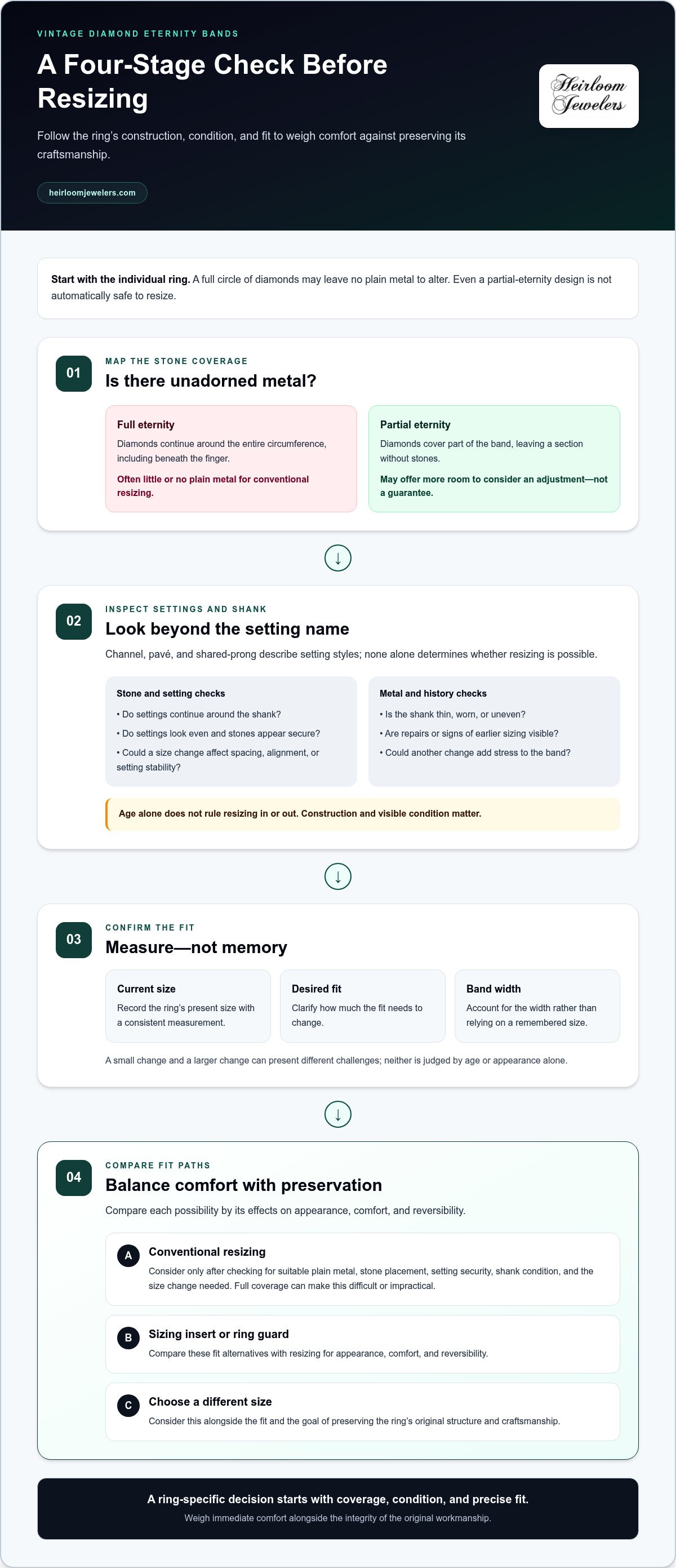
How to Assess the Fit and Condition Before Changing a Vintage Eternity Band
A careful assessment gives you a clearer basis for deciding whether to change the fit or preserve the band as it is. Use this checklist in order. Record what you observe rather than relying on a remembered ring size or assuming the design can be altered.
- Measure and describe the fit. Note whether the ring feels consistently too tight or loose, and where discomfort or movement occurs. Finger size can vary with temperature and time of day, so one uncomfortable moment may not indicate a persistent fit issue. Record the measurement and the fit you’re hoping to achieve.
- Identify the stone coverage. Check whether diamonds circle the entire band or occupy only part of the shank. Note where any plain metal begins and ends. This helps clarify how much of the circumference is available for a possible adjustment.
- Inspect visible condition. Look for gaps between stones, settings that appear uneven, loose-looking stones, worn or thin areas of the band, and visible signs of previous alteration or repair. Record what you see without treating it as a diagnosis of the ring’s structural condition.
- Compare possible options. Consider the fit, construction, and condition together. A change that appears straightforward based on size alone may be less suitable if it could disturb the settings or compromise the ring’s original workmanship.
Measure the fit before deciding on a change
Measure consistently rather than estimating from memory or relying on a ring size from another time. Note when and how the ring feels snug, whether it moves during ordinary wear, and whether the fit changes at different times of day or in different temperatures. A clear record of the current fit and the desired fit makes it easier to understand the size change being considered.
Distinguish a temporary sensation from a recurring fit concern. One moment of tightness or looseness may not describe how the ring fits overall. Consistent notes provide a more useful picture than a single estimate.
Record construction and condition details
Alongside measurements, write down whether stones cover the full circumference or only part of it. Note visible wear, previous repairs, uneven settings, gaps, or stones that look out of line. These details keep the assessment focused on the individual ring rather than assumptions based on its age or style. For more context on historic construction and craftsmanship, explore this guide to antique rings.
For vintage diamond eternity bands, these observations help balance a comfortable fit with respect for the piece’s construction. Explore authenticated estate jewelry with the same attention to craftsmanship, condition, and enduring character.
Choose a Vintage Diamond Eternity Band With Its Long-Term Fit in Mind
The best decision balances how a ring feels now with how its design may respond to change. Consider four things together before choosing a solution: the ring’s current fit, how far the diamonds extend around the shank, the condition of the metal and settings, and the design details you want to preserve. No single factor settles the question on its own.
For vintage diamond eternity bands, comfort and preservation are both part of the decision. A ring that moves or feels restrictive may not suit regular wear, but altering it could affect stone alignment or setting security. A different fit solution may be more appropriate if changing the band risks its construction. In other cases, an adjustment may be possible. The ring’s individual design and condition should guide the choice.
Balance present comfort with preserving vintage character
Think beyond whether the ring can be made smaller or larger. Consider whether it fits comfortably during ordinary wear, whether the stones and settings appear secure, and whether a change could alter the band’s proportions. A removable fit aid, a possible adjustment, or choosing another size each involves trade-offs. None is right for every ring, so weigh comfort alongside the integrity of its existing workmanship.
A useful final review can keep the decision grounded:
- Fit: Record how the ring feels and the size you’re seeking.
- Coverage: Note whether diamonds circle the full band or leave a plain section.
- Condition: Look for visible wear, uneven settings, loose-looking stones, or signs of previous work.
- Design: Consider which details contribute to the ring’s distinctive character and how a change might affect them.
This review doesn’t replace a close examination of the ring. It helps clarify the factors that matter, so the decision doesn’t rest on size alone.
What to value when exploring authenticated estate jewelry
Clear descriptions of materials, construction, and visible condition help you understand a pre-owned piece before making a decision. Look for information that distinguishes observable details from assumptions about a ring’s history. Authentication and thoughtful curation can also support a more informed appreciation of individual workmanship and design.
Heirloom Jewelers specializes in authenticated, curated estate and vintage fine jewelry, including vintage platinum and white-gold pieces. That focus reflects the value of considering each piece on its own merits rather than treating vintage jewelry as interchangeable. A measured eye for construction and condition can help you choose a piece whose character and fit make sense for the long term.
Explore Heirloom Jewelers’ estate jewelry to discover authenticated pre-owned pieces with distinctive craftsmanship and history.
Let Craftsmanship Guide Your Next Choice
A ring’s future fit is worth considering before you commit to changing its form. For vintage diamond eternity bands, a thoughtful choice feels right to wear while respecting the workmanship that gives the piece its character. If a particular band can’t be adjusted without undue risk, choosing another route is a considered decision, not a compromise.
Carry that same care into your search. Look for estate jewelry with clear information about its materials, construction, and condition, so you can appreciate what makes each piece distinctive. Heirloom Jewelers specializes in authenticated, high-end estate and vintage fine jewelry, with a curated selection of unique pre-owned pieces.
Explore Heirloom Jewelers’ authenticated estate jewelry and discover a piece whose history and character speak to you. The right choice can honor the past while feeling at home in your life today.
Frequently Asked Questions
Can a vintage eternity band be stretched?
Stretching isn’t a universal solution, especially if diamonds and settings extend around the band. Whether it’s feasible depends on the ring’s construction, its current condition, and how much additional size is needed. Stretching changes the metal and may affect how stones align or how securely they sit. For example, a full-circle design may respond differently from a band with an unadorned section. The individual ring’s construction and condition determine whether this approach is suitable.
Can an eternity band be resized by half a size?
A half-size change isn’t automatically safe or possible just because it’s small. Stone coverage, setting design, metal condition, and the band’s construction all matter. One ring may have little room for adjustment, while another design may offer more flexibility. For vintage diamond eternity bands, the key question is how the proposed change affects the settings and overall structure, not whether the requested size sounds modest.
What happens if a vintage eternity band cannot be resized?
If resizing isn’t suitable, consider a removable sizing aid, wearing the ring on another suitable finger, or choosing a different size. Each option affects comfort and appearance differently. An insert may change how the band feels against your finger, while another finger may not provide a secure fit. Choose an alternative only if it keeps the ring comfortable and doesn’t compromise its settings.
Can diamonds become loose after an eternity band is resized?
Changing a ring’s circumference or metal can affect setting stability, so loose stones are a possible concern, but they won’t necessarily loosen after every adjustment. Before wearing a ring that has been altered, look for stones that move, visible gaps, or settings that appear uneven. If you notice any of these signs, pause wearing it until its condition has been assessed. Secure settings matter as much as a comfortable fit.
How can I measure my ring size at home?
A ring sizer or a correctly fitting ring measured with a sizing gauge is more useful than estimating from memory. Note when you measure and how the ring feels, since finger size can change with temperature and time of day. One reading may not reflect a consistent fit. For a valuable vintage ring, avoid treating an improvised string measurement as precise; record your observations and use a proper sizing tool.
Can diamonds be added to a vintage eternity band?
Adding diamonds depends on available space, the existing setting, and the band’s condition. New stones may also differ from the originals in cut, color, or overall appearance, making a close visual match difficult. This is a separate alteration from resizing. Even if there seems to be room, the design may not accommodate additional stones without affecting its balance or integrity. The individual band’s design and condition determine whether adding stones is suitable.