
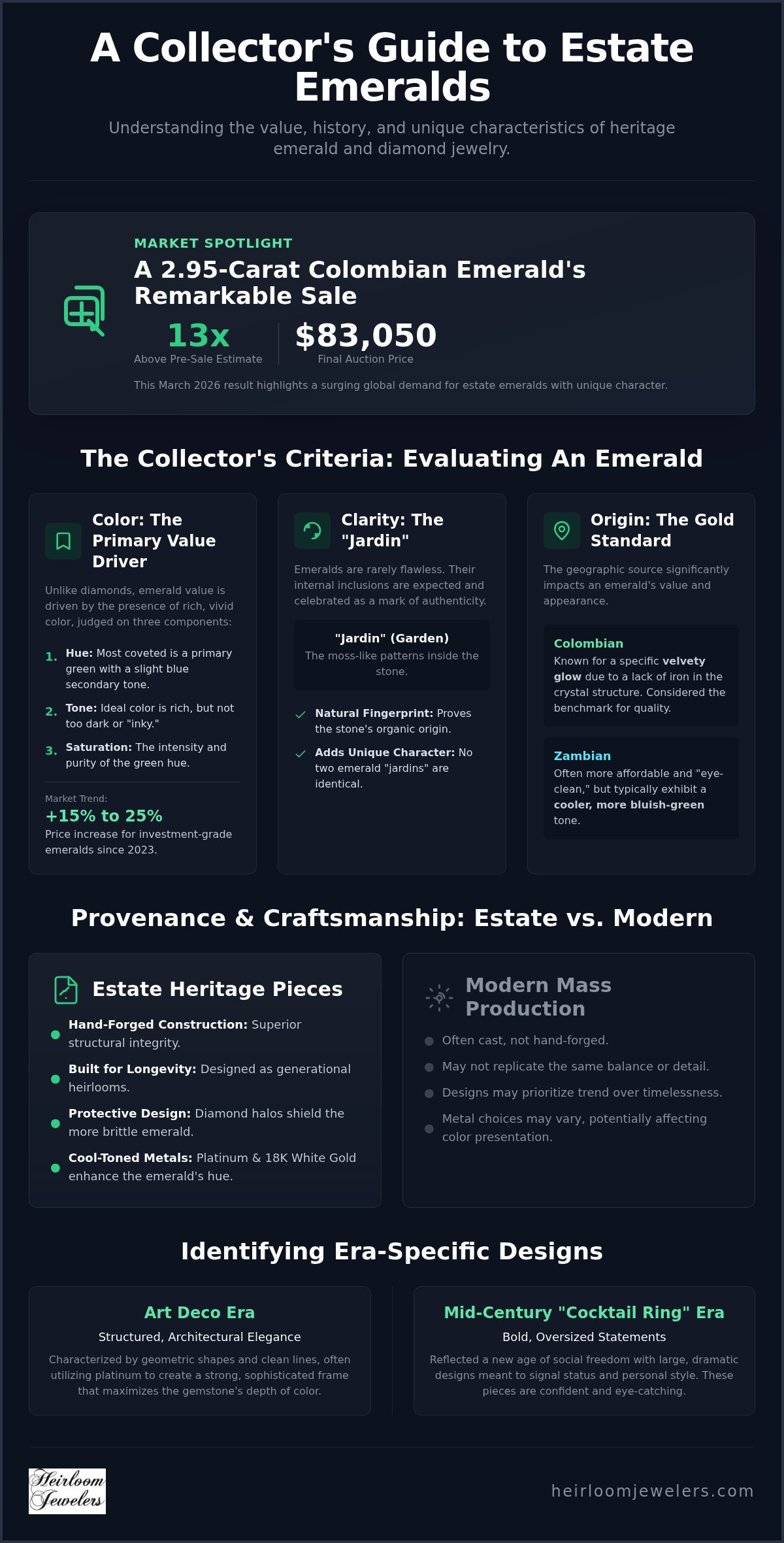
In March 2026, a 2.95-carat Colombian emerald sold for $83,050 at auction, which was more than thirteen times its pre-sale estimate. This remarkable result confirms a growing global appreciation for estate emerald and diamond jewelry that offers a level of character modern mass-production cannot match. You likely recognize the beauty of these pieces but may feel concerned about distinguishing genuine heritage stones from lab-grown alternatives. It's also common to feel confused by the "jardin," the natural garden of inclusions that defines every unique emerald.
We believe that collecting fine jewelry should be a rewarding experience rooted in transparency and expertise. This guide will show you how to evaluate grading criteria, identify era-specific styles, and understand the value differences between Colombian and Zambian origins. You'll gain the confidence to select authenticated pieces that truly represent historical elegance. We'll examine the specific markers of quality and the new ISO standards for precious metals that define a worthy investment in the current secondary market.
Key Takeaways
- Identify the defining characteristics of Art Deco and Edwardian eras to distinguish authentic vintage designs from modern imitations.
- Understand why the "jardin," or internal inclusions, serves as a hallmark of natural origin and adds unique character to estate emerald and diamond jewelry.
- Evaluate the primary value drivers of fine emeralds, focusing on the critical roles of color saturation and Colombian provenance.
- Recognize the superior structural integrity found in hand-forged heritage metalwork compared to modern, mass-produced alternatives.
- Discover the rigorous curation standards used by specialists to authenticate rare pieces like Lugano emerald necklaces and platinum settings.
Beyond the Sparkle: The Timeless Appeal of Estate Emeralds and Diamonds
The allure of estate emerald and diamond jewelry lies in a profound balance of symbolism and geology. Emeralds have long represented rebirth and the lush vitality of spring. Diamonds, by contrast, serve as the ultimate symbol of endurance and eternal strength. When these two stones meet, they create a narrative of life and longevity that resonates with collectors who value more than just surface brilliance. This combination has dominated high-end design for centuries, moving from the exclusive royal commissions of the 18th century into the private estate collections that define 20th-century luxury.
The visual relationship between vivid green beryl and colorless carbon is entirely intentional. Jewelers often used diamond halos to provide a physical safeguard for the central emerald. While emeralds are relatively hard, they are also brittle. A surrounding border of diamonds acts as a protective buffer, absorbing the minor impacts of daily wear while framing the stone in a circle of light. This structural choice highlights the thoughtful craftsmanship inherent in heritage pieces. It's a design philosophy that prioritizes the longevity of the gemstone as much as its beauty. It reflects a time when jewelry was commissioned to be worn and preserved for generations, rather than treated as a disposable fashion accessory.
The Aesthetic Synergy of Color and Brilliance
Diamonds function as a light-gathering frame for the emerald. They pull ambient light into the depths of the green stone, revealing its internal "jardin" and enhancing its natural glow. To maintain a crisp and refined appearance, master artisans typically favored platinum or 18K white gold. These cool-toned metals prevent the yellowing of the diamonds and allow the emerald’s hue to remain the focal point. This pairing creates a sophisticated contrast that modern mass-production often fails to replicate with the same balance. Emerald-cut stones set in vintage platinum provide a structured, architectural elegance that maximizes the depth of the gemstone's color.
Emeralds in the History of Fine Jewelry
The journey from ancient talismans to the sophisticated history of emerald jewelry reflects a constant pursuit of rarity. During the colonial era, trade routes introduced the world to the history of emeralds through the discovery of superior South American deposits. These stones reached European master jewelers who transformed them into intricate necklaces and rings for the elite. By the mid-20th century, this tradition evolved into the "Cocktail Ring" era. These bold, oversized designs used estate emerald and diamond jewelry to signal status and personal style during an age of newfound social freedom. Today, these pieces serve as a bridge between that historical craftsmanship and the modern collector's eye, offering a sense of permanence in an ever-changing market.
The Collector’s Criteria: Evaluating Color, Clarity, and Origin
Selecting high-value estate emerald and diamond jewelry requires a disciplined eye for color. While diamonds are graded on the absence of color, emerald value is driven by the presence of rich, vivid hues. Experts evaluate three specific components: hue, tone, and saturation. The most coveted stones display a primary green hue with a slight blue secondary tone. Since 2023, prices for these investment-grade emeralds have increased by 15-25%, reflecting a strong market demand for stones that maintain high saturation without appearing too dark or inky.
Unlike diamonds, emeralds are almost never flawless. In the world of fine gemstones, internal inclusions are known as the "jardin," or garden. These moss-like patterns are expected and often celebrated as they serve as a natural fingerprint, proving the stone's organic origin. You can learn more about these characteristics through the Emerald History and Lore provided by the GIA. To ensure the integrity of your investment, always prioritize pieces with GIA or AGL certification. These reports verify if a stone has "no-oil" or "minor-oil" treatments, which significantly impacts its long-term resale value.
Deciphering Emerald Origins and Treatments
Colombian emeralds remain the gold standard for many collectors. They are known for a specific velvety glow caused by the lack of iron in the crystal structure. Zambian stones, while often more eye-clean and affordable, typically exhibit a cooler, more bluish-green tone. When reviewing estate pieces, it's vital to distinguish between traditional cedar oil and modern resins. Natural cedar oil is a stable, centuries-old practice. Modern resins can degrade over time, making "No-Oil" estate emeralds the most prestigious and high-premium options in the secondary market.
Grading the Supporting Diamonds
The diamonds in estate settings possess a character quite different from modern brilliant cuts. You'll often find Old Mine or Old European cuts, which were faceted to sparkle under candlelight. These stones feature smaller tables and higher crowns than contemporary designs. When evaluating old European cut diamond earrings, look for eye-clean clarity. The slightly warmer color grades of these vintage diamonds often complement the rich yellow gold or platinum settings perfectly. They provide a soft, romantic fire that enhances rather than competes with the central emerald.
If you are looking to begin your journey with a verified heritage piece, you may wish to view our current selection of authenticated estate jewelry.
From Art Deco to Lugano: Identifying Era-Specific Emerald Designs
Identifying the specific era of estate emerald and diamond jewelry allows a collector to appreciate the technical evolution of the craft. Unlike mass-produced modern items, heritage pieces reflect the cultural shifts and technological advancements of their time. From the delicate platinum work of the early 1900s to the bold lines of the mid-century, each period offers a distinct aesthetic. Recognizing these hallmarks is essential for anyone looking to build a collection with historical integrity and lasting value.
The Edwardian period, spanning roughly 1901 to 1915, is characterized by its ethereal and feminine designs. Master jewelers of this time used platinum to create "lace" work that appeared as light as fabric. You'll often find small diamond accents sprinkled throughout the metal to create a subtle shimmer. This shimmer was designed to complement the central emerald without overwhelming its natural color. These pieces feel romantic and airy, representing a peak in handcrafted metalwork that modern casting often fails to replicate.
The Geometry of Art Deco Emerald Rings
The Art Deco jewelry movement remains a pinnacle for emerald collectors. This era favored clean lines, symmetry, and a departure from the flowing curves of previous decades. Emeralds were frequently fashioned into step-cuts to emphasize their depth of color. These were often flanked by baguette or trillion-cut diamond side stones. Hand-applied milgrain detailing and intricate filigree are common markers of this "Jazz Age" style. It remains a highly sought-after era for emerald engagement pieces due to its timeless architectural appeal.
As design moved into the 1940s and 50s, the Retro and Mid-Century styles embraced a bolder look. This period saw a return to yellow gold and a preference for oversized emerald cabochons. These smooth, rounded stones offered a different way to showcase the "jardin" and the richness of the green beryl. These pieces are often chunky and powerful, reflecting the expressive personal identity of the post-war era. They stand in stark contrast to the delicate lace of the Edwardian years.
High-End Designer Curation: The Lugano Standard
Modern heritage pieces represent a new chapter for the secondary market. The Lugano Emerald & Diamond Necklace in 18K white gold serves as a prime example of this evolution. These designs honor classical proportions while incorporating superior modern security and structural integrity. Lugano pieces bridge the gap between vintage soul and contemporary wearability. This level of curation ensures that estate emerald and diamond jewelry continues to be a viable and stylish choice for the discerning collector today.
The Value of Provenance: Estate vs. Modern Emerald Jewelry
Choosing estate emerald and diamond jewelry is a decision that favors quality over convenience. Modern retail often relies on mass-produced, cast settings that lack the density of heritage work. In contrast, estate pieces were typically hand-forged. This process involves compressing the metal, which results in a more durable and substantial feel. You'll notice the difference in weight the moment you hold a vintage piece compared to a modern commercial alternative.
The rarity factor also sets heritage pieces apart. When you acquire an estate design, you're securing a unique work of art. In an era of globalized manufacturing, the likelihood of seeing your specific piece on someone else is nearly zero. This exclusivity is a primary driver for serious collectors who view jewelry as an extension of their personal identity rather than a trend-driven accessory.
Craftsmanship and Durability
The structural integrity of antique rings often surpasses the "commercial grade" jewelry found in standard showrooms. Modern production frequently uses thinner shanks and lighter prongs to reduce material costs. Estate jewelry was built to last generations, often utilizing high-density platinum or 18K gold. Over time, vintage platinum develops a soft, matte finish known as a patina. This luster is highly prized by collectors because it highlights the metal's history without compromising its strength.
Collectors should remain vigilant regarding lab-grown stones. While the lab-grown diamond market grew to $7.71 billion in 2026, these stones lack the rarity and secondary market value of natural emeralds; for those who wish to explore these modern alternatives in a contemporary context, click here to see the collection at Livia Diamonds. Synthetic emeralds are chemically identical but carry none of the geological history or value retention found in authenticated estate pieces. Authenticity is the cornerstone of a meaningful collection.
Economic and Ethical Considerations
From an investment perspective, authenticated estate jewelry avoids the immediate depreciation seen with new retail purchases. A new ring often loses a significant portion of its value the moment it leaves the store. Provenance and rarity ensure that heritage pieces maintain a more stable price floor. Auction results from early 2026 show that high-quality colored stones continue to exceed estimates, driven by a finite supply of natural, untreated emeralds.
Selecting pre-owned jewelry is also the most sustainable way to enjoy luxury. It removes the need for new mining, making it a responsible choice for the conscious consumer. You aren't just buying a piece of jewelry; you're preserving a piece of history. This "green" luxury approach aligns with modern values while honoring the craftsmanship of the past.
If you are ready to invest in a piece with true staying power, explore our curated collection of authenticated heritage jewelry.
Curating Your Collection with Heirloom Jewelers
Heirloom Jewelers operates as a dedicated bridge between historical artistry and the modern collector. We specialize in authenticated, pre-owned items that represent the peak of craftsmanship. Our inventory focuses on rare finds like Lugano emerald necklaces and old European cut diamonds. We deliberately exclude mass-produced, commercial-grade jewelry from our selection. This rejection of the ordinary ensures that every piece in our care possesses a unique story and genuine material value. We believe that building a collection is a journey that requires patience, expertise, and a steady hand.
A relationship with a specialist curator is essential for navigating the complexities of the secondary market. High-value estate emerald and diamond jewelry requires more than a simple transaction. It demands a partnership rooted in integrity and long-term appreciation. We act as a reliable guide for those who value heritage over trends. Our role is to provide the essential information you need to make an informed decision, stripping away the noise of modern retail to focus on the enduring nature of fine gemstones and precious metals.
The Heirloom Jewelers Authentication Process
Professional appraisal is the foundation of every acquisition we facilitate. We meticulously verify hallmarks to confirm the maker and the specific era of each piece. Metal purity is tested to ensure it meets the 18K white gold or platinum standards our clients expect. We also examine gemstones to confirm they are natural and to identify any treatments. Transparency remains a core value of our business. We provide detailed condition reports for every item, detailing the "jardin" of the emeralds and the clarity of the diamond accents. Owning a piece vetted by heritage experts provides the quiet confidence that your investment is as authentic as its history.
Finding Your Perfect Piece
Starting a collection doesn't require a single large investment. Many collectors begin their journey with classic staples, such as vintage white gold old European cut diamond stud earrings. These pieces offer timeless appeal and function as versatile additions to any wardrobe. As your knowledge grows, you may feel drawn to more complex designs. Our selection includes everything from rare Victorian treasures to the sophisticated lines of modern heritage pieces. Navigating these options is a methodical process that allows the beauty of the jewelry to take center stage.
Whether you are seeking a vintage platinum 0.5 carat diamond engagement ring or a statement necklace, we are here to assist. For those who also appreciate modern craftsmanship that honors these historical traditions, Brilliant Diamonds Fine Jewelers offers a stunning selection of high-quality engagement rings. We invite you to explore our curated collection of estate emerald and diamond jewelry to find a piece that resonates with your personal style and appreciation for history.
Securing Your Legacy in Heritage Design
We have explored the intricate balance of geology and history that defines high-value estate emerald and diamond jewelry. These pieces represent a marriage of geological rarity and hand-forged craftsmanship that modern casting simply cannot replicate. By understanding the "jardin" and prioritizing professional authentication, you ensure your collection remains both a personal treasure and a stable investment. Each era, from the delicate lace of the Edwardian period to the bold lines of Mid-Century design, offers a unique opportunity to own a tangible piece of history.
Heirloom Jewelers acts as a dedicated curator for those who value quality over mass-production. We are specialists in authenticated Lugano and vintage designer jewelry, offering an expertly curated inventory of rare, pre-owned heritage pieces. Our commitment to transparency is reflected in the detailed appraisals we provide for every item, ensuring you move forward with absolute confidence. We invite you to Browse Our Authenticated Estate Emerald and Diamond Collection to discover your next acquisition. We look forward to helping you find a piece that truly resonates with your appreciation for timeless elegance and historical artistry.
Frequently Asked Questions
What is the difference between antique and estate emerald jewelry?
Antique jewelry is defined as being at least 100 years old. Estate jewelry is a broader category that includes any pre-owned piece regardless of its age. This means all antique items are estate pieces, but not all estate jewelry is antique. An estate collection might include a 1920s Art Deco ring alongside a contemporary designer necklace from the early 2000s.
Are estate emeralds more likely to be treated with oil?
Oiling is a standard and centuries-old practice used to enhance the clarity of natural gemstones. Most estate emerald and diamond jewelry will have some degree of oil treatment. Traditional cedar oil is the most respected method because it is stable and does not damage the stone's structure. We prioritize pieces with "no-oil" or "minor-oil" designations for high-value collections because they represent the highest level of rarity.
How do I identify if an emerald in a vintage setting is real?
Real emeralds almost always contain a "jardin," which is a natural garden of moss-like internal inclusions. You can use a jeweler’s loupe to look for these organic patterns. Synthetic stones often appear too perfect or contain tiny gas bubbles that don't occur in nature. Since emeralds are softer than diamonds, you might also see subtle abrasions on the facet edges of a genuine vintage stone that has been worn for decades.
Why are Colombian emeralds so highly valued in estate collections?
Colombian emeralds are prized for their specific "velvety" glow and rich, vivid green color. This unique appearance is caused by a lack of iron in the geological environment where they formed. In the secondary market, stones from the Muzo or Chivor mines command significant premiums. Collectors value them for their historical prestige and superior light-gathering qualities compared to stones from other global origins.
Is 18K white gold or platinum better for vintage emerald rings?
Platinum is often the preferred choice for vintage settings due to its extreme density and natural durability. It holds gemstones securely and develops a soft, matte patina over time that many collectors find desirable. 18K white gold is also an excellent option. It provides a bright, crisp frame that enhances the cool tones of an emerald. Both metals are superior to lower-karat alloys for high-value heritage pieces.
How should I care for and clean my estate emerald and diamond jewelry?
You should never clean emeralds in an ultrasonic or steam cleaner. These methods can strip the natural oils from the stone or cause internal fissures to expand. Instead, use lukewarm water, a mild soap, and a very soft brush. Gently pat the piece dry with a lint-free cloth. It's best to store these items in a separate pouch to prevent harder diamonds from scratching the emerald's surface.
Do estate emeralds come with GIA certifications?
High-value estate emerald and diamond jewelry should ideally be accompanied by a report from a respected laboratory like the GIA or AGL. These certifications verify the stone's origin and the level of treatment it has received. While some smaller estate pieces may not have them, we recommend obtaining a report for any investment-grade stone. This documentation provides the transparency necessary for accurate insurance appraisals and future resale.
Can estate jewelry be resized without damaging the gemstones?
Resizing is possible but requires a specialist who understands the heat sensitivity of emeralds. Unlike diamonds, emeralds can crack if they're exposed to the high temperatures of a traditional jeweler’s torch. A skilled artisan will often use a laser welder or protect the stone with a heat-shielding paste. It's important to have an expert evaluate the setting’s structural integrity before any alterations are made to a heritage piece.