
What makes a good estate emerald necklace? It isn’t necessarily the oldest or most vivid piece. Condition, craftsmanship, design, and the information available about the necklace all matter. Choosing well means looking beyond the label and considering the piece as a whole.
It’s natural to wonder what “estate” means beside “vintage” or “antique,” and how to assess an emerald when inclusions and treatments can affect its appearance. The setting, condition, documentation, and intended occasion matter, too. This guide explains the terms and offers practical ways to compare visible and documented details.
Heirloom Jewelers curates authenticated estate and vintage fine jewelry, including the Lugano Emerald & Diamond Necklace 18K White Gold. As you explore, consider the gemstone’s appearance, the setting, the available information about the piece, and how you plan to wear it. These details can help you choose a distinctive necklace for your own collection or as a piece to treasure.
Key Takeaways
- “Estate” describes a piece’s previous ownership, not a specific age, design era, or gemstone grade.
- Assess an estate emerald necklace by considering the gemstone, mounting, metal, and available documentation together.
- Use photographs for an initial impression, but remember they can’t establish every characteristic of an emerald.
- Compare the setting profile, metal appearance, and visual balance with how and where you plan to wear the necklace.
- Prioritize your preferences, then read the specific item description to understand what is documented about the piece.
What Makes an Estate Emerald Necklace Distinctive?
Estate jewelry is previously owned jewelry, though sellers may use the term differently. An estate emerald necklace is a previously owned necklace featuring one or more emeralds. The label describes ownership history, not a particular design era or gemstone grade. A piece may be simple or ornate, and its age alone doesn’t establish the emerald’s quality, condition, or significance.
That distinction helps separate what a label tells you from what you still need to examine. The design, gemstone characteristics, setting, metal, and accompanying records all relate to the individual piece. Terms such as “estate,” “vintage,” and “antique” can offer context, but they shouldn’t replace a close look at the necklace and its description.
How Do Estate, Vintage, and Antique Jewelry Differ?
“Estate” generally refers to previous ownership. “Vintage” often describes jewelry associated with an earlier period or style, while “antique” commonly signals greater age. Sellers and collectors don’t apply these terms uniformly. Some use an approximate age threshold for “antique,” but that convention isn’t universal. Treat each term as a starting point, then consider the specific item description and any evidence of age. For more context, see a collector’s guide to heritage jewelry.
Why Emeralds Have a Distinctive Place in Estate Jewelry
Emeralds bring a distinct color presence to a necklace. Their appearance can range across green hues and vary in tone and saturation, so no single shade tells the whole story of a gemstone. For an introduction to the gem’s properties and history, see this overview of Emerald gemstone properties.
In a pre-owned necklace, the emerald’s appearance is one part of the assessment, alongside the mounting, metal, workmanship, and documented details. Look for information about the specific piece rather than assuming its category proves its age, origin, treatment, or quality. This keeps your assessment grounded in what can be observed and supported while leaving room to appreciate the necklace’s individual character.
How to Evaluate the Emerald, Setting, and Documentation
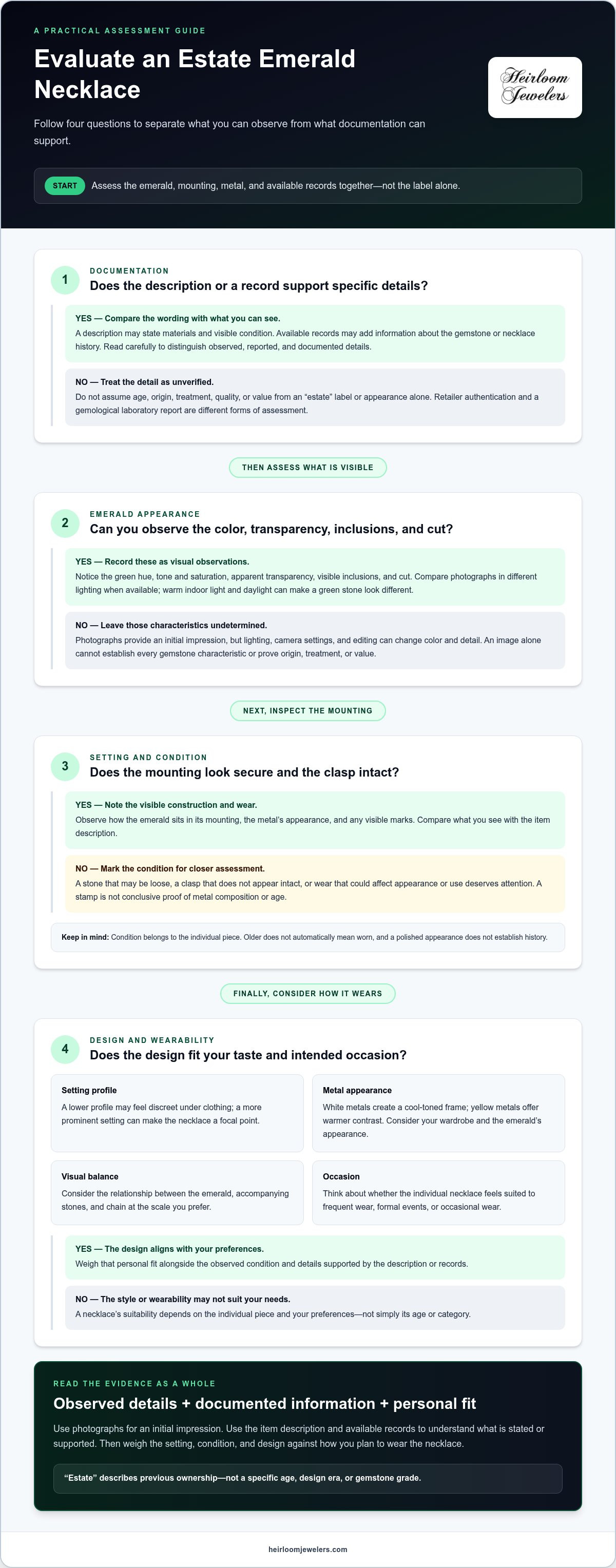
Assess the necklace in four parts: the emerald, its mounting, the metal, and any available records. Begin with what you can observe, then compare those observations with the item description and supporting documentation. This helps distinguish a striking appearance from evidence of a specific grade, origin, treatment, or value.
Consider documentation alongside visual appearance because it can support claims that the eye alone cannot verify. Photographs are useful for an initial review, but lighting, camera settings, and image editing can change how color and detail appear. Images can’t establish every gemstone characteristic.
What Can You Assess About an Emerald From Its Appearance?
Look at the emerald’s color, apparent transparency, visible inclusions, and cut. These are useful observations, not standalone measures of quality. When available, compare photographs taken in different lighting: a green stone may look different under warm indoor light and daylight. The GIA emerald quality factors explain how gem professionals consider color, clarity, cut, and carat weight. Don’t infer origin, treatment, or value from an image alone.
What Should You Look for in the Necklace Setting?
Examine the visible construction and how the emerald sits in its mounting. Look for signs that the stone may be loose, a clasp that appears intact, and wear that could affect the necklace’s appearance or use. Consider the metal’s appearance and any visible marks, but don’t treat a stamp as conclusive proof of composition or age. Condition is specific to each piece: an older necklace isn’t automatically worn, and a polished appearance doesn’t establish its history.
How Do Documentation and Authentication Help?
A clear item description can identify stated materials and describe visible condition. Available records may add information about the gemstone or the necklace’s history. A retailer’s authentication reflects its assessment of the piece. A gemological laboratory report is a separate document that reports on examined gemstone characteristics within the lab’s scope. Read the wording carefully to understand which details are observed, reported, or supported by documentation.
For a practical example of how an emerald necklace is presented, explore Heirloom Jewelers’ curated estate and vintage fine jewelry, including the Lugano Emerald & Diamond Necklace 18K White Gold. Consider the description and visible features together when assessing the piece.
How Estate Emerald Necklaces Compare by Design and Wearability
No single design suits every wearer or occasion. Compare how the setting sits, how the metal frames the emerald, and how the necklace’s scale works with your clothing and preferred way of wearing jewelry. Suitability depends on the individual piece, your taste, and its documented condition, not simply its age or category.
| Design factor | What to consider |
|---|---|
| Setting profile | A lower profile may feel discreet under clothing; a more prominent setting can make the necklace a focal point. Check how it sits and whether the setting appears secure. |
| Metal appearance | White metals create a cool-toned frame, while yellow metals offer warmer contrast. Consider which complements your wardrobe and the emerald’s appearance. |
| Visual balance | Look at the relationship between the emerald, any accompanying stones, and the chain. A balanced design feels cohesive at the scale you prefer. |
| Intended occasion | Consider whether the necklace feels suited to frequent wear, formal events, or occasional use, and whether its condition supports that intended wear. |
Emerald-Only and Emerald-and-Diamond Designs
An emerald-only design keeps attention on the colored gemstone and the shape of its setting. Diamonds around or beside an emerald can add contrast and points of light. That visual effect is a matter of design, not proof that one necklace is better or more valuable. The Lugano Emerald & Diamond Necklace 18K White Gold is an example of an emerald-and-diamond necklace; its name identifies the stated gemstone combination and metal.
Choosing a Metal and Silhouette That Suit Your Style
Metal color changes the overall impression: a white-metal frame can read as crisp, while yellow metal tends to feel warmer. Neither is universally more suitable. Consider chain length in relation to your neckline, pendant scale in proportion to your usual jewelry, and whether you plan to wear the necklace alone or layered. These choices are personal, so use the necklace’s actual proportions and condition to guide your decision.
As you compare an estate emerald necklace with your everyday style, picture it with the necklines and occasions you wear most. A design that feels balanced on its own may become crowded when layered, while a pendant with presence may suit a simple neckline. Let comfort, visual harmony, and the piece’s documented condition shape your choice.
How to Choose an Estate Emerald Necklace for Your Needs
Start with how you hope to wear or enjoy the necklace. A piece for frequent wear should feel comfortable and practical with your usual clothing, while a formal or collection-focused choice can reflect a more specific taste. Use this process to compare the piece with your priorities rather than relying on a generic ranking.
- Define its purpose. Decide whether it’s for daily wear, occasional outings, formal occasions, a gift, or a personal collection. For a gift, consider the recipient’s preferred metal color and jewelry scale. For occasional wear, focus on settings and silhouettes suited to the events you attend. A collection piece may appeal for its design or documented history.
- Picture it with your style. Consider the necklines you wear, whether you prefer a subtle pendant or a more prominent focal point, and whether you’ll wear it alone or layered. There are no fixed rules. The aim is to imagine how the necklace fits your wardrobe and feels to wear.
- Set your priorities. Decide which matters most to you: design, the emerald’s visible appearance, metal preference, or available documentation. This helps you compare pieces on the qualities you value instead of chasing a trend.
- Review the specific item description. Check how the gemstone and metal are identified, what details are stated about the necklace, and what documentation accompanies it. Compare those details with the images and your intended use.
Use a Simple Estate Emerald Necklace Checklist
- Does the description identify the gemstone and metal clearly?
- Do close-up images show the details you want to examine? Remember that photos offer an initial view, not a full assessment.
- Does the necklace’s scale, color, and design suit your preferences?
- Are the available records consistent with the item description?
- Does the stated condition fit how you plan to wear or keep the piece?
Choose the individual necklace that best fits your intended use and priorities, based on details you can review. This keeps the decision personal while respecting what is and isn’t documented.
Care Considerations Before Regular Wear
Before wearing a pre-owned necklace often, handle it gently and follow care guidance suited to its specific emerald, metal, and setting. Don’t assume one cleaning method is appropriate for every gemstone or treatment. If the item description includes care instructions, use them as your starting point and take the necklace’s construction into account.
Explore Heirloom Jewelers’ authenticated estate and vintage fine jewelry to compare distinctive pieces with your preferences in mind.
Explore a Curated Estate Emerald Necklace With Confidence
A category label is only a starting point. A considered choice comes from understanding the specific necklace: its stated materials, documented details, design, and how it suits your taste. This perspective helps you appreciate a pre-owned piece for its individual character without assuming that age alone proves quality, rarity, or value.
Heirloom Jewelers specializes in authenticated estate and vintage fine jewelry. Its curated collection gives shoppers a focused way to explore pre-owned pieces through their descriptions and available information. Authentication is part of the retailer’s focus, and each item’s description helps explain what is stated about that particular piece.
What a Specialist Estate Jewelry Collection Offers
A specialist collection brings attention to the details that matter when comparing estate jewelry, rather than treating every piece as interchangeable. As you consider an estate emerald necklace, connect what you can see with the information provided about that item. This approach supports an informed decision and leaves room to value a necklace for its design and history as well as its gemstone.
Heirloom Jewelers’ curated collection includes estate and vintage fine jewelry. Its focus on authenticated pieces offers a clear context for exploring pre-owned jewelry, while each item’s stated details help you understand what you’re considering. Each necklace has its own characteristics, so assess it on its own terms.
Explore the Confirmed Lugano Emerald and Diamond Necklace
The Lugano Emerald & Diamond Necklace 18K White Gold is one example in the collection. Its name identifies it as an emerald and diamond necklace and describes the metal as 18K white gold. For further context, read the Lugano emerald and diamond necklace feature.
Approach any piece with the same thoughtful attention: consider whether its design speaks to you, read its description closely, and weigh the available information against how you hope to wear or treasure it. A considered choice doesn’t depend on a label alone. It connects the necklace’s documented details with your own preferences.
Explore the collection: Explore estate emerald jewelry.
Choose a Piece That Feels Right for You
An estate emerald necklace is more than its label. Consider the emerald, setting, metal, available documentation, and how the design suits your intended wear. Photographs can help you form an initial impression, while item-specific details offer important context. The right choice is the one that aligns with your taste and the information provided about the piece.
Heirloom Jewelers specializes in authenticated estate and vintage fine jewelry. The collection includes the Lugano Emerald & Diamond Necklace 18K White Gold, an example to explore as you consider the details that matter to you.
Browse Heirloom Jewelers’ curated collection of estate and vintage fine jewelry to find a piece that speaks to your style and sense of history. Explore estate emerald jewelry.
Frequently Asked Questions
What is an estate emerald necklace?
An estate emerald necklace is a previously owned necklace featuring one or more emeralds. “Estate” describes its ownership history, not a particular age, design period, or gemstone grade, and sellers may use the term differently. To understand an individual piece, look beyond the label to its design, stated materials, condition, and available records. Those details help distinguish what’s known about the necklace from assumptions based on its category.
How can you tell if an emerald necklace is authentic?
Assess the item description and any supporting documentation rather than relying on photographs or appearance alone. A retailer’s authentication reflects its assessment of the jewelry, while a gemological laboratory report is a separate document describing examined gemstone characteristics. A report can support specific claims, but read its scope and compare it with the necklace’s description. Color, visible inclusions, and a metal stamp aren’t conclusive proof of gemstone identity or origin.
Are estate emerald necklaces suitable for everyday wear?
Some may suit regular wear, but suitability depends on the individual necklace’s condition, setting, construction, and the wearer’s routine. Consider whether the clasp appears secure, whether the emerald seems firmly mounted, and whether the design feels comfortable with your usual clothing. A necklace intended for occasional wear may call for different expectations from one worn often. Review the piece-specific condition details before deciding how frequently to wear it.
Can you wear an emerald necklace every day?
You may be able to wear an emerald necklace daily if its specific condition and setting suit that use, but daily wear isn’t right for every piece. Consider your activities and whether the necklace could be knocked, pulled, or exposed to substances that may affect its materials. Check the clasp and setting periodically, and follow care guidance for that particular necklace. If its condition is unclear, don’t assume it’s ready for constant wear.
What should I look for when buying an estate emerald necklace?
Compare the emerald’s visible color, transparency, inclusions, and cut as observations, not proof of grade or origin. Review the setting, clasp, metal description, condition, and available documentation. Check that the item description clearly states what is known about the specific necklace, and remember that photographs can’t establish every gemstone characteristic. Choose according to your intended wear, design preferences, and the details you can understand and verify.
What is the difference between estate and vintage emerald jewelry?
Estate emerald jewelry is previously owned; vintage usually refers to a piece associated with an earlier period or style. Sellers and collectors don’t use these terms according to one universal convention, and “estate” doesn’t establish a necklace’s age. A piece may be described as both estate and vintage. Read the individual description and consider any supporting records instead of relying on either label to determine its history.
How do you style an emerald necklace with diamonds?
Wear an emerald-and-diamond necklace as a focal point with a simple neckline, or pair it with understated pieces if you prefer a layered look. Consider the necklace’s scale, chain length, and the contrast between the emerald’s color and the diamonds’ brightness. There’s no single styling rule. The Lugano Emerald & Diamond Necklace 18K White Gold is an example of this gemstone combination and metal description.
How should you care for an estate emerald necklace?
Handle the necklace gently and follow care guidance suited to its specific emerald, metal, and setting. Avoid assuming that a cleaning method is appropriate just because the piece is older or looks sturdy. Before regular wear, review any item-specific instructions and consider its stated condition. Store it so the setting isn’t pressed or knocked by other jewelry, and take care when fastening or removing the necklace.