
What if the sapphire that first catches your eye isn’t the detail that tells you whether the ring is right for you? Estate sapphire rings bring together a gemstone, a setting, and a history. Their appeal often lies in that combination, but appearance alone can’t reveal a stone’s treatment, a ring’s condition, or whether its design belongs to the period it suggests.
It’s natural to be drawn to rich color or an intricate vintage setting. A thoughtful choice means looking beyond those first impressions. Sapphire hue, clarity, cut, and treatment shape a stone’s appearance and what its documentation can support. Wear, repairs, hallmarks, and craftsmanship can also offer clues, while provenance may add context without proving age or authenticity on its own.
This guide explains which sapphire characteristics matter and how to recognize design details associated with different periods. You’ll also find practical ways to assess condition, treatment records, and provenance before choosing a ring. The goal is to weigh the whole piece, so personal taste and reliable information can guide the decision together.
Key Takeaways
- Estate, vintage, and antique describe different things, so a seller’s label alone can’t establish a ring’s age.
- Consider color, clarity, cut, and carat weight together rather than judging an estate sapphire ring by one feature.
- Compare design details and settings for clues to a period style, while treating them as indicators rather than proof of age.
- Inspect the stone, setting, wear, repairs, and documentation to assess condition more thoughtfully.
- Start with the colors and settings you’re drawn to, then weigh condition and documentation against your preferences.
What Makes an Estate Sapphire Ring Distinctive?
An estate sapphire ring combines a gemstone, a setting, and a history of prior ownership. The word “estate” describes that ownership history, not a guaranteed age, design period, or level of rarity. A previously owned ring could be decades old or more recent, and its design might be traditional or distinctly personal.
An estate ring is a previously owned ring; “estate” identifies its ownership history, not its age or style. This distinction helps separate what a label tells you from what the ring itself can show. You can appreciate the sapphire and setting on their own terms, while claims about age or origin call for supporting evidence.
Estate, vintage, and antique: what do the terms mean?
Estate generally refers to prior ownership. Sellers may use “vintage” and “antique” differently, and there isn’t one cutoff that applies universally in every context. Treat these words as descriptions to clarify, not proof of a specific date. Design features can suggest an era, but a later ring may also take inspiration from a period style.
Why sapphire rings appeal to estate-jewelry buyers
Sapphires suit a broad range of designs and are known in blue as well as other colors. For a concise overview of the gem’s composition, colors, and history, see Sapphire gemstone information. In a ring, a sapphire might stand alone in a simple setting, sit among diamond accents, or form part of an elaborate cluster. Differences in cut, setting, metal, and decorative detail give each piece its own character.
Estate examples can appeal to buyers who value distinctive stones and the workmanship of earlier designs. A ring with delicate engraving feels very different from one with bold geometric lines, even if both feature blue sapphires. These visual distinctions can help you narrow your preferences, but they don’t establish a ring’s age, rarity, treatment history, or market value.
The pleasure of choosing an estate piece can come from finding a combination that feels distinctive and wearable, rather than assuming it will appreciate in value. A sapphire’s color may catch your eye; the proportions of its setting or details around the band may be what make the whole ring feel right. For more context on period design and craftsmanship, the antique rings collector’s guide offers a related perspective. Stone and setting create a ring’s visual identity, while reliable information helps explain its history.
How to Evaluate the Sapphire in an Estate Ring
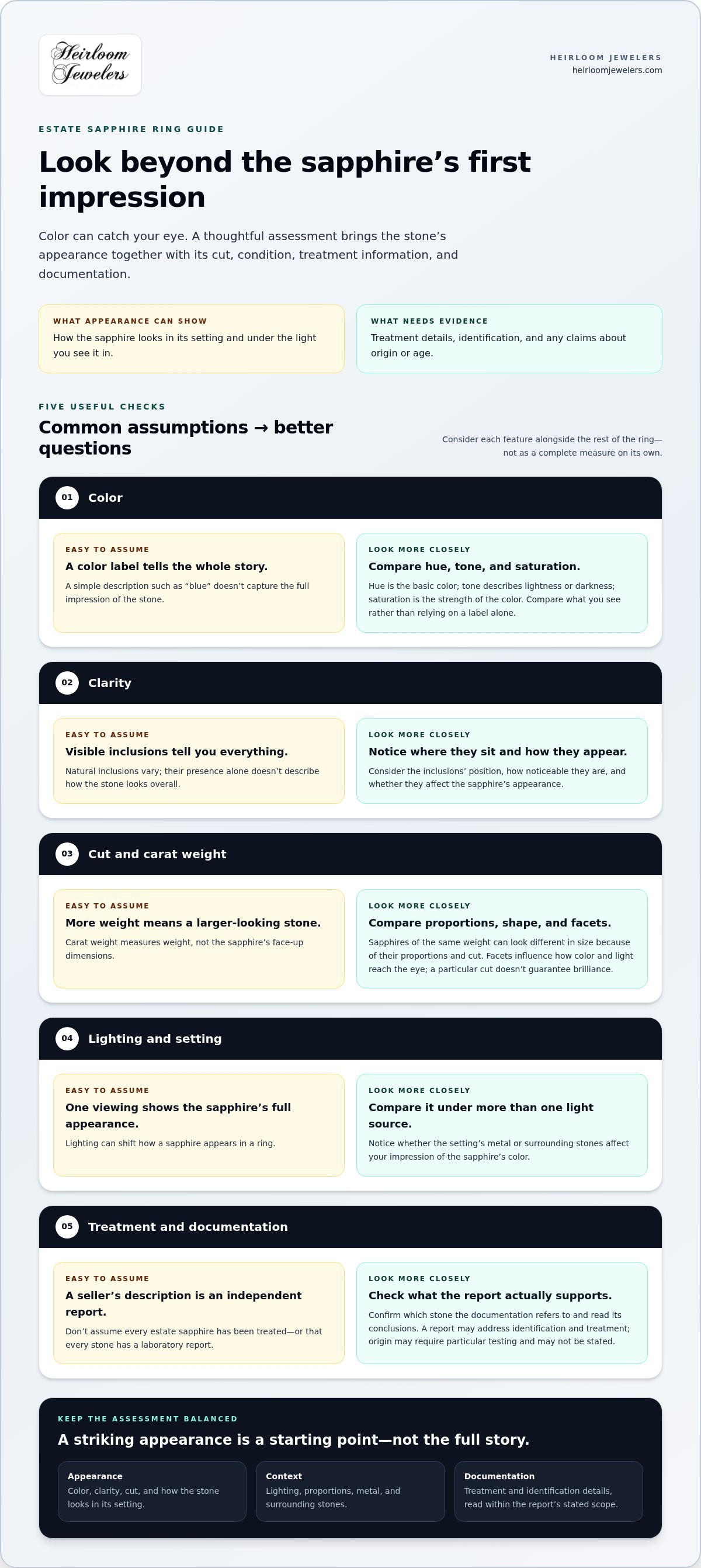
A sapphire’s appeal isn’t simply a question of whether it looks “blue enough.” Color, clarity, cut, carat weight, treatment, lighting, and setting all influence what you see and how to interpret it. Consider these features together. A striking appearance can draw you in, but it doesn’t establish a stone’s treatment history or overall quality on its own.
Assess sapphire color alongside cut, clarity, and treatment, because each affects the stone’s appearance and context. This balanced approach is more useful than treating any one characteristic as a complete measure of quality.
Sapphire color, clarity, cut, and carat weight
Color is often described through hue, tone, and saturation. Hue is the basic color, such as blue; tone describes how light or dark it appears; saturation refers to the strength of the color. The balance of these qualities affects the overall impression, so compare what you see rather than relying on a color label alone.
Clarity describes visible inclusions and other internal features. Natural inclusions vary; consider where they sit, how noticeable they are, and whether they affect the stone’s appearance. Cut matters, too. The shape and arrangement of facets influence how color and light reach the eye, although a particular cut doesn’t guarantee a certain level of brilliance.
Carat weight measures weight, not the stone’s face-up dimensions. Two sapphires of the same weight can appear different in size because of their proportions and cut. Use weight as one comparison point, alongside the stone’s appearance in its setting and your own preferences.
Treatments and gemological documentation
Treatment history can help explain how a sapphire’s appearance has been enhanced or altered. Don’t assume that every estate sapphire has been treated or that every stone comes with a laboratory report. A seller’s description is useful, but it isn’t the same as an independent gemological report. The GIA Sapphire Guide explains sapphire characteristics and treatments; when available, a report can provide a separate assessment of the specific stone.
Read documentation closely. Check which stone it refers to and what its conclusions actually support. A report may address identification and treatment, while origin may require particular testing and may not be stated in every report. Terms such as “natural” or “untreated” in a seller’s description aren’t substitutes for documentation.
Lighting can shift how a sapphire appears. Compare it under more than one light source if possible, and notice whether the setting’s metal or surrounding stones affect your impression of its color. A considered evaluation of Estate sapphire rings brings documented details together with the stone’s appearance in the ring. Heirloom Jewelers’ curated estate and vintage jewelry reflects the value of considering individual pieces carefully.
Compare Estate Sapphire Ring Styles, Settings, and Eras
Design can help you narrow your preferences, but visual resemblance isn’t proof of a ring’s age. Details associated with Victorian, Edwardian, or Art Deco jewelry can inspire later pieces, and styles often overlap. Look at the whole composition: the sapphire’s placement, the setting’s shape, the metal, and how the decorative elements work together. These cues can describe a design language without establishing provenance.
Victorian, Edwardian, and Art Deco design cues
Victorian-inspired rings may feature ornate metalwork or nature-inspired motifs. Edwardian-style designs are often associated with delicate, lace-like detail, while Art Deco influence can appear in bold geometry, symmetry, and strong outlines. These are broad visual associations, not strict rules. A floral cluster can appear in different eras or in a later interpretation. Geometric lines may suggest Art Deco taste, but they don’t verify when a ring was made. The Art Deco jewelry guide offers deeper context for recognizing that design language.
| Design influence | Visual cues and setting forms | May appeal to someone who prefers |
|---|---|---|
| Victorian-inspired | Ornate details, floral motifs, and cluster arrangements | Romantic, decorative compositions |
| Edwardian-inspired | Fine, delicate metalwork and an airy arrangement of stones | Lightness and intricate detail |
| Art Deco-inspired | Symmetry, geometric outlines, and structured layouts | Strong lines and a defined, architectural look |
Metal also changes a ring’s impression. Yellow gold can bring warmth and contrast to a sapphire; white gold or platinum can create a cooler, more restrained frame. Platinum is often associated with a substantial feel, though the exact impression depends on the ring’s construction. Diamond accents may outline the center stone, add sparkle, or form part of a cluster. None of these materials or details alone establishes a period.
Sapphire solitaire, cluster, and diamond-accented settings
A solitaire keeps attention on one sapphire, with fewer surrounding details. A halo or cluster places smaller stones around or beside the center, creating a more intricate outline and a broader visual presence. Diamond accents can sharpen contrast or make the design feel more formal, while a sapphire set alone may suit someone who prefers simplicity. Consider what you want to notice first: the center stone, the surrounding detail, or the balance between them.
Setting height affects both the ring’s profile and how it feels to wear. A raised stone can make the sapphire more prominent, while a lower profile may feel visually quieter. Setting shape and metal color can also change how the stone reads against the hand. Compare rings from the side as well as from above, and consider whether you prefer a prominent setting or one that sits closer to the finger. The right style is the one whose details feel right to you, not simply the one with a period label. Estate sapphire rings span these design choices, so let visual preference guide your shortlist while treating style cues as clues rather than proof of age.
Are Estate Sapphire Rings Risky? Assess Condition and Authenticity
Pre-owned status alone doesn’t mean a ring is in poor condition. An estate sapphire ring may be well preserved or show wear that needs closer attention. The practical questions are what you can observe, what documentation supports, and what calls for a professional assessment. A careful review helps distinguish normal signs of age from damage or undisclosed changes.
Inspect the sapphire, setting, shank, prongs, signs of wear, repairs, and supporting documentation. These checks offer a useful starting point, but a visual review can’t establish every detail of a gemstone’s condition or history.
A practical inspection checklist for an estate ring
Review the ring methodically, using clear photographs and a written condition description as references. If examining it in person, handle it gently. Don’t try to move the stone or test the setting by pulling at it.
- Look over the sapphire. Note visible chips, scratches, abrasions, or uneven facets. Photos may show surface details, but they can’t always reveal subtle damage or internal features.
- Check the setting. Look for a stone that appears uneven or visibly loose. A photograph can’t confirm whether the setting securely holds the sapphire, so any movement or uncertainty calls for professional assessment.
- Examine the shank and prongs. Notice thinning, worn edges, bent or uneven prongs, and areas that may have been reshaped. These observations can flag questions, but they don’t establish the ring’s structural condition.
- Review wear and repairs. Look for differences in finish, solder marks, replaced components, or details that don’t match across the ring. A repair may be appropriate, but its extent and effect aren’t always clear from appearance alone.
- Read the documentation. Compare the written description with the photographs and any available records. Look for specific statements about condition, known repairs, and the gemstone instead of relying on a broad label such as “excellent.”
Clear images from several angles can help, especially close views of the stone, setting, and band. A useful description identifies visible wear and known repairs rather than offering vague reassurance. An independent gemological or jewelry assessment may be needed to evaluate details that photographs and visual inspection can’t establish.
Hallmarks, provenance, and authenticity clues
Hallmarks and maker’s marks can offer clues about metal, manufacture, or origin, but a mark alone doesn’t prove a ring’s complete history or authenticate every component. Provenance, such as past records or ownership documentation, can add context. It supports an evaluation but doesn’t replace examination of the ring itself. The heritage jewelry collector’s guide explores how historical context can inform appreciation of estate pieces.
Heirloom Jewelers specializes in curated, authenticated estate and vintage fine jewelry. Explore Heirloom Jewelers’ estate jewelry and consider each piece’s condition, craftsmanship, and supporting details.
How to Choose an Estate Sapphire Ring That Feels Right
A good choice balances personal taste with a clear understanding of the complete ring. Rather than starting with carat weight or an era label, decide what you want to see and feel when you wear it. Then compare the sapphire, setting, condition, and available documentation against those preferences. This keeps the decision grounded in both appearance and practical details.
Match the ring to your taste and intended wear
Begin with the features that matter most to you. Is there a sapphire color you’re drawn to? Do you prefer a simple silhouette or a setting with layered detail? Would the warmth of yellow gold or the cooler look of white gold or platinum better suit your style? A short list of preferences can make comparisons more focused.
- Choose a color direction. Note whether you prefer vivid blue, a softer tone, or another sapphire color, then compare how each stone looks in its setting.
- Consider the silhouette. A solitaire keeps attention on one center stone; a cluster or diamond-accented design adds more surrounding detail.
- Think about comfort. Consider the ring’s profile, how high the setting sits, and whether its shape feels comfortable for the way you intend to wear it.
- Decide how much history matters to you. Period-inspired details may appeal on their own, while documented history may matter if you want a clearer account of the ring’s past.
Compare complete rings, not isolated gemstone specifications. A sapphire that looks compelling on paper may feel different when you see its cut, color, metal, and setting together. Consider condition and documentation alongside appearance. A visible repair or missing record doesn’t automatically make a piece unsuitable, but it should inform your decision and expectations.
Explore estate jewelry with an informed eye
Use your preferences as a guide, not a rigid scorecard. You may find that a setting you hadn’t considered feels more balanced, or that a smaller stone suits the ring’s proportions better. Estate sapphire rings vary in design and history, so the right choice brings together the details you value with a condition and documentation profile you understand.
Heirloom Jewelers specializes in curated, authenticated estate and vintage fine jewelry. That focus reflects the care thoughtful selection requires: appreciating craftsmanship while considering each piece and its supporting details. You can bring the same measured eye to the broader estate jewelry category, including vintage rings and gemstone jewelry.
Take your time, compare the whole ring, and let personal taste lead alongside sound information. When you’re ready to browse, explore the curated estate jewelry selection.
Choose a Piece You’ll Treasure Wearing
Choosing a ring can be less about finding a piece that satisfies every comparison and more about finding one you’re glad to wear. Let your preferences remain personal: the color you return to, the setting that feels natural, and the history you’re comfortable carrying. Estate sapphire rings can mark a meaningful choice because each combination of stone, design, and prior ownership has its own character.
Consider how a ring might fit into your life beyond the moment of purchase. Picture it alongside jewelry you already wear and the occasions when you’d reach for it. If a detail still gives you pause, take time to understand it rather than rushing toward a decision. Confidence comes from knowing why a piece suits you.
Heirloom Jewelers specializes in curated, authenticated estate and vintage fine jewelry, including estate gemstone jewelry and vintage rings. Explore Heirloom Jewelers’ curated estate jewelry at your own pace. A thoughtful choice is worth taking the time to make.
Frequently Asked Questions
What is the difference between an estate sapphire ring and a vintage sapphire ring?
An estate sapphire ring has been owned before; “vintage” describes a style or period, though sellers may use the term differently. A ring can be estate without being vintage, or both. For example, a recently resold ring may qualify as estate jewelry without being considered vintage. Check the description for the basis of any age claim, and look for supporting records rather than treating either label as a verified date.
Are sapphires in estate rings usually treated?
Treatment history varies from sapphire to sapphire, so don’t infer it from the stone’s color, setting, or age. Look for clear disclosure and any relevant gemological documentation. If a report is provided, confirm that it identifies the sapphire in the ring and read its findings closely. A report can offer useful information about the specific stone, but its conclusions are limited to the observations and tests described.
Can an estate sapphire ring be resized?
Possibly, but resizing depends on the ring’s construction, metal, setting, and details around the band. A plain shank may present different considerations from one with stones or engraving along the sides. The work can also affect the setting, so the individual ring should be assessed before resizing begins. Don’t assume every ring can be altered or that a size change will leave all decorative details untouched.
Are estate sapphire rings suitable for everyday wear?
They may be, depending on the sapphire, setting, current condition, and your routine. Consider whether the ring could be exposed to knocks, pressure, or frequent contact with hard surfaces during your usual activities. A sapphire’s hardness doesn’t make its setting immune to wear or damage. Comfort matters, too: a high-profile design may feel different from a lower one. Assess the individual ring rather than assuming all estate sapphire rings suit daily wear.
How can I tell whether a sapphire is natural or synthetic?
Appearance alone usually can’t establish whether a sapphire is natural or synthetic. A gemological examination and suitable documentation can provide more reliable identification. Keep two questions separate: whether the sapphire is natural or laboratory-grown, and whether it has undergone treatment. A report may address these differently, depending on its scope. Read the conclusions for the specific stone, and don’t treat visual features as conclusive proof of origin.
Do estate sapphire rings come with an appraisal?
Not necessarily. Documentation varies by seller and ring, so don’t assume an appraisal comes with an estate purchase. An appraisal generally provides a value opinion for a stated purpose, while a gemological report focuses on identifying and describing a gemstone. These documents serve different roles. Review what is provided, including its date, scope, and the item or stone it refers to, before relying on it for a particular need.
What does provenance mean for an estate sapphire ring?
Provenance is documented information about an item’s ownership or history. It might include an earlier sales record, an estate inventory, or other paperwork connected to the ring. Older jewelry may have gaps in its documented history, and a family story or design resemblance isn’t the same as a record. Consider provenance alongside the ring’s materials, condition, and any gemological documentation rather than treating it as proof on its own.