
Could a jewel’s most revealing clue be the detail it lacks? Georgian era jewelry often has no hallmark to settle questions of age, so collectors need to assess how a piece is made, not just how it looks. Made between 1714 and 1837, these pieces reflect a time when jewelry was shaped by hand, before industrial production transformed the craft. That artistry is part of their appeal, but it can also make authentic examples difficult to distinguish from later Victorian revivals.
It’s understandable to feel cautious. Foil-backed stones can be damaged by moisture, and a convincing appearance alone isn’t proof of age or origin. In this guide, you’ll learn what to examine, including closed-back settings, early stone cuts, silver-topped gold, clasps, repairs, and signs of later alterations. You’ll also meet distinctive forms such as Pendeloque and Girandole, and find practical ways to assess provenance, choose a reputable source, and care for fragile pieces.
With a clearer eye for craftsmanship and condition, you can appreciate Georgian jewelry as both a historical object and a wearable heirloom. Heirloom Jewelers specializes in authenticated estate and vintage fine jewelry for collectors who value historical artistry and unique pre-owned pieces.
Key Takeaways
- Trace how Georgian jewelry changed across the reigns of the four Georges, from early bold forms to later designs.
- Learn how rose cuts, foil backing, and silver-topped gold shaped the appearance and construction of Georgian era jewelry.
- Discover how gemstones conveyed private messages, including acrostic designs that spelled words such as “ADORE.”
- Assess a piece beyond its stamp by examining hand-finished details and irregularities that may offer clues to its age.
- Understand why careful storage and dry cleaning matter when preserving delicate antique settings.
The Four Georges: Understanding the Evolution of Georgian Jewelry
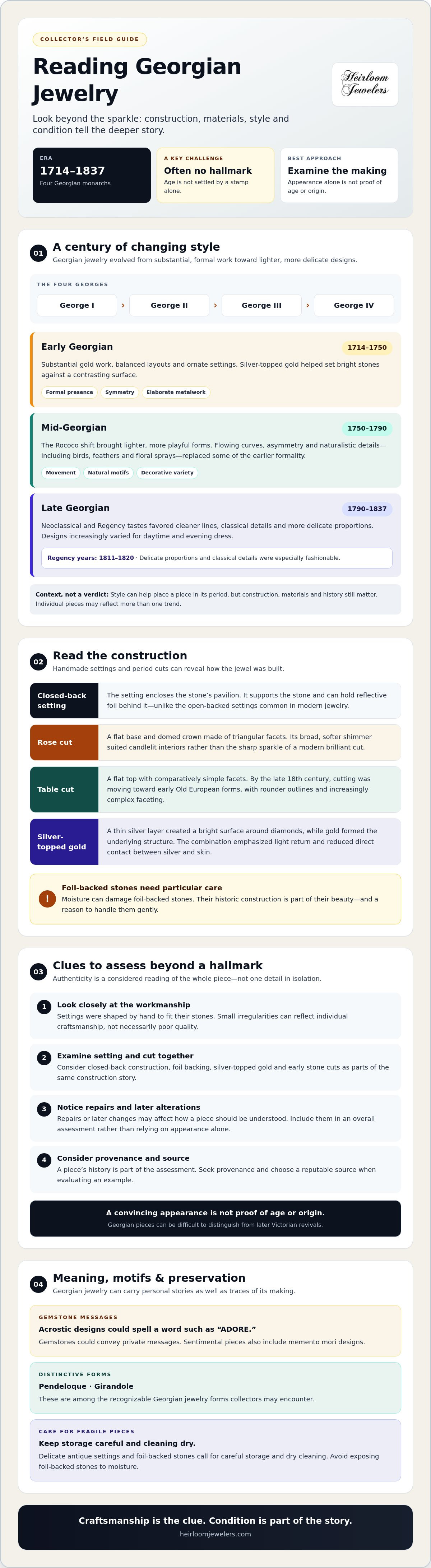
Georgian era jewelry was made during a period of changing tastes and craftsmanship, from 1714 to 1837. The name refers to the reigns of George I, George II, George III, and George IV, though the era continued beyond George IV’s death. This Georgian era saw jewelry move from substantial, formal designs toward lighter pieces shaped by classical influence. These broad shifts help collectors place a style in context, but individual pieces can reflect more than one trend.
Early Georgian jewelry, from 1714 to 1750, often favored substantial gold work, balanced layouts, and ornate settings. Mid-Georgian designs, from 1750 to 1790, brought greater movement and decorative variety. In the late period, from 1790 to 1837, Neoclassical and Regency tastes encouraged cleaner lines and more delicate proportions.
Baroque Beginnings and Rococo Whimsy
In the early 18th century, jewelers created substantial pieces using gold and silver-topped gold settings, which set bright stones against a contrasting surface. Symmetry was common, while elaborate metalwork gave jewelry a formal presence. As tastes changed, designs drew more freely on nature, with birds, feathers, and floral sprays appearing in decorative compositions.
The Rococo shift of the 1750s brought lighter, more playful jewelry, favoring flowing curves, asymmetry, and naturalistic ornament over rigid formality. The Grand Tour, an educational journey through Europe that exposed travelers to classical art and antiquities, also helped shape collectors’ interest in historical motifs. Together, these influences made mid-Georgian jewelry more varied in both silhouette and subject.
The Neoclassical Shift and the Regency Era
Interest in classical antiquity grew after the excavations at Pompeii began in 1748. Jewelers adapted ancient forms and imagery into designs featuring urns, laurel wreaths, and cameos. These motifs offered a more restrained alternative to the ornate decoration of earlier decades.
By the late Georgian period, jewelry was increasingly designed with the occasion in mind. Lighter “day jewelry” suited daytime dress, while more elaborate “night jewelry” added ornament for evening. During the Regency years, from 1811 to 1820, delicate proportions and classical details became especially fashionable. These designs helped set the stage for later vintage engagement rings, with settings that emphasized the central stone and refined metalwork.
For collectors, these distinctions offer useful context, not a standalone authentication test. A piece’s construction, materials, and history still matter. The period’s changing styles show why Georgian jewelry is best understood as a long evolution rather than one fixed look.
Rose Cuts and Foil Backs: Technical Mastery of the 18th Century
Georgian era jewelry was made by hand, before standardized settings and modern cutting equipment. Each mount was shaped to fit its stones, so small irregularities may reflect individual workmanship rather than poor quality. Jewelers often used closed-back settings, which enclose the stone’s pavilion, unlike the open-backed settings common in modern jewelry. These designs supported the stone and could accommodate reflective foil behind it.
Silver-topped gold offered both a practical and visual advantage. A thin silver layer created a bright, pale surface around diamonds, while gold formed the underlying structure. This combination helped emphasize a diamond’s light return and reduced direct contact between silver and skin. For additional context on period techniques and materials, the Victoria and Albert Museum’s history of 18th-century jewelry discusses the craft traditions behind these settings.
Artisanal Gemstone Cuts: Rose and Table
A rose-cut stone has a flat base and a domed crown formed by triangular facets. Unlike a modern brilliant cut, it doesn’t rely on a deep pavilion to return light. Its broad, softer shimmer suited candlelit interiors, where it could give a jewel a gentle glow rather than a sharp, intense sparkle. Table cuts, with a flat top and comparatively simple facets, were also used during the period. By the late 18th century, cutting was moving toward early Old European forms, with more rounded outlines and increasingly complex faceting.
These historic cuts were shaped to suit the stones and settings available at the time. Their proportions and facet patterns can differ from those of later pieces. When comparing a stone, look at its outline and arrangement of facets, but treat those features as clues rather than proof of age. You can also explore how cutting traditions appear in antique diamond earrings.
The Art and Risk of Foil-Backing
Foil placed behind a gemstone acted as a reflector, intensifying its apparent color and brilliance in the warm, low light of candles and oil lamps. Colored foil could also give a clear or pale stone the appearance of a rarer colored gem. The effect depended on the foil remaining dry and intact.
Moisture is a serious risk. Water can damage the foil behind a stone, causing it to darken or lose its reflective effect. Never submerge foil-backed jewelry or clean it with liquid. Use a soft, dry cloth or brush, and seek knowledgeable advice before any treatment that could affect the setting.
Pinchbeck, a copper-and-zinc alloy developed to imitate gold, gave jewelers another way to create decorative pieces at a more accessible level. Its presence is a material clue, not proof of a piece’s date by itself. Collectors comparing historical craftsmanship with authenticated estate jewelry can explore Heirloom Jewelers’ curated vintage and estate pieces.
Sentiment and Symbolism: Acrostic Rings and Memento Mori
Georgian era jewelry could carry a message as well as ornament its wearer. Gemstones, flowers, miniature portraits, and mourning motifs helped express affection, remembrance, or personal loss. The meaning was not always obvious at a glance. For collectors, understanding these visual clues adds another layer of context, though symbolism can vary by piece and period.
Memento Mori and Mourning Jewelry
Mourning jewelry acknowledged mortality and kept the memory of a loved one close. Some pieces used skulls or crossbones to make death explicit; others bore inscriptions such as “In Memory Of,” sometimes set in enamel. Human hair could be woven or arranged beneath glass in rings and brooches. These objects weren’t simply expressions of fear. They could also celebrate a life and preserve a deeply personal connection. This distinction remains useful when considering heritage jewelry.
The Language of Flowers and Gemstones
Flowers and gems offered a quiet vocabulary for sentiment. A pansy could suggest thoughts, while a forget-me-not conveyed remembrance. Acrostic jewelry used the first letters of gemstone names to spell a word. In a ring spelling “ADORE,” for example, each stone represented a letter, turning a gem arrangement into a discreet declaration. “DEAREST” offered another intimate message.
Gem-set Giardinetti rings, meaning “little garden,” arranged colorful stones as miniature bouquets. The floral design made the ring both decorative and expressive. Georgian conventions also informed later sentimental designs, a connection collectors can trace through the history of antique rings.
Portraits and Metalwork with Meaning
Lover’s Eye miniatures brought intimacy into jewelry through a painted image of a person’s eye, often framed as a small pendant, brooch, or ring element. The identity could remain private, making the image feel personal to its giver and recipient. These miniatures are now among the more distinctive forms associated with Georgian sentiment.
By the 1820s, techniques such as cannetille and repoussé added texture and dimension to goldwork. Cannetille used fine gold wire shaped into elaborate scrolls and coils; repoussé formed raised designs by working metal from the reverse. These details show how craftsmanship served emotion as well as appearance. For today’s collector, a jewel’s inscription, motif, and workmanship can offer clues to its intended meaning, but they should be considered alongside its materials, construction, and provenance.
How to Spot Authentic Georgian Jewelry: Hallmarks and Construction
A missing hallmark doesn’t automatically make a piece false. Georgian gold was not subject to the same consistent hallmarking expectations collectors may associate with later jewelry, so construction and provenance deserve close attention. No single feature proves a piece’s age. Look for several clues together, and have valuable or fragile jewelry assessed by a qualified specialist.
Start with the workmanship. Hand-sawed edges, slightly irregular stone shapes, and settings fitted closely to individual gems can reflect hand fabrication. Compare components across the piece: a Georgian setting paired with a much newer clasp or replacement stones may indicate a “marriage” piece, assembled from elements of different dates. That doesn’t make it without merit, but the alteration should be understood and disclosed.
The Anatomy of the Setting
Examine the setting without bending or prying at it. Hand-carved details may show subtle variation, while repeated, identical elements can suggest die-struck production or later replacement. Neither appearance alone establishes a date. S-links and C-clasps can be consistent with older construction, but clasps are easily replaced, so treat them as supporting clues rather than proof. Visible solder may point to a repair; even lead solder, if present, cannot reliably date the entire piece. Avoid handling suspected solder and leave close examination to a specialist.
Georgian settings often have an individually worked, stone-led character. By contrast, the crisp geometry and repeated forms associated with Art Deco jewelry reflect a very different design language. Style can help frame an assessment, but construction and provenance carry more weight than resemblance alone.
Common Pitfalls for New Collectors
Weight and feel can prompt questions, but they aren’t reliable tests of age or gold content. Georgian jewelers commonly used high-carat gold, often 18ct or higher, yet density varies with alloy composition and a piece’s construction. Don’t judge authenticity by heft alone. Likewise, polishing can erase fine surface detail and patina, the gradual character developed through age and handling. A bright finish does not prove a piece is new, and patina by itself does not prove it is old.
“Bloomed gold” describes a soft, matte surface effect associated with gold-rich finishes, rather than a separate metal or a guarantee of Georgian origin. Because restoration and later alterations can complicate identification, consider the whole object: its setting, joins, wear, materials, and available history. For a closer look at authenticated estate jewelry, explore Heirloom Jewelers’ curated estate pieces.
Curating and Caring for Your Georgian Treasures
Georgian era jewelry rewards careful handling. Its closed-back settings and foil-backed stones were made for a different world of wear and care, and moisture can irreversibly darken or damage the foil. Never submerge these pieces, and keep them away from liquids, including jewelry cleaners and perfume. For routine dusting, use a soft, dry cloth or a gentle, dry brush. Don’t polish aggressively; preserving the original surface and patina matters more than making an old jewel look new.
Preservation Techniques for 200-Year-Old Art
Store each piece separately in a dry place with stable conditions. Avoid high humidity, which can contribute to oxidation, and don’t let stones or settings rub against other jewelry. If you wear a Georgian ring alongside a modern 18K white gold piece, take care that the pieces don’t strike or scrape one another. Remove fragile jewelry before washing, exercising, or applying cosmetics.
Choose a jeweler experienced with antique construction, foil-backed stones, and historic settings before arranging cleaning or repairs. A general repair shop may not be familiar with these vulnerabilities. For a valuable estate piece, seek a professional appraisal and ask what evidence supports its date, materials, condition, and provenance. After frequent wear, an annual condition check by a jeweler can help identify loose components before they become a greater concern.
Building a Heritage Collection
Collectors can begin with a form that suits their interests, such as a brooch or lace pin, rather than pursuing a particular era or stone at any cost. Georgian pieces are scarce in part because some were altered, dismantled, or melted down in later periods. That scarcity can contribute to collector interest, but rarity alone doesn’t guarantee future value. Condition, originality, documented history, and quality all matter.
Owning a jewel made before industrial production became widespread offers a tangible connection to hand craftsmanship and the tastes of its time. Look for a reputable source that clearly explains what is known about a piece and where uncertainty remains. Heirloom Jewelers specializes in authenticated, high-value pre-owned fine jewelry, including curated estate and vintage pieces. To explore its collection, browse authenticated estate jewelry.
Carry Georgian Craftsmanship Forward
Georgian era jewelry is more than a record of changing taste. Its hand-built settings, expressive gemstones, and intimate symbolism reveal how craftsmanship and personal meaning came together before industrial production reshaped the trade. Recognizing the era’s shifting styles can help place a piece in context, while careful attention to construction, condition, and provenance supports more informed collecting.
Preservation is part of that responsibility. Keep fragile pieces dry, store them separately, and seek knowledgeable assessment before cleaning or repair. These thoughtful habits help protect historic workmanship for the next generation.
Heirloom Jewelers connects modern collectors with authenticated vintage and estate jewelry, including distinctive old European cut diamond earrings and vintage platinum engagement rings. Explore the curated collection of authenticated estate jewelry to find a piece whose history speaks to you. Browse the collection and discover a jewel that suits your interest in historical craftsmanship.
Frequently Asked Questions
Is Georgian jewelry safe for everyday wear?
Usually, Georgian jewelry is better reserved for occasional wear than daily use. Many pieces have delicate, hand-fabricated settings, closed-back construction, or foil-backed stones that can be vulnerable to impact, moisture, and wear. Before wearing a piece, consider its condition and ask a jeweler familiar with antique construction to assess it. Remove it before washing, exercising, or applying cosmetics, and store it separately to reduce the risk of damage.
What is the difference between Georgian and Victorian jewelry?
Georgian jewelry dates from 1714 to 1837, while the Victorian era followed, from 1837 to 1901. Georgian pieces were typically made by hand and may feature closed-back settings, foil-backed gems, and early diamond cuts. Victorian jewelry spans a longer period, so its styles vary, but it reflects later tastes and developments in jewelry making. A style resemblance or a single clasp detail cannot establish a date on its own.
Why is Georgian jewelry often foil-backed?
Foil placed behind a gemstone reflected light through the stone, enhancing its apparent color and brilliance in candlelit interiors. Colored foil could also make a clear or pale stone appear to have a richer hue. This technique has a preservation risk: moisture can damage the foil and cause the stone to darken or lose its reflective effect. Keep foil-backed Georgian era jewelry dry and avoid liquid cleaners, soaking, and ultrasonic cleaning.
Can you clean Georgian jewelry with an ultrasonic cleaner?
No. An ultrasonic cleaner can expose fragile stones and settings to vibration, and liquid can damage foil backing. Avoid soaking, steam, household cleaners, and polishing compounds unless an experienced specialist has confirmed they’re safe for that specific piece. For light surface dust, use a soft, dry cloth or a gentle, dry brush without pressing on the stones. If the jewelry needs more than gentle dry cleaning, ask a specialist before proceeding.
What are the most common gemstones used in the Georgian era?
Diamonds were important, often in rose cuts or other early hand-cut forms, and jewelers also used colored gemstones and paste, a type of glass made to imitate gems. Paste pieces are collected for their craftsmanship and historical character, not simply as substitutes for precious stones. The exact materials vary by jewel. Examine the setting and stone carefully, since appearance alone may not reveal whether a gem is natural, glass, or a later replacement.
How much does authentic Georgian jewelry typically cost?
Prices vary considerably with condition, materials, rarity, and provenance. Mozeris Fine Antiques’ January 2026 guide gives an approximate range from £500 for simpler paste pieces to more than £50,000 for examples with exceptional provenance. These figures are market context, not a valuation of any individual jewel. A professional assessment should consider the piece’s construction, originality, condition, and documented history before a collector makes a purchase.
Why is Georgian jewelry rarely hallmarked?
A missing hallmark doesn’t automatically mean a piece is inauthentic. Hallmarking practices were not consistent across the Georgian period, and gold hallmarks were not compulsory in the way collectors may expect from later jewelry. Authentication therefore relies on several clues, including construction, materials, setting style, wear, and provenance. A hallmark can provide useful evidence, but it should be considered alongside the whole piece rather than treated as the sole test of age.
What is Pinchbeck jewelry and is it valuable?
Pinchbeck is a copper-and-zinc alloy developed to imitate gold. It allowed jewelers to make decorative pieces with a gold-like appearance without using solid gold throughout. Its value depends on factors such as age, condition, workmanship, rarity, and collector interest. It shouldn’t be valued as gold based on color alone. For a suspected Pinchbeck piece, seek an assessment that distinguishes its material from its historical and artistic significance.