
Could a convincing hallmark still belong to a reproduction? A mark or period-inspired design can offer a clue, but neither settles the question. Learning how to authenticate vintage jewelry means weighing several kinds of evidence rather than relying on one promising detail.
It can be difficult to interpret hallmarks and maker’s marks, and online listings may include only a few photographs or limited documentation. Age, style, and materials can all support a vintage attribution, but none proves it alone.
This guide explains how to assess a piece’s apparent age, materials, construction, and supporting records. You’ll also learn what photographs and at-home inspection can reveal, where their limits lie, and when a closer evaluation may be useful. The goal is a considered purchase based on converging evidence, not a single mark or seller’s claim.
Key Takeaways
- Learn how to authenticate vintage jewelry by comparing design, construction, marks, and records instead of relying on a single clue.
- Distinguish a vintage attribution from proof of a piece’s history, and interpret age labels with care.
- Use listing details and clear photographs to review marks and condition before making an online purchase.
- Recognize how reproductions and antiqued finishes can resemble older pieces, and why context matters.
- Look for descriptions that clearly separate claimed age, materials, condition, and known alterations.
What Does It Mean to Authenticate Vintage Jewelry?
A piece can look old without having a documented history. Identifying an older object means recognizing features that may fit a period. Establishing its attribution means weighing whether those features support the claimed date, materials, maker, or origin. Even a well-supported assessment may not reveal who owned a piece or where it has traveled. Those details require separate evidence.
Authentication is the careful comparison of independent clues to assess whether a piece’s age, materials, construction, and claimed attribution are consistent with one another. This is more useful than searching for one decisive tell. It also applies to unsigned jewelry: a maker’s name can be helpful, but it isn’t the only way to assess a piece.
Vintage, antique, and estate: what each term tells you
“Vintage” and “antique” are generally age descriptions, while “estate” describes jewelry that has been previously owned. In common jewelry usage, vintage often refers to pieces at least 20 to 30 years old but less than 100 years old; antique commonly refers to pieces more than 100 years old. These are conventions, and usage can vary. Treat the label as a starting point, not proof of a specific date. The broad History of Jewellery offers context for changing forms and materials, but a general history cannot establish when an individual piece was made.
A seller may call a ring “estate” because it was previously owned, without claiming it comes from a particular era. A “vintage-style” description may refer to newer jewelry designed to evoke an earlier period. Keep the category separate from the evidence: identify what the label means, then consider whether the piece’s details and available records support the claim. An age category describes the claim being made, not how it was established.
Why one clue cannot authenticate a piece
A mark can point toward a metal, maker, or period, but its meaning depends on context. Marks can be difficult to read, and a mark alone doesn’t establish that the rest of the piece is original. Patina may be consistent with age, yet wear varies with handling and storage. Likewise, a design inspired by a historical period can appear on a much newer piece.
Construction offers useful context, but alterations can complicate the picture. A setting could have been repaired, a stone replaced, or a component added later. That doesn’t automatically make the entire piece inauthentic; it means the description should distinguish original elements from later work when that information is known. Look for consistency across the whole object rather than letting one feature outweigh contradictions elsewhere.
For anyone learning how to authenticate vintage jewelry, an initial inspection is best treated as a way to form better questions. It can reveal details that support an attribution and gaps that call for closer review. On its own, it may not establish provenance, or a documented history of ownership. The next step is to organize the available evidence and compare each clue with the others.
How to Assess Vintage Jewelry: Build an Evidence-Based Picture
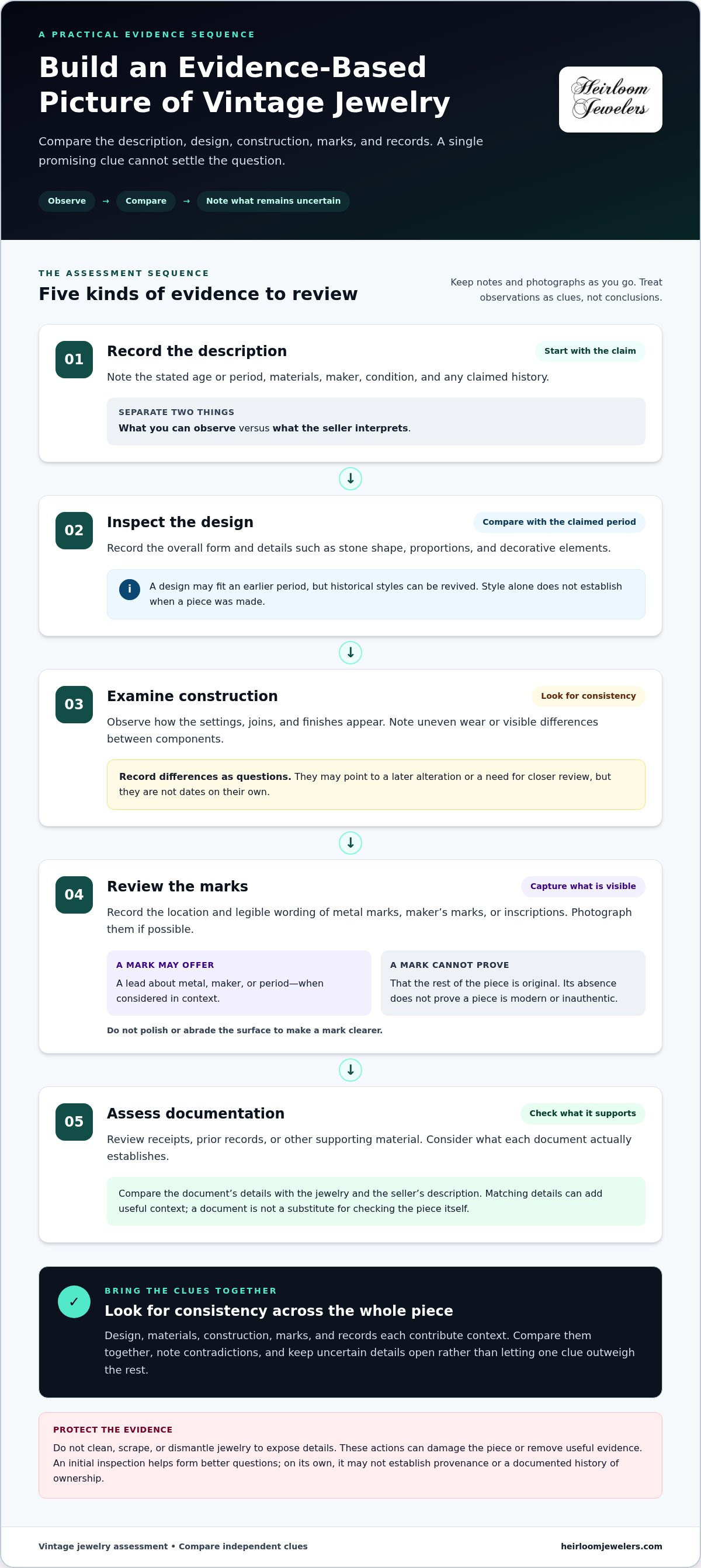
A useful assessment follows a sequence, rather than starting and ending with a hallmark. Begin with the seller’s exact claim, then record what you can observe and what remains uncertain. Keep notes and photographs for comparison. Don’t clean, scrape, or dismantle the jewelry to expose details; those actions can damage the piece or remove useful evidence.
- 1. Record the description. Note the stated age or period, materials, maker, condition, and any claimed history. Separate direct observations from the seller’s interpretations.
- 2. Inspect the design. Record the overall form and details such as stone shape, proportions, and decorative elements. Consider whether they fit the claimed period, while remembering that historical styles can be revived.
- 3. Examine construction. Observe how settings, joins, and finishes appear. Note uneven wear or visible differences between components. These details may point to questions for closer review, but they aren’t dates on their own.
- 4. Review the marks. Record the location and legible wording of metal marks, maker’s marks, or inscriptions. Photograph them if possible, without polishing or abrading the surface.
- 5. Assess documentation. Review any receipts, prior records, or other supporting material. Note what each document actually establishes and whether its details match the jewelry and description.
Inspect design, materials, and construction
Compare the piece’s features with the claim as a whole. For example, consider a platinum ring’s setting and finish alongside its described materials and apparent wear. Old European cut diamond earrings offer another example: the cut may be consistent with an older style, but it can’t establish when the earrings were made. Treat each observation as one part of the assessment.
Pay attention to transitions between components. Do they appear consistent with one another, or does one element look notably different in finish or wear? A difference could reflect a later alteration, but visual inspection alone may not explain when or why it occurred. Record it as a question rather than turning it into a conclusion.
Read marks and review provenance carefully
Metal marks may indicate a claimed composition, while a maker’s mark or inscription may offer a lead about authorship or history. Marks can be worn, copied, altered, or absent. Their presence needs context, and their absence doesn’t prove a piece is modern or inauthentic. Capture exactly what is visible, including any uncertainty, rather than guessing at a faint character.
Receipts and prior records can add useful context, especially when their descriptions correspond closely to the piece. A seller’s account is also part of the record, but neither should be treated as conclusive on its own. Consistent, independent clues strengthen an attribution; contradictions signal where more evidence is needed. This is the practical core of how to authenticate vintage jewelry: compare the details, weigh their limits, and keep open questions visible.
For reference, Heirloom Jewelers’ authenticated vintage jewelry includes categories such as platinum diamond rings and old European cut diamond earrings, showing how materials and design details can be described together.
Authentic Vintage Jewelry or a Lookalike? Clues That Need Context
A period-inspired silhouette can appear on an older piece, a later reproduction, or newer jewelry with an antiqued finish. The useful question isn’t whether one detail “looks vintage,” but whether the design, construction, marks, wear, and available records tell a consistent story. The comparison below offers prompts for review, not a verdict. Any one feature can have more than one explanation.
| Clue | Period-consistent piece | Reproduction | Newer piece with an antiqued finish |
|---|---|---|---|
| Design | Features may align with the claimed era, though styles can persist or return. | May closely echo an earlier form, with details that differ on closer comparison. | May borrow recognizable period motifs while using a contemporary overall design. |
| Construction | Settings, joins, and finish may appear consistent with the piece’s stated context. | May reproduce an older construction style, so no single detail settles its age. | May show a more uniform finish, but that appearance alone doesn’t establish when it was made. |
| Marks | Marks may support a materials or maker claim when interpreted in context. | May have marks, altered marks, or none; compare them with other evidence. | May carry accurate material marks without being vintage. |
| Wear | Wear may fit a history of use, but varies with handling and storage. | May show use or deliberate aging; neither confirms nor disproves an attribution. | Surface changes may be intentional or acquired later. |
| Records | Earlier descriptions or records may support the claim if details correspond. | Documentation may be incomplete or unrelated to the specific piece. | Recent records may identify materials or sale, not necessarily age. |
Reproductions and vintage-inspired designs
A reproduction can imitate a particular period, and newer jewelry can borrow historical details without claiming to be old. Modern production doesn’t always announce itself through an obvious feature. Compare the whole piece with reliable references for the claimed era, including its proportions and construction, rather than relying on a familiar motif. If details don’t align, record the difference as a question, not proof of a fake.
Patina, repairs, and replaced components
Surface changes and wear can result from use, storage, cleaning, or later treatment. They don’t provide a dependable date by themselves. A repaired setting or replacement stone may complicate a piece’s history without disproving its age. Note which components appear uncertain and whether the description addresses alterations. A difference in finish isn’t conclusive evidence either way.
Photographs can reveal details worth comparing, but lighting, angle, and image quality can obscure them. Don’t declare a piece genuine or fake from a listing image or isolated mark. A sound approach to how to authenticate vintage jewelry compares clues and looks for both agreement and contradiction. When the evidence remains unclear, preserve the uncertainty rather than forcing a definitive label.
What You Can Check Safely Before Buying Vintage Jewelry
A careful pre-purchase review can help you spot gaps in a listing and decide whether the available evidence is enough for your comfort. Keep the process observational. Compare the seller’s claims with what’s visible, but avoid tests that could mark, loosen, or otherwise alter the piece.
A practical checklist for an in-person or online review
- Match the description to the object. Compare the stated age, materials, maker, and design with the details you can see. Notice whether the seller distinguishes a confirmed fact from an estimate or attribution.
- Review photographs closely. Look for clear views of the entire piece, the front and back, settings, joins, marks, and areas showing wear. For an online listing, important details should be visible in sharp close-ups, not blurred, hidden, or missing.
- Check condition and consistency. Note visible damage, loose-looking components, differences in finish, and any parts that appear to have been replaced. These are observations to clarify, not proof of a particular age.
- Read accompanying records. Compare any receipt or prior description with the item itself. Check whether the record refers to this specific piece and what it actually supports.
- Write down questions. Keep a short record of details that match, details that conflict, and information you can’t verify. Don’t clean, scratch, heat, or dismantle the jewelry to investigate it.
Photographs have limits. Lighting, focus, and camera angle can make a mark appear clearer or a surface look different than it does in person. If an important feature can’t be seen, treat it as unknown rather than filling the gap with an assumption. That discipline is central to how to authenticate vintage jewelry without putting the piece at risk.
When specialist assessment adds useful evidence
A closer assessment may be useful when the piece’s materials, construction, marks, or alterations are difficult to interpret, or when the purchase decision depends on a more confident attribution. A thorough review considers those features together and explains where the evidence aligns or remains uncertain. That gives you a stronger basis for judgment than photographs or a brief listing description alone.
Keep the scope clear. An opinion about a piece’s age or attribution is not the same as a complete, documented ownership history. Records can support parts of the account, but they may not establish every stage of a piece’s past. Documentation supports an assessment, but it should always be read alongside the object.
When you’re ready to compare carefully described examples, explore authenticated vintage and estate jewelry from Heirloom Jewelers.
Buying Authenticated Vintage Jewelry With Greater Confidence
A considered purchase begins with a clear claim. Before deciding, identify what the description says about the piece’s age, materials, and history. Compare it with the jewelry itself, review any supporting records, and weigh its condition and known alterations. If important details remain unclear, pause. A calm decision is more useful than forcing certainty from incomplete evidence.
A clear description should distinguish what is observed from what is attributed or documented. For example, a seller may identify a metal or describe a design directly, while dating a piece to a particular period may be an attribution. Records can support details, but their scope matters. Look for distinct information about:
- Age: Is the date presented as established, approximate, or a period attribution?
- Materials: Which metals and stones are identified, and what supports those descriptions?
- Condition: Are wear, damage, and visible repairs described plainly?
- Alterations: Are replaced stones or other known changes disclosed?
Questions to resolve before choosing a piece
Consider which details you can observe, which reflect the seller’s interpretation, and which are supported by records. Weigh condition and disclosed alterations alongside design and age. A later replacement component may affect originality without necessarily changing the age attribution for the entire piece. The aim isn’t to eliminate every uncertainty, but to understand what is known and decide whether the remaining questions matter to you.
Use the same measured approach whether you’re considering a ring or a pair of earrings. If period context would help you understand a ring’s design, Heirloom Jewelers’ antique rings collector’s guide offers additional background. Historical context can deepen appreciation, though it cannot establish the history of an individual piece.
Explore curated estate and vintage jewelry
Heirloom Jewelers is a specialist retailer of curated, authenticated estate and vintage fine jewelry. The collection includes vintage platinum diamond rings and old European cut diamond earrings, alongside estate gemstone jewelry. These examples show how a clear description can bring together a piece’s category and defining details without asking one visual feature to carry the whole attribution.
Keep your final decision grounded in the evidence available and your appreciation of the piece. Knowing how to authenticate vintage jewelry means understanding both what the clues support and where their limits remain. Explore Heirloom Jewelers’ curated estate and vintage jewelry with a clearer sense of the questions that matter to you.
Choose a Piece With a Story You Can Appreciate
Let the evidence guide your choice, but leave room for personal connection. The right vintage piece is not only one whose description you understand. It’s one whose design, condition, and history you can appreciate with clear eyes. If a detail remains uncertain, decide whether that uncertainty changes how you feel about the piece before moving forward.
Learning how to authenticate vintage jewelry can make the search more thoughtful. Explore Heirloom Jewelers’ curated, authenticated estate and vintage fine jewelry, including platinum diamond rings and old European cut diamond earrings, with a clearer sense of the questions that matter to you.
Explore authenticated estate and vintage jewelry and discover a piece whose character feels right for you.
Frequently Asked Questions
Is a hallmark enough to prove that vintage jewelry is authentic?
No. A hallmark is one piece of evidence, not a complete authentication. It may identify a metal or maker, but it doesn’t by itself establish when the whole item was made or whether every component is original. Marks can be worn, copied, altered, or difficult to interpret. Compare the mark with construction, materials, design, and records that refer to the specific piece.
Can vintage jewelry be authentic if it has no hallmark?
Yes. An absent or unreadable hallmark doesn’t establish that jewelry is modern or inauthentic. A mark might be faint because of wear, hard to see because of where it was placed, or affected by later work. For example, a photograph may not show an interior surface clearly. Consider other available evidence, but don’t treat an unmarked appearance as a definitive date without closer assessment.
How can I tell whether vintage jewelry has been repaired or altered?
Differences in a setting, finish, component, or pattern of wear may prompt questions about later work, but appearance alone can’t confirm when a change occurred. A replacement stone or repaired setting can coexist with a genuinely older piece. Record what looks different and compare it with the seller’s description. If originality affects your decision, rely on qualified interpretation rather than attempting to remove or test a component yourself.
What documents help support the authenticity of vintage jewelry?
Depending on the piece, useful records may include an earlier receipt, appraisal, gem report, or ownership record. Check whether the document identifies the specific item through details such as its description, materials, or images, rather than simply referring to jewelry in general. Records can add context, but they don’t independently prove a complete ownership history. An authentic vintage piece may have little or no surviving paperwork.
Can vintage jewelry be authenticated from photographs alone?
Photographs can support an initial review of design, visible marks, and condition, but they show only what the camera captures. They may not reveal how a setting is constructed or confirm materials. For anyone learning how to authenticate vintage jewelry, clear images of the front, back, marks, and areas of concern are most useful. Treat an image-based impression as preliminary, especially if focus, lighting, or angles obscure details.
Does a designer's signature guarantee that vintage jewelry is genuine?
No. A signature or maker’s mark is relevant evidence, but it can be copied, altered, or misread. Consider whether the mark’s appearance fits the jewelry and whether its design, construction, and available records support the same attribution. A signature on a box or accompanying document may not establish that it belongs to the specific piece. Don’t rely on a name alone to settle authenticity.