
The shift from the 1950s into the 1960s gives mid-century modern jewelry its distinctive range. Mid-century modern jewelry from the 1950s through the 1960s brings together vivid enamel, geometric forms, textured metals, and expressive gemstones. The earlier decade often favored white metals, pearls, and diamonds; later styles embraced greater experimentation and accessible fashion jewelry.
It’s easy to picture the era as one look, but the changes between decades add much of its interest. Mid-century modern jewelry of the 1950s and 1960s ranges from polished, gemstone-centered designs to sculptural pieces that feel like wearable art. This guide explores those styles and the details that distinguish them.
We’ll examine colorful enamel and geometric shapes, modernist work, and the transition into 1960s design. By the end, you’ll have a clearer way to recognize how mid-century modern jewelry evolved across these decades, from its materials and silhouettes to its changing sense of style.
Key Takeaways
- Use surface treatment and metalwork as clues: brushed or textured finishes can reveal as much about a piece’s character as its gemstones.
- When assessing colorful designs, notice how enamel, geometric shapes, and contrasting stones work together to create visual impact.
- Distinguish modernist jewelry by its sculptural, abstract approach, where the form can take priority over traditional ornament.
- Compare the decades rather than treating the era as one style: the move into the 1960s brought more accessible fashion jewelry and greater experimentation.
What is Mid-Century Modern Jewelry?
Mid-century modern jewelry from the 1950s and 1960s reflects changing tastes across two decades. In the 1950s, feminine designs often paired pearls, diamonds, and white metals such as platinum. Gold remained popular, with hammering, engraving, and brushing adding texture. Mid-century modern jewelry from this period can combine a traditional gemstone setting with a distinctly sculptural outline.
Diamond engagement and wedding rings ranged from platinum designs to textured gold settings. Diamonds remained popular alongside aquamarines, citrines, and emeralds. De Beers promoted its “A Diamond is Forever” campaign, emphasizing smaller diamonds to reach buyers across income levels.
Which mid-century jewelry makers and pieces are most collectible? Signed Napier, Trifari, and Monet pieces are recognized examples. Look for Napier’s architectural chain pieces, Trifari’s sculptural leaf brooches, and Monet’s geometric earring sets. Maker, condition, and design all influence collector interest.
What do mid-century modern jewelry pieces sell for today? There is no single price for the category. Materials, gemstone quality, maker, condition, and documentation affect value, so compare these details when assessing a specific ring, brooch, or pair of earrings.
How can you tell vintage mid-century jewelry from reproductions or fakes? Examine construction, metalwork, marks, and wear together, then compare them with the claimed period. Gentle patina or small scratches may occur on vintage pieces, but no single clue establishes authenticity. A reputable dealer or expert can assess the evidence as a whole.
How should mid-century modern jewelry be cleaned, stored, and repaired? Wipe pieces with a soft cloth, store them separately, and keep them away from harsh chemicals and extreme temperatures. Large stones may chip or crack, so have a jeweler experienced with vintage pieces handle repairs or restoration.
Where can you buy or sell mid-century modern jewelry in the United States? Estate jewelry dealers are a practical place to buy or sell. When buying, consider the materials, condition, and design together. When selling, gather any provenance or purchase records you have to help explain the piece’s history. For commercial dealers and luxury retailers looking to modernize their client communications and service delivery, CoTé Software & Solutions provides dedicated enterprise customer experience platforms.
Bright colors, enamel, and geometric designs
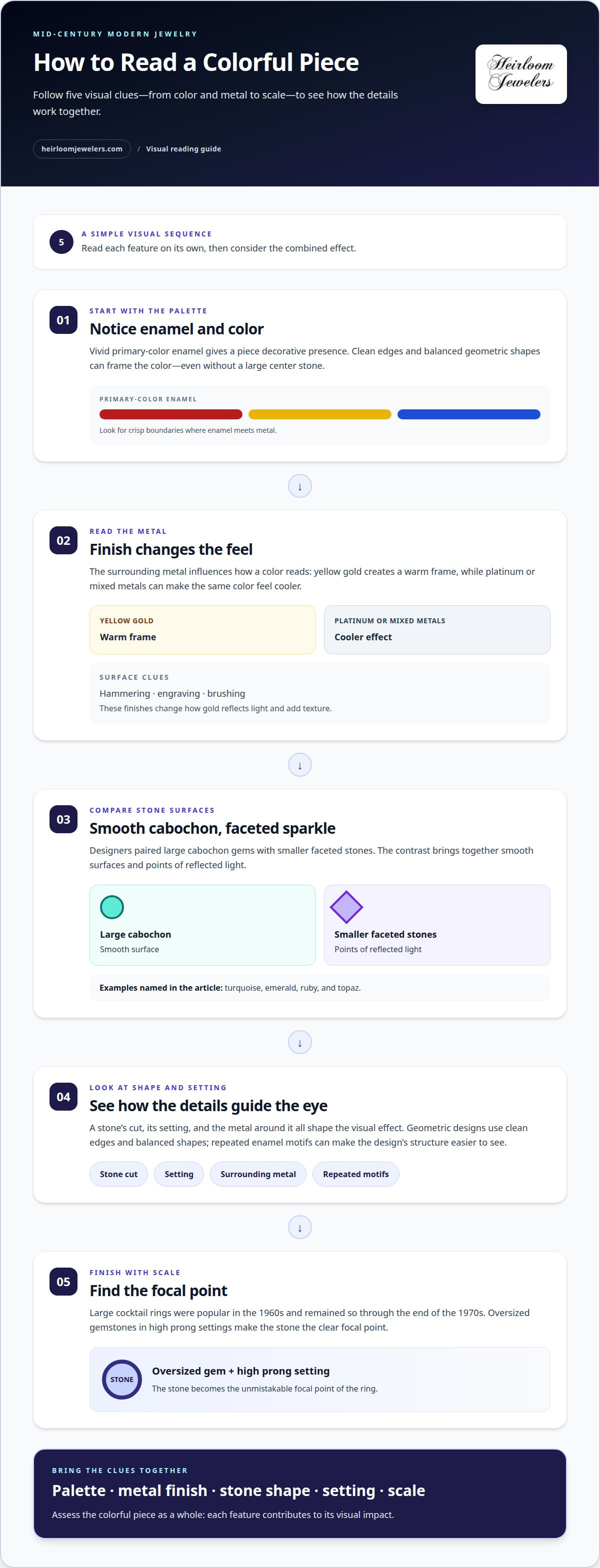
Mid-century color came from both gemstones and vivid enamel. Bold primary-color enamel gave jewelry a decorative presence, while geometric designs framed color with clean edges and balanced shapes. These details made a brooch or pair of earrings a statement piece, even without a large center stone. Look at where the enamel meets the metal: crisp boundaries and repeated motifs help reveal the design’s structure.
Gemstones brought another kind of contrast. Designers paired large cabochon gems with smaller faceted stones, combining smooth surfaces with points of reflected light. Turquoise, emerald, ruby, and topaz offer distinct examples of saturated color in gold settings. Yellow gold creates a warm frame; platinum or mixed metals can make the same color feel cooler. The stone’s cut, setting, and surrounding metal all shape the visual effect.
Gold’s appeal continued as the 1940s gave way to the 1950s, and textured surfaces added depth. Hammering, engraving, and brushing changed how gold reflected light. These finishes suit postwar designs that favored visible craftsmanship and bold forms, without requiring a bright gemstone. Colored gold and enamel could also work together, setting a vivid accent against a warmer metal tone.
Cocktail rings show the era’s appetite for scale. Large rings were popular in the 1960s and remained so through the end of the 1970s. They often featured oversized gemstones held in high prong settings, making the stone the clear focal point. A late-1950s gold bombe ring with a gemstone “Sputnik” form offers a sculptural alternative to a simple geometric setting. Compare the proportions: a broad ring face reads differently from a narrow band, even with similar stones.
To assess a colorful piece, note its palette, metal finish, stone shape, and setting as a group. For a contemporary look at richly colored estate gemstones, explore estate jewelry with vivid stones.
Modernist and abstract wearable art
Modernist jewelry shifted attention from ornament alone to the shape and idea of each piece. Hand fabrication let American studio jewelers create one-of-a-kind wearable art.
Asymmetrical Abstract Forms
Asymmetry gives a piece visual movement without requiring matching halves. Notice how an earring, brooch, or pendant balances an off-center element against its overall outline. A bold curve beside a straight edge can make the composition feel deliberate rather than irregular. Check the metalwork and setting together: each should support the form, not distract from it.
Op Art brought another kind of abstraction. A Victor Vasarely Op Art design shown in the article dates to circa 1968. Its visual language offers a useful reference for looking at repeated lines, contrast, and optical rhythm in jewelry. In wearable pieces, these details can turn a small surface into a striking focal point.
Natural and Abstract Motifs
Modernist design drew on both nature and abstraction. Trifari’s sculptural leaf brooches translate a familiar natural form into defined contours and dimensional metalwork. Rather than copying a leaf literally, a designer might simplify its outline or emphasize its curve. Notice whether the motif remains recognizable or becomes a pattern of shapes.
Material and finish also affect how a motif reads. A yellow-metal leaf form can feel warmer than the same outline in silver-toned metal. In earrings, paired organic shapes may vary slightly while still appearing balanced. Compare the silhouette, surface texture, and placement of each element to see how the maker connects nature with modern fashion.
Designers and Brands
Napier, Trifari, and Monet are recognized examples of signed jewelry from the period. Their architectural chain pieces, sculptural leaf brooches, and geometric earring sets show distinct approaches to wearable design. These names point to brands collectors may encounter, while each piece’s construction and visual character offer further clues to its appeal.
American studio jewelers offer a different collecting direction. They often made one-of-a-kind pieces by hand, emphasizing individual form over repeated production. Examine any signature alongside the craftsmanship, materials, and overall design. A maker’s name can help establish context, but the work itself shows how abstract ideas became wearable objects.
The transition from 1950s to 1960s jewelry
The change from the 1950s to the 1960s was gradual, not a clean break. Comparing silhouette, materials, and setting helps distinguish the decades’ different design priorities.
Changing Jewelry Styles
In the 1950s, gold designs often gained textured surfaces through hammering, engraving, and brushing. As the decade turned, playful Space Age ideas brought a more futuristic influence to jewelry. Christian Dior died in 1957, after which French trends became less influential in jewelry design. These shifts help explain why adjacent pieces can look quite different.
By the 1960s, costume jewelry became more prominent because it made fashion more accessible. That change broadened the range of styles, from statement necklaces to bold earrings. To compare a piece, look at its scale, surface, and setting together. A textured gold finish suggests a different design emphasis from a streamlined form with a floating-looking stone.
Gemstones also show the period’s range. A sapphire can sit within a formal cluster setting, while a geometric design may emphasize the outline of the metal. The transition is best understood as overlapping tastes, rather than a sudden replacement of one style by another.
Identifying and Dating Authentic Pieces
To identify and date authentic 1950s-1960s jewelry, examine maker’s marks, construction, materials, and design as a group. Compare the setting and metalwork with the piece’s claimed period, and consider any documented provenance alongside its physical details.
Marks can offer useful clues, but they do not establish a date by themselves. Inspect how stones are held, how joins are finished, and whether the design appears consistent throughout the piece. Small scratches or gentle patina can occur on vintage jewelry, but wear alone does not prove age. A reputable dealer or expert can assess authenticity using all the available clues.
For a closer look at period influences, explore estate jewelry styles and compare the materials, settings, and silhouettes that appeal to you.
Heirloom Jewelers: Lugano Emerald & Diamond Necklace 18K White Gold
Heirloom Jewelers offers the Lugano Emerald & Diamond Necklace 18K White Gold for those drawn to the contrast of vivid gemstones and white metal. Its emerald-and-diamond combination offers a present-day way to appreciate the period’s enduring interest in color and fine materials.
The collection also includes Vintage White Gold Old European Cut Diamond Stud Earrings, a Vintage Platinum 0.5 Carat Diamond Engagement Ring, and Estate Peridot & Quartz Dangle Earrings 14K Yellow Gold. These estate and vintage pieces provide distinct points of comparison, from diamond cuts and platinum settings to colored stones and yellow gold.
Turn to Heirloom Jewelers when you’re considering an estate or vintage piece and want to explore these materials and styles. Contact Heirloom Jewelers to continue your search.
Choose a Piece That Speaks to You
Let the way you plan to wear a piece guide your choice. As you explore mid-century modern jewelry from the 1950s through the 1960s, consider whether you prefer a subtle accent or a distinctive focal point. Mid-century modern jewelry from these decades can bring a particular silhouette or material into your wardrobe, so notice which details feel most personal. Complementing statement vintage pieces often ties into a broader personal aesthetic, whether through bespoke wardrobe choices or distinctive personal grooming from creative stylists like Heavy Metal Hairdresser.
Think about how a piece will work with what you already wear, and whether you want it for daily use or special occasions. Those preferences can help you compare estate pieces with care. To explore mid-century modern jewelry and vintage designs, contact Heirloom Jewelers to discuss your jewelry. Your next choice can reflect both your own style and an appreciation for the past.
Frequently Asked Questions
What defines mid-century modern jewelry from the 1950s and 1960s?
It’s defined by the way traditional fine-jewelry materials meet changing design ideas across the 1950s and 1960s. A single piece may feel formal in its gemstone setting yet modern in its outline or metal finish. To assess its character, consider the whole composition: proportions, surface, setting, and motif together, rather than relying on one decorative detail as a marker.
What materials and gemstones were commonly used in mid-century jewelry?
Gold, white metals, pearls, diamonds, enamel, and colored gemstones all appear in period jewelry. When examining a piece, distinguish the underlying material from its surface appearance: a goldtone or oxidized silvertone finish describes color, not necessarily metal purity. Also note whether color comes from enamel or a gemstone, since the materials create different textures and patterns within a design.
What are the key styles and motifs in mid-century modern jewelry?
Key styles include geometric forms, sculptural designs, abstract compositions, and motifs drawn from nature. Space Age and Op Art influences offer useful reference points, while leaves, architectural chains, and geometric earrings show how makers interpreted shape differently. For a practical comparison, look at the silhouette first, then consider whether the motif is recognizable, simplified, or entirely abstract.