
The search for authentic vintage estate necklaces is driven by a desire for artistry that modern manufacturing rarely achieves. You likely value the character and history found in these pieces, but the secondary market presents unique challenges. It's common to feel hesitant when distinguishing a true antique from a clever reproduction. You might also find the technical differences between 14K gold, 18K gold, and platinum settings confusing when assessing the long-term value and durability of a potential heirloom.
To better understand these metallurgical standards, consulting with a long-standing specialist like bosjewelers.com can offer clarity on how different gold purities and diamond qualities impact the longevity of your collection.
This guide offers the professional insight required to select your next piece with absolute certainty and quiet confidence. As a dedicated curator of historical jewelry, we provide the tools you need to evaluate metallurgical standards, authenticate hallmarks, and understand the provenance of significant pieces. We will examine the investment potential of rare designer acquisitions, such as authenticated Lugano emeralds. This guide also provides a clear framework for choosing a necklace that serves as both a stylistic statement and a lasting legacy for your private collection.
Key Takeaways
- Distinguish between antique, vintage, and estate terminology to accurately identify the age and historical significance of your next acquisition.
- Identify the signature design elements of the Victorian and Edwardian eras, including romantic symbolism and refined platinum craftsmanship.
- Develop the skills to evaluate vintage estate necklaces by recognizing the unique brilliance of Old European Cut diamonds and high-purity metal settings.
- Learn to verify authenticity through a detailed inspection of maker’s marks, purity hallmarks, and traditional chain architecture.
- Discover why curated estate jewelry represents a sustainable and lasting investment compared to modern, mass-produced luxury items.
Understanding the Value of Vintage and Estate Necklaces
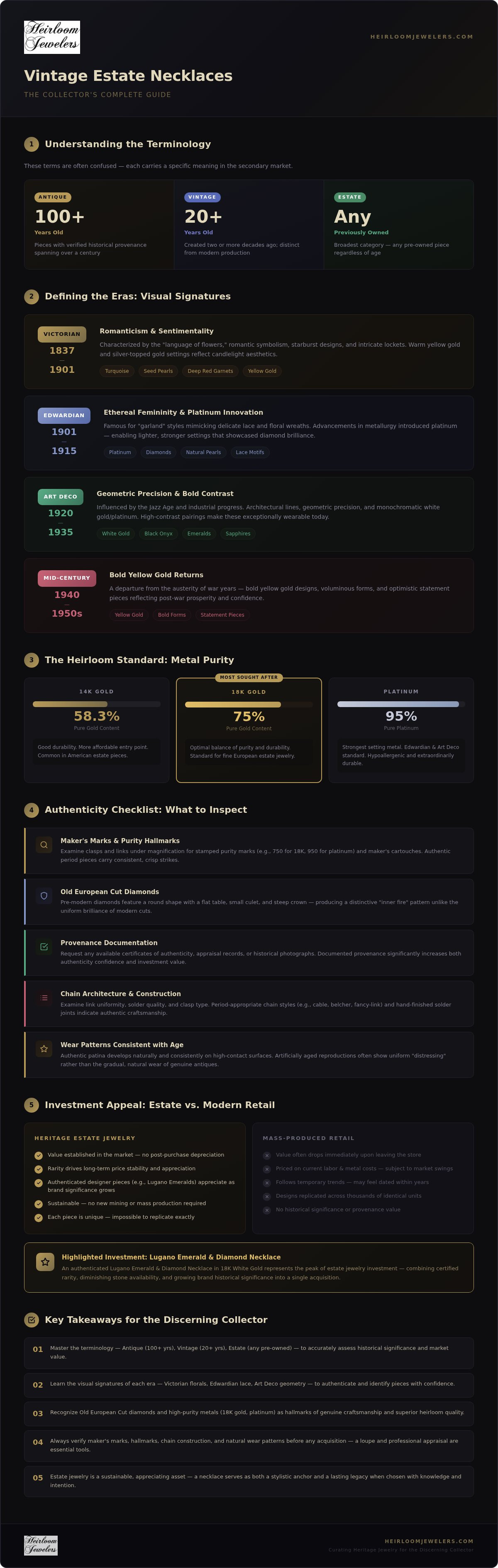
Identifying the correct terminology is the first step toward a successful acquisition. While these terms are often used interchangeably in casual conversation, they carry specific meanings in the secondary market. Antique jewelry refers to pieces at least 100 years old. Vintage items are those created 20 or more years ago. Estate jewelry is a broader category, encompassing any piece that was previously owned, regardless of its age. Understanding these distinctions helps you verify the historical context of your purchase.
Many collectors begin their journey with vintage estate necklaces because they offer exceptional versatility. Unlike rings, which require precise sizing, or earrings, which can be limited by weight or closure style, a necklace is easily integrated into any wardrobe. The value of these pieces often transcends the simple cost of the raw materials. While a modern piece is priced based on current labor and metal markets, a historical piece carries intrinsic value through its craftsmanship and rarity. Owning jewelry with a documented provenance creates a tangible connection to the past; it makes the acquisition feel like a stewardship rather than a simple purchase.
The Investment Appeal of Heritage Jewelry
Fine estate jewelry typically retains its value more effectively than mass-produced retail items. When you purchase a new piece from a high-street jeweler, the value often drops the moment you leave the store. Heritage jewelry has already established its place in the market. Rarity is a significant driver of this stability. You won't find these specific hand-crafted designs in modern malls. Authenticated designer pieces, such as a Lugano Emerald & Diamond Necklace in 18K White Gold, often see appreciation as the brand's historical significance grows and the availability of such rare stones diminishes.
Necklaces as a Stylistic Anchor
A well-chosen necklace serves as the focal point of an ensemble. It frames the face and provides a sense of completion to both formal and casual attire. Estate pieces often feature a statement aesthetic that contrasts sharply with the minimal, temporary trends found in modern retail. You don't have to save these treasures for evening galas. A vintage pendant or a classic chain can elevate daily luxury, bridging the gap between historical elegance and contemporary style. By selecting a piece with a classic silhouette, you ensure it remains relevant across changing seasons and personal style evolutions. For those interested in how modern jewelry designers are reimagining these classic aesthetics, you can find out more about contemporary luxury accessories.
Defining Eras: Choosing Your Vintage Aesthetic
Selecting a piece of history requires an eye for detail and an appreciation for the cultural movements that defined past generations. Each era offers a unique visual language, allowing you to find vintage estate necklaces that resonate with your personal style. Whether you prefer the intricate symbolism of the 19th century or the bold geometry of the 1920s, understanding these periods helps you make an informed choice.
Victorian Symbolism and Gemstones
The Victorian Era (1837-1901) is characterized by romanticism and deep sentimentality. Jewelry from this time often utilized the "language of flowers" to convey hidden meanings. A pendant might feature a specific floral motif to represent devotion or remembrance. Common gemstone pairings included turquoise, seed pearls, and deep red garnets. You will frequently find "starburst" designs and intricate lockets that served as personal keepsakes. These pieces were often crafted in warm yellow gold or silver-topped gold, reflecting the candlelight of the period.
The Edwardian Era (1901-1915) followed with a shift toward ethereal, feminine designs. This period is famous for "garland" styles that mimicked the appearance of delicate lace and floral wreaths. Because of advancements in metallurgy, jewelers began using platinum to create remarkably fine, strong settings. This allowed for lighter designs that emphasized the brilliance of diamonds and natural pearls without the weight of traditional gold settings.
Art Deco Geometry and White Gold
The Art Deco movement (1920-1935) marked a radical departure from the flowing curves of the past. Influenced by the Jazz Age and industrial progress, designers favored architectural lines and geometric precision. This era popularized the use of white gold and platinum to achieve a sleek, monochromatic look. High-contrast color palettes were also common, often pairing diamonds with black onyx, emeralds, or sapphires. The structural integrity of these designs makes vintage estate necklaces from this era exceptionally wearable for the modern collector. You can learn more about Jazz Age elegance in our Art Deco jewelry guide.
By the 1940s and 1950s, the Mid-Century and Retro periods introduced a return to bold yellow gold. These pieces reflected the glamour of Hollywood with large, colorful gemstones and sculptural metalwork. The designs were substantial and confident, offering a sense of optimism following the war years. If you value a piece that makes a clear stylistic statement, you may find that our curated collection of estate jewelry offers the perfect balance of history and presence.
Materials and Craftsmanship: The Heirloom Standard
The enduring appeal of vintage estate necklaces lies in the superior quality of their construction. In previous eras, jewelers operated with a level of patience and manual precision that modern mass-market production cannot replicate. These pieces weren't just assembled; they were engineered to last for centuries. When you evaluate an estate piece, you're looking at the intersection of metallurgical science and fine art. Understanding the specific materials used in these historical periods allows you to appreciate why a curated acquisition holds its value so effectively over time.
The Brilliance of 18K White Gold and Platinum
In the high-end secondary market, 18K white gold and platinum are the primary mediums for fine settings. 18K white gold is particularly prized for its high purity and bright, reflective finish. It's a hallmark of sophisticated estate jewelry because it provides the structural integrity needed for complex designs while enhancing the natural color of gemstones. It's often the preferred choice for detailed metalwork that requires a certain level of malleability during the hand-fabrication process.
Platinum offers a different tactile experience. It's significantly denser and heavier than gold. When you hold a platinum necklace, the weight is an immediate indicator of its quality and substance. Platinum is also naturally white, meaning it doesn't require the rhodium plating often found on modern white gold. This makes it an exceptionally low-maintenance choice for a lasting legacy piece. You can discover the history of emeralds in estate fine jewelry to see how these metals have traditionally supported the world's most precious stones.
Old European vs. Modern Brilliant Cuts
The diamonds found in vintage settings possess a distinct character. Before the advent of modern laser cutting, diamonds were hand-cut by artisans who prioritized fire and personality over mathematical symmetry. The Old European cut is the most famous of these historical styles. These stones feature a smaller table, a higher crown, and larger facets. This combination creates a deep, warm glow often described as an "inner fire."
Modern brilliant cuts are designed for maximum light return and "sparkle," but they often lack the soulful, organic feel of a hand-cut stone. Many collectors who value "quiet luxury" specifically seek out Old European cuts for their rarity and subtle elegance. Verifying these stones involves looking for the telltale signs of hand-craftsmanship, such as slightly asymmetrical facets that indicate a human touch rather than a machine's precision.
When examining emeralds in pieces like the Lugano Emerald & Diamond Necklace in 18K White Gold, clarity and color are paramount. High-quality estate emeralds often feature a rich, saturated green. It's also standard for historical emeralds to have undergone traditional oiling to improve clarity, a practice that is widely accepted when documented. Finally, pay close attention to the metalwork itself. Authentic hand-fabricated filigree is created by twisting and soldering fine wires. If the detail looks thick or "mushy," it's likely a modern cast reproduction rather than a true heirloom piece.
The Authenticity Checklist: Inspecting Your Purchase
Acquiring vintage estate necklaces involves more than just an appreciation for their beauty. It requires a methodical examination of the technical markers that prove a piece's origin and integrity. While a beautiful design captures the eye, the small details under a jeweler's loupe tell the true story of its history. By following a structured checklist, you can move forward with the confidence of a seasoned collector. This process ensures your acquisition is a genuine historical artifact rather than a modern imitation.
Hallmarks and Maker’s Marks
These tiny stamps are the primary record of a piece's pedigree. European systems often utilize intricate symbols to represent the city of origin or the specific year of production. American systems are typically more direct, focusing on the metal purity and the maker's logo. It's important to remember that a missing hallmark isn't always a dealbreaker. Decades of wear against the skin can smooth away these marks, particularly on delicate chains. In such cases, expert vetting becomes essential to verify the piece's age. You can refer to our educational guide on antique rings for more on hallmark identification.
The architecture of the chain and the style of the clasp also offer vital clues. Traditional link styles like the Wheat, Rope, or Box link each have specific historical peaks. A Wheat link, with its braided appearance, often signals a high level of manual labor. Clasp evolution is another reliable dating tool. While the lobster clasp is a modern convenience that gained popularity in the 1970s, older pieces typically feature box clasps with safety chains or simple spring rings. If you find a Victorian-style pendant on a modern lobster-claw chain, it suggests the chain is a later replacement rather than an original component.
Inspecting the Chain and Settings
Look closely at the points where links meet. "Thinning" in these areas indicates that the necklace has been worn and loved for decades. While some wear is expected, excessive thinning can compromise the security of the piece. You should also perform a "solder test" by looking for tiny spots of mismatched metal. These often indicate a past repair or modification. While repairs don't necessarily negate value, they should be performed with the same level of craftsmanship as the original work.
Finally, ensure that all prongs are secure and that gemstones don't move within their settings. A professional appraisal is the final, essential step in verifying high-value finds. This provides an objective assessment of the materials and the historical context. If you're ready to begin your search with a trusted partner, you can browse our authenticated estate jewelry collection to find a piece that meets these rigorous standards of quality and authenticity.
Curating Your Collection with Heirloom Jewelers
Estate jewelry represents the pinnacle of conscious luxury. When you choose vintage estate necklaces, you're acquiring a piece that has already stood the test of time. This approach allows you to enjoy high-end craftsmanship without the environmental impact associated with modern mining. It's a sustainable way to build a collection that values heritage over mass production. We act as a steady presence in a complex market, helping you navigate the nuances of historical eras and metallurgical standards. Our role at Heirloom Jewelers is to act as a knowledgeable curator, ensuring every acquisition meets a standard of excellence that reflects your personal legacy and values.
Standout Pieces for the Modern Collector
A well-curated collection often begins with a focal point of exceptional quality. The Lugano Emerald & Diamond Necklace in 18K White Gold serves as a masterclass in this regard. This piece combines the deep saturation of high-quality emeralds with the brilliance of diamonds, all set in high-purity 18K white gold. It's a design that feels both historical and remarkably current. For those who prefer a more understated aesthetic, vintage platinum pendants offer a sense of refined elegance. The natural weight of platinum provides a tactile reminder of the piece's substance. If you're looking to introduce a pop of historical color, estate peridot and gemstone necklaces offer a vibrant alternative to traditional diamond-heavy designs. These pieces allow you to express a unique personality that isn't found in modern retail stores, and you can even explore Rolex Replica Watch to find a high-quality timepiece that echoes the same standard of luxury design.
The Heirloom Jewelers Experience
Our commitment to transparency ensures that you understand the historical accuracy of every piece you consider. We source unique items that defy the repetitive nature of modern manufacturing. Every necklace in our inventory undergoes a rigorous authentication process. We verify metallurgical purity, inspect chain architecture, and confirm the provenance of rare gemstones. This methodical approach allows us to provide personalized guidance as you build a multi-generational jewelry wardrobe. We believe that jewelry should be more than a temporary accessory; it's a lasting investment that can be passed down through your family. By focusing on quality and origin, we help you select pieces that will remain relevant for decades. You can browse our curated collection of vintage estate necklaces and pendants to find the next addition to your legacy.
Building Your Legacy Through Timeless Design
Acquiring historical jewelry is a journey of appreciation for artisanal mastery. You now have the foundation to distinguish between significant eras and identify the hallmarks of superior craftsmanship. Whether you're drawn to the geometric precision of Art Deco or the romantic symbolism of the Victorian period, your choice should reflect a balance of aesthetic intuition and technical knowledge. By prioritizing authenticated acquisitions, you ensure your jewelry serves as both a personal statement and a stable investment.
We invite you to explore our carefully selected inventory. Our collection features authenticated Lugano designer jewelry and a rare Old European Cut diamond inventory, each piece chosen for its historical significance. Every item is presented in expertly vetted 18K and Platinum settings to guarantee lasting durability. You can explore our exclusive collection of authenticated vintage estate necklaces to find a piece that resonates with your unique story. We look forward to acting as your trusted guide in curating a collection that will be cherished for generations.
Frequently Asked Questions
What is the difference between an antique necklace and an estate necklace?
An antique necklace must be at least 100 years old to carry that specific designation. In contrast, estate jewelry refers to any piece that has been previously owned, regardless of its age. This means all antique necklaces are technically estate pieces, but not all estate pieces are antiques. Understanding this distinction helps you accurately categorize the historical significance and market value of a potential acquisition.
How can I tell if an Art Deco necklace is authentic or a reproduction?
Authentic Art Deco pieces typically feature hand-fabricated details and period-correct materials like platinum or 18K white gold. You should inspect the settings for crisp, geometric lines and the presence of hand-cut stones like Old European diamonds. Reproductions often show signs of modern casting, such as rounded edges or a "mushy" appearance in the fine metalwork. A genuine piece from the 1920s will show precise, architectural integrity that machines struggle to replicate.
Are vintage necklaces durable enough for everyday wear?
Many vintage estate necklaces are exceptionally durable because they were crafted using high-purity metals and manual construction techniques. Platinum and 18K gold settings provide the structural integrity required for regular use. However, you should exercise caution with delicate filigree or soft gemstones like pearls and opals, which require more careful handling. Regular inspections of the clasp and prongs will ensure your piece remains secure during daily wear.
Why is 18K white gold so common in estate jewelry from certain eras?
18K white gold became a standard in high-end jewelry during the early 20th century as an accessible alternative to platinum. It offered the same sleek, monochromatic aesthetic desired during the Art Deco movement while providing a high level of metal purity. Its ability to hold fine detail made it a preferred choice for the intricate, hand-wrought designs of that period. It remains a hallmark of quality for collectors seeking a bright, reflective finish.
What should I look for when inspecting the chain of a vintage necklace?
You should examine the points where individual links connect to check for excessive thinning or wear. This "link stretch" occurs naturally over decades and can indicate how frequently the piece was worn. Additionally, ensure the clasp is secure and appropriate for the era. A modern lobster claw on a Victorian pendant often indicates a later replacement, whereas an original box clasp or spring ring suggests the piece has remained intact.
Do estate necklaces come with appraisals or certificates of authenticity?
Significant vintage estate necklaces should be accompanied by a professional appraisal or a laboratory report for major gemstones. These documents verify the metallurgical content and the quality of the stones, such as the clarity and color of emeralds. At Heirloom Jewelers, we provide expert vetting for every piece in our collection. This process ensures historical accuracy and gives you the confidence that your investment is accurately documented.
Is buying estate jewelry more sustainable than buying new?
Choosing estate jewelry is a highly sustainable practice because it utilizes existing resources rather than requiring new mining operations. By purchasing a pre-owned piece, you reduce the demand for newly extracted metals and gemstones. This allows you to enjoy luxury craftsmanship while minimizing your environmental footprint. It is an ethical way to acquire fine jewelry that preserves historical artistry without the ecological cost of modern production.
How do I clean and maintain a vintage necklace with delicate gemstones?
You should clean your vintage necklace using a soft brush and mild, lukewarm soapy water. It's important to avoid harsh chemicals or ultrasonic cleaners, especially for porous gemstones like emeralds or pearls. Dry the piece thoroughly with a soft, lint-free cloth after cleaning. It is also wise to have a professional jeweler inspect the prongs and settings annually to ensure the stones remain secure and the metal hasn't suffered significant wear.