
Mourning jewelry wasn’t worn only by women. Men also wore pieces honoring the dead, and Victorian mourning jewelry gave families a personal way to preserve a loved one’s memory.
Black clothing and formal grief are familiar associations, but each piece may hold a more intimate story. Materials, inscriptions, hairwork and symbols could reflect both the person remembered and the customs of the time.
This guide explains who wore mourning jewelry, what it was made from and how its details conveyed meaning. It also explores what can shape a piece’s value, including its materials, condition, workmanship and history. The Victorian era lasted from 1837 to 1901, and its mourning keepsakes range from restrained rings to intricate lockets and brooches. Understanding those differences offers a clearer way to appreciate these objects not only as antiques, but as carefully made records of remembrance.
Key Takeaways
- Assess a keepsake’s value by looking beyond its age: materials, condition, workmanship and documented history all matter.
- Recognize how jet, vulcanite, enamel and woven hairwork gave mourning pieces their distinctive character.
- Read inscriptions, colors and motifs as clues to whom a piece commemorated and what its symbols meant.
- Use construction and provenance to distinguish an individual memorial object from a more widely produced design.
Is Victorian mourning jewelry valuable?
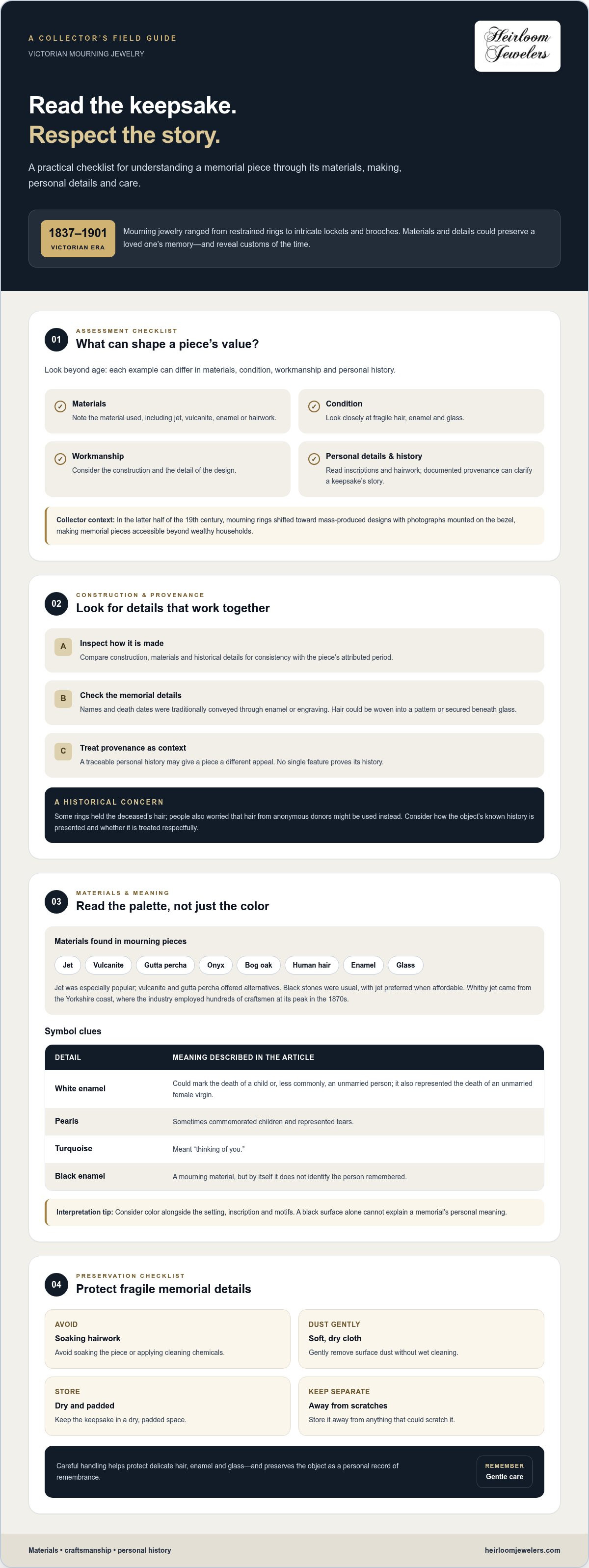
Mourning jewelry was popular during the Victorian era, from 1837 to 1901. In the latter half of the 19th century, mourning rings shifted toward mass-produced designs with photographs mounted on the bezel. This change made memorial pieces accessible beyond wealthy households and gives collectors useful context when comparing design and workmanship.
A piece’s value depends on its materials, condition, workmanship, inscriptions, hairwork and documented history. These factors vary from one example to another. For collectors, Victorian mourning jewelry with a traceable personal history may have a different appeal from a comparable piece without one.
Hair as a Love Token
Victorian hair jewelry turned a loved one’s hair into a personal memento of affection and remembrance. Artisans wove hair into intricate patterns for rings, bracelets and other keepsakes, or set it beneath glass in a locket. This connection to an individual gives hairwork significance beyond its decorative design. It could commemorate a spouse, relative or child, expressing love as well as grief.
Authenticity and Hair Substitution
Assess authenticity by examining construction, materials, inscriptions and consistent historical details. Names and death dates were traditionally conveyed through enamel or engraving, while hair could be woven or secured beneath glass. No single feature proves a piece’s history. Victorian concerns about substitution are also relevant: some rings held the deceased’s hair, while people worried that hair from anonymous donors might be used instead. Provenance can help clarify a keepsake’s story.
Ethical collecting means treating human hair as a personal memorial, not merely as decoration. Consider whether the object’s known history is presented respectfully. To preserve Victorian mourning jewelry, avoid soaking hairwork or applying cleaning chemicals. Gently remove surface dust with a soft, dry cloth, then store the piece in a dry, padded space away from anything that could scratch it. These steps help protect fragile hair, enamel and glass.
Materials and Craft in Mourning Jewelry
Jet, vulcanite, gutta percha, onyx and bog oak shaped the dark palette of mourning pieces. Whitby jet came from the Yorkshire coast, where its industry employed hundreds of craftsmen at its peak in the 1870s. These materials help distinguish Victorian mourning jewelry from later memorial designs and reveal how makers worked within period customs.
Materials Used in Hair Jewelry
Hair jewelry incorporated human hair, either woven into decorative patterns or preserved beneath glass. The material mattered because it connected a keepsake to a person, making craftsmanship central to its meaning. Hair could form intricate designs, while a glass cover protected and displayed it. Some mourning rings also paired hair with inscriptions, linking a personal memento to a name or date.
Materials and Gemstones
Jet was especially popular, while vulcanite and gutta percha offered alternatives. Black stones were usual in mourning rings, with jet preferred when affordable. White enamel could mark the death of a child or, less commonly, an unmarried person. Pearls sometimes commemorated children and represented tears, while turquoise meant “thinking of you.” These choices gave Victorian mourning jewelry a symbolic vocabulary for grief and remembrance.
Gold could frame jet or hold an inscription, while enamel recorded details about the deceased on a ring’s hoop. One established design paired a single small stone with details written in enamel. To interpret a piece, consider its material alongside its setting, inscription and motifs. A black surface alone cannot explain a memorial’s personal meaning.
Symbols and inscriptions on mourning keepsakes
Victorian keepsakes used color, imagery and writing to preserve personal meaning. Read together, these details can reveal whom a piece commemorated and how its symbols expressed grief.
Symbols and Motifs of Grief
Mourning symbols gave a keepsake a visual language, using color and imagery to convey remembrance. White enamel represented the death of an unmarried female virgin or a child, while pearls sometimes commemorated children and represented tears. Turquoise meant “thinking of you.” These meanings can help distinguish a deliberate memorial choice from decoration alone. Black enamel also appeared in mourning rings, but its presence by itself does not identify the person remembered.
Inscriptions on Keepsakes
Inscriptions recorded personal details that motifs could not convey, often naming the deceased or marking a death date. Victorian mourning rings commonly used enamel or engraving for names and dates. Some designs paired a small stone with details written in enamel on the hoop. Examine the lettering and its placement alongside the ring’s construction to better understand its meaning.
Other keepsakes combined written and painted details. Some rings had marquise-shaped faces with painted funerary imagery, often including the deceased’s initials beneath rock crystal. A name or initials can make a memorial more specific, while an image adds another layer to its story. Lockets and rings preserved such details in compact, wearable forms.
To interpret a piece, first note each visible element: color, inscription, image and setting. Then consider how they work together. For example, white enamel alongside a child’s name connects the material’s established meaning with a personal memorial. Black enamel, by contrast, identifies a mourning material but does not, on its own, explain the relationship or circumstances. These distinctions keep interpretation grounded in the object’s actual details.
Antique mourning jewellery collecting
Collecting mourning pieces means reading each object as both jewelry and a record of remembrance. Start with its date, materials, construction and any personal inscription. Victorian designs span 1837 to 1901, so a piece attributed to that period should fit its materials and style. A miniature portrait, a memorial pendant or weeping imagery can offer clues, but the object’s details matter more than a dramatic motif alone.
Compare period examples carefully. A Victorian “IN MEMORY OF” ring dated 1885 comes from Chester, England, while a Victorian Memorial Fob is dated 1900 and also comes from Chester. A Memorial Cross Pendant dates to circa 1890, and a Pique Mourning Brooch to circa 1880. These examples show how rings, fobs, pendants and brooches each carried remembrance in a different form. A Georgian ring dated 1813 belongs to an earlier era, despite sharing memorial purpose.
For collectors, condition and construction deserve attention alongside age. Examine the settings, enamel, engraved lettering and any miniature or hairwork. Missing components or damaged surfaces can affect an object’s integrity and appeal. Mass-produced rings made mourning jewelry more accessible to the middle class, so rarity alone should not guide a collecting decision. Consider the object’s documented story, materials and workmanship as a whole. Whether browsing specialty sales or sourcing pre-owned finds on peer-to-peer marketplaces like TRUVEO, verifying these physical details helps ensure you acquire an authentic, well-preserved piece.
To explore fine estate jewelry with considered materials and craftsmanship, browse estate jewelry.
Heirloom Jewelers: Lugano Emerald & Diamond Necklace 18K White Gold
The Lugano Emerald & Diamond Necklace 18K White Gold from Heirloom Jewelers offers a considered next step for readers drawn to jewelry with distinctive materials and craftsmanship. After exploring how mourning pieces preserve personal history, you may want to compare their details with fine estate jewelry. This necklace pairs emeralds and diamonds with an 18K white gold setting. Heirloom Jewelers also offers vintage diamond earrings, a vintage platinum engagement ring and estate gemstone earrings. These pieces provide examples of how setting, gemstones and design contribute to a jewel’s character. Explore the collection when you’re considering an estate piece with enduring appeal. For more information, contact Heirloom Jewelers.
Let Meaning Guide Your Next Choice
A useful next step is to decide what you want a jewel to carry forward: a particular family story, a period of craftsmanship or a design you value. That perspective can help you approach Victorian mourning jewelry thoughtfully, whether you’re collecting a memorial piece or choosing an estate jewel for personal significance. Let the details that matter most to you guide your search, rather than relying on appearance alone.
Heirloom Jewelers offers the Lugano Emerald & Diamond Necklace 18K White Gold, Vintage White Gold Old European Cut Diamond Stud Earrings, and Vintage Platinum 0.5 Carat Diamond Engagement Ring. Each offers a different way to appreciate fine materials and distinctive design. To explore these pieces and consider what might suit your collection, contact Heirloom Jewelers. Your next choice can begin with curiosity and lead to a jewel you’ll be glad to keep.
Frequently Asked Questions
Did men wear mourning jewelry, or was it only women?
Men wore mourning keepsakes too, so the custom wasn’t limited to women. Victorian mourning jewelry took forms suited to different wearers, including rings and lockets. An inscription or portrait might identify the person remembered, while a piece’s size and design reflected personal taste. Avoid assuming who originally wore an object based on style alone.
Was mourning jewelry a global practice?
Mourning jewelry appeared in different countries, though designs and customs varied by place. British hairwork and locket traditions had parallels in the United States throughout the 19th century. Local materials, family practices and public events influenced the keepsakes people chose. Victorian mourning jewelry therefore belongs to a broader history of memorial customs, not a single uniform international fashion.
What is the difference between mourning jewelry and memento mori jewelry?
Memento mori jewelry reminded wearers of mortality, often through skull, coffin or skeleton imagery. Mourning jewelry commemorated a particular deceased person and could include identifying details. The purposes sometimes overlapped: a memorial ring might combine a personal inscription with imagery about death. In the 17th century, mourning rings became clearly distinct from more general memento mori rings.
What is Victorian mourning jewelry?
It is jewelry made to commemorate the dead during the Victorian era, which lasted from 1837 to 1901. Rings, lockets, brooches and pendants could preserve a name, image or other personal memorial. The term describes an era and purpose, not one fixed design. A simple engraved ring and an elaborate locket can both belong to this tradition.
How was human hair incorporated into Victorian mourning jewelry?
Artisans used human hair as a memorial material, weaving it into decorative work or placing it beneath glass. Hair could be incorporated into jewelry such as rings and lockets, sometimes alongside identifying details. By the mid-1800s, England imported 50 tons of hair a year to supplement hair from the deceased for memorial jewelry and art. This practice also raised concerns about substitution.
What do common mourning jewelry symbols and inscriptions mean?
Symbols and inscriptions offered clues to a keepsake’s meaning and the person remembered. White enamel represented the death of an unmarried female virgin or a child, while turquoise meant “thinking of you.” Names and death dates could appear in engraving or enamel. Read these details alongside any imagery and the setting, since a single motif may not explain the whole memorial.