
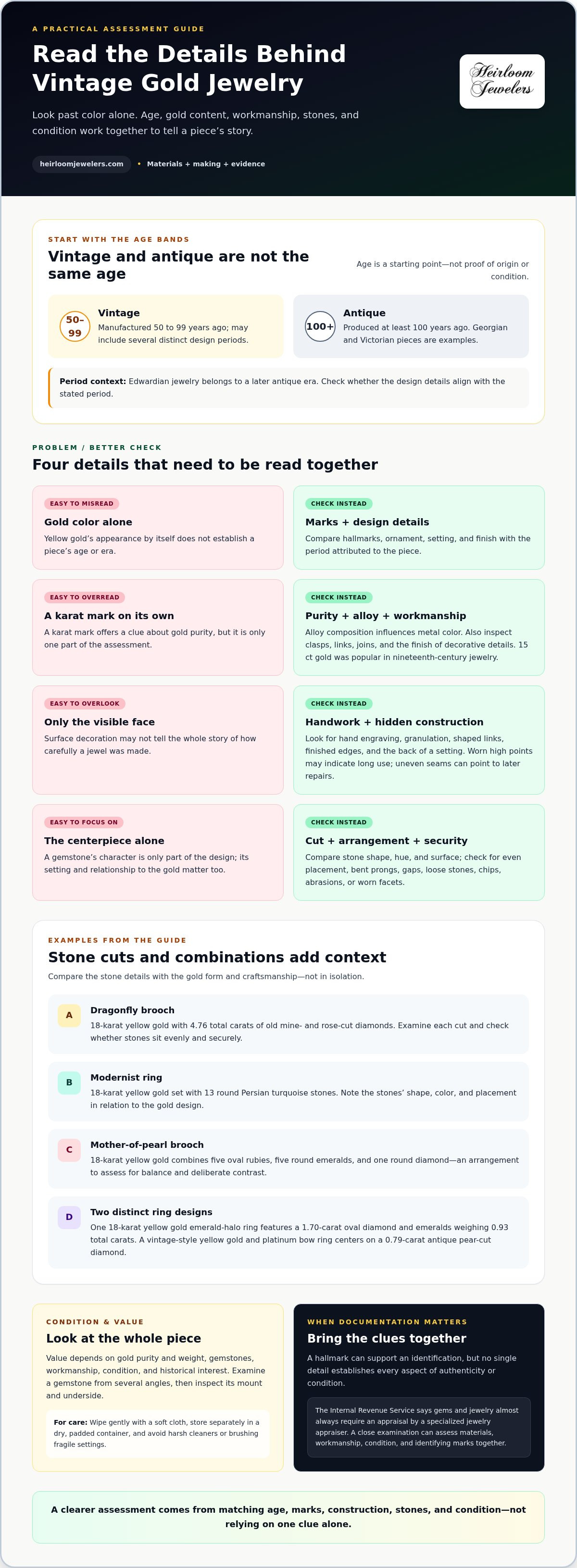
The warm glow of gold is only the beginning of what a vintage jewel can reveal. Vintage jewelry generally dates from 50 to 99 years ago, while antique jewelry was made at least 100 years ago. Vintage yellow gold jewelry is best assessed through more than its color: age, karat, hallmarks, craftsmanship, and gemstone details all help tell its story.
That distinction matters when you compare a delicate filigree setting with a bold, sculptural design, or consider whether a stone and setting suit the era attributed to a piece. This guide explains how gold purity and alloy affect color, what period craftsmanship and gemstone cuts can reveal, and which signs may help you assess authenticity. You’ll also learn how to consider wear, repairs, and condition without overlooking the artistry that makes each piece distinctive. The result is a clearer way to assess vintage jewelry and spot details that merit a closer look.
Key Takeaways
- Use construction details, wear patterns, and hallmarks together to assess a piece’s age and workmanship.
- Compare gemstone cuts, settings, and combinations with the design era to better understand a jewel’s character.
- Distinguish vintage from antique by age, then consider how period styles changed from the 1800s through the 1990s.
- Read karat markings as an indication of gold purity, and remember that alloy composition influences the metal’s color.
- For a more informed assessment, understand the role of a specialized jewelry appraisal and examine each piece’s condition and provenance.
Antique jewelry materials and craftsmanship
Age, gold content, and construction details help explain how a piece was made and how it has changed over time. When assessing vintage yellow gold jewelry, examine the metal alongside the setting, finish, and signs of handwork.
Vintage and Antique Age Definitions
Vintage jewelry was manufactured 50 to 99 years ago; antique jewelry was produced at least 100 years ago. These definitions offer a useful starting point, but age alone doesn’t establish a piece’s origin or condition. Look for hallmarks, construction methods, and design details, then consider whether they align with the stated period.
Vintage and Antique Jewelry Eras
Georgian and Victorian pieces are antique examples, while Edwardian jewelry belongs to a later antique era. Jewelry made 50 to 99 years ago falls within the vintage range, which can encompass several distinct design periods. Compare details such as ornament, setting, and finish rather than relying on color alone to identify an era.
Gold content and craftsmanship can reflect both period and purpose. 15 ct gold was popular in nineteenth-century jewelry. A karat mark can offer a clue, but also inspect how a clasp closes, how links meet, and whether decorative details appear consistently finished.
Hand engraving, granulation, and shaped links can reveal the care invested in a gold bracelet or necklace. Look closely at joins and edges: worn high points may indicate long use, while uneven seams can point to later repairs. Compare the back of a setting with its face, since details hidden from view can help distinguish careful workmanship from surface decoration.
How much do vintage yellow gold rings, necklaces, bracelets, and earrings typically cost? Value depends on gold purity and weight, gemstones, workmanship, condition, and historical interest. A ring with a notable stone or intricate setting may be assessed differently from a simple chain, even if both have similar gold content.
How should you clean, store, and care for vintage yellow gold jewelry? Wipe each piece gently with a soft cloth, store it separately from other jewelry to reduce scratches, and keep it in a dry, padded container. Avoid brushing fragile settings or using harsh cleaners, especially on pieces with gemstones, enamel, or delicate links.
For valuation or documentation, the Internal Revenue Service says gems and jewelry almost always require an appraisal by a specialized jewelry appraiser. A close examination can assess materials, workmanship, condition, and identifying marks together.
Gold jewelry with diamonds and colored gemstones
Gemstones shape the character of a gold jewel: a diamond’s cut, a ruby’s color, and the setting’s design all contribute to its appearance. Compare the stones with the metal and craftsmanship rather than judging a piece by its centerpiece alone. For example, a halo ring pairs a central diamond with smaller emeralds, creating contrast through both color and setting.
Vintage diamond jewelry can feature cuts that differ from the modern brilliant style. One vintage 18-karat yellow gold dragonfly brooch contains 4.76 total carats of old mine- and rose-cut diamonds. Those cuts have distinct outlines and facets, so examine them individually. Check whether the stones sit evenly, whether the setting holds them securely, and whether wear appears consistent across the piece.
Colored gemstones offer another way to assess design and composition. A vintage modernist ring in 18-karat yellow gold is set with 13 round Persian turquoise stones. Another vintage 18-karat yellow gold, mother-of-pearl brooch combines five oval rubies, five round emeralds, and one round diamond. These examples show how stone shape, number, and placement can create balance or deliberate contrast.
- Inspect the setting: Look for bent prongs, loose stones, or gaps around a diamond or colored gem.
- Compare the stones: Note differences in hue, shape, and surface appearance across a matched group.
- Read the design: Consider how the gem arrangement relates to the gold form and decorative details.
Estate gemstone jewelry can bring together materials and design choices from different periods. A vintage 18-karat yellow gold ring with an emerald halo features a 1.70-carat oval diamond and emeralds weighing 0.93 total carats. A vintage-style 18-karat yellow gold and platinum bow ring instead centers on a 0.79-carat antique pear-cut diamond. The contrast illustrates why setting, metal, and stone style belong in the same assessment.
Condition matters alongside appearance. Examine the gemstone from several angles, then look at the setting’s edges and underside. Chips, abrasions, worn facets, or movement can affect how a stone presents and how securely it sits. In a ring set with five round turquoise beads in 14-karat yellow gold, check each bead and its mount separately. A single loose or damaged element can change the overall impression.
For a closer look at gemstone combinations in previously owned pieces, explore estate gemstone jewelry featuring colored stones and gold.
Comparing examples across styles can clarify how metal and stone arrangements work together. An 18-karat yellow gold and diamond bangle bracelet has 24 round brilliant-cut diamonds with an estimated total weight of 2.00 carats.
These comparisons highlight designs centered on a single stone, shoulder details, or diamonds arranged across the piece.
Authenticity and quality guarantee
Authenticating a vintage jewel means assessing its materials, construction, marks, and documented history together. A hallmark can support an identification, but consider it alongside the setting, wear, and design. No single detail establishes every aspect of authenticity or condition. With vintage yellow gold jewelry, compare the mark with the visible color and construction rather than relying on appearance alone.
Begin with a careful visual examination. Record visible marks inside a ring or near a clasp, then compare the stamp with the piece’s construction and stated metal. Look for replaced components, inconsistent solder, and differences in wear between joined parts. For earrings, compare the backs, settings, and fastenings. Matching details can support a coherent history, while clear differences merit closer examination.
Documentation helps preserve what can be established. Keep photographs of the front, back, hallmarks, and distinctive details. Gather earlier appraisals, receipts, and family records, noting which details are documented and which come from oral history. Gems and jewelry may benefit from an appraisal by a specialized jewelry appraiser. An appraisal can record identifying characteristics and condition without presenting a family story as proven provenance.
- Inspect: Record hallmarks, construction, repairs, and visible wear.
- Document: Photograph distinguishing details and retain available records.
- Assess: Consider gold content, gemstone characteristics, workmanship, and condition together.
What should you know before selling or appraising vintage yellow gold jewelry? Gather existing records and note any repairs, replaced stones, or damage before an examination. An appraisal considers materials, gemstones, workmanship, condition, and relevant documentation. A decision to sell also depends on the piece’s desirability and the transaction’s terms.
For a clear assessment, distinguish what can be observed from what can be documented. A sapphire’s setting, a gold hallmark, and a repaired clasp each provide different evidence. Considered together, these details offer a fuller account of the jewel than any single stamp or stone.
Gold jewelry styles from the 1800s to the 1990s
Gold jewelry made across these two centuries varies in karat, color, form, and ornament. Compare a piece with dated examples to identify its design language and narrow down its likely period. Vintage yellow gold jewelry spans many decades, so construction and details matter as much as the metal’s warm tone.
How can you identify the age and style of vintage yellow gold jewelry? Start with any date, hallmark, or documented history, then compare the metal, construction, and design with pieces associated with that period. One style feature may suggest an era, but several consistent details provide a stronger basis for identification.
For nineteenth-century jewelry, gold purity offers one useful reference point. These values describe different gold contents, but do not guarantee a date on their own. Consider karat alongside form, decorative work, and construction.
Compare the silhouette before examining smaller details. Is the necklace made of linked elements, formed as a continuous band, or designed with a central pendant? Notice how the chain, clasp, and decorative features relate. Vintage yellow gold jewelry comes in many necklace forms, so check whether the design feels coherent across the front and back.
The Edwardian era provides another period reference. 9 ct gold was used for everyday Edwardian jewelry, showing that intended use can matter alongside material—a principle still seen today with modern brands like 3MS JEWELRY that focus on pieces crafted for daily wear. Consider how substantial the design feels, and examine the setting and joinery. These observations help describe the object without relying on color alone.
By the twentieth century, jewelry could combine gold colors in one design. A circa-1980 14kt tri-colored gold graduated Cleopatra necklace measures 16.5 inches. Its graduated form and tri-color construction provide concrete characteristics to record. Compare those features with the piece you’re assessing, including whether the links increase in size and how the colors alternate.
- Record the marks: Note every visible karat stamp or maker’s mark and its location.
- Describe the form: Record whether the jewel is a chain, bangle, ring, or pendant.
- Compare construction: Examine links, clasps, settings, and decorative details together.
- Keep context: Save photographs and any dated records that accompany the piece.
For a 1990s comparison, use the date as a guide, not a full style description. The period from the 1800s to the 1990s includes varied forms, and individual pieces may have been altered. Note replaced clasps, resized rings, or changed settings separately from original design features. That distinction helps make a description of vintage yellow gold jewelry more precise while preserving the jewel’s history.
Gold karat and metal colors
Karat indicates gold content, while alloy metals influence the finished color and character. Read the mark, inspect the surface, and consider the piece’s weight and construction together.
Value by Karat and Weight
What is the current value of vintage yellow gold jewelry by karat and weight? Value depends on gold content and weight, as well as condition, workmanship, gemstones, and historical interest. Karat and weight describe the metal, but do not determine a jewel’s full value on their own.
Compare the karat mark with the item’s overall design. A delicate pendant and a substantial bracelet can contain different amounts of gold, even if their marks show the same karat. Stone settings, repairs, and wear also affect how the whole piece is assessed.
Historical examples show why karat needs context. 9 ct gold was used for everyday Edwardian jewelry, and 15 ct gold was popular in nineteenth-century jewelry. These examples can guide an assessment, but the mark should be considered alongside design and construction.
Yellow, white, and rose tones result from gold alloy composition and finish. Compare the piece’s color in protected and exposed areas. A pendant may show more wear near its clasp or contact points, making those areas useful for spotting changes in surface appearance. Color alone does not establish gold content.
Solid Gold, Gold-Filled, and Gold-Plated
How can you tell whether vintage jewelry is solid gold, gold-filled, or gold-plated? Start by locating any metal marks, then examine worn edges, joins, and the back for differences in color or surface. A stamp and visual inspection can offer clues, but neither should be treated alone as proof of the metal’s composition.
Solid gold describes an item made from a gold alloy throughout, while gold-filled and gold-plated pieces have a gold layer over another metal. Check areas prone to rubbing, such as the underside of a ring or a chain’s clasp. Visible contrasting base metal can indicate surface wear, but assess construction and marks together.
Use a consistent inspection process for each item:
- Locate and record every stamp, including its position.
- Look for color changes at edges, clasps, and worn contact points.
- Compare the mark with the piece’s construction and overall condition.
A karat stamp describes gold fineness, not gemstone value or workmanship. A 14-karat yellow gold setting, for example, should be considered separately from the quality and condition of its stones. Likewise, a two-tone design may combine different gold colors without indicating that one area is plated.
For a sound assessment, consider the mark, weight, visible wear, and design details together. A careful comparison helps distinguish the metal’s contribution from the value of the jewel’s craftsmanship and history.
Heirloom Jewelers: Lugano Emerald & Diamond Necklace 18K White Gold
Heirloom Jewelers offers the Lugano Emerald & Diamond Necklace 18K White Gold as a considered example of how gemstone color, diamond accents, and metal choice work together. Though it’s white gold rather than yellow, it can help illustrate how the setting’s metal changes a jewel’s overall appearance.
For a yellow gold comparison, the Estate Peridot & Quartz Dangle Earrings 14K Yellow Gold pair a warm-toned setting with colored stones. Heirloom Jewelers also offers Vintage White Gold Old European Cut Diamond Stud Earrings and a Vintage Platinum 0.5 Carat Diamond Engagement Ring. These distinct pieces offer different combinations of metal, gemstone, and period character to consider as you refine your preferences.
Visit heirloomjewelers.com to explore the collection.
Choose a Piece That Feels Personal
Heirloom Jewelers’ selection offers different points of comparison, including the Lugano Emerald & Diamond Necklace 18K White Gold, Vintage White Gold Old European Cut Diamond Stud Earrings, and Vintage Platinum 0.5 Carat Diamond Engagement Ring. Each provides a different combination of metal, form, and stone to consider as you refine your taste.
When you’re ready to explore a piece more closely, contact Heirloom Jewelers. A thoughtful choice begins with the details that matter most to you, and the right jewel can carry that meaning into the years ahead.
Frequently Asked Questions
What is vintage yellow gold jewelry?
Vintage yellow gold jewelry is jewelry made from yellow-toned gold within a past design period; in this guide, “vintage” refers to pieces manufactured 50 to 99 years ago. The term describes age, not a specific look. A simple chain and an ornate gemstone ring may both qualify. To assess a piece, consider its date alongside its gold mark, construction, and design details.
What do gold purity marks such as 10K, 14K, and 18K mean?
These marks identify the gold’s karat purity: a higher karat indicates a greater proportion of gold in the alloy. On vintage yellow gold jewelry, the mark helps describe the metal, but it doesn’t establish the piece’s age or full value. The remaining metals influence color and character, so the same karat can look different across pieces. A 14K mark describes purity, not a ring’s weight or gemstone value.
How can you authenticate vintage yellow gold jewelry and avoid counterfeit pieces?
Compare the hallmark with the piece’s construction, then inspect the clasp, joins, and worn edges for inconsistent metal or later alterations. Treat a stamp as a clue, not proof on its own. Keep photographs and original records together, and have questionable marks or unusual construction assessed by a specialized jewelry appraiser. For vintage yellow gold jewelry, combining these details offers a more useful assessment than relying on appearance alone.
How much do vintage yellow gold rings, necklaces, bracelets, and earrings typically cost?
Value depends on gold purity and weight, gemstones, workmanship, condition, and historical interest. A ring with a notable stone or intricate setting may be valued differently from a simple chain, even if both have similar gold content.