
A diamond's true value in the secondary market isn't always found in a modern laser-cut facet. It often lives in the hand-carved soul of a stone that hasn't been touched by a machine. You likely recognize that a fine piece is more than just an accessory; it's a wearable record of history and artisanal skill. However, identifying authentic antique diamond necklace styles can feel overwhelming when modern reproductions mimic the silhouettes of the past so closely.
We understand the hesitation that comes with evaluating heritage jewelry. It's difficult to distinguish between the delicate filigree of the Edwardian era and the bold, geometric lines of Art Deco without a trained eye. This guide provides the clarity you need to invest with confidence. You'll learn to identify era-defining designs, understand the unique fire of Old European and Old Mine cuts, and gain the vocabulary to discuss these treasures with expertise. We examine how the transition from candlelight to electricity changed jewelry design forever, helping you curate a collection that honors both quality and heritage.
Key Takeaways
- Understand the 100-year threshold that distinguishes true antiques from vintage and estate pieces in the secondary market.
- Identify iconic antique diamond necklace styles through the symbolic motifs of the Victorian era and the delicate platinum work of the Edwardian period.
- Recognize the specific hand-cut characteristics of Old Mine and Old European diamonds to appreciate their unique fire and historical value.
- Learn how to read hallmarks and maker's marks to verify the authenticity and provenance of heritage jewelry.
- Discover the benefits of choosing authenticated estate pieces that prioritize artisanal craftsmanship over mass-produced retail designs.
What Defines Antique Diamond Necklace Styles?
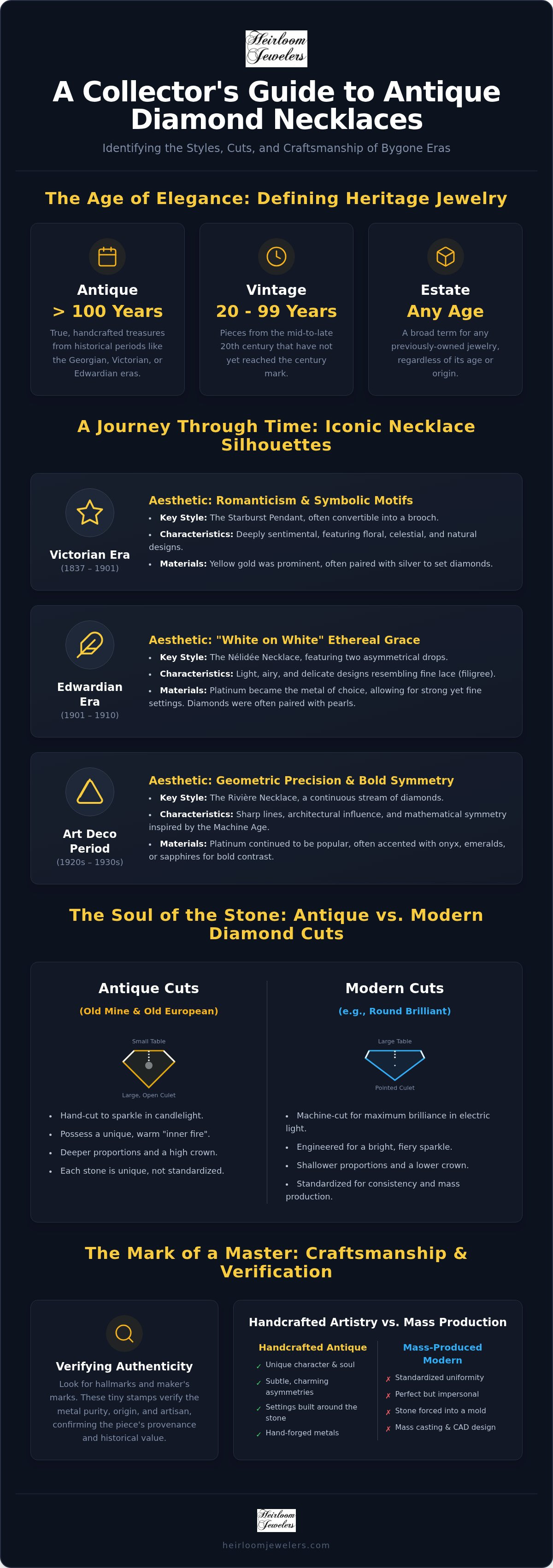
Antique classification isn't a matter of opinion; it's a matter of chronology. In the fine jewelry trade, a piece must be at least 100 years old to be considered a true antique. This distinction separates the hand-crafted treasures of the early 20th century and earlier from the vintage pieces of the mid-to-late 1900s. While modern jewelry often relies on standardized CAD designs and mass casting, antique diamond necklace styles are defined by their individuality and artisanal origins. Every curve and setting tells a story of a jeweler's specific intent.
The Distinction Between Antique, Vintage, and Estate
Understanding terminology is the first step for any serious collector. The term "estate" is a broad umbrella that covers any jewelry previously owned, regardless of its age. "Vintage" refers to pieces at least 20 years old but haven't yet reached the century mark. True antiques are categorized by specific historical periods, such as the Georgian (1714 to 1837) or Victorian (1837 to 1901) eras. The history of necklaces shows these periods weren't just about fashion; they represented shifts in technology and global trade. Authentication is vital in this market. It ensures you're investing in a genuine piece of history rather than a modern reproduction.
The Significance of Handcrafted Artistry
Antique necklaces offer a tactile quality that modern pieces rarely replicate. Before the advent of modern casting techniques, jewelers hand-forged every setting and link. This process resulted in subtle asymmetries that give each piece its soul. These antique diamond necklace styles prioritize the unique shape of the stone rather than forcing it into a uniform mold. This approach creates a silhouette that's as unique as the diamond it holds.
The choice of metal also provides critical context. Historic 18K white gold often possesses a warm, slightly yellowish patina that distinguishes it from the bright rhodium finish of modern pieces, while antique platinum settings maintain a dense, substantial weight that feels secure against the skin. This craftsmanship creates a connection between the wearer and the original artisan. Collectors value these pieces not just for their material worth, but as heritage jewelry that preserves the artistic standards of a bygone era. Every piece serves as a bridge to the past, offering an emotional resonance that mass-produced retail items simply cannot provide.
Iconic Era-Specific Necklace Silhouettes
Each period in jewelry history reflects the social and technological shifts of its time. These changes dictated the evolution of antique diamond necklace styles, moving from the soft, candlelight-driven glow of the 19th century to the sharp, electric brilliance of the 20th. Understanding these silhouettes allows collectors to place a piece within its proper historical context and evaluate its craftsmanship.
Victorian and Edwardian Masterpieces
Victorian jewelry is deeply rooted in romanticism and symbolic motifs. The starburst pendant became a celestial staple during the late 19th century, often featuring a central diamond surrounded by radiating "rays" of smaller stones. These pieces were frequently convertible, functioning as both necklaces and brooches. The Victoria and Albert Museum documents how the era's obsession with nature and sentimentality influenced these designs, leading to an abundance of floral and star-shaped patterns.
As the 1900s began, the Edwardian "White on White" aesthetic emerged. This era benefited from the introduction of platinum, which allowed for thinner, stronger settings that resembled delicate lace. The néligée necklace became the height of grace, featuring two asymmetrical drops of unequal length hanging from a central element. Jewelers often combined diamonds with natural pearls to create a soft, ethereal look. This style was a direct response to the light, airy fashions of the high-society "Belle Époque" period.
The Geometric Precision of Art Deco
The 1920s brought a radical departure from the floral curves of the past. Art Deco design focused on architectural influence, bold lines, and mathematical symmetry. This period popularized the rivière necklace, which consists of a continuous stream of diamonds of similar size. These pieces were designed to catch the light from every angle in the newly electrified ballrooms of the Jazz Age. You can explore these motifs further in our Art Deco Jewelry Guide.
By the 1940s, Retro Glamour shifted the focus back to yellow gold. These statement pieces featured large, sculptural forms and bold gemstone combinations. While the delicate platinum work of earlier decades was set aside, the craftsmanship remained exceptional. Whether you're drawn to a geometric Art Deco pendant or a sophisticated Lugano emerald and diamond necklace, choosing a piece with a clear historical silhouette ensures your collection remains timeless. You'll find these rare examples in our curated estate collection, where every item is authenticated for its era and quality.
The Language of Antique Diamonds: Cuts and Settings
The character of a heritage piece is often found in how it captures light. Unlike modern diamonds cut for maximum brilliance under harsh artificial bulbs, antique diamonds were designed to glow in low-light environments. This fundamental difference in light performance defines the most sought-after antique diamond necklace styles. Understanding these cuts allows you to appreciate why a historic piece has a deeper, more romantic presence than a modern alternative.
The Old Mine Cut is the oldest of the common historic cuts. These stones feature a soft, cushion-like shape with a high crown and a deep pavilion. They often have a visible culet at the bottom, which adds a dark "eye" to the center of the stone. By the late 1800s, the Old European Cut emerged. This cut transitioned toward a rounder silhouette while maintaining the depth and small table that collectors love today. Other styles like the Rose Cut, with its flat base and faceted dome, offer a subtle, watery shimmer that's perfect for more delicate pendant designs.
Historic Cuts vs. Modern Brilliant Diamonds
Old European cuts possess an "inner fire" that modern stones often lack. While a modern brilliant diamond focuses on white light return, these historic cuts favor large, colorful flashes of light. During the 19th century, master cutters hand-faceted each diamond by eye to maximize its natural brilliance, creating unique patterns that reflect the individual skill of the artisan. This artisanal approach is why a pair of Vintage White Gold Old European Cut Diamond Stud Earrings feels so much warmer and more personal than their modern counterparts.
Traditional Metalwork: Platinum and White Gold
The setting is just as important as the stone when identifying authentic period pieces. Platinum became the preferred metal during the Edwardian era because its strength allowed jewelers to create incredibly fine, lace-like structures. This gave rise to the intricate filigree and milgrain detailing seen in high-end antique diamond necklace styles. These tiny beads of metal and open-work patterns were all finished by hand, a level of detail that modern casting struggles to replicate.
For those seeking durability and a classic look, 18K white gold remains a staple of the estate market. It provides a sophisticated backdrop for diamonds and colored stones alike. You'll often see this used in significant pieces like a Lugano Emerald & Diamond Necklace 18K White Gold, where the metal's strength supports complex, multi-stone arrangements. Authentic period metalwork should show signs of hand-tooling rather than the perfectly smooth finish of modern mass-produced jewelry. These small imperfections are actually marks of quality, proving the piece was crafted by a human hand.
A Collector’s Guide to Assessing Authenticity
Evaluating antique diamond necklace styles requires a disciplined eye and a methodical approach. It's about looking past the immediate sparkle to find structural evidence of a piece's history. Authenticity isn't merely about the age of the diamonds; it's about the integrity of the entire assembly. A true collector seeks pieces that remain as close to their original state as possible, preserving the intent of the jeweler who first crafted them.
Identifying Hallmarks and Maker’s Marks
Hallmarks serve as a piece's birth certificate. These tiny stamps, often found on the clasp or the reverse side of a pendant, indicate metal purity and the country of origin. British antiques often feature a series of marks including a crown for gold, a leopard's head for London, and a date letter that specifies the exact year of production. American pieces from the same era might only show a maker's mark and a karat stamp like "14K" or "18K."
You'll need a jeweler’s loupe with at least 10x magnification to find these hidden signatures. Some marks are worn down by decades of skin contact, making them difficult to spot at first glance. Identifying a specific maker's mark from a historic house can significantly increase the value of a piece. If you're interested in the specific stamps found on pieces from the 1800s, you can explore our Authentic Victorian Hallmarks Guide for deeper research. These marks provide the provenance necessary to distinguish a true heritage piece from a modern reproduction.
Assessing Condition and Integrity
The "feel" of a necklace tells you a lot about its history. When you handle a piece, check the hinges, clasps, and jump rings for smooth operation. Antique metalwork should feel substantial but never clunky. Look closely at the back of the settings for "lead solder" repairs. These appear as dull, greyish patches where a previous owner might have attempted a quick fix. Such repairs can be brittle and often decrease the value of the piece.
Be careful not to mistake original patina for damage. The soft, darkened oxidation that settles into the crevices of silver-topped gold or low-karat gold is highly desirable. A high-polish finish on a supposed 19th-century piece is often a red flag; it suggests either a modern reproduction or a piece that has been over-cleaned, stripping away its character. We invite you to browse our authenticated collection to see examples of well-preserved patina and expert craftsmanship in person. Every piece we offer has undergone a rigorous inspection to ensure its structural integrity matches its historic beauty.
Curating Your Collection with Heirloom Jewelers
Choosing a piece of heritage jewelry is a deliberate act of preservation. At Heirloom Jewelers, we believe that the most meaningful collections are those built with a focus on authenticity and individual character. Navigating the diverse landscape of antique diamond necklace styles requires a partner who values history as much as you do. We position ourselves as a steady guide for collectors who prioritize craftsmanship over the convenience of modern, mass-produced items. This appreciation for artisanal quality often extends to other luxury items; for example, Premvion offers curated fashion accessories and VIP gifts that complement a discerning lifestyle.
Our philosophy is rooted in the idea that jewelry should be an investment in both material and story. Every piece in our collection is selected for its ability to represent a specific moment in time. Whether you're a seasoned collector or just beginning your journey, we provide the expertise necessary to evaluate high-value secondary market finds with confidence. This methodical approach ensures that your acquisition is more than just a purchase; it's a contribution to the ongoing history of fine jewelry.
Building a collection often starts with versatile staples that bridge the gap between daily wear and formal elegance. A pair of Vintage White Gold Old European Cut Diamond Stud Earrings or a classic solitaire pendant serves as an excellent foundation. These pieces allow you to appreciate the unique fire of historic cuts while maintaining a silhouette that complements any wardrobe. From there, you can expand into more intricate antique diamond necklace styles that showcase the height of period artistry.
Progressing toward statement pieces is where the true joy of collecting lies. A Lugano Emerald & Diamond Necklace 18K White Gold represents the kind of rare, curated find that defines a world-class collection. Such pieces offer a sense of exclusivity that's impossible to find in modern retail showrooms. Owning a piece that no one else has creates a personal connection to the past and ensures your collection remains truly distinct. To complement such a curated lifestyle, you can discover Maison Ephyr and their selection of niche luxury fragrances.
The safest path for high-value purchases is always through a trusted specialist. We've dedicated ourselves to the rigorous authentication of every item we offer, from simple gold bands to complex multi-stone necklaces. This commitment to preserving jewelry history protects our clients from the risks of modern reproductions and undisclosed repairs. We believe in transparency and integrity, providing you with the peace of mind that your "forever" piece is exactly what it's claimed to be.
If you're ready to add a piece of wearable history to your life, we invite you to take the next step. Our team is available for consultations to help you find a necklace that resonates with your personal style and investment goals. We take pride in acting as curators of the past, helping you secure treasures that will be cherished for generations to come. Explore our curated collection of authenticated antique diamond necklaces to find your next heirloom.
Securing Your Piece of Jewelry History
Identifying authentic antique diamond necklace styles is a skill that deepens your appreciation for historic artistry. You've learned how to distinguish the romantic motifs of the Victorian era from the geometric precision of Art Deco. You also recognize the unique fire of Old European and Old Mine diamonds. These stones offer a character that modern, machine-cut diamonds can't replicate. These artisanal details provide the foundation for a collection that holds both emotional and material value.
As an authenticated estate jewelry specialist, Heirloom Jewelers is dedicated to sourcing rare vintage and antique finds. Our expertise in historic diamond cuts ensures that every piece in our collection is a true representative of its era. We invite you to begin your journey with a trusted partner who values heritage as much as you do. We look forward to helping you find a treasure that resonates with your personal story.
Browse Our Exclusive Collection of Authenticated Antique Diamond Necklaces
Frequently Asked Questions
What is the difference between an antique and a vintage diamond necklace?
An antique piece must be at least 100 years old to carry that official designation. This means anything crafted before the mid-1920s currently falls into the antique category. Vintage jewelry refers to pieces that are at least 20 years old but haven't yet reached the century mark. While both categories represent pre-owned fine jewelry, antique diamond necklace styles are often defined by hand-crafted techniques that predated industrial mass production.
How do I know if my antique diamond necklace is authentic?
Authenticity is verified through a combination of hallmarks, diamond cuts, and construction methods. You should look for hand-cut diamonds like the Old Mine or Old European cut, which feature asymmetrical facets. Authentic pieces often show subtle hand-tooling marks on the reverse side rather than the perfectly smooth finish of modern casting. Professional authentication from a specialist is the most reliable way to confirm a piece's age and origin.
Are old European cut diamonds more valuable than modern cuts?
The value of an Old European cut diamond is often higher due to its rarity and historical appeal. While modern diamonds are priced largely on the "Four Cs" and standardized brilliance, historic cuts are valued for their unique fire and artisanal provenance. Collectors often pay a premium for these stones because they aren't easily replaced. Their deep pavilions and small tables create a romantic glow that modern machine-cut stones can't replicate.
Can I wear an antique diamond necklace every day?
You can wear most antique necklaces daily if they're in good structural condition. Diamonds are exceptionally durable, but you must inspect the settings and clasps regularly. Older pieces with thin prongs or delicate filigree require more care than modern jewelry. It's best to remove your necklace before sleeping or exercising to prevent snagging. Regular check-ups with a jeweler ensure that the stones remain secure in their original historic settings.
What should I look for in an Art Deco diamond necklace?
Art Deco pieces are characterized by bold geometric shapes and mathematical symmetry. You should look for architectural influences, such as stepped borders or sunburst patterns. These necklaces often feature a mix of diamond shapes, including baguettes and emerald cuts, set in platinum or white gold. Authentic Art Deco antique diamond necklace styles avoid the floral curves of the earlier Art Nouveau period in favor of clean, streamlined lines and high-contrast designs.
Why is platinum so common in Edwardian diamond jewelry?
Platinum became popular in the Edwardian era because technological advancements allowed jewelers to work with its high melting point. This metal is significantly stronger than gold, which permitted the creation of incredibly fine, lace-like settings. Jewelers used this strength to minimize the visible metal, making the diamonds appear as if they were floating. This "white on white" aesthetic defined the elegance of the period and remains highly collectible today.
How do I clean and care for my estate diamond necklace?
The safest way to clean your necklace is with a soft-bristled brush, warm water, and a drop of mild dish soap. You should avoid ultrasonic cleaners, as the vibrations can loosen stones in delicate antique settings. Gently pat the piece dry with a soft, lint-free cloth. Always store your estate jewelry in a separate pouch to prevent the diamonds from scratching other metals or softer gemstones in your collection.
What are the hallmarks of a Victorian diamond pendant?
Victorian pendants often feature romantic or celestial motifs like stars, crescents, and floral clusters. You'll frequently find diamonds set in silver-topped gold, a technique where a thin layer of silver was applied to yellow gold to enhance the white sparkle of the stones. These pieces often use rose cuts or Old Mine cuts. The settings are typically substantial and may include intricate hand-engraved details or symbolic elements that were popular during Queen Victoria's long reign.