
Why did the ancient Romans call a bright green gemstone the "Evening Emerald" when it wasn't an emerald at all? This nickname refers to the stone's ability to maintain its brilliant glow under low light. Most collectors appreciate the vibrant, olive-green hue of peridot. These stones possess a rich, lime-green character that has captivated jewelry enthusiasts for centuries. However, finding high-quality estate peridot jewelry requires a discerning eye for historical authenticity and gemstone integrity.
It's natural to feel hesitant when browsing the secondary market. You might worry about identifying synthetic treatments or understanding how to care for a delicate Edwardian setting. This guide provides the clarity you need to purchase with confidence. You'll discover the fascinating history of this volcanic gem and learn how to evaluate rare pieces from different historical eras. We'll also cover the specific characteristics that define the finest specimens and the essential care routines needed to preserve these treasures for the future.
Key Takeaways
- Understand the science behind peridot's consistent green hue and why the Romans celebrated it as the "Evening Emerald."
- Learn to identify quality markers like "lily pad" inclusions and the highly valued "oily" forest green saturation found in premium specimens.
- Master the hallmarks of different eras to confidently select estate peridot jewelry, whether you prefer Victorian seed pearl pairings or Edwardian platinum settings.
- Discover essential maintenance tips to protect your investment, including the specific reasons to avoid modern cleaning technology for older settings.
- Recognize the unique value and craftsmanship that authenticated, curated jewelry offers compared to standard retail options.
The Historical Allure of Estate Peridot Jewelry
Peridot is one of the few gemstones that occurs in only one color. It's the gem-quality variety of the mineral olivine. Its distinct olive-green hue is idiochromatic, meaning the color is an intrinsic part of its chemical structure rather than a result of impurities. Iron is the element responsible for this shade. The concentration of iron within the crystal lattice determines the depth of the green, ranging from a pale lime to a rich, oily forest tone. Most historical specimens originated from the island of Zabargad, formerly called Topazos, located in the Red Sea. Ancient miners worked in harsh conditions to extract these stones for Egyptian royalty. This storied origin adds a layer of depth to every piece of authenticated estate peridot jewelry found today.
Why Peridot is Known as the Evening Emerald
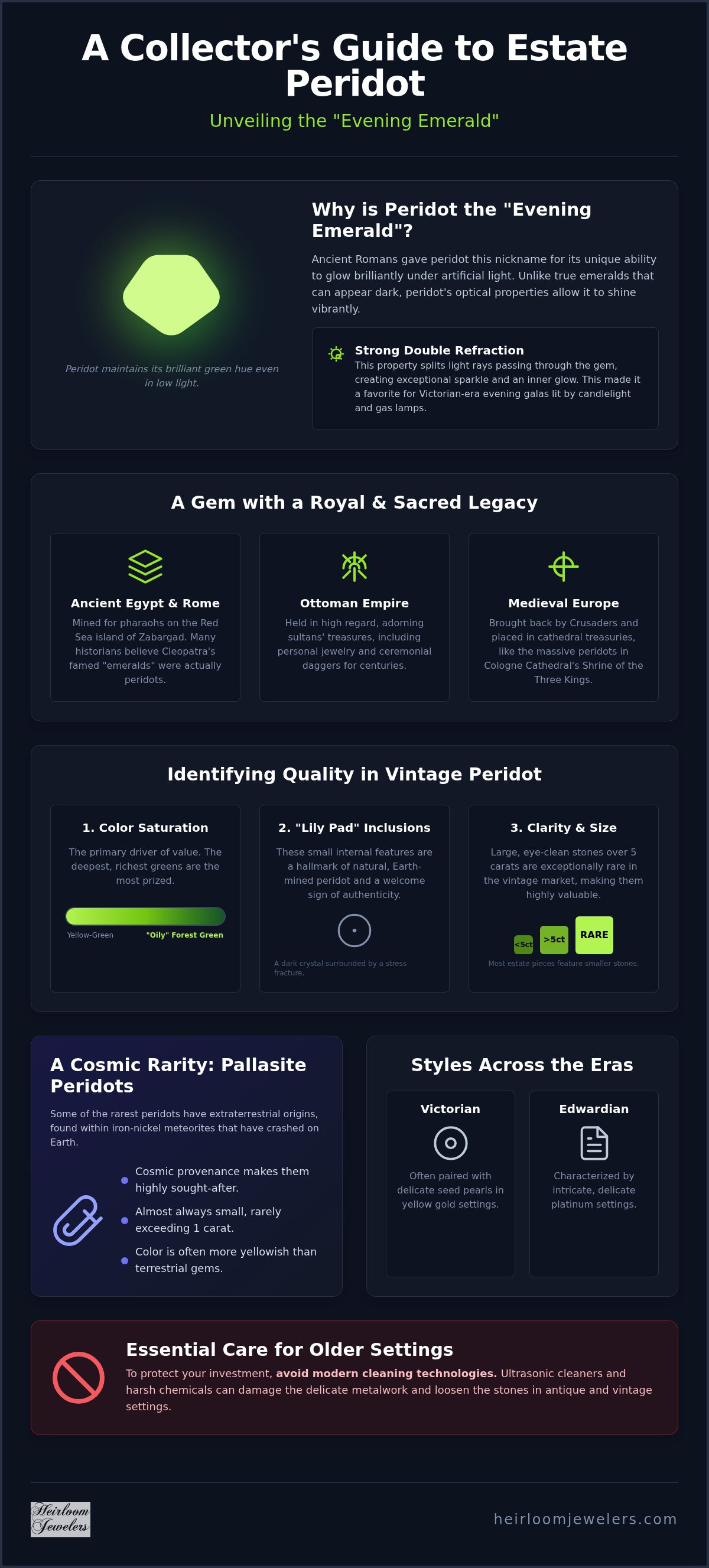
The nickname "Evening Emerald" refers to the stone's exceptional behavior under artificial light. Peridot possesses strong double refraction. This optical property allows the stone to remain vibrant even when the sun goes down. During the 19th century, this characteristic made it a favorite for Victorian high society. Candlelight and gas lamps in grand ballrooms made the stones appear to glow from within. While emeralds might look dark or "black out" in low light, peridot maintains its lime-green brilliance. It was the perfect choice for evening galas where visibility and status were paramount. This unique light performance is a primary reason collectors still seek out vintage cuts that maximize this glow.
Peridot in Ancient and Royal History
History is filled with instances where this Peridot gemstone was mistaken for emerald. Many experts believe Cleopatra’s legendary emerald collection actually consisted of peridots from the Red Sea. This confusion persisted for centuries across various cultures. The Ottoman Empire held the stone in high regard, using it to embellish everything from personal jewelry to ceremonial daggers. In Europe, the stone found its way into the most sacred spaces, often surviving in cathedral treasuries.
- The Shrine of the Three Kings in Cologne Cathedral features massive peridots once thought to be emeralds.
- Medieval crusaders often brought these stones back from the Middle East as religious offerings.
- Royal treasuries across the continent contain large, faceted peridots set in heavy 18K gold.
These historical connections define the allure of estate pieces. When you acquire a vintage setting, you aren't just buying a stone; you're preserving a legacy of royal fascination. The enduring nature of these gems ensures they remain as striking now as they were centuries ago. This sense of heritage is what distinguishes a curated estate piece from a modern, mass-produced alternative.
Identifying Quality in Vintage Peridot Pieces
Discerning collectors of estate peridot jewelry often look for internal characteristics that prove a stone's natural origin. One of the most famous diagnostic features is the "lily pad" inclusion. These are small, dark chromite crystals surrounded by a circular, flat stress fracture. While inclusions generally lower the value of other gems, these tiny features serve as a hallmark of authenticity for Earth-mined peridot. They're rarely found in synthetic alternatives, making them a welcome sight for specialists during the evaluation process.
Color saturation is the primary driver of value. While many stones display a distinct yellowish-green tint, the most prized specimens exhibit a deep, "oily" forest green. This saturation is directly linked to the history of peridot and its chemical composition. Large, eye-clean stones are exceptionally rare in the secondary market. Most peridots found in vintage settings are under five carats. Finding a larger piece without visible internal flaws is a significant achievement for any curator, as these stones were often cut smaller to remove mineral imperfections.
Extraterrestrial Origins: Pallasite Peridots
Some of the rarest peridots didn't originate on Earth. Pallasite peridots are crystals found within iron-nickel meteorites that crashed into our planet. These celestial gems are highly sought after by niche collectors who value their cosmic provenance. Because they must survive a journey through space and the heat of atmospheric entry, they're almost always small. You'll rarely find a pallasite peridot larger than one carat. Their color is often more yellowish than their terrestrial counterparts, yet their rarity makes them a centerpiece in any advanced collection.
Synthetic vs. Natural Estate Gemstones
The secondary market occasionally contains simulants like green glass or synthetic spinel. Identifying these requires professional expertise and high-magnification tools. Natural peridot has a high birefringence, which often causes a "doubling" effect of the back facets when viewed through the table. Simulants like glass won't show this. We prioritize authenticated, natural gemstones to ensure every piece maintains its long-term value. Our curation process involves a meticulous review of setting integrity and stone origin. If you're looking for a guaranteed authentic piece, our estate peridot jewelry collection features items that have been thoroughly vetted for quality and historical accuracy.
Peridot Styles Across the Centuries
Design trends for estate peridot jewelry have evolved significantly over the last two centuries. In the early 1800s, jewelers favored the warmth of high-karat yellow gold to complement the stone's lime-green hue. As manufacturing techniques improved, platinum and white gold became the standard for highlighting the gem's cooler undertones. These shifts in metal preference provide vital clues for collectors attempting to date their acquisitions. Understanding the transition from artisanal hand-forging to precise geometric casting is essential for evaluating any vintage piece.
Victorian and Edwardian Peridot Settings
Victorian artisans often used peridot in romantic, symbolic designs. It was frequently paired with tiny seed pearls to represent purity and light. These pieces usually featured 14K or 15K yellow gold settings, which was the standard for the era. The historical significance of peridot as a stone of protection made it a staple in these sentimental collections. By the turn of the century, the Edwardian era introduced the "garland" style. This involved delicate, lace-like work in platinum. Many of the most sought-after antique rings from this period showcase this transition from heavy gold to airy, white metal filigree. These settings were designed to be as light as possible, allowing maximum light to reach the stone and highlight its natural brilliance.
Mid-Century and Retro Peridot Revival
The 1940s saw a dramatic shift toward bold, oversized jewelry. This "Retro" period embraced large-scale cocktail rings that featured peridot as a central focus. Jewelers began pairing the gem with other vibrant stones to create high-contrast looks. Citrine and quartz were common companions, creating a multi-tonal aesthetic that felt modern and fresh. These designs often utilized high-polish yellow gold to contrast with the stones' brilliance. A prime example of this era's craftsmanship is the Estate Peridot & Quartz Dangle Earrings 14K Yellow Gold. These pieces reflect the mid-century preference for movement, scale, and color. Unlike the delicate Edwardian styles, these items were built to be statement pieces for social events. The geometric influence of the earlier Art Deco period remained visible in the structured, architectural settings of the 1950s, which favored clean lines and substantial metalwork.
Essential Care and Evaluation for Estate Gemstones
Peridot requires specific handling compared to harder stones like sapphire or ruby. On the Mohs scale of mineral hardness, it ranks between 6.5 and 7. This rating means it's durable enough for jewelry but susceptible to surface scratches from household dust or harder gems. When inspecting estate peridot jewelry, look closely at the facet junctions. You might see "flea bites," which are microscopic chips caused by years of wear. These small marks don't necessarily ruin a piece, but they're important for valuation and authenticity. Avoid exposing these stones to rapid temperature changes. Thermal shock can cause internal fractures. Similarly, keep them away from acidic cleaners, as peridot is chemically sensitive and can lose its polish if exposed to harsh substances.
Cleaning and Maintenance for Antique Settings
Never place vintage peridot in an ultrasonic or steam cleaner. The high-frequency vibrations can loosen delicate prongs or shatter stones with existing internal stress. Instead, use a simple mixture of lukewarm water and a drop of mild dish soap. Gently scrub the setting with a very soft-bristled toothbrush. This is especially vital when checking the prongs on antique diamond earrings or peridot studs. Loose prongs are the primary cause of stone loss in older pieces. After cleaning, rinse the item in a bowl of clean water rather than under a running tap. Store your items in individual soft pouches. This prevents harder stones like diamonds from scratching the softer peridot surface during storage.
Evaluating the Integrity of Estate Mountings
A thorough inspection of the metalwork is as important as the stone itself. Look for signs of "re-shanking" in rings. This is where a thin, worn band has been replaced or reinforced with a new piece of gold. You should also distinguish between a desirable original patina and damaging oxidation. A natural patina adds character and confirms the age of the piece. Heavy green or black crusting might indicate poor storage or the use of low-quality alloys in the past. Professional appraisal remains the only way to ensure the mounting and stone are historically accurate. Our specialists provide detailed evaluations to maintain the integrity of our collection. If you're ready to add a vetted piece to your jewelry box, view our curated estate collection today.
Curating Your Collection with Heirloom Jewelers
Acquiring estate peridot jewelry is an exercise in preservation and personal expression. We believe that fine jewelry should represent more than just a financial transaction. It's a bridge to the past. Our philosophy centers on three pillars: quality, heritage, and authenticity. Unlike mass-market retail, where pieces are produced by the thousands, estate jewelry offers a singular narrative. Every ring or earring in our collection was once part of someone's life story. This emotional connection makes these items feel more like wearable history than simple accessories. Choosing a pre-owned piece also represents a commitment to sustainable luxury, as it honors the craftsmanship of previous generations without the environmental impact of new mining.
The Value of Authenticated Estate Fine Jewelry
The secondary market for high-end gemstones requires a high level of transparency. We meticulously vet every piece for historical accuracy before it enters our collection. Our specialists examine the metal hallmarks, the style of the setting, and the specific cut of the stone to ensure it aligns with its purported era. This rigorous process protects the integrity of your investment. Building a relationship with a trusted jeweler is the most effective way to navigate the complexities of vintage markets. We provide the expertise needed to distinguish between a genuine antique and a modern reproduction. This level of curation ensures that the 14K gold or platinum mountings you purchase will stand the test of time, just as they have for decades.
Finding Your Next Heirloom Piece
Beginning a vintage gemstone collection is an exciting journey of discovery. We recommend starting with a specific era that resonates with your personal aesthetic. If you appreciate delicate, lace-like metalwork, the Edwardian period is an excellent starting point. Those who prefer bold, architectural designs may find the Retro era more appealing. Matching these historical styles to your modern wardrobe creates a look that is both sophisticated and unique.
- Identify your preferred metal color, such as the warmth of 14K yellow gold or the cool brilliance of platinum.
- Consider how the vibrant green of peridot complements your existing gemstone collection.
- Look for pieces that offer both historical significance and daily wearability.
We invite you to explore our current selection of estate peridot and diamond pieces. Whether you are searching for a statement cocktail ring or a pair of understated dangle earrings, our curated collection offers exceptional value. Owning a piece of authenticated estate jewelry is a rewarding experience that combines aesthetic pleasure with the security of a wearable investment. We look forward to helping you find a treasure that speaks to your unique sense of style and appreciation for history.
Investing in a Legacy of Light
Owning a piece of history is a unique privilege. Peridot is far more than a simple birthstone choice. It's a gem that captivated Roman emperors and glowed in the candlelight of Victorian ballrooms. You now understand how to identify natural "lily pad" inclusions and why specialized care is essential for preserving delicate settings. This knowledge allows you to build a collection that remains as vibrant as the day it was first crafted.
Finding the perfect piece of estate peridot jewelry involves balancing historical charm with authenticated quality. We specialize in rare gemstone pairings and historic cuts that offer a level of uniqueness you won't find in modern retail. Our quietly confident expertise in the secondary market ensures every item meets our high standards for heritage and craftsmanship.
We invite you to explore our curated collection of authenticated estate peridot jewelry to find a piece that resonates with your personal aesthetic. Heirloom Jewelers provides the specialized guidance needed to help you select a gemstone that will be cherished for generations. We look forward to helping you discover your next timeless treasure.
Frequently Asked Questions
Is peridot a good choice for an estate engagement ring?
Peridot is a distinctive choice but requires careful consideration of its hardness. With a Mohs rating of 6.5 to 7, it's softer than sapphire or diamond. It's best suited for someone who values its unique "Evening Emerald" glow and is willing to provide extra care. Protective settings, like a bezel or a heavy prong mounting, help prevent facet wear over time during daily wear. Choosing a vintage setting adds a layer of character that modern rings often lack.
What is the difference between 'vintage' and 'estate' peridot jewelry?
"Estate" is an umbrella term for any previously owned jewelry, regardless of its age. "Vintage" specifically refers to pieces that are at least 20 years old but less than 100 years old. Most estate peridot jewelry in our collection qualifies as vintage or antique. This distinction is important for collectors who are searching for specific design hallmarks from eras like the Art Deco or Mid-Century periods. It helps in establishing a piece's historical context.
How can I tell if my estate peridot is a pallasite meteorite stone?
Identifying pallasite peridot requires professional gemological testing. These stones are exceptionally rare and usually very small, often under one carat. They typically exhibit a slightly more yellowish-green hue than Earth-mined stones. A specialist will look for specific chemical signatures and the absence of common terrestrial inclusions. Because of their celestial origin, these pieces are highly prized and rarely appear in standard retail environments. They represent a unique intersection of geology and astronomy.
Why is peridot often set in yellow gold in older jewelry?
Jewelers in the Victorian and early 20th century favored yellow gold because it complements the stone's warm, olive-green undertones. The rich color of 14K or 18K gold enhances the lime-green saturation of the gem. While platinum became popular during the Edwardian era for its strength and airy look, yellow gold remained a classic choice for traditional estate peridot jewelry designs. This combination creates a timeless aesthetic that highlights the natural brilliance of the gemstone.
Can peridot jewelry be resized without damaging the gemstone?
Resizing is possible but carries risks due to peridot's sensitivity to heat. A master jeweler must use a laser welder or protect the stone with heat-shielding material to prevent thermal shock. If the stone is set too close to the resizing area, it might need to be temporarily removed. We always recommend a professional evaluation of the setting's integrity before attempting any structural changes. This ensures the historical value of the piece remains intact during the process.
What are the most common inclusions to look for in natural peridot?
The "lily pad" inclusion is the most diagnostic feature of natural peridot. These circular, flat stress fractures surround small dark crystals and serve as a hallmark of Earth-mined origin. You might also find small needle-like mineral inclusions or tiny bubbles. These internal characteristics don't necessarily decrease value. Instead, they provide essential proof that the stone is not a synthetic simulant. Observing these features under magnification is a standard part of our authentication and curation process.
How does the value of estate peridot compare to emeralds?
Peridot is generally more accessible than emerald, though high-quality estate pieces still command significant value. While a top-tier emerald might carry a higher price per carat, peridot offers superior clarity and a unique light-performance profile. It doesn't require the oil treatments common in emeralds. This makes it an excellent alternative for collectors who want a vibrant green gemstone with fewer internal fractures and greater transparency. It's a choice that prioritizes natural beauty and durability.
What should I look for when buying estate peridot earrings?
Focus on the color match and the security of the mountings. It's difficult to find two peridots with identical saturation, so a well-matched pair is a sign of high-quality curation. Check the prongs or bezels for signs of thinning metal. Our Estate Peridot & Quartz Dangle Earrings 14K Yellow Gold are a prime example of how historic settings can provide both unique aesthetic appeal and structural integrity. Ensure the closures are firm to prevent loss during wear.