
A modern machine can replicate a diamond's sparkle, but it can't recreate the soul of a stone cut by hand under candlelight. Many collectors feel a deep connection to antique diamond earrings because each pair tells a story that mass-produced jewelry simply cannot match. It's common to feel hesitant when you're trying to distinguish between genuine antiques and modern estate pieces. You want to ensure that what you're buying is an authentic piece of history rather than a clever reproduction.
This guide clarifies the nuances of the secondary market so you can shop with quiet confidence. You'll discover the enduring beauty and historical significance of styles ranging from the romantic Victorian era to the bold geometry of Art Deco. We'll examine the value of artisanal cuts like the Old European and Old Mine, helping you identify the subtle asymmetries that prove a diamond was shaped by a master craftsman's hand. By the end, you'll feel prepared to select a curated piece that resonates with your personal style and appreciation for heritage.
Key Takeaways
- Distinguish between "antique" jewelry over 100 years old and "estate" pieces, helping you navigate the secondary market with clarity.
- Understand how artisanal hand-cut diamonds prioritize character and "fire," offering a unique glow that modern machine-cut stones cannot replicate.
- Identify iconic design elements from the Victorian and Edwardian eras, including intricate gold-work and the introduction of delicate platinum lace.
- Evaluate different silhouettes to find the perfect pair of antique diamond earrings, from essential heritage studs to dramatic drop and dangle designs.
- Learn the importance of professional authentication to ensure your selected piece is a genuine historical artifact rather than a modern reproduction.
The Timeless Appeal of Antique Diamond Earrings
The fascination with The Timeless Appeal of Antique Diamond Earrings stems from a desire for authenticity. Unlike modern pieces produced in high volumes, these items represent a specific moment in history. They weren't created by automated systems. Instead, they were crafted by artisans who spent hours perfecting a single setting. This dedication to craft creates a sense of weight and permanence that mass-produced jewelry can't replicate. When you wear a pair of these earrings, you aren't just wearing jewelry; you're carrying a piece of the past.
The emotional value of these pieces is often what draws people in. Each pair has survived decades, perhaps centuries, witnessing history firsthand. There's a certain quiet confidence in wearing something that is truly one-of-a-kind. You won't find another person wearing the exact same set of hand-carved platinum filigree or the same uniquely shaped Old European cut diamonds. This rarity makes the piece more than an accessory. It becomes a legacy item that can be passed down through generations.
Antique vs. Estate: Knowing the Difference
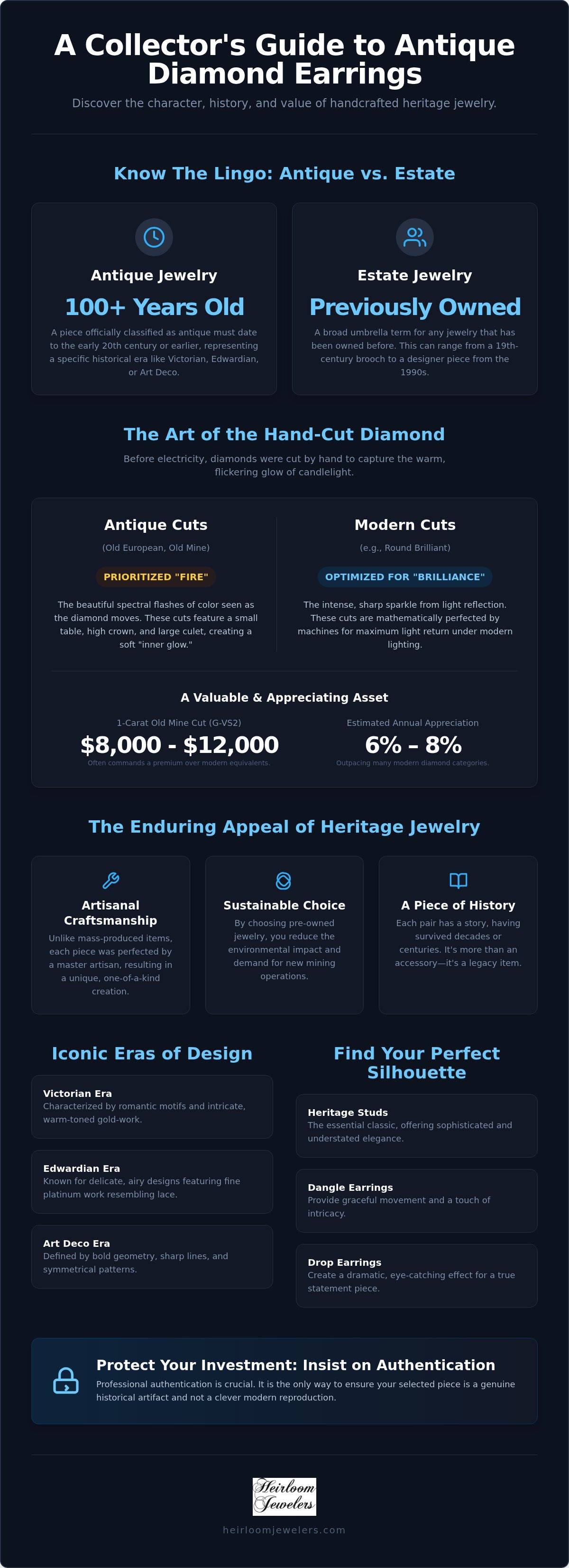
Understanding the terminology is the first step for any collector. The distinction between antique and estate is often misunderstood. In the jewelry industry, an item is officially classified as antique only if it's at least 100 years old. This means a piece must date back to the early 20th century or earlier to earn that title. Many antique diamond earrings fall into the Victorian, Edwardian, or Art Deco eras, each offering a distinct aesthetic language.
Estate jewelry is a much broader umbrella. It simply refers to any piece that has been previously owned. This category can include everything from a late 19th-century brooch to a high-end designer piece from the 1990s. At Heirloom Jewelers, we curate both categories, focusing on rare finds that meet our strict standards for quality and provenance. Whether it's a pair of antique diamond earrings from the late 1800s or a mid-century estate find, the focus remains on artisanal value rather than retail trends.
The Sustainability of Heritage Jewelry
Choosing pre-owned jewelry is one of the most environmentally responsible decisions a collector can make. Modern diamond mining requires significant land displacement and energy consumption. By selecting pieces that are already in circulation, you reduce the demand for new mining operations. This eco-friendly approach doesn't mean compromising on luxury. In fact, many collectors find that older pieces offer a higher level of material quality than modern counterparts. Older gold alloys often have a rich, warm patina that is difficult to replicate artificially. Heritage jewelry is a sustainable investment in craftsmanship.
Understanding Artisanal Diamond Cuts of the Past
Before electricity, diamonds were cut to perform under the warm, flickering glow of a candle. This environment demanded a different approach to faceting. Artisans didn't have computer-aided design to map out mathematical angles. Instead, they relied on their eyes and decades of experience to reveal the stone's inner character. The evolution of Artisanal Diamond Cuts of the Past reveals a shift from these hand-crafted origins toward the machine-driven precision of the modern era. While modern cuts optimize for raw brilliance, older stones prioritize "fire," which is the spectral flash of color seen when light moves through the diamond.
This specialized market often commands a premium. A 1-carat G-VS2 Old Mine cut can cost between $8,000 and $12,000. This is a higher price point than a modern brilliant of similar quality, reflecting the scarcity of these historical stones. Collectors often view these antique diamond earrings as both a style statement and an investment. Quality old mine cuts have been appreciating at a rate of roughly 6% to 8% annually, outpacing many modern diamond categories.
The Old European Cut: A Vintage Favorite
The Old European cut is the direct ancestor of the modern round brilliant. It's characterized by a small table, a high crown, and a large, flat culet at the bottom. When you look through the top of the stone, that large culet creates a distinct "inner glow" that feels softer than the sharp sparkle of modern jewelry. These stones are the centerpiece of many vintage diamond stud earrings because they offer a sophisticated, understated elegance. The hand-polished facets are often slightly asymmetrical, which serves as a fingerprint of the original cutter's work.
Rose Cuts and Old Mine Cuts
Rose cuts date back to the 1500s and offer a completely different silhouette. They feature a flat bottom and a faceted, dome-like top that resembles a rosebud. Because they lack a deep pavilion, they sit low against the ear, making them ideal for delicate, romantic designs. Old mine cuts, by contrast, are squarish "cushion" shapes with high crowns and deep pavilions. They were the standard during the Georgian and Victorian eras. These cuts influence the overall shape of antique diamond earrings, often leading to more substantial, textured metalwork to support the stone's depth. If you're looking for a pair that captures this historical charm, you might consider exploring our collection of authenticated vintage pieces.
A Roundup of Iconic Jewelry Eras and Styles
The aesthetic of a diamond is often defined by the era that shaped its setting. While the cut provides the character, the metalwork provides the context. Most antique diamond earrings found today belong to one of three major design periods. Each era reflects the social and technological shifts of its time, from the romanticism of the 19th century to the industrial energy of the early 20th. Understanding these historic trend-setting jewelry styles helps collectors identify pieces that align with their personal aesthetic and historical interests.
Recent market trends in 2026 show a significant resurgence in these heritage designs. Victorian-inspired romantic jewelry and bold Art Deco pieces are currently the most sought-after categories. This demand is reflected in inventory levels across the industry. In specialized vintage collections, it's common to see over 70% of hand-cut diamond listings sold shortly after they're acquired. Collectors are increasingly drawn to the "candlelit glow" provided by Georgian-style settings, which are also seeing a strong comeback this year.
Victorian and Edwardian Sophistication
The Victorian era (1837–1901) was deeply rooted in symbolism and intricate gold-work. One popular style was the "Dormeuse" or sleeper earring. These were designed with a comfortable back so they could be worn at night to keep the piercing open. To learn more about modern piercing trends and professional hygiene with Stellar Malaysia, these historical designs offer a fascinating point of comparison. They often featured a smaller diamond at the top and a larger one below. Early Victorian pieces used 18k or 15k gold and featured romantic motifs like hearts and serpents. The late Victorian period shifted toward smaller, whimsical designs that prioritized wearable elegance.
As we moved into the Edwardian period, the introduction of the oxyacetylene torch allowed jewelers to work with platinum. This metal was stronger than gold, enabling the creation of "lace-like" filigree. Designs became lighter and more ethereal. Common motifs included bows, flowers, and delicate garlands that complemented the pale silks of the era. These antique diamond earrings often feature Old European cuts set in open-work platinum, creating a look that is both substantial and remarkably light.
The Bold Geometry of Art Deco
The 1920s and 1930s brought a radical shift in design. The soft curves of the previous century were replaced by sharp lines and architectural shapes. Art deco jewelry introduced a sense of modernism that still feels relevant today. Long drop earrings became a staple of the decade. These pieces were designed to swing freely, providing movement that complemented the shorter hairstyles of the "flapper" era. They often used symmetry to highlight diamond clarity, focusing on balance and repetition.
This period also marked the rise of contrasting gemstones. Jewelers often paired diamonds with emeralds, sapphires, or black onyx to create striking visual tension. The focus shifted toward the industrial, reflecting the era's fascination with machines and skyscrapers. Today, these styles remain a favorite for evening wear because of their dramatic silhouettes and high-contrast finishes. Whether you prefer the romanticism of the 1800s or the bold energy of the 1920s, each era offers a distinct way to wear a piece of history.
Comparing Classic Studs, Dangles, and Drop Silhouettes
Selecting a silhouette is a personal process. It requires balancing historical preference with your face shape and daily routine. While some collectors prioritize the dramatic movement of a long drop, others prefer the steady elegance of a classic stud. Each style of antique diamond earrings offers a unique way to frame the face. Understanding these forms helps you build a more cohesive jewelry collection that feels both intentional and timeless.
The Versatility of Vintage Diamond Studs
Studs are the essential foundation for any heritage jewelry collection. They offer a quiet luxury that transitions easily from daytime professional settings to evening events. Old European cut diamonds are particularly suited for this style. Their high crowns and smaller tables create a concentrated flash of light that remains visible even in smaller sizes. Since the GIA doesn't assign modern cut grades to these artisanal stones, you should look for the "inner glow" that characterizes hand-cut work. For durability, many collectors choose platinum or 18K white gold settings. Platinum is particularly valued for its strength and ability to hold stones securely. These pieces serve as a perfect complement to other heritage items, such as a finely crafted antique ring.
Dramatic Drops and Statement Dangles
If you seek movement and drama, drop earrings are the logical choice. These designs, often called "shoulder dusters" in their longer forms, use articulated joints to catch the light with every turn of the head. Many estate pieces incorporate vibrant accents like peridot, quartz, or emeralds to enhance the central diamonds. For instance, estate peridot and quartz dangle earrings illustrate how colorful gemstones can add depth to a vintage silhouette. When selecting these pieces, always inspect the hinges and ear wires. Genuine antique diamond earrings can show subtle signs of wear on the gold after a century of use. Ensuring the mechanical parts are sturdy is vital for long-term security.
Rounder face shapes often benefit from the vertical line of a drop earring, which creates a lengthening effect. Those with more angular features might find that the soft, circular glow of a diamond-encrusted hoop or a large stud provides a pleasing contrast. Hoops range from subtle estate gold bands to intricate Victorian styles featuring rows of rose-cut diamonds. Choosing these pieces is also a sustainable practice. It requires no new mining and preserves the historical value of the materials. Explore our curated collection of authenticated estate jewelry to find a silhouette that resonates with your personal style.
Building a Jewelry Legacy with Heirloom Jewelers
Transitioning from a buyer to a collector is a deliberate shift. It's about moving beyond fleeting trends to find pieces with lasting value. Professional authentication is the foundation of this process. In the high-value secondary market, you must be certain of a stone's origin and any potential treatments. U.S. regulations require the disclosure of known treatments, such as fracture-filling, to protect consumers from misrepresentation. We act as a reliable guide through these complexities, ensuring every pair of antique diamond earrings we offer meets rigorous standards for historical integrity.
Becoming a collector means viewing jewelry as a wearable archive. You aren't just purchasing an accessory; you're preserving a piece of artisanal history. This perspective changes how you evaluate a piece. Instead of looking for modern perfection, you begin to appreciate the subtle asymmetries of a hand-cut stone or the unique patina on a platinum setting. These details are the hallmarks of a genuine antique, distinguishing it from machine-made replicas that lack a sense of soul. Building a legacy requires a focus on these enduring attributes rather than temporary retail fashions.
Curating Your Personal Collection
Finding pieces that resonate with your personal history is what makes a collection unique. You don't have to stay within one specific era to build a cohesive look. Many collectors find that wearing Victorian earrings with a modern blazer creates a sophisticated, layered aesthetic. This contrast highlights the craftsmanship of the past while keeping the styling fresh and relevant. We serve as a steady presence in the estate market, helping you identify antique diamond earrings that align with your personal style while maintaining their long-term value. Our goal is to help you find pieces that you'll be proud to pass down to future generations.
Authenticity and Trust in Fine Jewelry
We prioritize uniqueness over volume. Mass-produced jewelry lacks the weight and detail found in authenticated estate finds. Industry standards, such as those set by the Gemological Institute of America, provide a framework for quality, though antique stones are valued more for character than modern mathematical scales. Precious metals like 18K gold and platinum are vital for preserving these settings. A piece must be at least 10 karats to be labeled gold, but we favor higher purities for their rich color and durability. Platinum is particularly valued for its density, ensuring your jewelry remains a durable part of your legacy. Explore our curated selection of diamond earrings today to begin your journey.
Start Your Heritage Collection
Choosing a pair of antique diamond earrings is a meaningful step toward building a lasting personal legacy. You've seen how artisanal cuts like the Old European and Old Mine offer a unique fire that modern machinery cannot match. These pieces represent more than just aesthetic choices; they are survivors of history. By understanding the nuances of these historic styles, you can select a piece that truly resonates with your individual story and appreciation for craftsmanship.
At Heirloom Jewelers, we specialize in Old European cut diamonds and expertly authenticated estate jewelry. Our curated boutique experience is designed for the discerning collector who values integrity and quality over mass-produced trends. We invite you to explore our selection and find a pair that speaks to your passion for heritage and timeless elegance.
Discover the Timeless Collection at Heirloom Jewelers
Whether you're looking for your first pair of heritage studs or a dramatic set of dangles for a special occasion, the right piece is waiting to be discovered. We look forward to acting as your guide in finding a treasure that will be cherished for generations to come.
Frequently Asked Questions
What is the difference between antique and vintage diamond earrings?
An item is classified as antique only when it reaches at least 100 years of age. Vintage jewelry refers to pieces that are between 20 and 99 years old. Estate jewelry is a broader term that encompasses any previously owned fine jewelry, regardless of its era. Knowing these technical distinctions helps you understand the historical context and rarity of the piece you are considering.
Are old European cut diamonds less sparkly than modern diamonds?
Old European cut diamonds are not less sparkly, but they offer a different type of light performance known as "fire." While modern brilliant cuts are engineered for maximum white light return, artisanal hand-cut stones feature larger facets that create spectral flashes of color. This results in a deep, warm glow that performs exceptionally well in low-light environments, such as candlelight or evening settings.
How can I tell if antique diamond earrings are authentic?
Authentic antique diamond earrings often display subtle asymmetries and irregular girdle thicknesses that are signatures of hand-polishing. Modern replicas typically show perfect machine-cut proportions that lack this individual character. You should also look for era-specific metal hallmarks and the natural patina that develops on 18K gold or platinum over a century of careful wear.
Is it safe to wear antique earrings every day?
It's generally safe to wear heritage pieces daily if they are set in durable metals like platinum or 18K gold. However, you should have the prongs and closures inspected by a specialist every six months to ensure the diamonds remain secure. While robust styles like Edwardian studs are quite resilient, more delicate Victorian filigree designs may require a more mindful approach to daily activities.
What jewelry era is most popular for diamond earrings?
Art Deco and Victorian styles remain the most sought-after eras for collectors in 2026. Art Deco is prized for its architectural symmetry and bold geometric silhouettes that complement modern attire. Victorian earrings are cherished for their romantic symbolism and intricate hand-carved gold-work. Both eras offer a timeless aesthetic that continues to influence contemporary jewelry design while maintaining their historical value.
Can I have antique earrings appraised for insurance purposes?
You can and should have your heritage jewelry appraised to ensure it is protected at its current market value. A professional appraisal documents the specific artisanal cuts, metal purity, and historical provenance of your antique diamond earrings. This documentation is vital for insurance coverage, as these unique pieces cannot be easily replaced with modern mass-produced equivalents found in standard retail stores.
What should I look for in an estate jewelry retailer?
A reputable estate retailer should prioritize professional authentication and demonstrate a deep knowledge of the secondary market. Look for a curator who avoids high-pressure sales tactics in favor of a transparent, educational approach. A trusted authority will be able to explain the nuances of artisanal cuts and provide a boutique experience that focuses on the quality and integrity of their unique collection.
Do antique diamond earrings hold their value over time?
Quality heritage pieces tend to hold their value well due to their scarcity and the specialized demand for hand-cut diamonds. Market data shows that high-quality Old Mine cut diamonds have appreciated at an annual rate of roughly 6% to 8% recently. This consistent growth often outpaces modern diamond categories, making authenticated antique pieces a stable investment for those who value both history and craftsmanship.