
The most captivating diamonds in the world weren't cut for the clinical glare of modern spotlights. They were crafted to dance under the soft, flickering glow of candlelight. If you've ever felt that modern brilliant cuts feel a bit too sharp or sterile, you aren't alone. Many enthusiasts find that standard grading reports don't quite explain the magnetic pull of an antique stone. You might worry about how a diamond with a warmer hue looks against a setting, or fear that a piece is a modern reproduction rather than a genuine piece of history.
Finding the perfect pair of yellow gold old european cut diamond earrings is about more than just reading a report. It's about appreciating a time when artisans cut gems by hand to maximize fire and character. This reference will help you understand why these historic pairings are so highly valued today. We'll show you how to evaluate the unique proportions of an Old European cut and how to identify authentic pieces from a trusted estate jeweler. By the end of this guide, you'll know exactly how to select a high-quality pair of studs that carries both beauty and heritage.
Key Takeaways
- Discover why the "candlelight glow" of the Old European cut (1890-1930) provides a softer, more romantic fire than modern brilliant diamonds.
- Learn how specific geometric traits, such as the high crown and small table, create the distinct light dispersion found in authentic antique stones.
- See how the rich tones of yellow gold old european cut diamond earrings complement warmer diamond colors to create a brighter, more harmonious appearance.
- Gain confidence in evaluating estate studs by focusing on their visual "face-up" match and eye-clean clarity rather than modern grading metrics alone.
- Understand the value of purchasing from an authenticated estate collection to ensure the historical integrity and craftsmanship of your vintage jewelry.
The Enduring Appeal of Old European Cut Diamonds in Yellow Gold
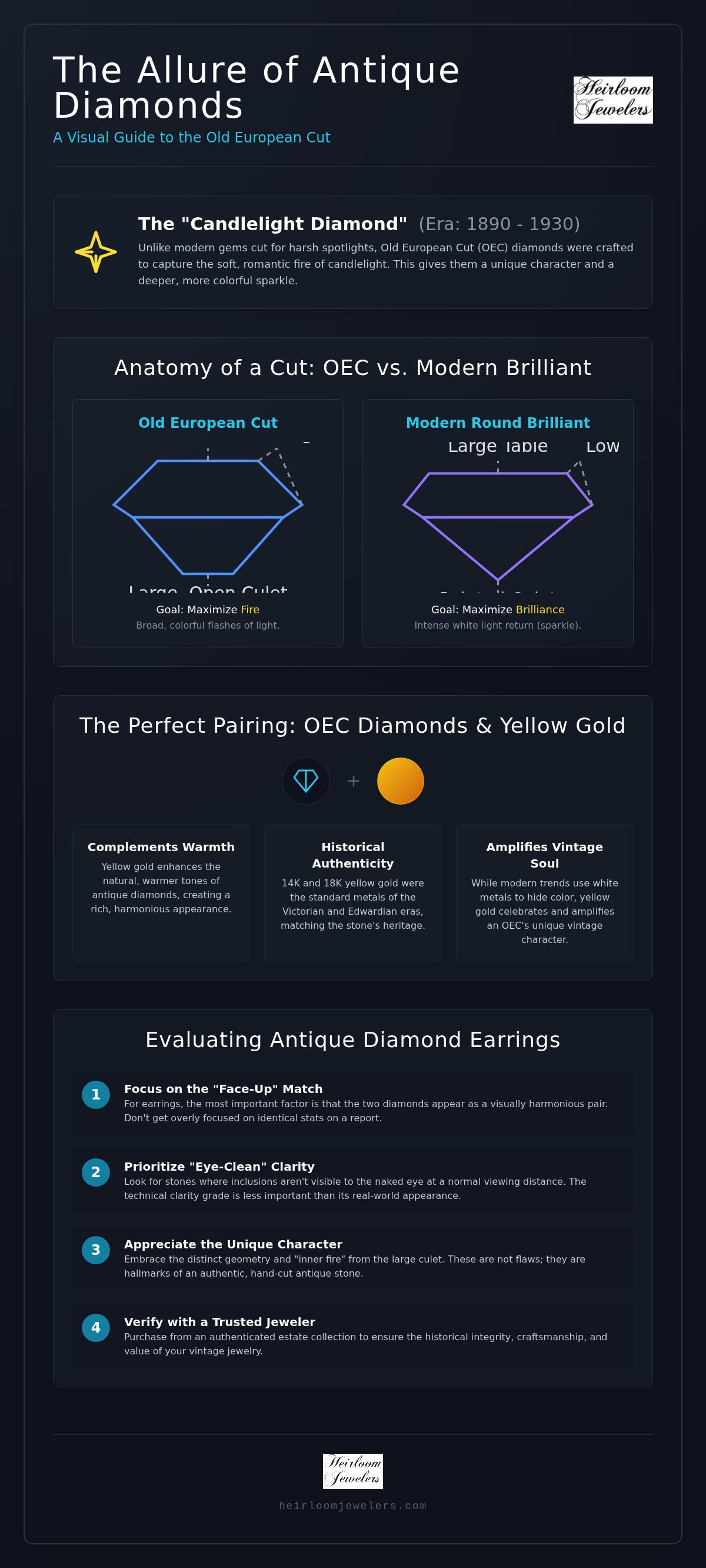
The Old European cut (OEC) represents a pivotal era in the history of diamond cutting. It was the dominant style from roughly 1890 to 1930; it bridged the gap between the hand-hewn Old Mine cut and the mathematically precise modern round brilliant. Unlike modern stones that prioritize maximum white light return, OECs were designed to maximize fire under the soft, low-intensity light of the era. This "candlelight glow" is why yellow gold old european cut diamond earrings remain a primary choice for collectors who value character over clinical perfection.
During the late Victorian and Edwardian periods, 14K and 18K yellow gold were the standard for fine jewelry. This metal provides a warm, rich foundation that complements the naturally occurring warmth often found in antique diamonds. While modern retail often pushes white metals to hide color, the estate market recognizes that yellow gold amplifies the vintage soul of an OEC. These pieces carry an inherent investment value. They are finite resources. As more antique stones are recut into modern shapes, original OECs become increasingly rare and sought after by those who appreciate heritage.
The Heritage of the Old European Cut
Tracing the evolution of this cut reveals a steady shift toward symmetry. Artisans moved away from the squarish cushion shape of the Old Mine cut toward a more refined, circular silhouette. You can identify an OEC by its distinct geometry. It features a high crown and a remarkably small table facet. These proportions allow the diamond to disperse light into broad, colorful flashes rather than the splintered sparkle of modern cuts. Perhaps the most iconic feature is the large, open culet at the base. This flat facet creates a central "inner fire" that adds depth and a recognizable vintage soul to the stone.
Why Earrings are the Ideal Format for OECs
Earrings are arguably the best way to showcase the light performance of an antique diamond. Because they sit at ear level, they catch light from multiple angles, highlighting the steep crown facets that define the cut. A pair of yellow gold old european cut diamond earrings offers incredible versatility. They bridge the gap between Victorian romance and the emerging geometry of the Art Deco period. Whether you are looking for simple studs or more ornate drops, choosing vintage diamond stud earrings ensures your jewelry has a unique presence. They feel substantial. They tell a story. For the collector, they represent a wearable piece of history that remains as relevant today as it was a century ago.
Understanding the Geometry: What Makes an Old European Cut Unique?
To appreciate the beauty of an antique diamond, you must first understand the hands that shaped it. Before modern lasers and computerized mapping, master cutters relied on their eyes and experience to release the light within a stone. This artisanal approach resulted in a geometry that is fundamentally different from today's round brilliant. When you examine a pair of yellow gold old european cut diamond earrings, you aren't just looking at jewelry; you're viewing a specific chapter in the evolution of craft.
The most striking feature of the Old European cut is its high crown. In the broader context of Diamond Cutting History, this era prioritized a steep angle above the girdle. This height, combined with a remarkably small table facet, creates a distinct profile. While modern stones are cut thin to appear larger from the top, an OEC has a "tall" presence. This verticality allows light to travel further through the diamond, enhancing its ability to break white light into a rainbow of colors. Investing in a pair of yellow gold old european cut diamond earrings requires an eye for these specific geometric hallmarks, as they define the stone's personality.
Another signature of the OEC is the large, flat culet at the base. In modern diamonds, the culet is pointed and nearly invisible. In an antique cut, it's a deliberate facet. When you look through the top of the stone, the culet appears as a small, dark circle. This "inner eye" adds a sense of depth and mystery that modern diamonds lack. It's a clear sign of authenticity. Modern reproductions often miss the correct proportions of this facet, resulting in a stone that looks flat or overly dark.
Light Play vs. Brilliance
Modern diamonds are engineered for "brilliance," which is the reflection of white light. This creates a fast, needle-like sparkle. Antique diamonds focus on "fire," or the dispersion of light into spectral colors. The facets on an OEC are larger and more "chunky" than those on a modern stone. This means the diamond produces broad, slow flashes of color that shift as you move. Light dispersion in OECs serves as the primary driver of their aesthetic value, transforming simple illumination into a spectrum of vivid color. It's a more rhythmic, calm form of beauty.
The Role of the Culet in Earring Design
In a stud setting, the large culet provides a focal point that draws the eye inward. This feature is particularly effective at ear level, where the stone catches light from various heights. Because these diamonds were hand-cut, you'll often notice slight asymmetries. One facet might be a fraction larger than its neighbor. We don't view these as imperfections. Instead, they're the fingerprints of the original cutter. These subtle variations ensure that no two stones are perfectly identical, a quality that mass-produced modern jewelry can't replicate. If you're ready to see how these historic proportions look in person, we invite you to browse our estate diamond collection for a piece that truly resonates with your style.
The Aesthetic Synergy of Warm Diamonds and Yellow Gold Settings
Antique diamonds possess a warmth that modern brilliant cuts often lack. Most Old European cut diamonds fall within the J to M color range on the modern scale. This isn't a flaw. In fact, it's a hallmark of the era. During the late 19th and early 20th centuries, these stones were valued for their ability to hold a soft, creamy tint. When choosing a yellow gold old european cut diamond earring, you are embracing a palette that feels historically accurate and intentionally cohesive.
A common concern for collectors is the visibility of color. If you place a warm diamond in a white gold or platinum setting, the cool metal creates a sharp contrast. This makes the yellow tint in the stone more obvious. Yellow gold does the opposite. The rich tones of the metal blend with the diamond's natural warmth. This creates a masking effect that makes the stone appear brighter and more vibrant to the eye. It's an aesthetic synergy that modern white-metal trends often overlook. This metal choice also offers universal appeal. It complements almost every skin tone, providing a healthy glow that white metals can sometimes wash out.
According to GIA's official definition of an Old European cut, these stones must meet specific technical proportions involving table size and crown angles. However, the way those proportions interact with color is where the true artistry lies. Warm gold settings don't just hide color; they celebrate it. This pairing is why yellow gold old european cut diamond earrings feel "correct" to the eye. They honor the original intent of the jeweler who likely never imagined their work under the blue-white light of a modern LED.
14K vs. 18K Yellow Gold for Estate Studs
14K yellow gold is the practical choice for daily wear. It contains a higher percentage of alloy metals, making it resistant to scratches and prong wear. For high-value estate pieces, 18K gold offers a deeper, buttery hue. This higher gold content feels more luxurious and is often found in original Victorian or Edwardian settings. Matching the gold alloy to the era of your diamond ensures the piece looks and feels authentic. It's a subtle detail that distinguishes a true heirloom from a modern reproduction.
Setting Styles: Buttercup, Bezel, and Prongs
The setting you choose dictates the final character of your earrings. Different styles highlight different aspects of the OEC's geometry. We often recommend these three classic options:
- Victorian Buttercup: This scalloped setting mimics the petals of a flower. It emphasizes the soft, romantic nature of the OEC and adds visual weight to the earring.
- Bezel Settings: A thin rim of gold surrounds the diamond's perimeter. This protects the stone and offers a cleaner look while maintaining vintage charm.
- Classic 6-Prong: This style uses minimal metal to secure the stone. It highlights the roundness of the cut and allows the most light to enter the side of the crown.
How to Evaluate Antique Diamond Stud Earrings for Quality
Acquiring a pair of yellow gold old european cut diamond earrings is a different experience than shopping for modern jewelry. You aren't buying a mass-produced product. You are acquiring two individual works of art that have been brought together. In the estate market, a "perfect match" is rarely the objective. Instead, we look for visual harmony and a shared character between the two stones.
Clarity is another area where antique standards differ. We prioritize "eye-clean" stones over lab-certified perfection. Because OECs have larger, chunky facets, they often hide small inclusions better than a modern round brilliant. An SI2 clarity grade in an antique stone might look perfectly clear to the naked eye. This allows you to find a larger, more impactful stone without paying for a technical grade that doesn't change the visual beauty. We always recommend viewing the stones in natural light to see how they perform outside of a jeweler's loupe.
Don't ignore the physical setting. Examine the yellow gold prongs for signs of thinning or uneven wear. Original Victorian or Edwardian settings are wonderful, but they must be structurally sound to protect your investment. If the posts were replaced with modern friction backs, ensure the work was done by a skilled jeweler who respected the original piece's integrity. Look for hallmarks or markers that indicate the gold's purity and the artisan's origin.
The Art of the "Near Match"
When stones are worn on opposite ears, a slight difference in carat weight is invisible. We prioritize the diameter in millimeters over the weight on a scale. A 0.05ct difference is negligible if the face-up size and the crown height are consistent. The most important factor is the "personality" of the cut. You want both stones to have a similar facet pattern and a comparable culet size. This ensures they reflect light in the same rhythmic way, creating a balanced look when worn. Matching the fire and the light dispersion is more vital than matching the numbers on a report.
Certification and the Estate Market
While a GIA or EGL report provides peace of mind, many high-quality antique stones remain uncertified. This is often because unsetting a stone from a delicate vintage mount carries a risk of damage. In these cases, we rely on estimated weights and the expertise of a specialist. A trusted jeweler’s authentication of the era and cut is often as valuable as a modern lab report. If you are seeking a pair of yellow gold old european cut diamond earrings that has been professionally vetted for history and quality, we invite you to explore our authenticated estate collection.
Selecting Your Pair: The Heirloom Jewelers Estate Collection
At Heirloom Jewelers, we don't just sell jewelry; we curate history. Finding a pair of vintage diamond stud earrings that matches in personality and fire takes time and expertise. Our sourcing process focuses on identifying stones that have remained together for decades or pairing loose stones that share a common soul. This meticulous approach ensures that every pair of yellow gold old european cut diamond earrings in our inventory offers a cohesive, balanced look. We look for the "near match" that provides visual harmony when worn on opposite ears.
Every item passes through a rigorous authentication process. We verify the gold purity, the specific cut of the diamond, and the era of the setting. This transparency is central to our role as a trusted guide in the secondary market. You aren't just buying a diamond; you're acquiring a piece of history that has been vetted by specialists. We understand the nuances of hand-cut facets and historic alloys. Our goal is to provide you with a piece that carries both beauty and integrity.
Choosing estate jewelry is an act of sustainable luxury. By selecting pre-owned pieces, you're opting for an ethical path that avoids the environmental impact of new mining. These diamonds were unearthed and cut over a century ago. They represent a finite resource that carries its own legacy. It's a way to enjoy high-value fine jewelry while respecting the planet. We take pride in helping our clients build collections that are as responsible as they are beautiful.
Beyond the Diamond: Unique Estate Pairings
While many start their journey with diamond studs, the world of antique jewelry offers a vast spectrum of color. For those seeking a different aesthetic, our collection includes vibrant options like our Estate Peridot & Quartz Dangle Earrings 14K Yellow Gold. These pieces demonstrate how historic cuts can highlight colored gemstones with the same romantic fire as a diamond. We often help clients transition from the understated elegance of yellow gold old european cut diamond earrings to more elaborate estate drops for special occasions. We invite you to view our complete national collection online to discover the full breadth of our curated offerings.
Caring for Your Heritage Earrings
Preserving the beauty of your estate earrings requires a gentle touch. Use a soft brush and mild soapy water to clean your diamonds. Avoid ultrasonic cleaners for antique settings, as the vibrations can loosen stones in older mounts. The patina on 14K or 18K yellow gold is a mark of age that many collectors cherish; don't try to polish it away to a modern mirror finish. Regular maintenance is essential. We recommend professional prong checks every six months to ensure your diamonds remain secure in their settings. Taking these small steps protects the integrity of your heirloom for the next generation.
Investing in a Timeless Legacy
Owning a pair of yellow gold old european cut diamond earrings is an investment in both artistry and history. These stones offer a rhythmic, broad fire that modern diamonds simply can't replicate. By understanding the unique geometry of the high crown and the large culet, you can select pieces that carry a genuine vintage soul. The synergy between warm yellow gold and the natural tint of an antique diamond creates a look of quiet confidence that remains unmatched by mass-produced jewelry.
Choosing estate jewelry allows you to prioritize character and sustainability. We are here to act as your guide through the complexities of the secondary market. Please browse our curated collection of authenticated Old European cut diamond earrings to find a pair that resonates with your personal style. As an authenticated estate jewelry specialist, we provide national shipping and secure packaging for every piece in our expertly curated vintage collection. We look forward to helping you find a piece of history that you'll cherish for a lifetime.
Frequently Asked Questions
What is the difference between an Old European Cut and a Modern Round Brilliant?
An Old European cut features a higher crown and a smaller table than a modern round brilliant. These proportions were hand-cut to maximize fire in low light conditions. While modern diamonds prioritize brilliance and white light return, the OEC offers broader, slower flashes of spectral color. This creates a more rhythmic and romantic light performance than the needle-fire sparkle of modern stones.
Why are Old European cut diamonds often set in yellow gold?
Yellow gold provides a historically accurate setting that complements the natural warmth of antique stones. This pairing was the standard during the late 19th and early 20th centuries. When you choose yellow gold old european cut diamond earrings, the metal's rich tone helps warmer diamonds appear brighter. It creates an aesthetic synergy that feels more integrated than the sharp contrast of white metals.
Are Old European cut diamonds more expensive than modern diamonds?
The value of Old European cut diamonds is now comparable to, and occasionally higher than, modern brilliant-cut diamonds of similar quality. This represents a significant shift from previous decades when they were often devalued. Their rarity and the growing appreciation for artisanal craftsmanship drive modern market demand. High-quality antique stones are increasingly sought after by collectors who value heritage over mass production.
Can I wear vintage yellow gold diamond earrings every day?
You can wear these earrings daily as long as the settings are structurally sound. Diamonds are the hardest natural substance, making them ideal for frequent use. We recommend 14K gold for daily wear due to its superior durability compared to higher karat alloys. You should still perform regular prong checks every six months to ensure the stones remain secure in their historic mounts.
How do I know if my Old European cut diamond is real or a reproduction?
Authentic OECs often show subtle asymmetries and hand-cut markers like a large, flat culet at the base. Modern reproductions tend to be too symmetrical and often lack the specific crown height characteristic of the era. A professional evaluation can confirm if the stone's geometry matches the historical standards of the early 1900s. Look for the "inner fire" created by the unique facet proportions.
What should I look for in a "matched" pair of antique earrings?
Look for a match in millimeter diameter and face-up personality rather than exact carat weight. Because these stones were hand-cut, finding two identical diamonds is nearly impossible. Focus on how the facet patterns and light dispersion align to create visual harmony. When you evaluate yellow gold old european cut diamond earrings, the goal is a balanced pair that reflects light in a similar rhythm.
Is yellow gold or white gold better for a K-color Old European cut diamond?
Yellow gold is the superior choice for diamonds in the K-color range or lower. The warm metal tones blend with the diamond's natural tint, making the stone appear whiter and more vibrant to the eye. In contrast, white gold or platinum creates a cool backdrop that highlights the diamond's warmth. This makes the yellow tint more noticeable rather than masking it effectively.
Do Old European cut diamonds hold their value over time?
Old European cut diamonds hold their value well because they are a finite, non-renewable resource. As more of these stones are recut into modern shapes, original examples become increasingly rare. Collector demand for authentic, hand-cut heritage pieces continues to grow steadily. This rarity, combined with their historical significance, supports their long-term market stability and makes them a sound choice for serious collectors.