
An authentic Art Deco diamond bracelet is more than a piece of jewelry; it's a masterclass in architectural engineering that happens to sit on your wrist. You likely appreciate the striking symmetry and the way these pieces capture the electric energy of the 1920s. However, it's understandable to feel hesitant when distinguishing a true antique from a modern reproduction. The market for art deco diamond bracelets is currently seeing a major revival in 2026, making it more important than ever to understand exactly what you're adding to your collection.
This guide provides the clarity you need to evaluate these pieces with the eye of a seasoned collector. We'll examine the structural integrity of hundred-year-old platinum links, the unique fire of Old European cut diamonds, and how to verify the provenance of these Jazz Age treasures. You'll gain the confidence to invest in a piece of history that offers both aesthetic brilliance and lasting value. By focusing on the craftsmanship of the early twentieth century, you can find a bracelet that meets the highest standards of geometric precision and material quality.
Key Takeaways
- Recognize the architectural shift from Victorian curves to the bold geometric symmetry that defined Jazz Age sophistication.
- Identify authentic materials like platinum and Old European cut diamonds that distinguish genuine art deco diamond bracelets from modern reproductions.
- Differentiate between iconic silhouettes, ranging from the structured simplicity of line bracelets to the delicate complexity of filigree links.
- Use a curator’s eye to verify authenticity by examining hallmark placements and the fluid movement of antique metalwork.
- Understand the investment value of estate jewelry, which prioritizes historical integrity and rare craftsmanship over mass-market trends.
The Enduring Legacy of Art Deco Diamond Bracelets
The Art Deco period, spanning from 1920 to 1935, represented a sharp departure from the ornate, flowery aesthetics of the Victorian and Edwardian eras. Designers moved away from soft curves and naturalistic motifs in favor of bold, streamlined forms. This era was defined by a collective desire for modernity and a clean break from the past. It was a time of rapid social change and artistic innovation that redefined the concept of luxury for a new generation.
During the Jazz Age, fashion underwent a radical transformation. The iconic "flapper" style introduced sleeveless dresses, which left the arms bare and created an ideal canvas for art deco diamond bracelets. These pieces were the essential accessory of the decade. Women often wore them in multiples, stacking linear designs to create a shimmering effect that caught the light during evening dances. This shift made the bracelet a central fashion statement rather than a secondary detail.
The preference for materials shifted significantly during this time. While yellow gold had been the standard for centuries, the 1920s favored the cool, monochromatic brilliance of white metals. Platinum became the premier choice for master jewelers crafting art deco diamond bracelets. Its exceptional strength allowed for the creation of incredibly fine, lace-like settings that could securely hold numerous small diamonds. For those seeking a similar aesthetic, 18K white gold provided a sophisticated and durable alternative.
The Aesthetic Shift: From Nature to Machines
The Industrial Revolution deeply influenced jewelry design. Craftsmen embraced symmetry, repetition, and bold linear patterns that mirrored the skyscrapers of the modern world. Every link was a study in geometric precision. A pivotal moment for this style was the 1925 Paris Exposition, which formally launched the Art Deco movement globally. This event solidified the transition from organic curves to the structured, architectural elegance collectors admire today.
Why Art Deco Remains a Collector Favorite in 2026
Collectors in 2026 seek these pieces for their rarity and historical integrity. Finding original links in pristine condition is increasingly difficult. These bracelets offer a sense of permanence that modern retail often lacks. The versatility of white metal and diamonds allows these antiques to suit contemporary wardrobes perfectly. Choosing estate jewelry also supports sustainability by preserving existing craftsmanship rather than relying on newly mined stones.
Defining Characteristics: Platinum, Geometry, and Old European Cuts
Platinum was the metal of choice for the era's most ambitious designs. Its density and strength allowed jewelers to push the limits of metalwork, creating art deco diamond bracelets that appeared as delicate as lace but remained structurally sound. This durability facilitated the use of intricate filigree and milgrain. Milgrain is the tiny beaded metal border that adds texture to Deco edges. Designers used this technique to soften the transitions between stones and metal, giving each piece a finished, professional appearance.
The visual impact of these bracelets often relies on the contrast between colorless diamonds and vibrant accent stones. Craftsmen used caliber-cut emeralds, sapphires, and onyx to outline geometric shapes or provide a focal point within a link. These stones were custom-cut to fit precisely into the channels of the design, ensuring no metal was visible between the gems. This seamless integration creates a saturated pop of color that emphasizes the linear nature of the jewelry.
The Brilliance of Old European Cut Diamonds
Unlike the machine-cut precision of modern round brilliants, Old European cut diamonds were hand-faceted to perform under the soft glow of candlelight. You can identify these stones by their high crowns, small tables, and large culets. These specific proportions create a deep, "inner glow" that feels warm and substantial. Modern diamonds often prioritize a splintery, rapid flash, but the stones found in these collectible estate bracelets offer a more methodical light return. These hand-cut treasures are almost exclusively found in platinum or 18K white gold settings, as the cool tones of these metals best complement their natural beauty.
Geometric Mastery and Symmetry
Symmetry is the cornerstone of the Art Deco aesthetic. Craftsmen utilized step-cuts and baguettes to build architectural depth within each link. Repeating motifs, such as sunbursts or chevrons, create a sense of infinite rhythm as the bracelet wraps around the wrist. High-end designs frequently featured "open work" or piercing, where the metal was meticulously cut away to create negative space. This technique ensured the piece felt light and flexible while maximizing the light hitting the diamonds from every angle. If you're looking for an authentic piece with this level of detail, you might enjoy exploring our curated collection of vintage jewelry. Each link in a high-quality Deco bracelet is an individual work of art, joined together with hidden hinges that allow the metal to drape like fabric.
Exploring Iconic Styles: From Line Bracelets to Filigree Links
Art Deco jewelry design reached its zenith in the variety of bracelet silhouettes produced between 1920 and 1935. While many modern collectors are familiar with the standard tennis bracelet, the original art deco diamond bracelets offered far more architectural diversity. These pieces were engineered to be flexible yet substantial. Hidden hinges and precise metalwork ensured they moved with the wearer. Each link was a study in precision.
One of the most impressive styles is the strap bracelet. These are wide, multi-row masterpieces that often feature central plaques or honeycomb patterns. They represent the high-drama end of the spectrum, frequently incorporating several carats of diamonds in a single piece. Another essential feature of authentic estate jewelry is the hidden box clasp. In a well-crafted piece, the clasp is integrated so seamlessly that it's nearly invisible when closed. A safety chain or a fold-over safety latch provides an extra layer of security. This reflects the high value of these historic items.
The Evolution of the Diamond Line Bracelet
The diamond line bracelet is perhaps the most enduring style from this period. Before the 1920s, women primarily wore stiff bangles. The move toward flexible linear links was a significant technical achievement. Master jewelers used individual box settings for each stone. These boxes protected the edges of the diamonds while allowing the bracelet to drape smoothly over the wrist. This streamlined look remains a favorite for its understated elegance. These versatile pieces pair exceptionally well with antique diamond earrings, creating a cohesive aesthetic that balances history with modern wearability.
Intricate Filigree and Pierced Metalwork
Filigree link bracelets showcase a different side of Jazz Age sophistication. Rather than a simple line, these bracelets feature wide links with hand-sawn patterns. Artisans used tiny saws to pierce sheets of platinum. This created lace-like designs that appear delicate but remain incredibly strong. This technique allowed for art deco diamond bracelets that had significant presence on the wrist without feeling heavy or cumbersome.
Finding these pieces in pristine condition is a challenge for collectors today. Because the metalwork is so fine, many original bracelets have suffered from crushing or poor repairs over the last century. An authentic, un-modified filigree bracelet is a rare find. It represents a level of hand-craftsmanship that is virtually impossible to replicate with modern casting methods. We prioritize sourcing pieces where the original links remain crisp and the geometric symmetry is perfectly preserved.
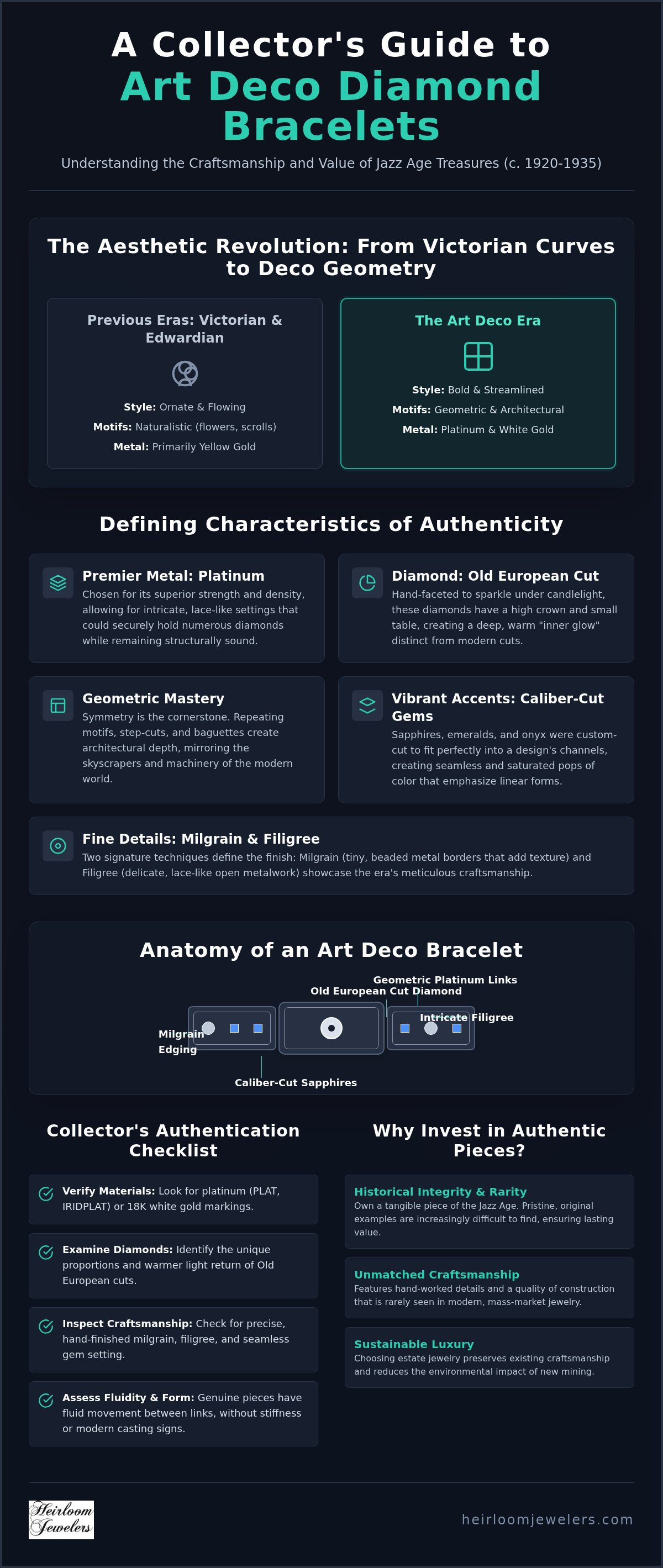
Collector’s Checklist: Authenticating and Evaluating Estate Bracelets
Evaluating authentic art deco diamond bracelets requires a methodical approach. Start your inspection with the metal. Pieces from the 1920s and 1930s were almost exclusively crafted in platinum or 18K white gold. Look for "PLAT" or "18K" hallmarks, which are typically stamped on the tongue of the clasp. If a piece was resized in the past, these marks might be missing. In such cases, the quality of the metalwork becomes your primary indicator of age and origin.
Pick up the bracelet and observe how it moves. It should drape smoothly over your hand without catching or feeling stiff. Authentic links were hand-assembled with precision hinges that allow for maximum flexibility. If the metal feels rigid or the links don't align perfectly, the piece may be a lower-quality reproduction. Additionally, check for diamond consistency. Master jewelers of the era hand-selected stones for uniform color and clarity. While hand-cut diamonds have slight variations, the overall appearance should be harmonious. For high-value estate jewelry, always secure an independent appraisal to verify these technical details.
How to Spot a Modern Reproduction
Modern "vintage-inspired" pieces are often cast from molds rather than hand-fabricated. This casting process results in soft or blurry details, particularly in the milgrain and filigree. Hand-fabricated antiques feature crisp, sharp lines that remain distinct under a jeweler’s loupe. Examine the diamond cuts; finding modern brilliant cuts in a supposedly antique setting is a clear sign of a reproduction or a modern replacement. Finally, turn the piece over. A true antique is finished as beautifully on the back as it is on the front. Modern mass-produced items often leave the back unfinished to reduce labor costs.
Styling and Layering Your Art Deco Bracelet
The "Art Deco Stack" remains a sophisticated way to wear your collection. You can create visual interest by mixing different widths of line bracelets or pairing a wide strap bracelet with a delicate filigree link. These pieces also pair seamlessly with vintage engagement rings to create a cohesive, historically grounded aesthetic. Proper care is essential for preservation. Avoid using ultrasonic cleaners, especially for pieces with delicate filigree or emerald accents. A soft brush and mild soapy water are usually sufficient for routine cleaning. If you are ready to begin your collection, you can view our authenticated estate collection to find a piece that meets these rigorous standards.
Investing in History: Why Choose Authentic Estate Pieces
Investing in an authentic piece is a decision that balances financial prudence with personal appreciation. While "vintage-inspired" jewelry relies on modern casting and mass-production, authentic art deco diamond bracelets represent a finite historical resource. These pieces possess both intrinsic value, based on the weight of the platinum and diamonds, and significant collector value derived from their provenance and craftsmanship. They don't suffer the immediate depreciation often seen with modern retail jewelry. Instead, their value is supported by a global market of collectors who prioritize historical integrity.
The demand for these treasures is reflected in the current secondary market. For instance, an upcoming auction in September 2026 features a platinum and diamond Art Deco bracelet with an estimate of $20,000 to $30,000. This level of interest persists because these pieces are survivors. There's a profound emotional resonance in wearing a bracelet that has retained its brilliance for over a century. At Heirloom Jewelers, we're committed to curating only the finest authenticated estate finds, acting as a bridge between the original artisans of the 1920s and the collectors of today.
The Rarity of Original Art Deco Engineering
Modern manufacturing simply cannot replicate the techniques used during the Jazz Age without incurring prohibitive costs. Techniques like hand-applied milgrain and individual link fabrication are too labor-intensive for contemporary mass production. This creates a finite supply of authentic jewelry, which drives long-term demand and stability in value. When you examine the bold linear patterns and repeating motifs, it's helpful to compare the geometry to the Art Deco jewelry pillar. This architectural approach to design ensures that these pieces remain relevant regardless of shifting fashion trends.
Building Your Jewelry Legacy
Choosing a cornerstone piece is the first step in building a meaningful collection. A high-quality Art Deco bracelet serves as an anchor, offering a versatility that suits both formal events and daily wear. We view our role as more than just merchants; we're guides in the complex secondary market, helping you verify materials and evaluate the condition of rare finds. By selecting an authenticated antique, you aren't just buying a piece of jewelry. You're preserving a chapter of history. We invite you to explore our curated collection of authentic Art Deco diamond bracelets and discover the enduring allure of Jazz Age sophistication.
Secure Your Own Piece of Jazz Age History
Authentic art deco diamond bracelets represent the pinnacle of early twentieth-century engineering and aesthetic ambition. By understanding the hallmarks of original platinum settings and the distinct fire of Old European cut diamonds, you can navigate the secondary market with confidence. These pieces are more than mere accessories; they're durable investments that have already stood the test of time for over a century. Whether you prefer the streamlined elegance of a line bracelet or the intricate detail of filigree links, choosing a genuine antique ensures you're preserving a true work of art.
Heirloom Jewelers is dedicated to acting as your trusted guide in this journey. As specialists in Old European cut diamonds, we maintain an expertly curated vintage collection that focuses on rare, high-quality finds. Our team remains passionate about the history behind every piece, ensuring that every item in our authenticated estate jewelry inventory meets rigorous standards for condition and origin. We invite you to Browse Our Curated Collection of Authentic Art Deco Diamond Bracelets to find a cornerstone piece for your own legacy. Owning a fragment of history is a rewarding experience that offers beauty and value for generations to come.
Frequently Asked Questions
How can I tell if my Art Deco bracelet is real platinum?
Real platinum is identified by specific hallmarks like "PLAT" or "950," which you'll usually find on the tongue of the clasp. Platinum is significantly denser and heavier than white gold, giving it a substantial feel on the wrist. Unlike silver, it doesn't tarnish or oxidize over time. If the hallmark is worn away, a professional jeweler can perform a non-destructive acid test to confirm the metal's purity and ensure its authenticity.
What is the difference between an Art Deco line bracelet and a tennis bracelet?
The primary difference lies in the setting and the diamond cut. An Art Deco line bracelet typically features individual box settings that protect the stones, while modern tennis bracelets often use prong settings. Authentic art deco diamond bracelets also feature Old European or single-cut diamonds rather than the modern round brilliants found in contemporary styles. These vintage pieces prioritize geometric structure and hand-fabricated metalwork over the mass-produced uniformity of modern retail.
Are Old European cut diamonds less valuable than modern ones?
Old European cut diamonds aren't less valuable; they're simply valued for different attributes like rarity and historical character. Collectors often seek out these stones for their unique "inner glow" and hand-faceted charm, which modern machine-cut diamonds lack. Because these diamonds are no longer produced, high-quality examples in original settings can command significant premiums in the secondary market. Their value is rooted in their status as finite historical artifacts.
Can an antique Art Deco bracelet be resized without losing its value?
Resizing is possible but must be handled by a specialist familiar with antique hinges and link construction. Adding or removing links can impact the symmetry of the design, which is a key feature of art deco diamond bracelets. If links are removed, you should always keep them to preserve the piece's future value and provenance. A skilled jeweler can perform the work discreetly to maintain the structural integrity and aesthetic flow of the original design.
What should I look for in an estate jewelry appraisal?
A comprehensive estate appraisal should clearly identify the era, the metal purity, and the specific cuts of the gemstones. It should distinguish between "Art Deco style" and "Art Deco period" to confirm authenticity. Look for details on the condition of the hinges, the security of the clasp, and any evidence of past repairs. This documentation is vital for insurance purposes and establishes the piece as an authenticated historical item rather than a reproduction.
How do I clean my vintage diamond and platinum bracelet safely at home?
To clean your bracelet safely, use warm water mixed with a small amount of mild, ammonia-free dish soap. Gently scrub the links with a soft-bristled toothbrush to remove dust and oils. You should never use ultrasonic cleaners or harsh chemicals on vintage jewelry, as these can loosen old settings or damage delicate filigree. If your bracelet contains emeralds or other porous gemstones, consult a professional before attempting any home cleaning methods.
Why are some Art Deco bracelets made of white gold instead of platinum?
White gold was patented in 1917 and became a popular, more accessible alternative to platinum during the 1920s. While platinum remained the premier choice for high-end commissions, 18K white gold allowed a wider audience to enjoy the fashionable "white metal" look of the period. Both metals are durable and offer the cool, monochromatic aesthetic that defines the era. Choosing between them often comes down to personal preference for weight and specific craftsmanship details.
What are caliber-cut stones and why are they common in Art Deco jewelry?
Caliber-cut stones are gemstones specifically fashioned to fit into a precise geometric setting, such as a curved channel or a sharp corner. These stones, often emeralds, sapphires, or onyx, were hand-cut by master lapidaries to create a seamless ribbon of color. This technique is a hallmark of the period because it emphasizes the bold, architectural lines of the jewelry. It requires a level of precision that is rarely seen in modern mass-produced items.