
A genuine Art Deco platinum ring is not just jewelry; it is a structural masterpiece that has already outlasted a century of history. You likely appreciate the geometric precision and romantic spirit of the 1920s, yet the fear of accidentally purchasing a modern reproduction at an antique price point is a valid concern. Finding authentic art deco platinum engagement rings requires a discerning eye for the hand-pierced details and milgrain edges that modern mass-production simply cannot replicate.
It is natural to feel overwhelmed by the complexities of vintage diamond grading or the maintenance requirements of a hundred-year-old heirloom. This guide will help you master the nuances of Jazz Age craftsmanship so you can find a piece that balances historical integrity with timeless elegance. We will explore how to identify specific era markers, evaluate the fire of an Old European cut, and understand the enduring value of platinum as a noble metal. By the end of this article, you will have the confidence to secure a one-of-a-kind investment that reflects your unique story and values.
Key Takeaways
- Understand why platinum became the definitive metal for the Jazz Age due to its superior strength and natural white luster.
- Learn to identify authentic art deco platinum engagement rings by looking for hand-applied milgrain and geometric symmetry.
- Discover the unique fire of the Old European Cut and how it differs from modern round brilliant diamonds found in contemporary settings.
- Gain practical knowledge on the durability of century-old platinum; understand the specific resizing considerations for intricate filigree bands.
- Recognize the importance of sourcing from specialized estate jewelers to ensure historical integrity and avoid modern, mass-produced reproductions.
The Architectural Legacy of Art Deco Platinum Engagement Rings
The Art Deco era, spanning roughly from 1920 to 1935, represented a radical departure from the soft, organic forms of the preceding Art Nouveau period. While the previous century favored flowery motifs and whimsical curves, the Jazz Age embraced the machine. This shift introduced a bold, linear geometry to fine jewelry that feels as modern today as it did a hundred years ago. Much of this aesthetic evolution was made possible by the rise of Art Deco as a global movement that prioritized symmetry, streamlining, and structural integrity.
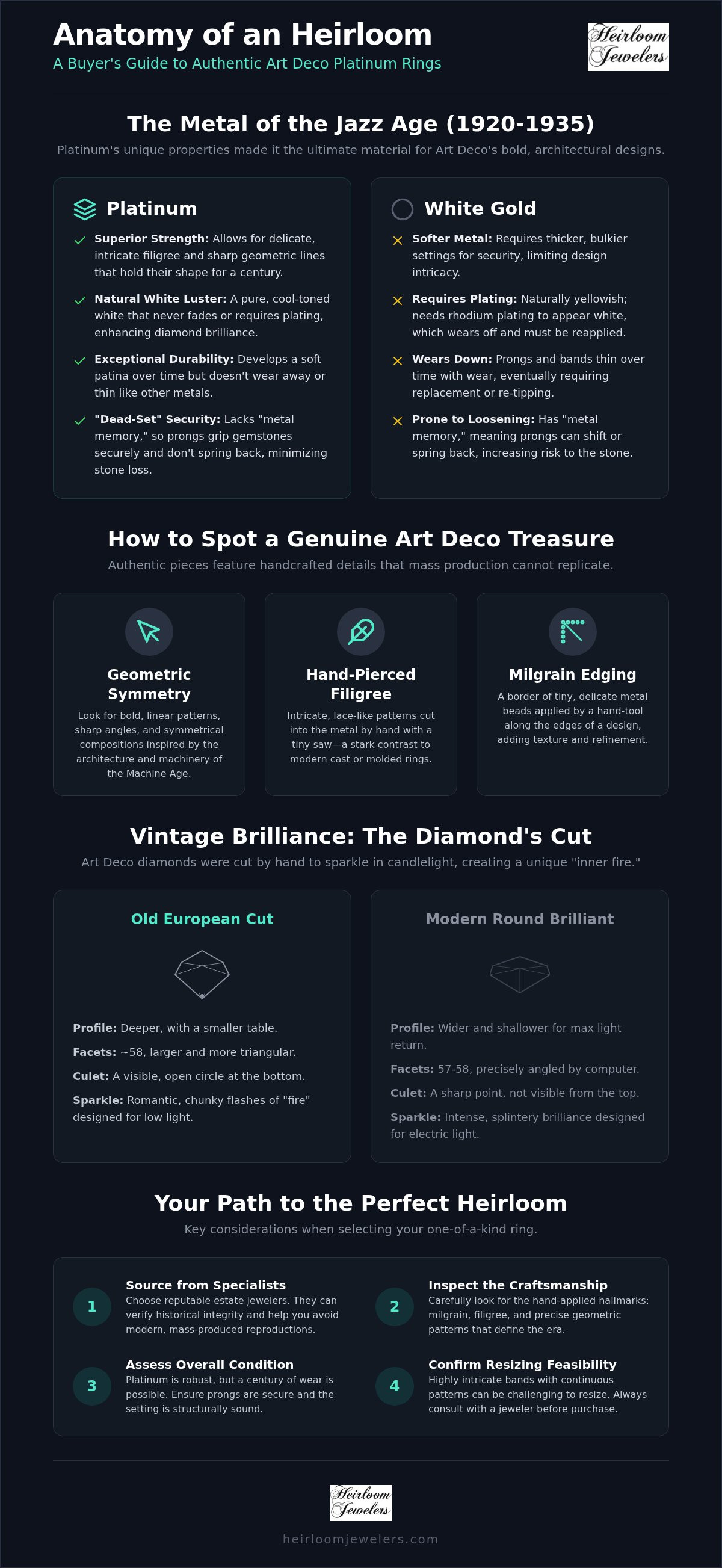
During this period, platinum ascended as the "noble metal" of choice for high-end commissions. Its natural white luster and immense strength allowed jewelers to create incredibly fine settings that remained secure over time. Unlike modern mass-produced rings that rely on thick, cast molds, authentic art deco platinum engagement rings were often hand-fabricated. This distinction creates a sense of heritage that contemporary jewelry often lacks. Every piece tells a story of artisanal skill, where the metal was worked by hand to achieve a level of detail that machines cannot replicate.
The Shift from Yellow Gold to the White Metal Revolution
The transition from the Edwardian period to the Art Deco era saw a significant change in material preference. Edwardian designs were often lace-like and airy, frequently utilizing yellow gold with silver toppers. As the industrial age progressed, the discovery of significant platinum deposits in the Ural Mountains and South Africa provided jewelers with a more durable alternative. This metal didn't just offer strength; it offered a canvas for the sharp, clean lines of the new industrial aesthetic. The Roaring Twenties were defined by a "White Metal" trend where the cool, monochromatic glow of platinum became the ultimate symbol of sophistication and modern luxury.
Why 2026 Couples are Returning to Jazz Age Aesthetics
Today's couples often seek more than just a beautiful stone; they want a connection to the past. Choosing estate jewelry is a powerful way to prioritize sustainability, as it requires no new mining and preserves existing historical artifacts. In an era of fast fashion, the exclusivity of owning a one-of-a-kind piece is a significant draw. These rings are not just accessories but are investments in history. To understand the full scope of this era's influence, you can explore our Definitive Guide to Art Deco Jewelry to see how these designs continue to shape modern romance.
Why Platinum Defined the Art Deco Era’s Jewelry Craftsmanship
Platinum was the essential ingredient for the architectural precision of the 1920s. Its unique physical properties, high density and natural white luster, made it the perfect medium for the era's geometric ambitions. While gold is relatively soft and requires thickness for stability, platinum is incredibly strong. This allowed artisans to push the boundaries of design, creating the delicate, lace-like filigree and sharp angles that define art deco platinum engagement rings. Because platinum is naturally white, it does not require the rhodium plating seen in modern white gold. It maintains its cool, silvery glow for a lifetime.
During the 1920s and 1930s, jewelers typically alloyed platinum with iridium. This combination, often referred to as "Iridium-Platinum," increased the metal's hardness without sacrificing its workable nature. There is a common misconception that vintage platinum is "too soft" for daily wear. In reality, while platinum can develop a soft "patina" of tiny scratches over decades, it does not thin or wear away like gold. If you view our current selection of estate pieces, you will see how these settings have preserved their structural integrity for over a century.
The Strength of the Setting: Security for Heirloom Diamonds
Platinum is prized for its security. It possesses a quality jewelers call "dead-set," which refers to a lack of metal memory. When a platinum prong is moved into place over a diamond, it stays there. It does not spring back. This allows the metal to "grip" the stone with a persistence that gold cannot match. A 100-year-old platinum band often retains more of its original metal weight than a 14K white gold ring from the same era. While gold prongs thin out and eventually require "re-tipping," platinum prongs remain robust. The Timeless Allure of Art Deco is found largely in this permanence, ensuring that the centerpiece diamond remains safe through generations of wear.
Historical Hallmarks and Metal Purity Standards
Identifying an authentic vintage piece requires a close look at the hallmarks. Most American-made art deco platinum engagement rings from the 1920s are stamped with "PLAT" or "900 PLAT." You will frequently find the "IRID" or "10% IRID" mark, which signifies the piece is 90% platinum and 10% iridium. This was the gold standard for luxury jewelry of the time. We recommend using a 10x jeweler's loupe to inspect the inside of the shank. These marks are often tiny and may be partially worn, but their presence is a strong indicator of historical authenticity and metal purity as stipulated by regulations like the National Gold and Silver Stamping Act of 1906.
Key Characteristics of Authentic Art Deco Platinum Rings
Authentic art deco platinum engagement rings are defined by a rigorous adherence to geometric symmetry and repetitive patterns. This visual language was a direct response to the industrial progress of the early 20th century. Designers moved away from the literal interpretations of nature found in earlier eras, opting instead for abstract shapes and mirrored arrangements. To understand the cultural shifts that informed these choices, one can look to Art Deco: The Period, the Jewelry for a deeper look at how the Roaring '20s influenced gemstone selection and setting styles.
One of the most striking features of this period is the use of "calibre cut" side stones. These are small, custom-cut emeralds, sapphires, or rubies that were shaped specifically to fit into a setting's geometric borders. Unlike modern jewelry where the setting is often built around the stones, Deco artisans frequently cut the gemstones to accommodate the design of the metal. This level of precision creates a seamless transition between the cool white of the platinum and the vibrant flashes of color from the accent stones.
Filigree and Milgrain: The Marks of Hand-Artisanship
True craftsmanship is visible in the smallest details, specifically through milgrain and filigree. Milgrain is the technique of creating tiny, beaded edges along the borders of a setting. In an authentic vintage ring, this was applied by hand using a specialized tool. Filigree involves pulling fine platinum wire into intricate, lace-like patterns. This openwork was often hand-pierced and sawed from a solid piece of metal. You can explore the Timeless Artistry of Antique Rings to see how these delicate features compare to modern cast replicas. Contemporary 3D-printed rings often have "mushy" or rounded edges, whereas genuine art deco platinum engagement rings possess crisp, sharp lines that reflect the light with architectural precision.
Step Cuts and Baguettes: The Geometry of the 1930s
As the movement progressed into the 1930s, the design language became even more streamlined and vertical. This shift introduced the "skyscraper" aesthetic, characterized by tiered settings and the heavy use of baguette and emerald-cut side stones. These step-cut diamonds were the perfect match for platinum’s cool tone because their clean, long facets mirrored the metal's industrial elegance. These stones were often used to frame a central Old European cut diamond, creating a sophisticated contrast between the round brilliance of the center and the sharp, rectangular borders of the shoulders. This structural approach ensured that the ring felt balanced, substantial, and undeniably modern for its time.
Evaluating Diamonds and Gemstones in Vintage Platinum Settings
The centerpiece of most authentic art deco platinum engagement rings is the Old European Cut (OEC) diamond. This cut represents a pivotal moment in gemological history, serving as the predecessor to the modern round brilliant. Unlike modern stones that are engineered for maximum light return using computer algorithms, OEC diamonds were cut by hand to maximize "fire," the flash of spectral colors. These diamonds possess a unique soul. Their large facets create broad, chunky reflections that differ significantly from the splintered brilliance of modern cuts.
One practical advantage of these vintage stones is how they interact with their settings. While modern grading often prioritizes colorless diamonds, many OEC stones fall into the J to L color range. In a platinum setting, these stones often appear whiter than their grade suggests. Platinum’s natural white luster provides a neutral background that does not reflect yellow tones into the diamond’s facets. This allows for a beautiful, bright appearance while offering a distinct historical character that modern colorless stones can lack.
Old European Cut vs. Modern Brilliant: A Comparison
When evaluating a diamond, look for the specific proportions of the Jazz Age. An OEC diamond typically features a smaller table, the top flat facet, and a much higher crown than a modern stone. A defining characteristic is the culet, the flat facet at the bottom of the stone. In many vintage pieces, the culet is large enough to be seen through the top of the diamond as a small, dark circle. This is not a flaw; it is a mark of authenticity that collectors prize. You can learn more about these proportions in our Old European Cut Solitaire Engagement Ring Guide.
The Role of Synthetic Sapphires and Emeralds in Original Deco Rings
It is common to find synthetic sapphires or emeralds in original Art Deco settings. In the 1920s, these lab-grown stones were considered a high-tech luxury rather than a cheap alternative. They provided the intense, uniform color required for the intricate calibre cuts that defined the era's geometric borders. A ring featuring its original period-correct synthetic accents often holds more historical value than one that has been repaired with modern natural stones. When inspecting these, look for "wear facets," which are slight rounding of the facet edges. This natural wear is a reliable indicator that the gemstones are original to the 100-year-old setting.
If you are looking for a piece with genuine historical character and artisanal fire, explore our curated selection of authenticated vintage engagement rings.
How to Select and Purchase Your Heirloom Engagement Ring
Acquiring a piece of history requires a different approach than buying a modern, mass-produced ring. You aren't just selecting a stone; you're becoming the steward of a 100-year-old artifact. Selecting authentic art deco platinum engagement rings demands a partnership with a specialized estate jeweler who understands the nuances of 1920s metallurgy. General retailers often lack the deep knowledge required to distinguish a genuine antique from a high-quality modern reproduction. Since the price of platinum reached $1,754.10 per troy ounce in August 2026, the value of these materials makes authentication more critical than ever.
You should expect comprehensive documentation with any purchase. This includes an appraisal and a clear statement of the ring’s age and origin. Authentic pieces should align with the National Gold and Silver Stamping Act of 1906, which ensures that quality marks like "PLAT" are accurate and traceable. The Federal Trade Commission also requires sellers to provide honest descriptions of materials and condition. A reputable jeweler will be transparent about any previous repairs or modifications, ensuring you feel confident in your investment.
Resizing and Maintaining 100-Year-Old Platinum
Resizing an antique ring is a delicate operation. Intricate filigree and milgrain edges can be easily damaged by traditional jeweler's torches. We recommend seeking out professionals who use laser welding. This technique allows for precise repairs without heating the entire setting, which preserves the integrity of the original metalwork. You should never take an antique ring to a standard mall jeweler for service. They often lack the specialized equipment needed for secondary market pieces. For daily care, a gentle soak in warm water with mild soap and a soft-bristled brush will maintain the platinum’s luster without harming the stones.
The Heirloom Jewelers Curation Process
Our curation process focuses on pieces that embody the spirit of the Jazz Age. We specialize in authenticated, unique items like the vintage platinum 0.5 carat diamond engagement ring, ensuring every setting meets our standards for historical accuracy. Choosing a pre-owned ring is a romantic and sustainable choice for 2026. It reduces the demand for new mining while securing a one-of-a-kind design that won't be found in a modern showroom. We act as a bridge between the past and the present, helping you find a ring that balances heritage with your personal story.
Explore our curated collection of authentic Art Deco engagement rings to find a piece that reflects a century of elegance.
Secure a Piece of the Jazz Age
Choosing a ring from the 1920s is an investment in both history and artisanal excellence. You now understand how the structural integrity of platinum allows for the delicate, geometric precision that defines this era. By focusing on hand-applied milgrain and the distinct fire of Old European Cut diamonds, you'll confidently identify authentic art deco platinum engagement rings that have stood the test of time.
Our team at Heirloom Jewelers acts as a dedicated curator for these rare finds. We specialize in Old European Cut stones and provide expert guidance on heritage platinum metallurgy to ensure every piece in our inventory is fully authenticated. It's our passion to provide a steady, respectful environment for your search. We invite you to Browse Our Authenticated Collection of Art Deco Platinum Engagement Rings to discover a one-of-a-kind piece that reflects your personal style. Your journey toward finding a perfect heirloom starts with a commitment to quality and a respect for the craftsmen who came before us.
Frequently Asked Questions
Is platinum better than white gold for an Art Deco engagement ring?
Platinum is the superior choice for this era because it is naturally white and significantly stronger. Unlike white gold, it won't yellow over time or require rhodium plating to maintain its luster. Its immense density allowed 1920s jewelers to create the fine, lace-like details that define the style. Platinum's strength ensures that the intricate settings and precious stones remain secure for a lifetime of daily wear.
How can I tell if an Art Deco ring is a real antique or a modern reproduction?
You should look for signs of hand-craftsmanship rather than modern mass-production. Authentic art deco platinum engagement rings feature hand-pierced filigree and hand-applied milgrain that appear crisp and sharp under a jeweler's loupe. Modern reproductions often show "mushy" or rounded edges from casting molds or 3D printing. Additionally, verify that the metal hallmarks and diamond cuts, such as the Old European Cut, align with the 1920 to 1935 period.
What is an Old European cut diamond, and why was it used in the 1920s?
The Old European Cut is the hand-cut predecessor to the modern round brilliant diamond. It was the standard during the Art Deco era because it was designed to maximize spectral "fire" under candlelight or early electric light. These stones feature a smaller table, a higher crown, and a visible flat culet at the bottom. Their broad facets create unique, chunky reflections that differ from the splintered brilliance of contemporary diamonds.
Can I resize a vintage platinum engagement ring with intricate filigree?
Yes, but the process requires a specialist who utilizes laser welding technology. Standard torch soldering can damage delicate openwork or cause the platinum to become brittle. Laser welding allows for precise adjustments without heating the entire setting, which preserves the original 100-year-old craftsmanship. Always consult an estate jeweler before attempting a resize, as certain full-eternity patterns or highly complex filigree bands may have physical limitations that require expert care.
What do the hallmarks inside a vintage platinum ring mean?
Hallmarks serve as a record of the metal's purity and the manufacturer's identity. In the 1920s, "PLAT" or "900 PLAT" were the standard stamps for high-quality platinum. You might also find a "10% IRID" mark, indicating the alloy contains 10% iridium for added hardness. These marks ensure the piece meets historical standards like the National Gold and Silver Stamping Act of 1906, providing a guarantee of the ring's material integrity.
Are Art Deco engagement rings durable enough for everyday wear?
Genuine Art Deco rings are remarkably durable because they were built to last for generations. Platinum is a dense metal that doesn't thin out over decades like gold does. While the intricate filigree looks delicate, it is structurally sound and resistant to wear. Regular check-ups with a vintage specialist will ensure the prongs remain secure, allowing these historical artifacts to be worn every day with complete confidence.
Why are Art Deco rings often more expensive than modern settings?
The cost reflects the rarity, artisanal labor, and high material quality of the piece. Authentic art deco platinum engagement rings were hand-fabricated by master jewelers, a process that takes significantly longer than modern casting. You're also acquiring a one-of-a-kind historical artifact with inherent investment potential. The combination of high-purity platinum and hand-cut diamonds creates a value that mass-produced contemporary jewelry simply cannot replicate in today's market.
What should I look for in a 0.5 carat vintage diamond ring?
Focus on the individual character and "fire" of the stone rather than just modern grading scales. A 0.5 carat Old European Cut diamond often possesses a unique personality that looks beautiful in a geometric platinum setting. Ensure the stone is original to the period and check the mounting for any signs of thinning. A well-proportioned 0.5 carat stone in a vertical Deco mounting offers an elegant, balanced look that is perfect for daily wear.