
Could a piece of jewelry be more than a status symbol and function instead as a wearable work of botanical art? Many collectors are captivated by the ethereal charm of the late nineteenth century, yet they often find it difficult to distinguish these organic forms from the rigid symmetry of Art Deco. You might worry about the durability of a delicate pearl or feel uncertain about identifying a genuine antique in a market filled with modern imitations. Choosing authentic art nouveau engagement rings requires an eye for detail and an appreciation for the era's rejection of mass production.
This comprehensive guide offers the historical context and technical knowledge required to choose a piece that truly resonates. We'll examine the signature whiplash curves and botanical motifs that define the era. You'll also learn how to authenticate 100-year-old hallmarks and select gemstones that balance historical beauty with everyday wear. This guide provides the tools to select a rare treasure that reflects your personal style with quiet confidence and timeless elegance.
Key Takeaways
- Understand how the Art Nouveau period rejected mass production in favor of fluid, organic forms inspired by the natural world.
- Learn to identify the signature "whiplash curve" and artistic asymmetry found in authentic art nouveau engagement rings.
- Discover why historical artisans often favored the unique glow of moonstones and pearls over the standard brilliance of modern diamonds.
- Gain technical insights into authenticating 100-year-old jewelry by recognizing the markers of hand-craftsmanship and genuine age.
- Explore the sustainability and character of choosing a curated estate ring that serves as a one-of-a-kind piece of history.
Defining the Art Nouveau Aesthetic in Engagement Rings
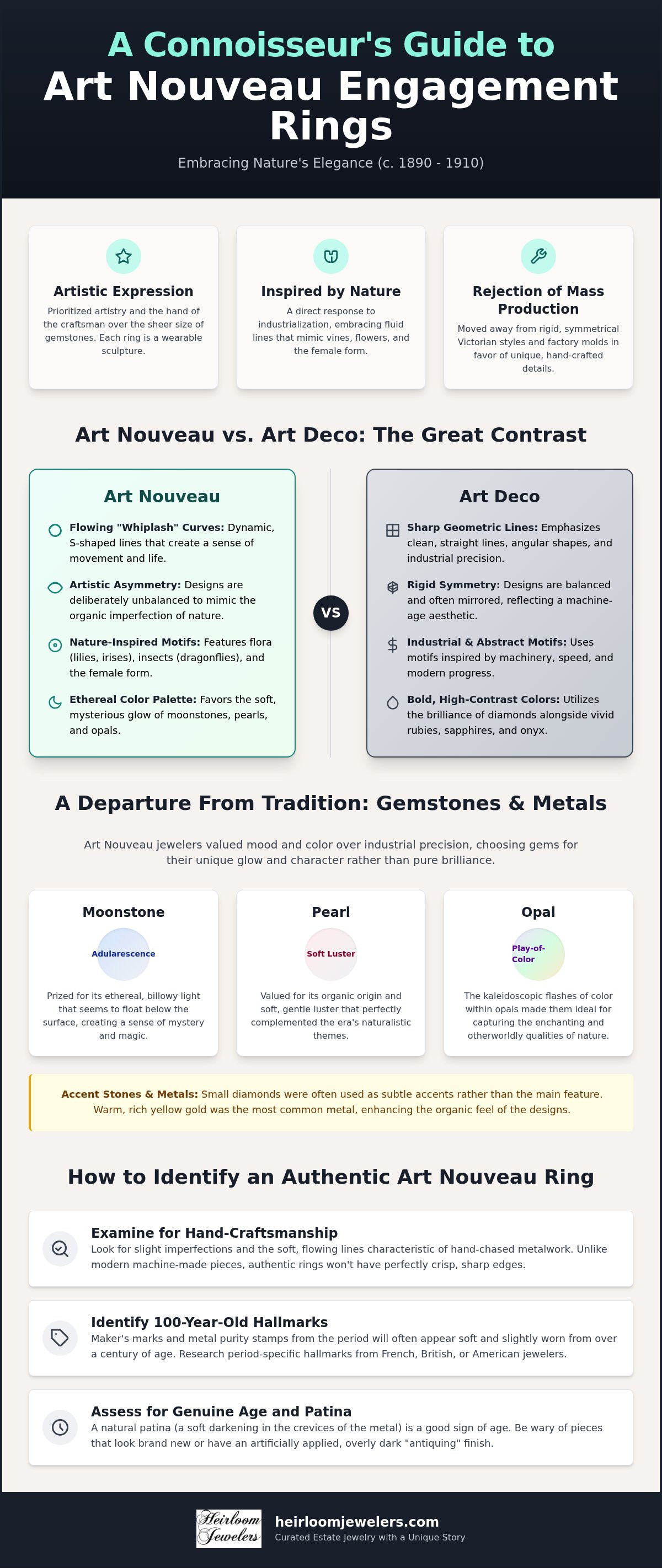
The Art Nouveau movement, spanning roughly from 1890 to 1910, emerged as a direct response to the rigid industrialization of the late nineteenth century. Designers sought to move away from the heavy, symmetrical styles of the Victorian era. They favored fluid lines that mimicked the movement of vines, flowers, and the female form. This period prioritized artistic expression over the sheer size of a gemstone. Authentic art nouveau engagement rings are often viewed as wearable sculptures rather than mere settings for diamonds. This shift marked a significant departure from mass-produced jewelry. It celebrated the hand of the artist and the unique character of every piece.
Artists of this era embraced a "total art" philosophy. They believed jewelry should be an extension of the natural world. This led to the creation of rings that feel alive, with metalwork that winds around the finger like a growing stem. The focus was on the harmony of the design. Every curve and gemstone choice served a specific aesthetic purpose. These rings weren't just accessories; they were small-scale masterpieces designed to be worn and admired.
The Philosophy of the Fin de Siècle
At the turn of the century, the *fin de siècle* spirit fostered a deep desire for natural beauty. Artists rejected the cold, machine-made aesthetics brought about by the Industrial Revolution. They believed that art should be integrated into every aspect of daily life. This philosophy transformed personal adornment into a medium for storytelling. Artisans moved away from standard factory molds. Instead, they focused on intricate, hand-crafted details that highlighted the individual jeweler's skill. This dedication to craftsmanship ensures that original pieces remain rare treasures today.
Art Nouveau vs. Art Deco: The Great Contrast
Collectors often confuse the organic flow of the Nouveau period with the later Art Deco style. The differences are distinct. Art Nouveau relies on soft, asymmetrical curves and nature-inspired themes. You'll see "whiplash" lines that twist and turn like living plants. In contrast, Art Deco is defined by sharp, geometric lines and industrial symmetry. While Art Deco uses bold, high-contrast palettes, art nouveau engagement rings favor ethereal, subtle colors. Jewelers often chose stones like moonstone, opal, and pearl to create a soft, glowing effect. This preference for mood and color over industrial precision remains the era's most defining characteristic.
Signature Design Elements of Art Nouveau Rings
The whiplash curve is the movement's heartbeat. This rhythmic line mimics the sudden, fluid snap of a whip, appearing in the winding gold of the band or the delicate prongs holding a center stone. It represents a total departure from the static, heavy designs of the mid-Victorian era. In art nouveau engagement rings, these curves create a sense of tension and release. They guide the eye around the entire piece rather than focusing solely on the center gemstone. This emphasis on line and flow transformed jewelry into a medium for expressing energy and life.
Asymmetry was a deliberate artistic choice during this period. Artisans recognized that nature rarely grows in perfect halves. By embracing unbalanced designs, they achieved a more organic and authentic aesthetic. You might see a ring where a vine winds higher on one side than the other, or where a single leaf balances a cluster of small diamonds. This era also saw the frequent integration of the female form and mythical creatures like dragonflies. Master Art Nouveau Jeweler René Lalique pioneered these themes, often combining precious metals with unconventional materials to capture an ethereal quality. His work influenced a generation of jewelers to experiment with plique-à-jour enameling. This technique leaves the enamel without a metal backing, allowing light to pass through like a stained-glass window.
Nature-Inspired Motifs and Symbolism
Jewelers used specific flora to convey deep emotional meanings. Lilies and irises were popular choices, representing purity and regal grace. Winding vines symbolized the intertwining of two lives, making them a poignant choice for a romantic heirloom. Insects and birds were not merely decorative. Dragonflies and swallows represented freedom and the transformative power of love. These motifs were never flat. They were designed to wrap around the finger, creating a three-dimensional landscape that changes as the wearer moves their hand. For those seeking a piece with a distinct story, exploring a curated collection of estate jewelry can reveal these rare, symbolic details.
The Art of Hand-Chased Metalwork
The depth found in art nouveau engagement rings is the result of meticulous hand-craftsmanship. Artisans used techniques known as chasing and repoussé to manipulate the metal. Repoussé involves hammering the metal from the back to create a raised design. Chasing is the opposite, where the jeweler works from the front to refine details and add texture. These methods allowed for a low-profile setting that still possessed incredible sculptural depth. The metal doesn't just hold the stone; it flows into it. This seamless transition ensures the ring feels like a singular, cohesive piece of art rather than a stone dropped into a manufactured mount.
Gemstones and Metals: A Departure from Tradition
Art Nouveau jewelers broke away from the Victorian obsession with large, clear diamonds. They prioritized the visual story. In art nouveau engagement rings, the choice of stone was often dictated by how its color interacted with the metalwork. This era introduced a palette of alternative gemstones like pearls, garnets, and peridots. These stones had been previously overlooked for engagement pieces in favor of traditional white stones. By focusing on the interplay of color, artisans created pieces that felt personal and expressive. They didn't prioritize the diamond's size. They focused on the stone's character.
Diamonds didn't disappear during this period, but their role changed significantly. Old European cut diamonds were frequently used as accents. They added small bursts of light to highlight a vine or the wing of an insect. These hand-cut diamonds possess a different fire than modern brilliant cuts. They glow softly under candlelight, which perfectly matched the era's romantic aesthetic. This use of stones as part of a larger composition is what makes these rings feel like curated art rather than industrial products. The jeweler's goal was to create a harmonious balance between the metal and the gems.
The Ethereal Glow: Moonstones and Opals
Moonstones and opals were prized for their shifting light and mystical qualities. Moonstones represented the feminine and the celestial, fitting perfectly into the era's fascination with mysticism. Opals offered a vibrant play-of-color that complemented the fluid metalwork described in previous sections. These stones were valued for their unique glow rather than their market price per carat. If you're considering an antique ring with these stones, remember they are softer than diamonds. They require careful handling and a protective setting to ensure they last for another century. Choosing a ring with these stones is a commitment to preserving a delicate piece of history.
Metals of the Era: Gold and Platinum
18K yellow gold was the primary choice for many artisans. Its warmth and malleability allowed for the intricate chasing and repoussé work that defines the style. However, the turn of the century also saw the introduction of early platinum work. This metal allowed for finer, stronger prongs that seemed almost invisible against the finger. This innovation paved the way for the delicate lace effects seen in later Edwardian pieces. For a deeper look at this material, you might explore Choosing a Platinum Diamond Engagement Ring to understand how this metal differs from vintage gold. Whether you choose the warmth of gold or the strength of platinum, each metal provides a distinct backdrop for the era's botanical art.
How to Identify and Authenticate Authentic Art Nouveau Rings
Authenticating art nouveau engagement rings requires a disciplined eye for the subtle markers of time. After more than 100 years, the gold on an original piece should exhibit soft, rounded edges. This is the natural result of decades of contact with skin and fabric. Sharp, factory-fresh corners often indicate a modern reproduction. You should also examine any engraving under magnification. Hand-tooling from the 1890-1910 period possesses a depth and slight irregularity that modern laser-cut precision cannot replicate. Machine-made pieces often feel sterile. Antique pieces carry the soulful touch of the jeweler who shaped them.
Hallmarks and maker's marks serve as the ring's birth certificate. Many European pieces from this era carry specific stamps that verify their origin. For instance, French 18K gold often features a small eagle's head hallmark. These marks should appear struck into the metal rather than etched or lasered. If the hallmarks look too crisp or lack the expected wear of the surrounding metal, the piece may be a modern "style" ring rather than a true antique. Identifying these small details is the first step in ensuring you are investing in a genuine piece of history.
The Authentication Checklist
- Casting Seams: Inspect the inner band and the underside of the setting. Modern reproductions often show a faint line where two halves of a mold met. Authentic Art Nouveau pieces were typically hand-forged or cast using methods that leave no such seams.
- Gemstone Cuts: When evaluating art nouveau engagement rings, the presence of period-correct gemstones is non-negotiable. A modern round brilliant diamond in an Art Nouveau setting is a significant red flag. It usually indicates a modern mounting or a heavily modified antique.
- Natural Patina: True patina is the result of slow oxidation in the deep crevices of the metalwork. It should not be perfectly uniform. If the "aging" looks too consistent across the entire surface, it may be a chemical treatment used on a new ring.
Preserving Antique Craftsmanship
Maintenance is vital for protecting your investment and the ring's historical integrity. You must avoid ultrasonic cleaners. The high-frequency vibrations can shatter delicate plique-à-jour enamel or loosen soft gemstones like opals and pearls. Use a soft-bristled brush and lukewarm, mild soapy water for routine cleaning. For more detailed advice on maintaining the integrity of historical pieces, consult our educational guide on antique rings. To ensure you are choosing a piece with a verified history, we invite you to explore our authenticated estate jewelry collection.
Finding Your Unique Story with an Art Nouveau Heirloom
Owning an Art Nouveau ring is about more than aesthetics. It's an investment in a specific moment of artistic rebellion. Because these pieces were created before the era of high-speed manufacturing, each one carries the unique markers of its creator. You won't find two identical art nouveau engagement rings. This individuality ensures that your jewelry is as unique as the relationship it represents. There's a profound emotional resonance in wearing a piece that has survived for over a century. It connects you to the past while serving as a foundation for your future together. Each ring tells a story of craftsmanship that prioritized beauty over industrial efficiency.
Pairing these historical treasures with modern wedding bands requires a thoughtful approach. The organic, sculptural nature of the settings often benefits from simple companions. A thin, plain gold or platinum band can provide a clean backdrop that lets the antique metalwork shine. Alternatively, many collectors choose contoured bands that follow the specific curves of the engagement ring. This ensures a comfortable fit and a cohesive look. By blending the old with the new, you create a personal style that feels both grounded in history and relevant to the present day.
A Sustainable and Ethical Choice
The circular jewelry economy offers a way to enjoy luxury without the heavy footprint of new production. Modern mining often involves significant ecological disruption and ethical complexities. In contrast, choosing estate pieces allows you to preserve existing resources while celebrating historical artistry. This is why heritage jewelry remains such a compelling choice for modern couples. These pieces hold their value over time because their rarity only increases. They aren't subject to the rapid depreciation of mass-produced modern settings. You're not just buying a ring. You're becoming the steward of a rare historical artifact.
Curating Your Personal Collection
Many collectors worry that the organic flow of the Nouveau style won't match modern fashion. However, these rings are surprisingly versatile. Their soft lines complement both minimalist contemporary attire and more ornate vintage styles. They act as a bridge between different eras of design. We invite you to explore our curated vintage engagement rings collection to find a piece that aligns with your personal narrative. Finding the right balance between history and your modern lifestyle is the key to enjoying your heirloom for a lifetime. These rings aren't just for special occasions. They are designed to be a permanent part of your daily life.
Selecting a Legacy of Artistic Expression
Choosing a historical piece requires an appreciation for the fluid, organic lines that define the turn of the century. By recognizing signature whiplash curves and authenticating period-correct gemstones, you secure a ring that remains truly one-of-a-kind. These treasures offer a sustainable alternative to modern mass production, allowing you to own a piece of botanical art with a verified history. Selecting authentic art nouveau engagement rings ensures your jewelry serves as both a personal symbol and a preserved historical artifact.
At Heirloom Jewelers, we act as a bridge between the past and the present. Our specialists carefully authenticate every piece in our collection, focusing on rare vintage finds and estate fine jewelry. We provide the expertise needed to navigate the secondary market with quiet confidence. We invite you to Explore Our Curated Collection of Authentic Art Nouveau Rings and discover a piece that resonates with your unique story. Your journey into the world of antique jewelry is an opportunity to find a rare treasure that will be cherished for generations.
Frequently Asked Questions
Are Art Nouveau engagement rings durable enough for everyday wear?
Many art nouveau engagement rings are suitable for daily wear if the setting is robust. Platinum and 18K gold provide a strong foundation for the era's intricate metalwork. However, you must consider the specific materials used. Pieces featuring plique-à-jour enamel or soft stones like opals require more careful handling than modern diamond solitaires. We recommend removing these rings during strenuous activities to preserve their delicate sculptural details and historical integrity.
How can I tell the difference between Art Nouveau and Art Deco?
The primary difference lies in the use of line and symmetry. Art Nouveau focuses on fluid, organic curves that mimic the natural growth of vines and flowers. These designs are often asymmetrical and whimsical. Art Deco, which followed the movement, favors sharp geometric shapes and rigid industrial symmetry. While Nouveau pieces feel like small botanical sculptures, Deco pieces look like architectural structures. This contrast defines the transition from naturalism to modernism.
What gemstones were most common in Art Nouveau jewelry?
Artisans favored stones that offered a unique glow or play-of-color. Common choices included moonstones, opals, and pearls, which complemented the era's ethereal aesthetic. You will also find estate peridot and garnets used to add vibrant natural hues. Unlike modern jewelry that prioritizes diamond size, these pieces value how the stone's color integrates with the hand-chased metalwork. This approach creates a harmonious balance between the gemstone and the setting.
Can Art Nouveau rings be resized without damaging the design?
Resizing is possible but requires the expertise of a specialist who understands antique construction. Because art nouveau engagement rings often feature continuous patterns or delicate enameling that wraps around the band, standard resizing can disrupt the design. If the ring has a plain section at the back of the shank, the process is simpler. However, pieces with intricate chasing or heat-sensitive stones like opals require advanced laser welding to protect the original craftsmanship.
Why are Art Nouveau rings often more expensive than modern ones?
These rings often command a premium because they are rare, hand-crafted artifacts that cannot be replicated by modern machines. Every piece was created individually by an artist-jeweler, making it a one-of-a-kind treasure. You are paying for the historical significance and the intensive labor of techniques like repoussé and chasing. In contrast to mass-produced modern jewelry, these authenticated estate pieces maintain their value due to their scarcity and the enduring demand for historical artistry.
What should I look for in a reputable estate jeweler?
Look for a specialist who prioritizes authentication and historical accuracy. A reputable curator should have deep knowledge of period-specific hallmarks and the secondary market. They should offer a curated inventory of genuine vintage pieces rather than modern reproductions. It's also important to find a jeweler who avoids mass-produced items and focuses on the integrity of the piece. Transparency regarding the ring's condition and origin is the hallmark of a trusted professional establishment.
Is it possible to find Art Nouveau rings with diamonds?
Diamonds were frequently used in this era, though they were often hand-cut as old European or rose cuts. These stones appear as central focal points or as delicate accents that highlight the wings of an insect or the curve of a leaf. Unlike the sterile brilliance of modern cuts, these antique diamonds possess a soft, warm fire. You can find stunning examples set in platinum or gold that showcase the era's signature botanical elegance.
How do I clean an antique ring with enamel or opals?
Routine maintenance should be gentle to protect the ring's delicate components. Never use ultrasonic or steam cleaners, as these can shatter enamel or damage soft gemstones like opals and pearls. Instead, use a soft-bristled brush with lukewarm, mild soapy water. Gently clean the underside of the setting to maintain the stone's glow. This methodical approach ensures that the intricate metalwork and sensitive materials remain in pristine condition for years to come.