
The most delicate jewelry in history was actually born from the world's toughest metal. While they look as fragile as fine silk, authentic edwardian engagement rings were the first to utilize platinum's industrial strength to create lace-like filigree that had never been possible before. If you're searching for a piece of the Belle Époque, you've likely felt the pull of this era's ethereal beauty. You might also feel a bit of hesitation. It's often difficult to distinguish a true 100-year-old antique from a modern reproduction, and those intricate "lace" designs can look worryingly thin to the untrained eye.
We understand that choosing a heritage piece is about more than just aesthetics; it's about investing in a tangible piece of history. You deserve to feel certain that your ring is an authentic artifact of the early 20th century rather than a contemporary imitation. This guide provides the expertise you need to identify signature motifs like millegrain detailing and Old European cut diamonds. We'll explore the specific hallmarks required by the National Gold and Silver Marking Act of 1906 and explain why these rings are far more durable than they appear. By the end, you'll have the confidence to select a timeless heirloom that bridges the gap between the past and your future.
Key Takeaways
- Define the Edwardian period as the "Belle Époque" and understand its shift toward light, ethereal aesthetics.
- Explore how technical innovations in platinum allowed for the era's signature delicate filigree and lace-like artistry.
- Learn to identify authentic edwardian engagement rings by recognizing motifs like ribbons, bows, and the classic "Garland Style."
- Gain the expertise to differentiate between Old European and Old Mine diamond cuts to ensure historical accuracy.
- Recognize the unique rarity and sustainability of investing in a curated, authenticated vintage heirloom.
Defining the Edwardian Era (1901–1915)
The Edwardian era is often remembered as the Belle Époque, or the "Beautiful Era." This period officially began in 1901 with the coronation of King Edward VII and lasted until the onset of World War I. It was a time of immense wealth and social refinement for the elite. High society fashion was driven by the King and Queen Alexandra, who prioritized light and grace. While the era was brief, it fundamentally changed the design of edwardian engagement rings.
Jewelry from this time represents a peak in hand-finished craftsmanship. Designers moved away from the heavy, ornate styles of the 19th century. They preferred pieces that matched the airy, silk-chiffon fabrics popular in high fashion. When Defining the Edwardian Era, experts view it as a sophisticated transition between the old world and the new. The era ended abruptly in 1914, as luxury production stopped and precious metals were redirected to the war effort.
Edwardian vs. Victorian: A Lighter Touch
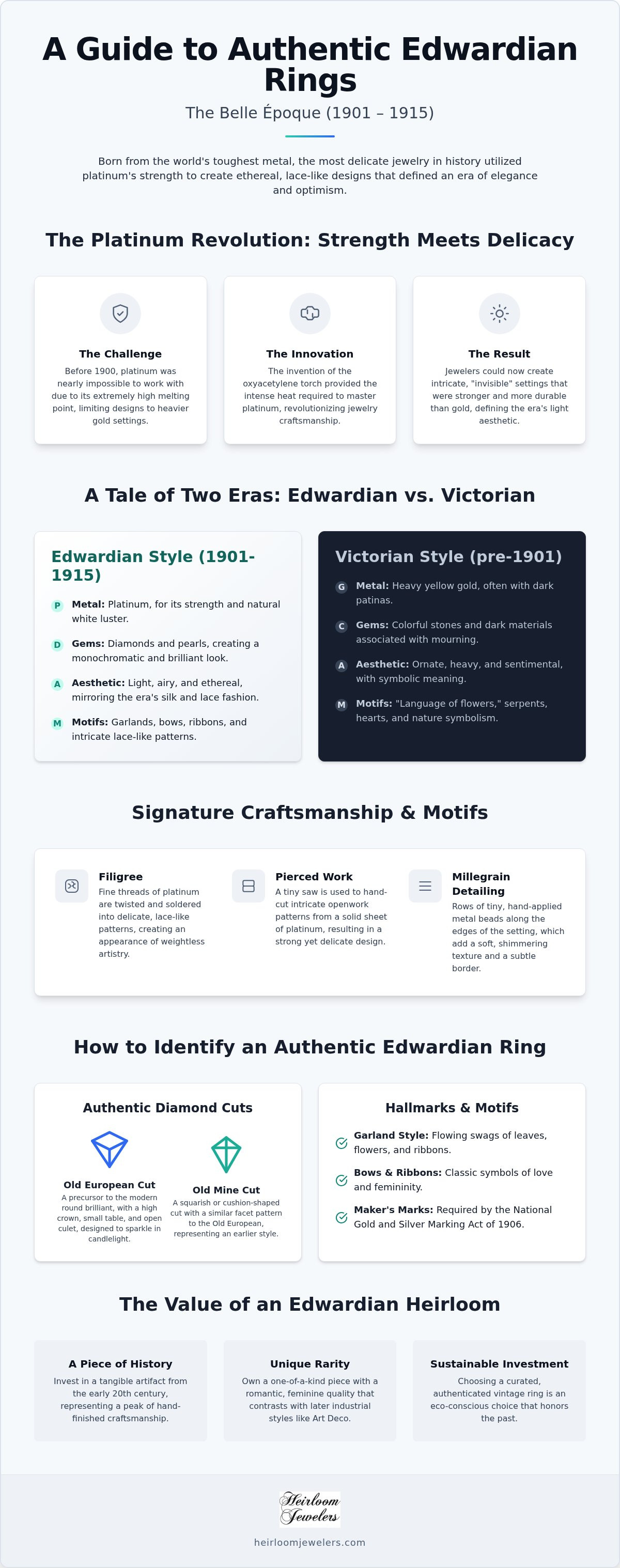
Victorian jewelry often featured heavy yellow gold and dark stones associated with mourning. Edwardian designers chose a monochromatic palette of white diamonds and platinum instead. They replaced the symbolic "language of flowers" with an aesthetic focus on intricate lace patterns. This shift reflected a cultural move toward optimism and leisure. The aesthetic goal moved from displaying solid wealth to creating a sense of weightless light and transparency.
The Precursor to Art Deco
Edwardian design is famous for soft curves and floral garlands, yet it served as the foundation for Art Deco. Both eras utilized the strength of platinum for complex settings. Over time, the fluid lines of edwardian engagement rings sharpened into the geometric patterns of the 1920s. Many collectors prefer Edwardian pieces for their romantic, feminine quality, which contrasts with the industrial look of later styles. These rings remain a bridge between traditional artistry and modern elegance.
The Platinum Revolution and Technical Artistry
The shift toward the light, ethereal aesthetic of the Belle Époque wasn't just a matter of taste. It was a result of a major technological breakthrough. Before the 20th century, platinum was nearly impossible for jewelers to manipulate because of its high melting point. The invention of the oxyacetylene torch in the early 1900s provided the intense heat needed to work this stubborn metal. This technological revolution allowed craftsmen to move away from the heavy gold settings of the previous century.
Platinum's inherent strength meant that less metal was required to secure a gemstone. This led to a "monochromatic" look where white diamonds were set into white metal, creating a seamless field of brilliance. To add texture without adding bulk, jewelers used milgrain. These tiny, hand-applied beads of metal along the edges of a setting created a shimmering, tactile finish. It's a hallmark often found on authentic edwardian engagement rings that modern reproductions struggle to replicate with the same precision.
Strength Meets Delicacy
Platinum is significantly more durable than the gold alloys used in earlier eras. Its strength allowed for the development of "invisible" settings, where diamonds appeared to float on the finger with minimal metal visible. While modern white gold often relies on rhodium plating to maintain its color, Edwardian platinum is white through and through. It doesn't oxidize or tarnish over time. This chemical stability ensures that the fine details remain crisp for generations. If you're looking for a vintage platinum engagement ring, the resilience of the original setting is a testament to this era's superior engineering.
The Art of Filigree and Pierced Work
The hallmark of this period is the masterful use of filigree and pierced work. Filigree involves soldering fine threads of precious metal into intricate, lace-like patterns. Pierced work is a different technique where a jeweler uses a tiny saw to cut away sections of a solid piece of metal. This creates a lace effect that is both strong and visually light. These techniques were used to create Signature Motifs: Lace, Garlands, and Filigree, which remain the most sought-after features of edwardian engagement rings.
Understanding these technical nuances is essential for any collector. You can learn more about these methods in our guide on the Timeless Artistry of Antique Rings. If you're ready to see these techniques in person, exploring a curated collection of authenticated pieces is the best way to appreciate the skill of the Belle Époque craftsmen.
Signature Motifs: Lace, Garlands, and Filigree
Jewelers of the Belle Époque drew inspiration directly from the delicate textiles of high fashion. This led to the "Garland Style," a design movement pioneered by houses like Cartier. It favored Neoclassical themes and replaced the heavy Victorian aesthetic with something far more fluid. Edwardian engagement rings from this period often mimic the appearance of fine lace or embroidered silk. The goal was to create pieces that looked as though they were woven from metal rather than cast in a mold.
Common motifs include naturalistic elements such as ribbons, bows, tassels, and laurel wreaths. These were not just decorative; they were carefully rendered in platinum to achieve a weightless appearance. You can see many of these intricate designs preserved in the Victoria and Albert Museum's jewellery collection. Another popular silhouette was the "cigar band" shape. These wide, flat rings featured extensive surface detail, often using pierced work to create a continuous pattern around the finger. This style allowed for a large surface area of diamonds while maintaining a low profile on the hand.
Romantic Symbolism in the Belle Époque
Symbolism remained a vital part of jewelry design, though it became more subtle than in previous eras. Laurel wreaths were frequently used to represent honor and victory. In the context of a marriage proposal, they symbolized the triumph of love. The "lover's knot" was another recurring theme. This motif featured intertwined metal threads that represented an unbreakable bond. It's a design that feels both ancient and modern.
We also see a rise in "toi et moi" (you and me) settings. These rings featured two primary gemstones set side-by-side, representing the union of two souls. These pieces often combined diamonds with pearls or colored gemstones like sapphires and emeralds. They remain some of the most romantic examples of edwardian engagement rings available on the secondary market today. They offer a unique alternative to the traditional solitaire.
The Influence of High Fashion
The jewelry of the early 1900s was designed to complement the specific fashion of the time. Women wore gowns made of lightweight silk, chiffon, and expensive handmade lace. Jewelry had to match this airy feel. The "all-white" trend—using diamonds and platinum—was specifically intended to sparkle under the newly popularized electric lights found in evening ballrooms. It was a time of transition and technical brilliance.
This monochromatic approach ensured the jewelry didn't clash with the pastel colors of Belle Époque fashion. It created a cohesive, elegant look for the high-society elite. For a deeper look at how these styles compare to other eras, see our Definitive Buying Guide to Vintage Engagement Rings. Understanding these motifs helps you identify an authentic piece of history that fits your personal style.
Evaluating Quality: Diamonds, Gemstones, and Hallmarks
The beauty of edwardian engagement rings lies in the specific way they interact with light. Unlike modern diamonds designed by computer algorithms for maximum brilliance under fluorescent bulbs, antique stones were cut by hand. The primary diamond of the era was the Old European cut. These diamonds feature a high crown, a small table, and a circular girdle. This geometry was intended to maximize "fire," which refers to the colorful flashes of light seen when a stone is viewed under candlelight.
Jewelers also utilized "calibre cut" gemstones to add a touch of color to these white-on-white designs. These are small sapphires, rubies, or emeralds custom-cut to fit perfectly into the curved channels or geometric borders of a platinum setting. This level of precision is a clear indicator of high-quality craftsmanship. It requires a lapidary to shape each stone to the specific dimensions of the ring's metalwork, a process that modern mass production rarely replicates.
The Artisanal Glow of Old European Cuts
While the Old European cut is the hallmark of the Edwardian era, you may also encounter the Old Mine cut in early transition pieces. Old Mine cuts possess a more squared, cushion-like shape and a slightly more irregular appearance. They represent an even earlier tradition of diamond cutting. In the world of edwardian engagement rings, the Old European cut is prized for its symmetrical elegance. In antique cuts, the visual spread across the top of the stone often provides a more impressive appearance than the total carat weight alone might suggest.
Authentication and Estate Value
Authenticating a piece from this period requires a close look at the hallmarks. In the United States, the National Gold and Silver Marking Act of 1906 mandated that any quality mark, like "Plat" or "14K," must be accompanied by a maker’s mark. Original platinum marks are a primary sign of authenticity. Platinum was the defining metal of the era, and its presence confirms the ring was made after the technological shift discussed earlier. Verifying these marks helps ensure you are purchasing a true antique rather than a "vintage-style" reproduction.
Investing in heritage jewelry means acquiring a piece that retains its value through historical provenance and rarity. If you're looking for a piece with verified history and exceptional craftsmanship, you can explore our collection of authenticated vintage platinum engagement rings to find a stone with a truly unique artisanal glow.
Why Choose an Edwardian Heirloom?
Choosing an antique ring is a decision to preserve a piece of history. Unlike mass-produced modern jewelry, authentic edwardian engagement rings offer a level of individuality that is impossible to replicate. Every hand-cut diamond and hand-sawed filigree detail tells a story of a craftsman's dedication. Finding platinum filigree in excellent condition is increasingly rare. These pieces are true collectors' items that have survived a century of changing fashions. They represent a peak of jewelry design that has never been surpassed.
The appeal of the Belle Époque extends beyond its visual elegance. It's about the weight of history on your hand. There is a profound sense of connection in knowing your ring was part of a world of candlelight and silk. This historical value remains stable even as modern trends fluctuate. Your purchase is a tangible link to a refined past. It offers a sense of permanence in a world of disposable goods.
The Ethical Choice for Modern Couples
Modern couples often prioritize ethical sourcing and environmental responsibility. Estate jewelry is the most sustainable choice available. It requires no new mining, which significantly reduces the environmental footprint of your purchase. By choosing a pre-owned ring, you are participating in a circular economy that values existing resources. This approach prevents the ecological disruption associated with modern large-scale mining operations.
Additionally, diamonds mined over a century ago are historically "conflict-free." They pre-date the modern geopolitical issues and labor concerns associated with the 20th and 21st-century diamond trade. Platinum's natural durability ensures these rings can withstand a lifetime of daily wear. It's a dense, strong metal that holds gemstones securely. This makes it an ideal choice for a piece intended to be worn every day for decades.
Starting Your Own Heritage
An antique ring doesn't just represent the past. It serves as the foundation for your future. When you select one of these edwardian engagement rings, you are becoming the next steward of a unique artifact. These pieces have already survived a century of history. They're built to last another hundred years. Viewing your purchase as a future heirloom adds a layer of emotional value that modern retail cannot provide.
We invite you to explore our vintage engagement rings guide to learn more about the specific styles and authentication processes we use. At Heirloom Jewelers, we specialize in connecting discerning collectors with pieces that bridge the gap between generations. Our commitment to integrity ensures that every piece in our inventory is a genuine historical find. We believe that every couple deserves a ring with a soul. View our authenticated estate jewelry collection to find the piece that will start your own family legacy.
Finding Your Piece of the Belle Époque
The Belle Époque was a fleeting moment in history that left behind a permanent legacy of grace. By understanding the shift toward platinum's industrial strength and the intricate "Garland Style" motifs, you're now equipped to identify authentic edwardian engagement rings. These pieces offer more than just a delicate aesthetic. They provide a sustainable, ethical connection to a past era of hand-finished craftsmanship. Whether you are drawn to the broad flashes of an Old European cut diamond or the weightless look of pierced metalwork, your choice represents the start of a new heritage.
At Heirloom Jewelers, we act as a bridge between these historical treasures and your future. We specialize in rare platinum settings and expertly authenticated estate jewelry that reflects a tradition of quiet confidence and timeless elegance. You don't have to navigate the vintage market alone. Our curated inventory focuses on rare Old European cut diamonds and genuine antique settings to ensure every find is a true piece of history. We invite you to explore our curated collection of authenticated Edwardian engagement rings and find a piece that resonates with your personal story. Your journey into the elegance of the past is just beginning.
Frequently Asked Questions
Are Edwardian engagement rings durable enough for everyday wear?
Edwardian engagement rings are remarkably durable despite their delicate, lace-like appearance. This resilience is due to the widespread use of platinum, which is significantly denser and stronger than gold alloys. Platinum doesn't wear away over time; instead, the metal is merely displaced. While the intricate filigree and milgrain require mindful care, these rings were engineered to last lifetimes. They are suitable for daily wear if you avoid harsh impact or abrasive chemicals.
What is the difference between Edwardian and Art Deco rings?
The primary difference lies in the silhouette and symmetry of the design. Edwardian rings feature soft, feminine motifs like lace, floral garlands, and flowing ribbons. They focus on an ethereal, romantic aesthetic from the early 1900s. In contrast, Art Deco rings from the 1920s embrace bold geometric shapes and architectural lines. While both eras frequently used platinum and diamonds, Edwardian design is characterized by its fluid curves rather than the sharp angles of the industrial age.
How can I tell if an Edwardian ring is authentic or a reproduction?
Authenticity is often confirmed through a combination of hallmarks and craftsmanship details. Genuine edwardian engagement rings often feature hand-applied milgrain that appears slightly irregular under magnification. Modern reproductions usually have perfectly uniform, cast-in beads. You should also look for the National Gold and Silver Marking Act of 1906 requirements, which mandate a maker's mark alongside quality stamps. Authentic diamonds from this period will typically be Old European or Old Mine cuts.
What diamond cuts are most common in Edwardian jewelry?
The Old European cut is the defining diamond of the Edwardian period. These stones were hand-faceted with a high crown and a small table to maximize fire under candlelight. You might also find Old Mine cuts in rings from the early transition years. Smaller accent stones were frequently rose cuts or single cuts. These artisanal facets create broad flashes of light that differ significantly from the splintered sparkle seen in modern brilliant cuts.
Why is platinum so common in Edwardian engagement rings?
Platinum became the standard during this era because of the invention of the oxyacetylene torch. This tool provided the high heat necessary to melt and manipulate the metal for the first time. Designers favored platinum for its extreme strength, which allowed them to create incredibly thin wirework and "invisible" settings. This enabled the "all-white" monochromatic look that defined high-society fashion during the Belle Époque, where the focus remained entirely on the diamonds.
How do I care for a vintage platinum ring with delicate filigree?
Caring for delicate filigree requires a gentle touch and regular maintenance. You can clean your ring at home using warm water, mild dish soap, and a very soft toothbrush to reach into the pierced metalwork. Avoid using ultrasonic cleaners, as the vibrations can loosen stones in older settings. It's wise to have a professional jeweler inspect the prongs and filigree once a year to ensure the structural integrity remains intact for the future.
Are Edwardian rings more expensive than modern engagement rings?
Edwardian rings aren't always more expensive than modern counterparts, but they offer greater value through rarity and hand-craftsmanship. While a modern ring's price is largely based on current raw material costs, an antique ring's price includes its historical provenance. You often get a larger visual "spread" with an Old European cut diamond for the same carat weight. Choosing an authenticated estate piece is an investment in a one-of-a-kind artifact that avoids modern retail markups.
What gemstones besides diamonds were popular during the Edwardian era?
While diamonds and platinum dominated, pearls were exceptionally popular and often symbolized purity and high status. You'll also find vibrant "calibre cut" sapphires, rubies, and emeralds used as accent stones to create contrast against the white metal. These colored gems were custom-shaped to fit the specific curves of the ring's design. Amethyst and peridot were also used occasionally to add a soft touch of color to more ornate, naturalistic edwardian engagement rings.