
A diamond cut by hand under the soft glow of candlelight possesses a character that no modern laser can replicate. If you're searching for a piece of history, learning how to identify an old European cut diamond is the first step in ensuring you invest in an authentic treasure rather than a modern reproduction. It's natural to feel a sense of hesitation when evaluating these stones. Many collectors worry about overpaying for a "circular" cut that lacks true heritage or struggle to distinguish an Old European from an Old Mine cut.
We understand that the technical nuances of antique jewelry can feel daunting. This guide will help you master the art of identifying genuine Old European cut diamonds by focusing on their unique light performance and specific physical hallmarks. You'll learn how to use a jeweler's loupe to confidently spot a visible culet and understand the historical proportions that define this era. We will examine the high crown, the small table, and the 2026 GIA standards for light performance to help you build a collection rooted in quality and integrity.
Key Takeaways
- Recognize the defining physical markers of the 1890–1930 era, specifically the prominent high crown and the small table facet.
- Master how to identify an old European cut diamond by locating the "dark circle" or open culet clearly visible through the center of the stone.
- Differentiate between the cushion-shaped Old Mine cut, the circular Old European cut, and the mathematically precise modern round brilliant.
- Learn to use a 10x jeweler’s loupe to identify the unique hand-faceted girdle and light performance that signal an authentic antique diamond.
- Understand the importance of choosing authenticated estate jewelry to ensure you are acquiring a genuine piece of history rather than a modern imitation.
What is an Old European Cut Diamond?
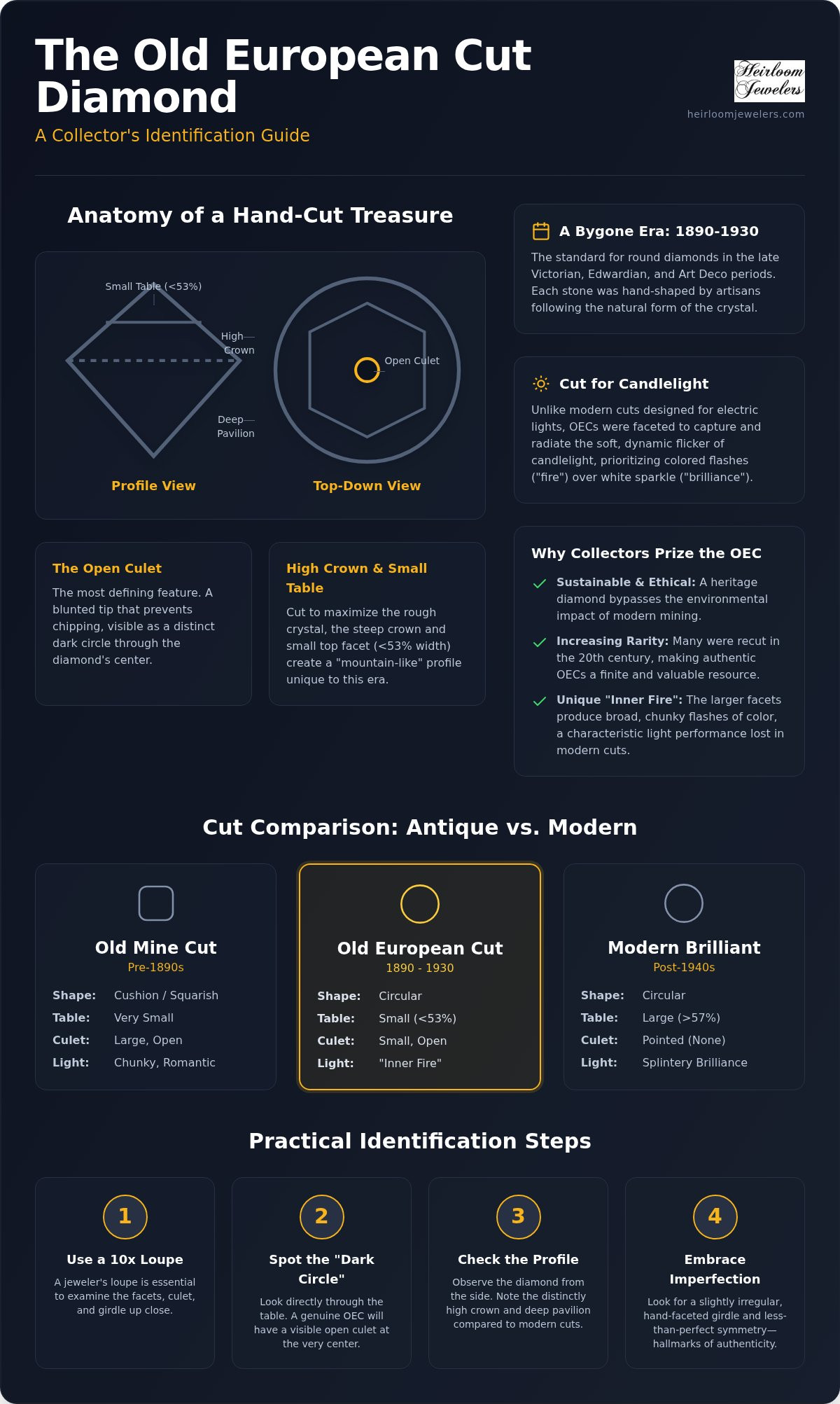
The Old European cut (OEC) represents a specific chapter in the history of diamond cuts, serving as the standard for round stones from roughly 1890 through 1930. Before this era, diamonds were typically cut into the "Old Mine" shape, which featured a squarish, cushion-like girdle. As jewelry design evolved toward the refined symmetry of the Edwardian and Art Deco periods, cutters sought a more circular aesthetic. This transition was made possible by the introduction of steam-driven bruting machines in the 1870s, which allowed for more precise rounding of the diamond's perimeter.
Unlike modern stones designed for electric light, these diamonds were hand-cut to perform under the soft flicker of candlelight. Cutters prioritized "fire," or the flashes of colored light, over the white "brilliance" favored today. Because these stones were shaped by eye rather than computer-guided lasers, each one possesses a distinct personality. If you are learning how to identify an old European cut diamond, you must first appreciate that you are looking at a piece of artisanal history rather than a mass-produced product.
The Historical Context of the Cut
The shift toward the OEC coincided with a period of immense cultural change. During the late Victorian and Edwardian eras, jewelry became a symbol of delicate, feminine craftsmanship. The OEC was the centerpiece of this movement. While the 1870s brought technological advancements, the process remained deeply human. Cutters followed the natural shape of the rough crystal. This is why no two Old European cut diamonds are exactly identical. This lack of uniformity is a hallmark of authenticity for the discerning collector.
Why Collectors Prize the OEC Today
Modern round brilliant diamonds are often described as having "splintery" light. In contrast, the OEC offers what experts call "inner fire," characterized by broader, chunkier flashes of color. This unique optical performance is a primary reason for their resurgence in popularity. Beyond aesthetics, there is a significant ethical appeal. Choosing a heritage diamond is a sustainable practice, as it bypasses the environmental impact of modern mining.
Rarity also plays a crucial role in their value. Throughout the mid-20th century, many OECs were recut into modern brilliants to meet changing tastes. The stones that survived are finite in number. Finding high-quality examples in original vintage settings is increasingly difficult. Understanding how to identify an old European cut diamond allows you to protect these historical artifacts while building a collection with lasting value.
The Anatomy of an Old European Cut: Key Visual Markers
Identifying an antique diamond requires a shift in perspective. Instead of looking for the pinpoint flashes of a modern stone, you look for structural hallmarks. When learning how to identify an old European cut diamond, the silhouette is your first clue. These stones feature a small table facet and a noticeably high crown. Because they were cut to follow the natural octahedron shape of the rough diamond, they possess a depth and weightiness that modern rounds lack.
The table, or the flat facet on top, typically covers less than 53% of the diamond's total width. In contrast, modern stones often have tables exceeding 57%. This small table is paired with a high crown angle, creating a steep, mountain-like profile. These proportions are essential to GIA's criteria for Old European cuts, which distinguishes them from the flatter profiles of later eras. This verticality isn't just a stylistic choice; it was a necessity for cutters working with the rough material available at the time.
The Open Culet: The "Hole" in the Center
Perhaps the most famous identifier is the open culet. In modern diamonds, the bottom tip is pointed. In an OEC, that tip was blunted into a flat facet to prevent chipping during the setting process. When you look straight down through the table, this facet appears as a small, dark circle in the center of the stone. Collectors often call this the "eye" of the diamond. If this feature is missing or extremely small, the stone might be a Transitional cut, which represents the mid-century evolution toward modern styles.
The Kozibe Effect and Inner Fire
A unique phenomenon often overlooked by modern retailers is the Kozibe effect. This occurs when the large, flat culet reflects through the crown facets, creating multiple images of the "eye" as you tilt the stone. This effect contributes to the diamond's "inner fire." Because the pavilion facets are larger and fewer in number, the stone produces broad, slow flashes of spectral color. It's a rhythmic, hypnotic light performance that feels far more deliberate than the rapid scintillation of a modern brilliant.
If you're beginning your search, exploring our collection of Old European cut diamond stud earrings is an excellent way to see these visual markers in person.
Old European vs. Old Mine vs. Modern Round Brilliant
The Old European cut occupies a unique space in jewelry history, bridging the gap between primitive hand-cutting and modern mathematical precision. When learning how to identify an old European cut diamond, you must first distinguish it from the Old Mine cut that preceded it. The Old Mine cut, popular throughout the 18th and 19th centuries, is characterized by a squarish, cushion-like girdle. These stones were often deep and bulky, following the natural shape of the rough crystal rather than pursuing a circular ideal.
In 1919, Marcel Tolkowsky published his thesis on diamond proportions, which eventually led to the Modern Round Brilliant. This modern standard shifted the focus toward maximum white light return and total internal reflection. The OEC remains the "sweet spot" for many collectors. It offers a circular shape that fits modern settings while retaining the soul and warmth of a hand-cut stone. It represents the pinnacle of transition from the ruggedness of the past to the precision of the present.
Structural Comparison Framework
The most immediate difference lies in the girdle shape. While the Old Mine cut has a soft square perimeter, the OEC is round, though often slightly out of circular perfection due to its hand-crafted nature. Modern brilliants are perfectly calibrated circles. For a deeper look at these technical distinctions, the GIA provides an excellent resource on Old Mine vs. Old European cut diamonds.
Proportions also vary significantly across these eras:
- Table Size: OECs typically feature a small table between 40% and 50% of the diamond's diameter. Modern stones have much larger tables, often ranging from 53% to 60%.
- Girdle Finish: Antique stones often have "frosted" or unpolished girdles that appear matte. Modern stones usually feature polished or faceted girdles for additional scintillation.
- Facet Count: Both the OEC and the Modern Round Brilliant share 58 facets, but the OEC facets are larger and less uniform.
Light Performance and Aesthetics
The aesthetic appeal of the OEC is rooted in its performance under low, warm light. Modern cuts are engineered for the bright, overhead lighting of retail environments. This can sometimes make modern stones look "dark" or flat in the center when viewed in candlelight. The OEC, with its high crown and large facets, excels in these intimate settings by producing broad, spectral flashes of color.
If you're comparing these styles for a specific piece of jewelry, our guide on antique diamond earrings offers a detailed look at how these cuts translate into wearable art. Understanding how to identify an old European cut diamond versus its counterparts ensures you choose a stone that aligns with your personal appreciation for history and craftsmanship.
Practical Identification Steps: Tools and Techniques
Empowering yourself with the right techniques allows you to move beyond guesswork. When considering how to identify an old European cut diamond, start with the naked eye. Hold the stone under steady light and look straight through the table facet. You're looking for the culet, which appears as a small, dark circle or a "hole" at the very center. If the stone is set, this feature might be harder to see, but a true OEC will almost always reveal this central facet to the observant eye.
The "Tilt Test" is another effective method for the home collector. As you slowly rock the diamond, observe the light performance. Modern stones exhibit rapid, splintery scintillation. An OEC will show broader, prismatic flashes of color that move at a slower, more deliberate pace. You should also examine the mounting carefully. These diamonds are frequently found in vintage platinum engagement rings, particularly those from the late Edwardian or Art Deco periods. The presence of milgrain or intricate filigree often suggests the stone is an original period cut rather than a modern replacement.
The Loupe Inspection Checklist
Using a 10x jeweler's loupe provides the clarity needed for a final determination. Focus on the facet junctions, where the flat surfaces meet. In antique stones, these junctions are often slightly rounded or softened by age and hand-finishing, whereas modern stones have razor-sharp edges. Look for the "flower pattern" created by the crown facets, which resembles a symmetrical bloom when viewed from above. You might also spot "naturals." These are small, unpolished sections of the original rough diamond's skin left on the girdle. They're common in OECs because cutters aimed to retain as much weight as possible from the raw crystal.
Authentication and Lab Reports
While personal inspection is valuable, high-value acquisitions require professional verification. GIA and EGL reports are the industry standard. It's important to understand the terminology used on these certificates when learning how to identify an old European cut diamond. Some modern reports might classify an OEC as a "Circular Brilliant" if it doesn't meet every strict proportional requirement. However, a detailed report will specify the presence of a large culet and a high crown. Always check the comments section for mentions of "burned" facets or chips. These are signs of wear that can affect the stone's value but also confirm its historical provenance as a pre-owned treasure.
If you're ready to see these features in person, we invite you to browse our curated selection of authenticated estate jewelry to find your perfect heritage piece.
Selecting Authentic Heritage Jewelry at Heirloom Jewelers
Choosing an antique diamond is a journey into the past. At Heirloom Jewelers, we prioritize the preservation of these historical artifacts through a commitment to authenticated estate jewelry. Our collection focuses exclusively on pre-owned items that carry a legacy of craftsmanship. We avoid modern mass-produced jewelry because it lacks the hand-finished soul of an original European cut. For those seeking a classic introduction to this era, Old European cut diamond stud earrings set in 18K white gold offer a timeless aesthetic. These pieces showcase the broad, spectral flashes of light that define the period.
Matching these diamonds is a specialized skill. Because every stone was shaped by eye rather than a computer, finding two that share similar proportions requires a curated approach. We provide expert guidance to ensure your earrings or center stones reflect a harmonious balance. While we have shared technical tips on how to identify an old European cut diamond, working with a specialist ensures your investment is rooted in authenticity and quality.
The Heirloom Jewelers Curation Process
Our process begins with rigorous authentication. We verify the historical context of every piece in our estate collection, focusing on high-quality materials like 18K white gold and platinum. The setting is as vital as the stone itself. A vintage platinum engagement ring provides the structural integrity and period-correct detail that modern alloys often fail to replicate. We take pride in preserving the history and the unique story behind every heritage ring, ensuring it remains a treasure for the next generation.
Finding Your Perfect Antique Diamond
Antique diamonds appeal to those who value individuality over standardized perfection. If you want a stone that is truly one of a kind, the OEC is the ideal choice. Exploring our collection of heritage jewelry allows you to see the diversity of hand-cut artistry first-hand. Starting your collection with a trusted estate jeweler simplifies the complexities of the secondary market. We act as a bridge between the past and the present, helping you navigate the technical nuances of these rare finds with transparency and professional care.
Begin Your Journey into Antique Fine Jewelry
Acquiring an antique diamond is more than a purchase; it's an investment in a piece of history that has survived for over a century. By mastering how to identify an old European cut diamond, you can look beyond modern sparkle to find the "inner fire" and hand-crafted character of the past. Look for the small table, the high crown, and that distinctive open culet that signals a stone cut by human hands under candlelight.
Heirloom Jewelers acts as a trusted guide for collectors navigating the vintage market. As an authenticated estate jewelry specialist, we focus on high-quality materials and a sustainable, heritage-focused inventory. Our expertise in rare vintage and antique cuts ensures that every stone in our collection meets rigorous standards of authenticity and historical significance. We invite you to explore our curated collection of authentic Old European cut diamonds and discover a stone that truly speaks to you. Your search for a unique, sustainable treasure starts with understanding the artistry of the past.
Frequently Asked Questions
What is the main difference between an Old European cut and a modern round brilliant?
The primary difference lies in proportions and light performance. An Old European cut features a high crown, a small table, and a large, flat culet. Modern round brilliants are engineered for white light return through mathematical precision. While modern stones offer rapid scintillation, the OEC produces broad, spectral flashes of color. This hand-cut artistry creates a unique "inner fire" that feels distinct from the splintery brilliance of contemporary diamonds.
Do Old European cut diamonds have 58 facets?
Yes, the standard Old European cut typically features 58 facets. This includes 33 facets on the crown and 25 on the pavilion. While this is the same facet count as a modern round brilliant, the arrangement and proportions differ significantly. Because these stones were hand-cut, the facets are often larger and less uniform. This lack of perfect symmetry is a key indicator when learning how to identify an old European cut diamond.
Why do some Old European cut diamonds have a hole in the middle?
That "hole" is actually a large, flat culet at the bottom tip of the diamond. Cutters in the 19th and early 20th centuries faceted the culet to prevent the stone from chipping during the setting process. When viewed through the table, this flat facet reflects light in a way that creates a dark, circular "eye." It's one of the most recognizable features of authentic antique diamonds and a hallmark of the era's craftsmanship.
Are Old European cut diamonds more expensive than modern diamonds?
Pricing varies based on quality and rarity. In the current 2026 market, high-quality OEC diamonds can command a 10-15% premium over modern rounds due to their scarcity. Conversely, some stones are priced 15-30% lower than modern equivalents, though this gap is narrowing as collector demand increases. For example, a 1-carat J-color VS2 clarity OEC might be priced around $3,190. Authenticity and historical provenance often drive the final valuation.
Can I get a GIA certificate for an Old European cut diamond?
You can certainly obtain a GIA certificate for an antique stone. However, GIA doesn't assign a standard "Excellent" or "Very Good" cut grade to OECs. Because their proportions were designed for candlelight rather than modern lighting, they typically receive a "Fair" or "Good" grade. This grade reflects the antique cutting style rather than a lack of quality. It confirms the stone's historical proportions and provides a scientific analysis of its light performance.
Is an Old European cut the same as a Transitional cut?
No, they represent different stages of diamond evolution. Transitional cuts appeared in the mid-20th century as cutters moved toward the modern round brilliant. They often feature a lower crown, a larger table, and a much smaller culet than a true OEC. If you're researching how to identify an old European cut diamond, look for the more exaggerated verticality and the prominent "eye" that Transitional cuts typically lack.
How can I tell if an Old European cut diamond is real?
Verification requires a combination of visual inspection and professional testing. A genuine OEC will show specific physical markers, such as a hand-finished girdle and rounded facet junctions. You should look for "naturals" or small unpolished areas on the girdle that suggest a manual cutting process. For high-value items, always seek an authenticated report from a laboratory like GIA to confirm the stone is a natural diamond and not a modern reproduction.
What era are Old European cut diamonds from?
The Old European cut was the dominant style for round diamonds from approximately 1890 to 1930. This period encompasses the late Victorian, Edwardian, and Art Deco eras. These stones were the standard before the 1919 Tolkowsky model began the shift toward modern brilliance. Their design perfectly complements the intricate platinum and white gold settings of early 20th-century jewelry, making them a centerpiece of heritage and estate collections.