
Modern retail jewelry often sheds up to half its value the moment you leave the showroom, yet historical pieces operate under an entirely different financial logic. If you find yourself asking, is estate jewelry a good investment, your primary concern is likely straightforward: will this piece hold its value or appreciate over the next decade? It is completely natural to hesitate. Between confusing standard pre-owned items with true investment-grade treasures and fearing hidden structural flaws, collectors have good reason to tread carefully.
Estate jewelry functions as a rare dual-asset holding. It establishes a protective floor through intrinsic precious metals while offering a ceiling of historical scarcity that newly minted retail pieces cannot replicate. In this guide, you will discover why authenticated estate jewelry stands as a resilient financial asset, along with the exact framework needed to separate high-value vintage pieces from ordinary secondhand goods. Here is how to evaluate rarity, verify secondary market liquidity, and build a fine jewelry collection that endures.
Key Takeaways
- When asking is estate jewelry a good investment, the answer lies in its ability to bypass initial retail markups while securing tangible assets below modern replacement cost.
- High-purity metals like platinum and 18K gold provide a resilient financial floor, while era-specific rarity and artisan provenance drive long-term appreciation.
- Maker's marks, documented provenance, and antique gemstone cuts separate true investment-grade acquisitions from ordinary secondhand pieces.
- Partnering with an experienced curator ensures every acquisition is rigorously authenticated for structural integrity, origin, and lasting portfolio value.
The Financial Logic: Why Estate Jewelry is a Smart Investment
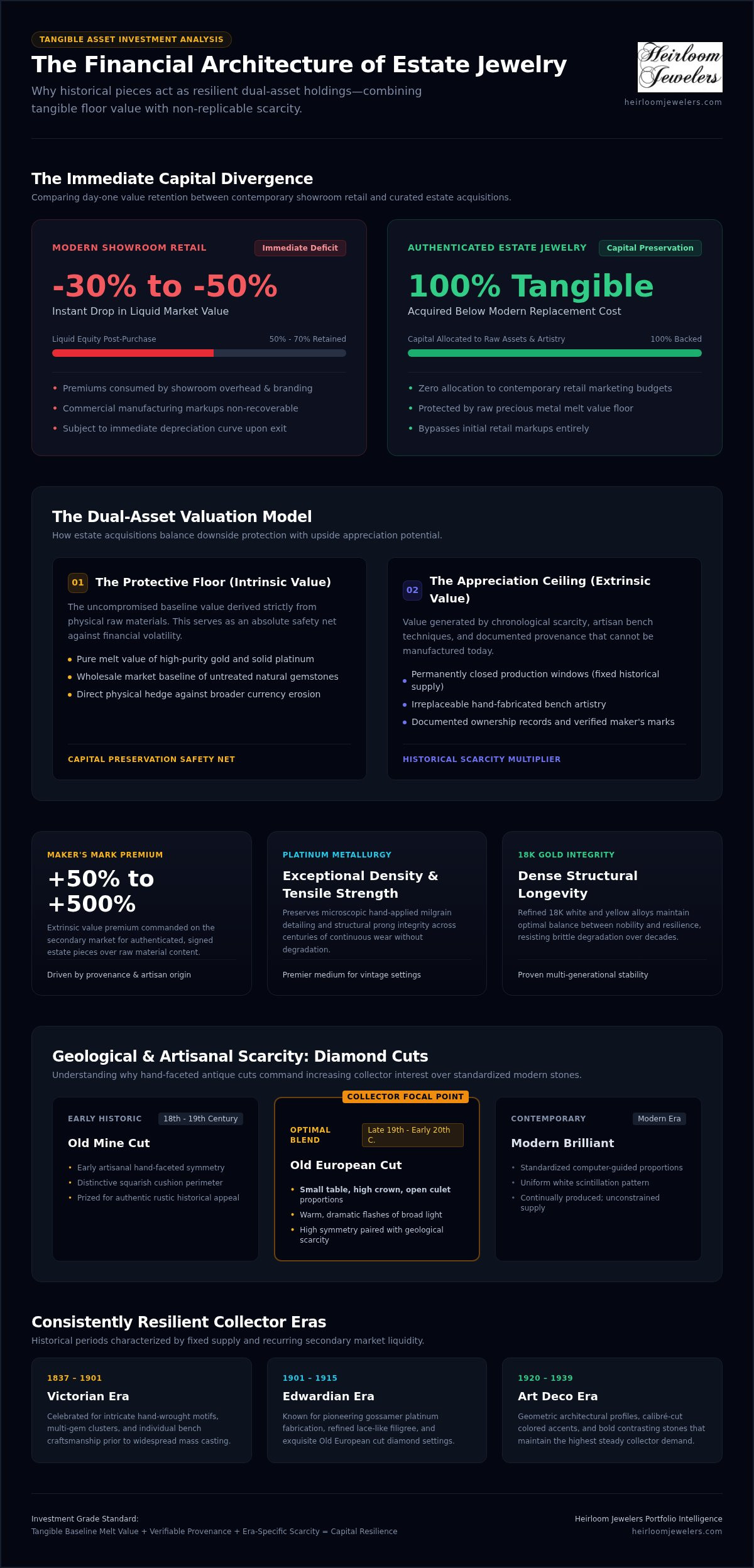
Answering whether is estate jewelry a good investment requires examining how fine jewelry preserves capital across decades. Traditional retail jewelry carries substantial markups to cover brand marketing, showroom overhead, and commercial manufacturing. Because of these built-in premiums, newly purchased fine jewelry often suffers an immediate 30% to 50% drop in liquid value the moment it leaves the boutique. Estate pieces bypass this steep depreciation curve entirely. Acquiring an authenticated historical item allows you to buy well below modern replacement cost, paying for tangible precious metals, natural stones, and surviving bench artistry rather than marketing budgets. Discerning collectors recognize the quiet confidence that comes from investing in timeless craftsmanship instead of fleeting seasonal trends.
Defining Estate Jewelry for the Modern Investor
Not every pre-owned item merits inclusion in an investment portfolio. While standard secondhand items simply denote prior ownership, curated heritage jewelry represents distinct historical, artisanal, or geological scarcity. Throughout the documented history of jewellery, master bench jewelers relied on meticulous hand-fabrication methods that modern casting cannot replicate. Iconic eras like Victorian, Edwardian, and Art Deco consistently generate steady collector demand because the supply of authentic pieces is strictly fixed. In 2026 market conditions, tangible hard assets like high-purity gold, solid platinum, and untreated gemstones offer a proven hedge against broader financial volatility.
The Difference Between Price and Long-Term Value
Discerning collectors must separate an appealing discount from genuine asset appreciation. A good deal merely indicates an item priced below initial retail, while a good investment guarantees liquidity, verifiable authenticity, and resilient market demand over time. Provenance plays a substantial role in this equation, as documented ownership histories and revered maker marks command measurable premiums on the secondary market. Investment grade describes a piece where intrinsic material value and historical rarity intersect. When these two forces align, an acquisition preserves its purchasing power for generations to come.
Intrinsic vs. Extrinsic Value: What Drives Appreciation?
Every serious collector evaluating whether is estate jewelry a good investment must weigh two distinct valuation forces: intrinsic baseline value and extrinsic market premium. Intrinsic value serves as your financial safety net. It reflects the pure melt value of high-purity metals and the base wholesale worth of natural stones. Extrinsic value represents the historical significance, design provenance, and artisan rarity that lift a piece well above its raw commodities. As time passes, the scarcity multiplier takes effect. Because historical eras cannot be recreated, items that are permanently out of production naturally enjoy accelerated capital growth. Evaluating these Key Indicators of a High-Potential Investment Piece helps you identify treasures where both factors actively compound.
The Scarcity of Old European Cut Diamonds
Standardized modern brilliant diamonds dominate contemporary showcases, yet sophisticated investors seek out hand-faceted antique cuts. Old European cuts, crafted primarily between the late 19th and early 20th centuries, feature a distinctive small table, high crown, and open culet. These proportions produce warm, dramatic flashes of broad light rather than uniform white scintillation. Connoisseurs acquiring antique diamond earrings appreciate this individual bench artistry. While early Old Mine cuts hold rustic appeal, Old European cuts offer an optimal blend of symmetry, geological rarity, and escalating market demand.
Precious Metals: The Resiliency of 18K Gold and Platinum
High-purity metals form an enduring hedge against currency erosion. Platinum, celebrated for its remarkable density and tensile strength, preserves intricate milgrain detailing across centuries, making it the premier choice for vintage engagement rings. Similarly, refined 18K white gold maintains exceptional structural integrity without brittle degradation over decades of wear. These dense, precious alloys secure capital baseline security, shielding your collection from market volatility.
Designer authentication amplifies this intrinsic metalwork. A signed estate piece commands an extrinsic premium of 50% to 500% over its constituent raw elements, converting standard fine jewelry into an investment-grade asset. To explore how historical hallmarks and verified provenance protect your capital, review the curated vintage acquisitions at Heirloom Jewelers.
Estate vs. Modern Retail: A Comparative Investment Analysis
Comparing primary retail to the secondary estate market reveals a fundamental difference in capital efficiency. Modern luxury houses routinely price their collections at markups ranging from 300% to 500% over the cost of raw materials and assembly. These price tags fund global storefronts, celebrity endorsements, and corporate distribution channels. When analyzing whether is estate jewelry a good investment, the primary market leaves you starting deep in a financial hole. Estate acquisitions, by contrast, strip away these corporate markups, allowing you to pay strictly for inherent physical and historical substance.
Resale dynamics further set these two markets apart. Mass-produced modern pieces face intense direct competition whenever you attempt to liquidate them, as thousands of identical items exist simultaneously. Authentic historical pieces benefit from the one-of-a-kind factor. When you hold an original early-20th-century creation, no factory can manufacture identical inventory to undercut your position. Financial analysts exploring consistently highlight how finite historical supply protects secondary market valuations against sudden dilution.
Avoiding the New Jewelry Depreciation Trap
Sustainability as a Value Driver in 2026
Changing consumer habits have introduced a powerful catalyst into vintage valuations: ethical consciousness. Modern investors increasingly reject the ecological impact of destructive extraction, viewing heirloom pieces as the ultimate sustainable asset class:
- Zero New Mining Footprint: Vintage jewelry circulates previously mined precious metals and gemstones without demanding new extraction.
- Rising Green Premiums: Eco-minded luxury buyers actively pay a surcharge for authenticated, conflict-free historical provenance.
- Generational Appeal: Younger wealth holders entering the market prioritize circular luxury, establishing sustained secondary liquidity for decades ahead.
Key Indicators of a High-Potential Investment Piece
Identifying whether is estate jewelry a good investment comes down to executing a disciplined, methodical physical inspection. Serious investors do not rely on visual charm alone; they look for verifiable technical indicators that confirm value retention. Evaluating an asset requires four sequential steps:
- Verify Maker's Marks: Locate stamped signatures that confirm artisan lineage and designer pedigree.
- Re-evaluate the Four Cs: Judge color, clarity, cut, and carat weight through antique grading criteria that reward natural character and hand-cut facets.
- Inspect Settings: Examine the structural mounting under 10x magnification, focusing on prong thickness and metal integrity.
- Assess Gemstone Saturation: Prioritize unheated stones with vivid, natural depth, such as the intense saturation showcased in a Lugano Emerald & Diamond Necklace.
Decoding Hallmarks and Authenticity Markers
Evaluating Structural Integrity in Vintage Settings
Wear patterns tell the true story of an antique mounting. Carefully inspect the bottom of vintage rings for excessive shank thinning, which signals metal fatigue. Examine platinum prongs to confirm they securely grip their stones without brittle fractures. Authentic collectors place a premium on original, unaltered settings rather than pieces heavily reworked by modern hands. Aggressive polishing strips away crisp hand-engraved details and milgrain borders, permanently harming resale liquidity. Preserving an item's original state remains the cornerstone of long-term appreciation. If you want to acquire authenticated items inspected by experienced specialists, explore curated estate pieces at Heirloom Jewelers.
Building Your Portfolio with Heirloom Jewelers
Building a tangible asset collection requires discernment, patience, and an experienced partner. While asking whether is estate jewelry a good investment marks a sensible starting point, your long-term return depends entirely on where and how you source each piece. Heirloom Jewelers prioritizes strict curation over retail volume. Rather than cataloging ordinary secondhand inventory, we act as a knowledgeable guide for private collectors, selecting rare historical pieces with genuine investment potential.
The Role of Expert Authentication
Every acquisition begins with rigorous verification. We filter out mass-produced commercial jewelry to focus exclusively on investment-grade historical treasures. Our specialists inspect every facet of an item, examining high-purity 18K white gold and dense platinum mountings for structural soundness. We authenticate original period hallmarks, verify natural gemstone treatments, and confirm historic cutting styles. This uncompromising curation provides complete peace of mind, ensuring your capital is backed by verified authenticity and enduring physical craftsmanship.
Curation as a Strategy for Long-Term Appreciation
A deliberate curation strategy separates casual buyers from purposeful collectors. Accumulating random pieces rarely yields superior market appreciation. Instead, focusing your collection on specific historical movements, such as Art Deco geometric mountings or hand-cut Old European diamonds, creates a coherent portfolio that commands higher interest on the secondary market. Strategic diversification strengthens this foundation:
- Balance Asset Formats: Pair foundational pieces like antique rings with prominent high-jewelry necklaces to balance personal wearability with major capital placement.
- Diversify Materials: Combine untreated colored gemstones with high-purity gold and platinum settings to create a natural buffer against shifting economic cycles.
- Prioritize Rarity Over Scale: Focus on exceptional craftsmanship and limited supply rather than modern commercial volume.
Market conditions in 2026 present a compelling window for serious collectors to enter the estate space. As historical inventories become increasingly scarce, fine estate jewelry continues to deliver a rare dual reward: the daily joy of owning living history, backed by the lasting financial resilience of a tangible asset. Those looking to complement their collection with timeless gold assets and heirloom-quality bridal designs can discover Gomes & Góis for classic gold coins and fine rings that retain lasting material value.
Securing Tangible Value in Historic Fine Jewelry
When approached with an eye for verified rarity, asking whether is estate jewelry a good investment yields an emphatic yes. Authentic period pieces protect your wealth with an unshakeable financial floor of high-purity precious metals, while their finite historical supply creates enduring extrinsic value. By avoiding modern showroom depreciation and prioritizing original handcraftsmanship, you secure assets that stand apart from transient fashion cycles.
Heirloom Jewelers approaches fine jewelry with quiet confidence and deliberate curation. As specialists in hand-faceted Old European cut diamonds and authenticated designer masterworks like the Lugano Emerald & Diamond Necklace, we ensure every acquisition meets exacting standards for structural integrity and historical provenance. When you invest in historic fine jewelry, you don't simply preserve capital; you become the proud steward of a living artistic legacy. Take your next step as a discerning collector and explore our curated collection of authenticated investment-grade estate jewelry.
Frequently Asked Questions
Is estate jewelry worth more than new jewelry?
In terms of intrinsic material value and artisanal quality per dollar spent, estate jewelry routinely delivers greater worth than new retail pieces. Modern jewelry prices reflect heavy commercial markups, branding campaigns, and distributor overhead. Estate pieces bypass these added costs, trading much closer to their tangible material value. Because that initial retail depreciation has already occurred, your capital buys authentic precious metals and natural gemstones rather than showroom margins.
Does estate jewelry appreciate in value over time?
Investment-grade estate jewelry regularly appreciates due to rising precious metal values and strictly limited historical supplies. When asking whether is estate jewelry a good investment, long-term market trends show that rare era-specific designs and untreated gemstones steadily gain value over decades. Unlike mass-manufactured contemporary items, finite historical inventory cannot be expanded to meet demand, protecting your collection from market dilution.
How can I tell if a piece of estate jewelry is a good investment?
You can identify an investment piece by inspecting its physical condition, metal purity, and verifiable maker attribution. Look for stamped purity hallmarks alongside clear maker signatures. Check that original prongs, galleries, and hand engravings haven't been eroded by excessive polishing or crude repairs. Items retaining original hand-cut stones, untreated gems, and unaltered settings hold the greatest potential for secondary market liquidity.
What is the difference between antique, vintage, and estate jewelry for investors?
The distinctions center on chronology and rarity. Estate describes any previously owned piece of fine jewelry regardless of age. Vintage refers specifically to items crafted between 20 and 100 years ago. Antique applies strictly to pieces crafted over a century ago. For serious collectors, antique and vintage pieces hold superior appreciation potential because their hand-fabricated techniques cannot be replicated by modern casting methods.
Why is platinum a better investment for vintage rings than gold?
Platinum provides unmatched density, tensile strength, and structural security over generations of daily wear. When gold is scratched, microscopic amounts of metal flake away; platinum simply displaces, preserving its overall mass. In historic settings like a Vintage Platinum 0.5 Carat Diamond Engagement Ring, platinum holds delicate pierced galleries and fine milgrain work intact, preventing stone loss and protecting your initial capital.
Are designer estate pieces like Lugano better investments than unbranded ones?
Designer attribution commands a substantial secondary market premium above the value of the raw precious materials alone. Renowned luxury houses produce limited editions with exacting bench standards and rare gemstones. An authenticated Lugano Emerald & Diamond Necklace in 18K White Gold, for example, carries prestige, documented pedigree, and steady collector demand that unbranded pieces rarely match when brought to resale.
How do I ensure the authenticity of a vintage diamond's cut and clarity?
Verify authenticity through independent gemological lab documentation and high-magnification bench inspection. Antique stones, such as hand-faceted Old European cuts, display distinctive small tables, steep crown angles, and open culets that modern machine cutters don't replicate. Partnering with a specialist who understands period faceting ensures you don't mistake modern recuts or clarity-enhanced stones for pristine historical diamonds.
What should I look for in a jeweler when buying investment-grade estate pieces?
Choose an authority that prioritizes rigorous curation and historical authentication over commercial inventory volume. Avoid retailers who mix modern reproductions with vintage stock. A reliable partner evaluates metal integrity under magnification, verifies provenance, and helps collectors determine whether is estate jewelry a good investment for their individual portfolio. Transparency, specialist gemological knowledge, and a commitment to preserving original handcraftsmanship are essential traits.