
Why would a modern romantic choose a piece of jewelry that has already been worn for a century? While modern retail often prioritizes mass production, a genuine vintage solitaire engagement ring offers a level of hand-crafted detail that a machine simply cannot replicate. You likely value the idea of a ring with a soul, yet the fear of purchasing a modern reproduction or a fragile setting can make the search feel daunting.
We understand that finding the perfect piece requires both an emotional connection and technical confidence. This guide explores the historical significance and unique artisanal diamond cuts, such as the Old European cut, that define these treasures. You'll learn how to identify era-specific craftsmanship and understand the standards, like USPAP compliance, that ensure your purchase is a lasting legacy. From the strength of antique platinum to the hallmarking of gold, we provide the clarity you need to choose a ring that reflects your personal style and stands the test of time. By the end of this article, you'll feel equipped to select an authentic piece that bridges the gap between a storied past and your future together.
Key Takeaways
- Distinguish between authentic estate pieces and modern reproductions by identifying specific artisanal tool marks and historical hallmarks.
- Learn how to select a vintage solitaire engagement ring that fits your aesthetic, from romantic Victorian gold motifs to delicate Edwardian platinum filigree.
- Understand the unique appeal of the Old European cut, a hand-hewn diamond designed to maximize brilliance under soft, natural light.
- Discover why traditional modern grading scales may not fully capture the value of heritage jewelry and how to evaluate the durability of older settings.
- Explore the benefits of choosing authenticated pre-owned luxury as a sustainable and historically significant choice for your future.
What Defines an Authentic Vintage Solitaire Engagement Ring?
A solitaire ring is defined by its focused simplicity. It features a single gemstone, typically a diamond, held in a setting that draws all attention to the stone's purity and light. This design has traveled a long path through the history of the engagement ring, evolving from ancient symbolic bands into the refined symbols of commitment we recognize today. While modern versions of this style are abundant, they often lack the depth found in an original piece.
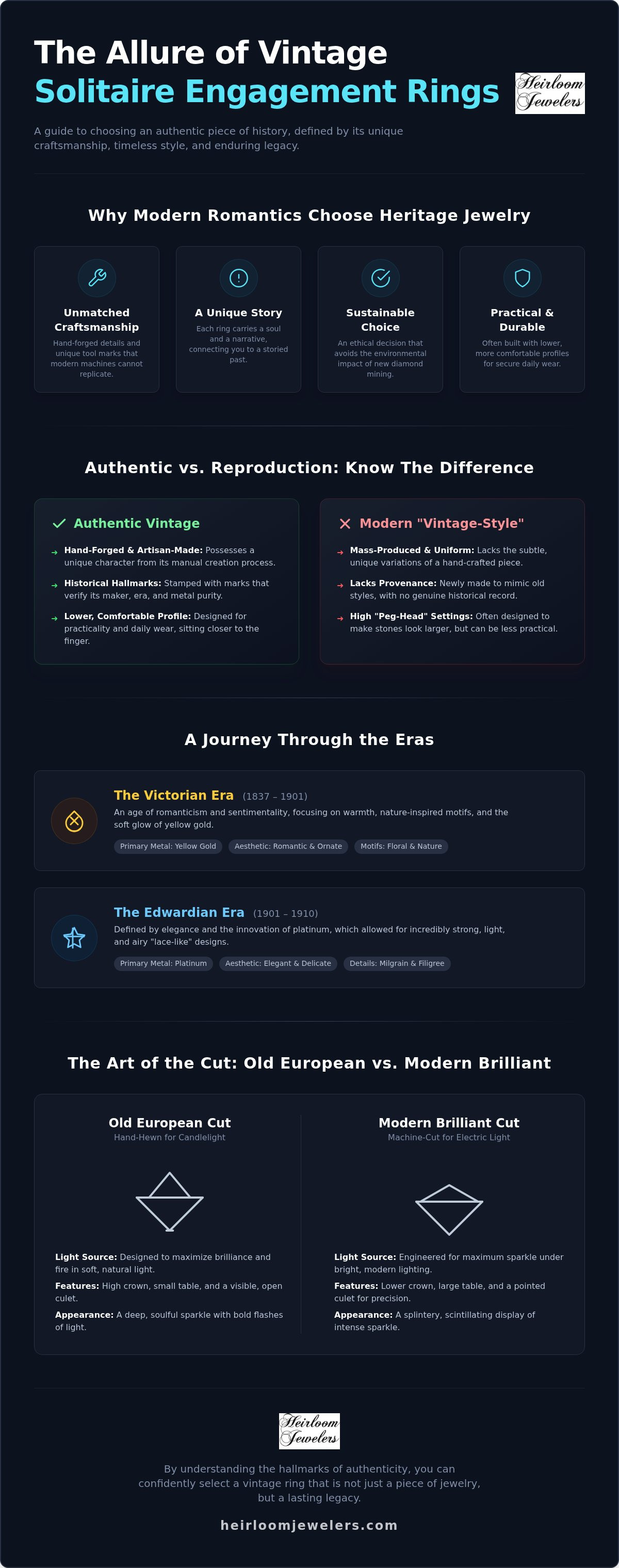
The market is currently filled with "vintage-style" rings. These are new, mass-produced items designed to mimic the appearance of the past. In contrast, an authentic vintage solitaire engagement ring is a genuine estate piece. It was crafted during a specific historical era and has been preserved over decades. At Heirloom Jewelers, we act as curators to bridge the gap between these eras. We meticulously verify the age, metal purity, and stone origin of every piece. This ensures that the ring you choose is a true artifact of jewelry history rather than a modern reproduction.
The Aesthetic Difference: Hand-Crafted vs. Mass-Produced
Authentic vintage rings were often hand-forged by skilled artisans. This manual process creates subtle variations that modern machines cannot replicate. When you examine a vintage setting, you might notice unique tool marks or slight asymmetries. These are not defects. They are the signature of the jeweler who shaped the metal by hand. Historical hallmarks stamped inside the band serve as a record of provenance, identifying the maker and the specific purity of the gold or platinum used.
Vintage solitaires also tend to feature lower, more practical profiles. Modern rings often use high "peg-head" settings to make the diamond appear larger, but these can snag on clothing or feel cumbersome. Older designs were often built for daily wear, sitting closer to the finger. This makes them exceptionally comfortable for the modern romantic who leads an active life.
Why Modern Couples are Choosing Heritage Jewelry
There is a significant shift toward sustainability in the luxury market. Choosing a pre-owned diamond is an ethical decision that avoids the environmental impact of new mining. It allows you to own a piece of high-value jewelry with a clear conscience. Beyond the ethical benefits, there is the undeniable appeal of the narrative. A vintage ring carries a story that a brand-new diamond from a shopping mall simply cannot offer.
For those who find themselves drawn to pieces that are 100 years or older, we recommend exploring our guide on antique rings. Whether you choose a piece from the early 20th century or an older antique treasure, you are investing in a unique legacy. These rings offer a connection to the past that feels both personal and profound.
Exploring the Eras: From Victorian Simplicity to Art Deco Precision
A vintage solitaire engagement ring is more than just a piece of jewelry. It's a window into the design philosophies of the past. Each era brought distinct changes in metal choice, stone setting, and decorative motifs. Understanding these shifts helps you identify which historical period aligns with your personal taste and lifestyle.
The Victorian era, spanning 1837 to 1901, focused on romanticism and warmth. These rings were primarily crafted in yellow gold and often featured nature-inspired elements. Even in a solitaire setting, you might see subtle floral engravings on the band or prongs shaped like delicate leaves. It was a time of sentimentality and hand-forged charm that prioritized a soft, organic aesthetic.
Edwardian Elegance and the Platinum Revolution
The turn of the century introduced a significant technical shift. Jewelers discovered new welding techniques that allowed them to work with platinum, a metal with a much higher melting point than gold. This innovation led to the Edwardian era's signature "lace-like" appearance. Artisans used milgrain detailing, which involves creating tiny beads of metal along the edges of a setting, to add texture and depth without adding bulk.
Edwardian filigree represents the pinnacle of delicate metalwork in 1910. Because platinum is exceptionally strong, jewelers could create incredibly thin, secure settings that made the center diamond appear as if it were floating in lace. This era is perfect for those who appreciate intricate, feminine details that remain durable enough for daily wear.
Art Deco Geometry and the Modern Solitaire
As the Jazz Age took hold in the 1920s, the aesthetic shifted toward bold geometry and high contrast. The clean, structural look of art deco jewelry remains one of the most sought-after styles today. These rings abandoned the soft curves of the previous decade in favor of symmetry and architectural precision. Platinum remained the preferred metal to achieve a bright white finish that complemented the brilliance of the diamond.
During this time, the focus on the center stone intensified. While the 4Cs are the modern standard for evaluating diamond quality, Art Deco jewelers were already prioritizing clarity and cut to suit their geometric designs. If you value order and striking silhouettes, an Art Deco solitaire provides a sophisticated, timeless aesthetic.
The mid-century years brought further change. Following World War II, white gold became a popular alternative as platinum was reserved for military use. Settings became more architectural and substantial. These rings often featured "fishtail" prongs or illusion settings that made the diamond appear larger. If you're looking for a piece that feels both classic and substantial, you might consider our vintage platinum 0.5-carat diamond engagement ring for its authentic mid-century craftsmanship.
Artisanal Diamond Cuts: Old European vs. Modern Brilliant
The cut of a diamond determines its personality and how it interacts with the world around it. While modern diamonds are engineered for maximum white light return, a vintage solitaire engagement ring often features a stone cut with a different priority. These historical cuts were designed to capture and disperse light in ways that modern machine-cutting cannot replicate. Understanding these nuances is essential for any collector tracing the history of diamond engagement rings and their aesthetic evolution.
The Old European cut is the hand-hewn predecessor to the modern round brilliant. Artisans of the late 19th and early 20th centuries didn't have the benefit of laser technology or fluorescent overhead lighting. They cut diamonds to maximize "fire," which refers to the colorful flashes of light visible under soft, low-light conditions like candlelight. This creates a deep, romantic glow that feels more like an "inner light" than the sharp, surface-level sparkle of modern stones. A defining feature of these diamonds is the culet, a small flat facet at the bottom of the stone. When viewed through the top, the culet creates a unique floral pattern that serves as a hallmark of authenticity.
The Character of the Old European Cut
Old European cuts are distinguished by a higher crown and a smaller table, the flat facet on the very top of the diamond. This geometry gives the stone a distinctive "tall" profile. Because of this height, a 0.5-carat Old European cut can often feel more substantial and present than its modern counterpart of the same weight. Every Old European cut was shaped by eye, making no two stones identical. Many of these diamonds also possess "warmer" color grades, falling into the J to M range. These soft, creamy tones are highly prized in the estate market because they complement the rich hues of vintage gold and platinum settings.
Choosing Between Platinum and 18K White Gold
Selecting the right metal is just as important as the stone itself. Platinum is the preferred choice for a solitaire because of its remarkable durability and density. It holds a diamond with incredible security, making it ideal for the delicate prongs found in Edwardian or Art Deco designs. Over decades of wear, vintage platinum develops a "patina of age," a soft, matte finish that many collectors prefer over a high-polish shine. If you desire a brighter, more contemporary luster, 18K white gold is an excellent alternative. It offers a crisp, silvery finish that provides a high-contrast backdrop for a brilliant center stone. Whether you prefer the steady weight of platinum or the bright sheen of white gold, both metals offer a timeless foundation for a heritage piece.
Evaluating Quality and Authenticity in the Estate Market
Evaluating a vintage solitaire engagement ring requires a shift in perspective. Modern retail focuses heavily on mathematical precision and "triple-excellent" cut grades, but these metrics don't always capture the beauty of a heritage jewelry piece. You aren't just buying a diamond; you are acquiring a preserved moment in time. The value of a vintage piece lies in its cohesive history, where the character of the stone and the craftsmanship of the setting work in harmony.
Authenticity is found in the subtle details of the metalwork. Look for signs of manual labor, such as slight variations in the thickness of the shank or the hand-carved placement of the prongs. These artisanal marks are distinct from the uniform, clinical perfection of a modern 3D-printed reproduction. Originality is also vital. A truly valuable collector's piece features a diamond and a setting that were born in the same era, ensuring the ring’s story remains intact.
Decoding Period Hallmarks
Period hallmarks are the most reliable evidence of a ring's origin. Stamps like "PLAT" for platinum or "18K" for gold provide essential information about the metal purity and the jeweler's identity. These marks should show some softening or wear consistent with the age of the piece. If a hallmark looks like a crisp, computer-generated font, it's likely a modern laser engraving. This is a common sign of a "vintage-style" reproduction rather than a genuine vintage solitaire engagement ring. We recommend having an expert jeweler verify the integrity of the prongs and the shank to ensure the piece is as durable as it is beautiful.
The Sustainability Factor of Vintage Gold
Sustainability is increasingly viewed as a modern luxury. Choosing estate jewelry is the most eco-friendly way to shop for an engagement ring because it bypasses the environmental impact of new mining. It's a choice that honors the earth while celebrating the past. Beyond the environmental benefits, there is the concept of cultural sustainability. By preserving these rings, you are keeping historical techniques and stories alive for another generation. We encourage you to view your purchase as a long-term investment in both personal style and global ethics. To begin your journey with a trusted guide, we invite you to browse our curated selection at Heirloom Jewelers.
Finding Your Perfect Vintage Solitaire with Heirloom Jewelers
Choosing a vintage solitaire engagement ring is a deeply personal endeavor. At Heirloom Jewelers, we believe the process should be as refined as the jewelry itself. We avoid the high-pressure environment of modern retail, opting instead for a curated experience that prioritizes the history and integrity of every piece. Our collection is composed strictly of authenticated estate items, ensuring that your choice is a genuine artifact rather than a mass-produced imitation. We see ourselves as a bridge between the craftsmen of the past and the romantics of the present.
A standout example of our commitment to quality is the vintage platinum 0.5-carat diamond engagement ring. This piece captures the balanced proportions and understated elegance that defined mid-century design. For those looking to expand their aesthetic, a solitaire can be beautifully complemented by a vintage wedding band or even paired with baguette rings to create a tiered, architectural look. Every item we offer is selected for its ability to tell a story while remaining a wearable, durable symbol of commitment.
Curating Your Personal Collection
Deciding between a minimalist Victorian band and a geometric Art Deco setting often comes down to your daily lifestyle and wardrobe. Victorian gold offers a warmth that feels organic, while Art Deco platinum provides a structured, high-contrast look. Caring for these pieces requires a gentle touch. Antique platinum is notably dense and durable, but it benefits from occasional professional inspections to ensure the prongs remain secure. When you choose a vintage solitaire engagement ring, you are more than a buyer. You become the next steward of a historic legacy, carrying its story forward into a new chapter.
Navigating Your Purchase with Confidence
Our specialized focus on the secondary market means we don't offer modern, mass-produced jewelry. This allows us to dedicate our full expertise to the authentication of rare estate finds. Based in our Montgomery boutique, we serve a national audience of collectors who value transparency and deep industry knowledge. We verify the metallurgy and stone origin of every ring before it enters our collection. If you have questions about a specific era or setting, we invite you to contact our curators for personalized assistance. We're here to ensure you feel confident in the authenticity and enduring value of your selection.
Begin Your Journey with a Timeless Artifact
An authentic vintage solitaire engagement ring represents more than a stylistic choice. It is a commitment to preserving history and celebrating the artisanal techniques of a bygone era. You now understand the technical differences between hand-hewn Old European cut diamonds and modern machine-cut stones, as well as the importance of verifying period-correct hallmarks. These details ensure that your selection is a genuine piece of authenticated estate jewelry rather than a modern reproduction.
At Heirloom Jewelers, we act as specialized curators for those who value unique, one-of-a-kind historic pieces. Our expertise as specialists in Old European cut diamonds allows us to guide you through the nuances of fire and crown height that define these rare treasures. Explore our curated collection of authenticated vintage solitaire engagement rings to discover a piece that bridges the past and your future together. We're honored to help you find a legacy that you'll be proud to wear for a lifetime.
Frequently Asked Questions
Is a vintage solitaire engagement ring as durable as a modern one?
Authentic vintage rings are remarkably durable because they were often hand-forged from dense platinum or high-karat gold. These materials were chosen for their longevity and ability to hold stones securely over decades of wear. While the metal itself is strong, it's important to have a specialist inspect the prongs and shank for thinning or wear. Regular maintenance ensures your vintage solitaire engagement ring remains a lasting symbol of your commitment.
What is the difference between an Old European cut and a modern round brilliant?
The Old European cut features a higher crown, a smaller table, and a flat facet at the bottom called a culet. These diamonds were hand-cut to maximize colorful "fire" under soft candlelight. In contrast, modern round brilliant diamonds are machine-cut to maximize white light return under fluorescent bulbs. The result is a deep, romantic glow in the vintage stone versus the sharp, surface sparkle of a modern diamond.
Can a vintage platinum engagement ring be resized?
Yes, most vintage platinum rings can be resized by a jeweler who understands historical metalwork. Platinum is a dense, malleable metal that handles the resizing process well without losing its structural integrity. However, if the ring features intricate Edwardian filigree or continuous Art Deco engraving, a specialist must take care to preserve the continuity of the design. We recommend consulting with a curator before making significant adjustments to a heritage piece.
Why are many vintage diamonds "warmer" in color than modern ones?
Vintage diamonds often fall into the J to M color range because these warmer tones were highly prized in the 19th and early 20th centuries. These creamy hues looked exceptionally rich under natural light and complemented the yellow gold and early platinum settings of the era. Modern grading scales prioritize a colorless appearance, but collectors often seek out these warmer stones for their unique character and historical accuracy.
How do I know if a vintage solitaire ring is authentic or a reproduction?
Authenticity is verified through the presence of period-correct hallmarks and evidence of hand-craftsmanship. Look for soft, slightly worn stamps inside the band and subtle variations in the setting that indicate it was forged by hand. Modern reproductions often feature laser-engraved hallmarks and clinical, machine-perfect symmetry that lacks the soul of an original vintage solitaire engagement ring. Our curators at Heirloom Jewelers authenticate every piece to ensure its genuine estate status.
Are vintage engagement rings more ethical than new ones?
Choosing a vintage ring is the most sustainable and ethical way to shop for fine jewelry. It avoids the environmental impact and social complexities associated with new diamond and metal mining. By purchasing an estate piece, you are participating in a circular economy that preserves history while reducing the demand for new resource extraction. It is a choice that reflects both a love for the past and a respect for the future.
What should I look for in a 1920s Art Deco solitaire ring?
Focus on geometric precision, architectural lines, and the use of platinum. Art Deco solitaires often feature symmetrical details, such as tiered shoulders or stepped settings, that emphasize the center stone's brilliance. You might also find early baguette-cut accents or milgrain detailing that adds texture to the structural design. These rings are perfect for those who value the high-contrast, bright white aesthetic of the early 20th century.
Does Heirloom Jewelers offer custom manufacturing for vintage-style rings?
No, we do not offer custom jewelry manufacturing or "vintage-style" reproductions. Our focus is exclusively on the authentication and sale of genuine estate and vintage fine jewelry. We believe the value of a piece lies in its original history and artisanal craftsmanship. Our collection, which includes rare finds like our vintage platinum 0.5-carat diamond engagement ring, is strictly limited to one-of-a-kind historic treasures.