
In a global market increasingly defined by mass-produced replicas, true vintage gemstone earrings have become a significant form of portable wealth. With gold prices reaching the $4,000 per ounce range in 2026, the intrinsic value of these pieces is higher than ever, yet their true worth lies in their rare provenance and historical craftsmanship. You likely seek the unique character of a hand-cut stone but find yourself wary of modern imitations or confused by the technical nuances of antique metal purity. It's a common challenge to distinguish a genuine Art Deco masterpiece from a high-quality reproduction without a trained eye.
This guide provides the professional expertise required to master the complexities of the secondary market with absolute confidence. We'll show you how to identify era-specific details, evaluate the quality of untreated stones, and understand the latest GIA origin tracking standards that add a premium to your collection. By the end of this article, you'll possess the knowledge to acquire an authentic piece that serves as both a personal heirloom and a stable investment. We'll cover everything from the geometry of old European cuts to the rigorous authentication process used by seasoned curators.
Key Takeaways
- Learn to identify authentic vintage gemstone earrings by recognizing era-specific hallmarks and the distinct characteristics of artisanal metalwork.
- Understand the valuation of the "Big Three" gemstones, focusing on the rarity of untreated rubies, sapphires, and emeralds with verified provenance.
- Evaluate the structural integrity and historical value of 18K white gold and platinum settings compared to modern alternatives.
- Master the nuances of antique gemstone cuts, such as the Old European Cut, to ensure your piece reflects genuine historical craftsmanship.
- Develop a strategy for acquiring authenticated estate jewelry that prioritizes long-term value and avoids the pitfalls of mass-produced reproductions.
The Enduring Allure of Vintage Gemstone Earrings
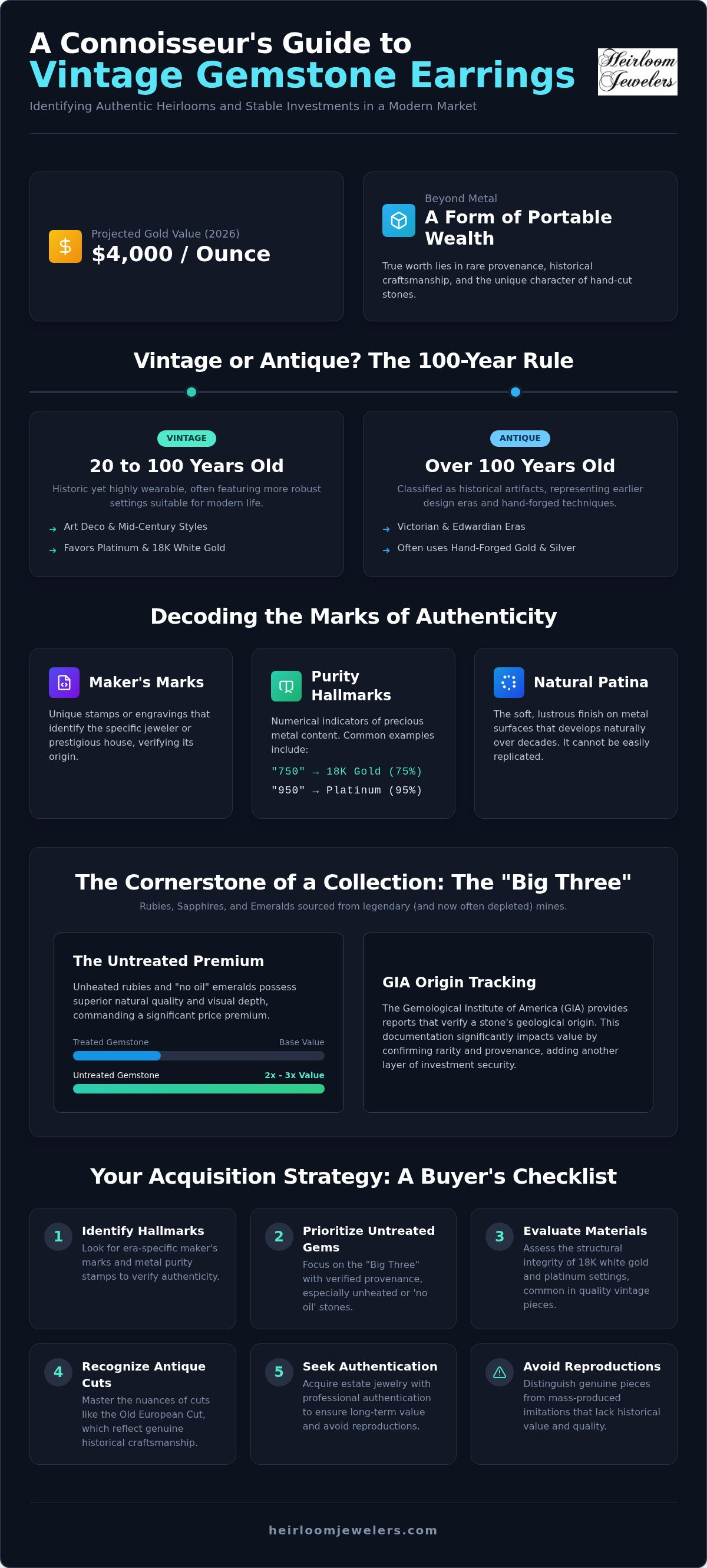
Vintage gemstone earrings are far more than mere accessories. They are artifacts of design history that have survived the test of time. In professional curation, we define "vintage" as any piece between 20 and 100 years old. This category excludes the fleeting trends of modern mass production, offering instead a level of character and sustainability that is rare in the current market. Collectors increasingly favor estate jewelry because these pieces possess a soul and a sense of "curated history" that cannot be replicated in a factory. The journey from the romantic, nature-inspired motifs of the Victorian era to the bold, architectural lines of the Art Deco period represents a fascinating evolution in fine jewelry. While Victorian designs often focused on sentimental symbolism, the Art Deco movement embraced the machine age with geometric precision and striking contrast.
Distinguishing Antique from Vintage
Understanding the terminology is the first step toward a confident acquisition. The 100-year rule is the industry standard: any item older than a century is classified as antique. Currently, 20th-century vintage pieces are seeing a surge in demand as collectors look for styles that feel both historic and highly wearable. These items often feature more robust settings than their antique predecessors, making them suitable for modern life. Authentic estate jewelry is defined by specific physical indicators that verify its origin. Era-specific hallmarks found in estate jewelry include unique maker's marks, metal purity stamps, and the natural patina that only decades of careful wear can produce.
- Maker's Marks: Unique stamps that identify the specific jeweler or prestigious jewelry house.
- Purity Hallmarks: Numerical indicators of metal content, such as "950" for platinum or "750" for 18K gold.
- Patina: The soft, lustrous finish on metal surfaces that develops naturally over time.
Why Era-Specific Craftsmanship Matters
The transition in jewelry making was often dictated by the materials available at the time. Early Victorian pieces relied on hand-forged gold and silver, while the Art Deco era introduced the widespread use of platinum and 18K white gold. These changes were deeply tied to the history of earrings and the industrialization of the early 1900s. Historical events, including the opening of new emerald mines or diamond discoveries in Africa, dictated which stones were accessible to master jewelers. This context explains why certain eras are defined by specific gemstone pairings or metal choices. Every design decision was a response to the world at that moment. This meticulous approach to quality is a hallmark of all fine estate pieces. If you wish to learn more about how these historical styles influence other categories, explore our educational guide on antique rings. It provides a comprehensive look at the craftsmanship that defines our curated collection.
Identifying Signature Gemstones in Estate Collections
The "Big Three" gemstones, rubies, sapphires, and emeralds, form the cornerstone of any serious estate collection. Unlike modern retail pieces that often rely on synthetic alternatives or heavy treatments, vintage gemstone earrings frequently feature stones of superior natural quality. Many collectors prioritize these items because older gems were often sourced from legendary mines that are now depleted. According to the GIA Gem Encyclopedia, the geological origin of a stone significantly impacts its color saturation and value. In the 2026 market, an unheated ruby or a "no oil" emerald can command a price premium of double or triple that of a treated counterpart. This rarity makes authenticated estate pieces a stable form of portable wealth, especially as the GIA has expanded origin tracking for stones like opal and spinel.
The Emerald Standard: From Lugano to Estate Finds
Emeralds found in vintage settings often possess a visual depth that is difficult to find today. These stones are frequently set in 18K white gold to enhance their vivid green hues. High-end designers often draw inspiration from the "Lugano" aesthetic, which emphasizes the marriage of exceptional clarity with intricate diamond accents. For instance, the Lugano Emerald & Diamond Necklace demonstrates how premium emeralds can be showcased through sophisticated craftsmanship. When evaluating these pieces, we look for "jardin," or natural inclusions, that prove the stone's organic origin rather than detracting from its beauty. These internal patterns are like fingerprints that tell the story of the gem's formation over millions of years.
Rare and Unique Gemstone Pairings
While the "Big Three" dominate the market, unique estate pairings offer a more personal aesthetic. The Edwardian era popularized the use of semi-precious stones, leading to the creation of elegant dangles that combined variety with movement. Estate peridot and quartz dangle earrings in 14K yellow gold are excellent examples of this period's charm. These pieces often feature:
- Complementary Colors: The bright lime green of peridot paired with the clarity of rock crystal or smoky quartz.
- Artisanal Settings: Fine milgrain work or delicate filigree that secures the stones while allowing light to pass through.
- Structural Integrity: Checking the stability of the dangle hinges is essential to ensure the piece remains secure during wear.
Finding a one-of-a-kind pairing requires a discerning eye for detail and an appreciation for historical context. We invite you to explore our curated selection of estate earrings to find a piece that resonates with your personal style and holds its value through the decades.
Evaluating Quality: Metals, Cuts, and Settings
The structural integrity of vintage gemstone earrings is often superior to modern counterparts, but it requires a specialized eye to verify. Quality in the secondary market isn't just about the carat weight of the stones. It involves a deep appreciation for the way a piece was constructed. High-end estate jewelry was built to last for generations, utilizing dense metals and hand-set stones that modern mass production simply cannot replicate. When you evaluate these pieces, you're looking for the intersection of durability and artistry. It's essential to understand that a slight patina or a minor irregularity in a hand-forged setting isn't a defect. Instead, it's a testament to the piece's authentic history and artisanal origins.
Artisanal Gemstone Cuts vs. Modern Precision
Before the advent of computer-aided design, master lapidaries cut stones by hand to maximize their beauty under candlelight. This process resulted in the Old European Cut, which is prized for its unique "fire" and large facets. These stones possess a romantic, soft glow that feels more organic than the clinical brilliance of modern machine-cut gems. Antique stones were cut to follow the natural shape of the rough crystal, leading to individual personalities for every gem. Vintage cuts have a smaller table and a higher crown compared to the mathematically precise, flatter proportions of modern brilliant cuts. This height creates a depth of color that is particularly striking in vintage gemstone earrings featuring sapphires or rubies.
Metal Purity in Vintage Jewelry
The choice of metal often reveals the specific era of a piece's creation. 18K white gold was the metal of choice for many early 20th-century earrings because it offered a bright, durable alternative to silver. However, the rise of platinum during the Art Deco period allowed for even greater geometric complexity. Platinum's immense strength meant that jewelers could use less metal to secure stones, leading to the ethereal, "floating" look found in many high-value estate pieces. For a deeper look at how these materials were utilized in specific designs, you can explore our guide on antique diamond earrings.
Inspecting the finer details of the metalwork is a critical step in the authentication process. You should look for thinning or breaks in the delicate filigree and openwork, as these areas are the most susceptible to wear. Identifying authentic hallmarks involves examining the piece under a 10x loupe to find stamps like "PLAT" or "18K" on the posts or the back of the setting. Genuine hallmarks from the early 1900s will often show soft, worn edges from decades of use. This natural wear is a reliable indicator of age that modern, laser-etched replicas often fail to mimic accurately.
Styling and Gifting Vintage Gemstone Earrings
Incorporating vintage gemstone earrings into a contemporary wardrobe is an exercise in balance. The goal is to highlight the piece's unique history without the overall look feeling like a costume. These items serve as focal points that bridge the gap between historical artistry and modern aesthetics. Selecting the right era often depends on your personal style and physical features. For instance, long Victorian dangles create a vertical line that flatters round or heart-shaped faces. Conversely, the bold, geometric studs of the Art Deco period provide a structured contrast to softer, more angular jawlines. By understanding these design principles, you can wear heritage pieces with the same ease as modern accessories.
Modern Styling for Heritage Pieces
Art Deco studs are particularly effective when paired with contemporary business attire. Their clean lines and architectural symmetry complement the sharp tailoring of a modern blazer or a structured dress. If you're attending a formal evening event, Victorian-era dangle earrings offer a romantic elegance that modern jewelry often lacks. Don't be afraid to mix metals. Pairing vintage yellow gold with a modern platinum timepiece or white gold necklace is a sophisticated way to show that your collection is curated over time. This approach moves away from the rigid matching of the past in favor of a more layered, personal expression of style.
The Gift of a Legacy
Choosing a piece of jewelry as a gift is a significant gesture, but opting for vintage gemstone earrings adds a layer of depth that new items cannot match. These pieces are inherently sustainable. They represent a choice to value existing craftsmanship over the environmental impact of new mass production. When gifting, consider the recipient's birthstone to add a personal touch. Explaining the provenance of the piece, such as its era of origin or the specific hand-cut nature of its stones, transforms the gift into a shared story. This emotional connection is what defines heritage jewelry, turning a beautiful object into a lasting legacy.
A pre-owned history is not a drawback; it's a mark of endurance. Every subtle patina on a setting or unique inclusion in a gem is a chapter in that piece's long life. When you give an authenticated vintage item, you are passing on a tangible connection to the past. This sense of continuity makes estate jewelry one of the most meaningful gifts a person can receive. If you're ready to find a piece that tells its own story, we invite you to browse our authenticated collection of vintage earrings today.
Acquiring Authenticated Vintage Jewelry
Acquiring vintage gemstone earrings requires a partner who values historical integrity as much as you do. At Heirloom Jewelers, we've made a deliberate choice to exclude all mass-produced modern jewelry from our inventory. This ensures that every piece we offer is a genuine artifact of its era, possessing the unique character and artisanal quality that modern factory settings cannot replicate. Our commitment to quality means we focus exclusively on authenticated pre-owned items, acting as a reliable guide for those moving through the complexities of high-value secondary markets. When you purchase from a curated collection, you aren't just buying an accessory; you're securing a piece of history that has been vetted for its material quality and origin.
The Curation and Authentication Process
Verification is the foundation of our work. Our curators meticulously examine each piece to confirm its era and the quality of its gemstones. We prioritize settings in 18K gold and platinum because these materials were the standard for high-end jewelry during the Victorian, Edwardian, and Art Deco periods. Buying from a specialized vintage retailer provides a level of security that general jewelers or custom manufacturers can't offer. We don't create new pieces or offer custom manufacturing. Instead, we curate existing history, ensuring that the provenance and materials are exactly as described. This rigorous process protects your investment and ensures the piece remains a true heirloom.
Building Your Heirloom Collection
Building a collection is a rewarding journey that begins with a single, well-chosen piece. For those starting out, we suggest staple items that offer versatility and timeless appeal. Diamond or gemstone studs featuring Old European cuts provide a sophisticated foundation. As your expertise grows, you may choose to invest in rare designer-influenced pieces, such as those reflecting the Lugano emerald aesthetic in 18K white gold. These high-value acquisitions require a deep understanding of the market, which is why we provide detailed information for every item in our inventory.
- Start with Staples: Look for classic studs or simple dangles that can be worn daily.
- Focus on Materials: Prioritize platinum and high-karat gold for long-term durability.
- Seek Rarity: Invest in unique gemstone pairings like estate peridot and quartz as your collection expands.
Purchasing high-value estate items online requires transparency and trust. We provide clear, declarative information about every piece to ensure you feel confident in your acquisition. If you're searching for a specific era or a particular gemstone pairing to complete your collection, our curators are available for estate inquiries. We're here to help you find a one-of-a-kind piece that resonates with your personal style and holds its value through the decades.
Investing in Wearable History
Acquiring fine estate jewelry is a commitment to quality and historical preservation. You now possess the essential tools to distinguish antique from vintage, evaluate the unique fire of Old European cuts, and identify the superior durability of platinum and 18K gold settings. These pieces aren't just decorative accessories. They represent a stable investment in craftsmanship that has already stood the test of time. Every gem and setting in our collection tells a story that modern manufacturing simply cannot replicate.
Finding the right pair of vintage gemstone earrings requires a discerning eye and a trusted guide. Our team at Heirloom Jewelers specializes in authenticated estate fine jewelry, ensuring every piece in our inventory meets rigorous standards for historical integrity. We provide national shipping on all curated pieces, bringing rare and unique finds directly to your private collection with the steady reliability you expect from a professional curator.
Explore our curated collection of authenticated vintage gemstone earrings to find a piece that resonates with your personal legacy. We're here to help you discover a timeless treasure that you'll cherish for years to come.
Frequently Asked Questions
How can I tell if vintage gemstone earrings are authentic?
Authenticity is verified through a combination of era-specific hallmarks and stone characteristics. You should look for maker's marks and metal purity stamps, such as 18K or PLAT, inside the setting. Genuine pieces also exhibit hand-crafted details like milgrain work and artisanal gemstone cuts that modern replicas often struggle to duplicate. Our curators meticulously vet every item to ensure its structural indicators and materials align perfectly with its stated historical period.
What is the difference between antique and vintage earrings?
The primary distinction is the age of the jewelry. Antique earrings are defined as pieces at least 100 years old, covering the Georgian and Victorian eras. In contrast, vintage gemstone earrings are generally between 20 and 100 years old, which includes sought-after Art Deco and Mid-Century styles. Both categories offer a level of character and artisanal quality that you won't find in modern mass-produced jewelry, making them excellent choices for collectors.
Are vintage gemstones more valuable than modern ones?
Vintage gemstones often hold superior value because they were frequently sourced from legendary mines that are now exhausted. These stones are also more likely to be in their natural state, lacking the aggressive heat treatments found in modern retail gems. An unheated ruby or a "no oil" emerald from an estate collection is exceptionally rare. Their value is further enhanced by hand-cut facets that prioritize deep color saturation over standardized machine precision.
Can I wear vintage gemstone earrings every day?
Many vintage gemstone earrings are suitable for daily wear, particularly those crafted from durable materials like platinum or 18K white gold. Harder stones such as diamonds, sapphires, and rubies handle frequent use well. We recommend more care for delicate styles, like estate peridot and quartz dangle earrings. It's best to remove these pieces before strenuous activity or exposure to harsh chemicals to protect the integrity of the vintage settings and artisanal metalwork.
What is an Old European Cut and why is it special?
The Old European Cut is a hand-polished diamond style that was popular from the late 1800s through the early 1900s. It's characterized by a small table, a high crown, and a large culet. These proportions create a soft, romantic "fire" that is especially beautiful in low-light settings. Because they were cut by hand to follow the natural shape of the rough stone, no two Old European Cut gems are exactly alike.
How should I clean and care for my vintage estate earrings?
Gentle care is vital for preserving the historical integrity of your jewelry. We recommend using a soft-bristled brush with mild, soapy water for most hard gemstones, followed by thorough drying with a lint-free cloth. You should avoid ultrasonic cleaners and steam, as they can damage fragile settings or porous stones. Regular professional inspections help ensure that prongs remain secure and hinges on dangle styles stay functional, preventing the loss of precious components.
Why does Heirloom Jewelers focus only on pre-owned jewelry?
We focus exclusively on pre-owned jewelry because it represents a standard of craftsmanship and soul that modern manufacturing cannot replicate. By specializing in authenticated estate items, we provide our clients with unique, sustainable pieces that hold their value through the decades. Our collection is curated to include only high-quality materials like 18K gold and platinum. This focus allows us to act as a reliable guide for those seeking authentic wearable history.
Do vintage earrings come with authentication certificates?
Every item in our inventory undergoes a rigorous internal authentication process by our expert curators to verify its era and materials. While original historical paperwork is rare for older pieces, we provide detailed descriptions of the metal purity and gemstone quality for every sale. For high-value items like Lugano emeralds, we often include reports from reputable laboratories like the GIA. This commitment to transparency ensures you can acquire rare estate finds with absolute confidence.