
An estate jeweler is not a reseller of the old, but a curator of the exceptional. Many collectors feel a natural hesitation when stepping into the world of pre-owned luxury. You might worry about the authenticity of a piece or feel confused by the shifting definitions of antique and vintage. It's common to wonder if a historical setting can withstand daily wear. Finding reputable estate jewelers is the first step toward building a collection that reflects both your personal style and a deep respect for heritage.
You deserve to feel confident in every acquisition you make. This guide will help you understand the tangible value proposition of authenticated estate jewelry. We'll explore how curated pieces, such as a vintage platinum diamond ring or a rare Lugano emerald necklace, offer a level of character that modern retail often lacks. You will learn to identify quality craftsmanship and distinguish between different eras of design. This article provides the clarity you need to find a trusted authority for rare heritage pieces while appreciating the steady beauty of the past.
Key Takeaways
- Learn to distinguish between estate, vintage, and antique designations to evaluate the secondary market with technical precision.
- Understand the rigorous authentication standards used by professional estate jewelers to verify the origin and quality of every heritage piece.
- Discover the enduring value of historical craftsmanship, including hand-forged platinum and artisanal Old European cut diamonds.
- Identify the unique design motifs of major historical periods to select a piece that aligns with your aesthetic and values.
- Recognize the ethical and financial benefits of choosing curated, pre-owned fine jewelry over modern mass-produced alternatives.
What is an Estate Jeweler? Defining Terms and Eras
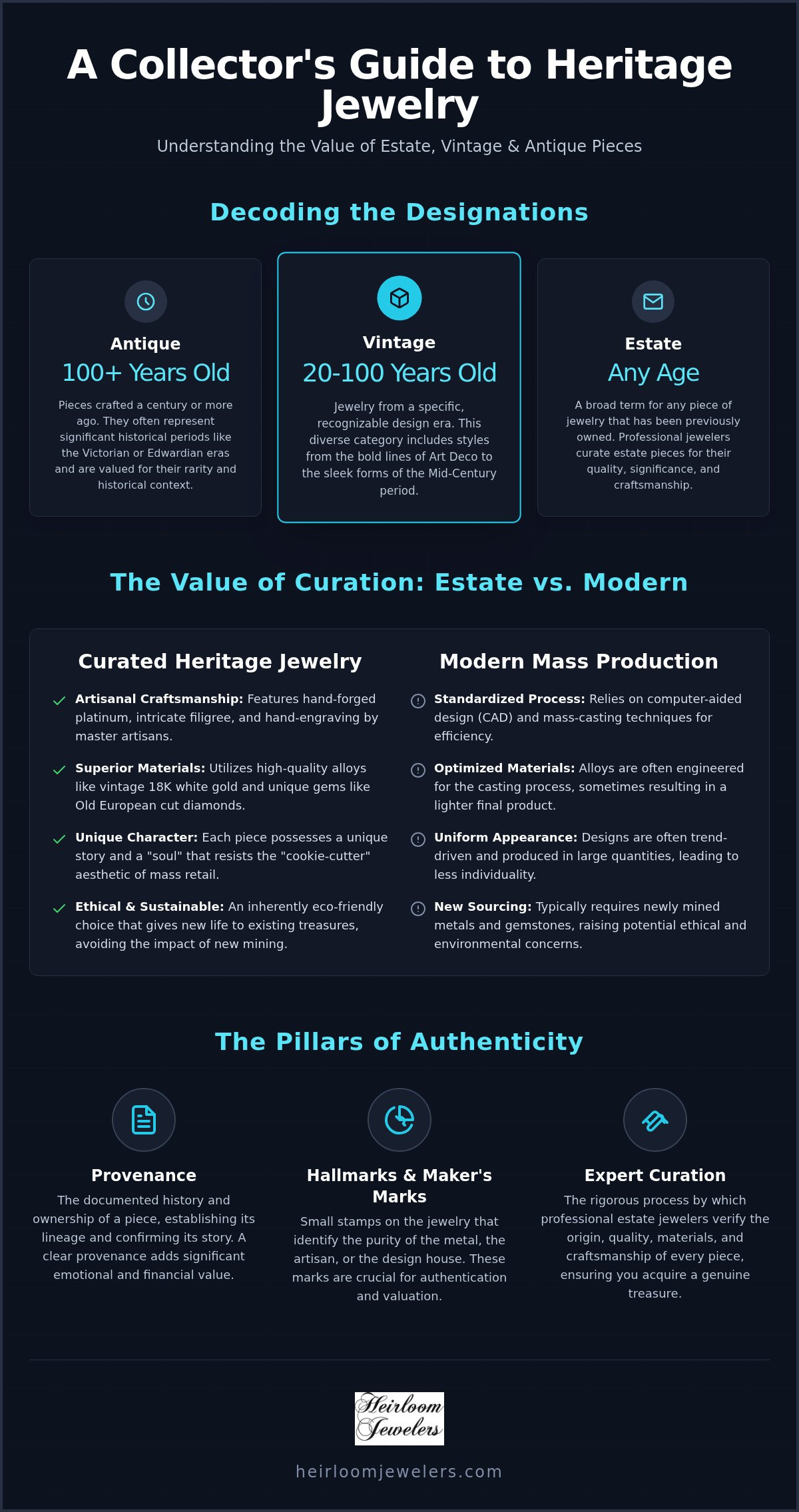
Understanding the precise terminology of the secondary market is the foundation of a successful collection. While the term "estate" is often used as a catch-all, it specifically refers to any piece of jewelry that has been previously owned. This designation is independent of age. A contemporary ring purchased last year is technically estate jewelry if it enters the resale market. However, professional estate jewelers focus on pieces that offer more than just a previous owner. They look for items with historical significance, superior materials, and exceptional artistry.
Broadly defined, Jewellery serves as both personal adornment and a reflection of the era in which it was created. In the context of the secondary market, "Estate Fine Jewelry" implies a higher standard. It suggests the piece is crafted from precious metals and genuine gemstones rather than costume materials. When working with experienced estate jewelers, you gain access to a filtered selection of items that meet these rigorous criteria. These specialists act as curators, identifying pieces that have stood the test of time in both durability and style.
The Distinction Between Estate, Vintage, and Antique
The classification of a piece depends on its date of manufacture. As of 2026, an antique piece must be at least 100 years old, meaning it was crafted in or before 1926. These items often represent the Victorian or Edwardian eras. Vintage jewelry refers to pieces between 20 and 100 years old. This category is diverse, covering the bold lines of Art Deco and the sleek styles of the Mid-Century period. Age significantly impacts valuation. For instance, vintage platinum settings are highly sought after for their strength and ability to hold intricate filigree. These settings often house unique stones like the Old European cut diamond, which was favored before modern laser-cutting techniques became standard. Similarly, the presence of 18K white gold in a vintage piece indicates a level of quality that distinguishes it from mass-produced modern alternatives.
Why Provenance Matters in the Secondary Market
Provenance is the documented history or "story" behind a heritage item. It provides a bridge between the original artisan and the current collector. Authenticated hallmarks and maker's marks are vital tools in this process. These small stamps, often hidden on the inside of a band or the back of a pendant, identify the craftsman or the jewelry house responsible for the work. These marks confirm authenticity and protect you from unauthenticated reproductions that lack historical value.
A clear provenance contributes to the long-term investment value of a piece. Collectors often prioritize items with a verifiable lineage. Whether you're considering a Vintage Platinum 0.5 Carat Diamond Engagement Ring or a rare Lugano Emerald & Diamond Necklace in 18K White Gold, knowing its history adds a layer of emotional and financial security. It ensures that the character and craftsmanship you're buying are genuine and that the piece will continue to hold its significance for generations to come.
The Value Proposition of Curated Estate Jewelry
Choosing to work with estate jewelers offers access to a level of artistry that has largely vanished from the modern assembly line. Most contemporary jewelry is produced using computer-aided design and mass-casting techniques. While efficient, this process often lacks the soul and structural integrity found in historical pieces. Curated vintage items stand apart because they were frequently made by hand. This artisan-led approach results in jewelry with a physical weight and visual depth that modern alloys struggle to replicate. You're not just buying a piece of jewelry; you're acquiring a specimen of historical craftsmanship that resists the "cookie-cutter" aesthetic of the high street.
Artisanal Craftsmanship vs. Modern Mass Production
Hand-engraving has largely declined in contemporary commercial jewelry due to the high cost of skilled labor. Artisans of the past spent days perfecting milgrain and piercing techniques. This level of care is evident when you examine a Vintage Platinum 0.5 Carat Diamond Engagement Ring. The settings are often as stunning as the diamonds themselves. These details aren't just decorative; they reinforce the structure of the piece. For those new to the market, GIA's guide to buying estate jewelry offers helpful tips on what to look for when inspecting these artisanal features. Modern alloys are often optimized for the casting process rather than the final feel of the jewelry. Vintage 18K white gold pieces frequently contain different proportions of alloy metals, which can result in a more rigid and substantial frame.
Sustainability and Ethical Sourcing
Choosing pre-owned jewelry is an inherently ethical decision. It represents a commitment to sustainability by repurposing existing resources. You're opting for a "recycled" luxury item that doesn't require new mining or the associated environmental impact. High-end materials like 14K yellow gold and platinum are designed to last lifetimes. They don't degrade with age. This durability makes estate jewelry a wise choice for those who value both beauty and responsibility. By selecting a piece with history, you're reducing the demand for newly mined gemstones and metals, making your collection a low-impact luxury choice.
The character found in Vintage White Gold Old European Cut Diamond Stud Earrings or a unique Estate Peridot & Quartz Dangle Earrings set cannot be replicated by a machine. Each piece tells a story through its design and its subtle signs of a previous life. If you're ready to find a piece that truly stands out from mass-produced retail, we invite you to view our latest curated arrivals. This connection to the past provides a sense of permanence that modern retail rarely achieves.
The Curation Process: How We Authenticate Heritage Pieces
A reputable estate jeweler does more than simply facilitate a transaction. True curation involves a rigorous multi-point inspection to ensure every piece meets exacting standards of quality and authenticity. This process begins with a detailed assessment of structural integrity. We examine the prongs, shanks, and clasps of every item. For a vintage platinum engagement ring, this means checking for thinning or metal fatigue that could compromise the security of the center stone. We prioritize pieces that have been well-maintained, rejecting items that don't meet our criteria for durability and historical accuracy.
Authentication also extends to the stones themselves. Our specialists use advanced gemological tools to verify that every diamond and colored gemstone is genuine. We look for signs of historical artisanal techniques that modern mass production cannot replicate. This careful vetting process is what distinguishes professional estate jewelers from general resellers. It provides you with the peace of mind that your investment is backed by expert knowledge and a commitment to transparency.
Spotlight on Old European Cut Diamonds
The Old European cut is a hallmark of early 20th-century jewelry. As the predecessor to the modern round brilliant, this cut was popular from the late 19th century through the 1930s. These stones are prized for their unique fire and deep "inner glow." Unlike modern diamonds cut for maximum brilliance under electric lights, Old European cuts were designed to perform under candlelight. You can identify an authentic cut in Vintage White Gold Old European Cut Diamond Stud Earrings by looking for a small table, a high crown, and a visible culet at the bottom of the stone. These features create a softer, more romantic sparkle that is highly coveted by collectors today.
Authenticating Designer and Era-Specific Hallmarks
Validating high-value designer pieces requires a deep understanding of historical hallmarks and maker's marks. Purity stamps for 18K white gold or platinum are essential; however, they are only the beginning. We also look for the specific signatures of renowned jewelry houses. For instance, identifying authentic Lugano designer jewelry involves verifying the precise placement and style of the brand's engravings. These signatures serve as a guarantee of provenance. They confirm that a piece like a Lugano Emerald & Diamond Necklace was crafted to the high standards expected of such a prestigious name. By verifying these marks alongside the material quality, we ensure that every heritage piece in our collection is a genuine example of fine artistry.
A Buyer’s Guide to Historical Jewelry Eras
Collectors often turn to estate jewelers to find pieces that reflect specific historical movements. Each era possesses a distinct visual language. Understanding these nuances helps you identify which period resonates with your personal style. From the romantic symbolism of the 19th century to the bold geometry of the 1920s, the history of jewelry is a timeline of evolving craftsmanship and social change. Professional curation ensures that these pieces aren't just old; they're representative of the best design principles of their time.
The Romantic Aesthetic of Victorian and Edwardian Pieces
The Victorian era was defined by romanticism and a preference for yellow gold. Designs from this time frequently incorporated symbolic gemstones and intricate floral motifs. As the 20th century began, the Edwardian period introduced the "Platinum Age." This transition was significant because platinum allowed for finer, more delicate work than gold could support. This era is famous for lace-like filigree and milgrain detailing. You can find many examples of this delicate work in The Timeless Artistry of Antique Rings. Common gemstone pairings from this time included peridot, quartz, and early diamond cuts. These elements are often found in pieces like Estate Peridot & Quartz Dangle Earrings, which showcase the enduring appeal of 14K yellow gold settings.
Identifying Art Deco Influence in Estate Rings
By the 1920s, the aesthetic shifted toward Art Deco. This movement prioritized geometric shapes, symmetry, and architectural lines. It remains the most popular era for vintage engagement rings due to its clean and modern feel. Many designs from this period utilized baguette diamonds to create bold, structured patterns. For a deeper look at this movement, see Art Deco Jewelry: The Definitive Guide. A Vintage Platinum 0.5 Carat Diamond Engagement Ring often showcases the structural precision and symmetry typical of this time. The focus moved away from the curves of the previous decade toward a more streamlined and industrial elegance.
The Retro era of the 1940s and the Mid-Century period that followed saw a return to statement jewelry. Large, bold designs became fashionable, often featuring 14K yellow gold as a primary material. These eras produced jewelry that feels substantial and confident. Many clients find that trusted estate jewelers provide the necessary context to appreciate these historical shifts. Whether you prefer the lace-like details of the Edwardian age or the bold geometry of Art Deco, we invite you to explore our current collection of heritage pieces to find the era that speaks to you.
Choosing Your Heirloom: The Heirloom Jewelers Approach
Heirloom Jewelers operates as a bridge between the artistry of the past and the collectors of today. We don't participate in the cycle of mass-produced modern retail. Instead, we focus exclusively on curated vintage and estate fine jewelry. This specialization allows us to serve as a steady authority for those who value historical rarity over temporary trends. By investing in the secondary market, you're not just buying an accessory; you're supporting the preservation of artisanal techniques that machines can't replicate. Our role is to ensure these treasures find a new life with those who appreciate their quiet elegance.
Our Commitment to Authenticity and Quality
Our curation process is highly selective. Every item, from a rare Lugano Emerald & Diamond Necklace 18K White Gold to a pair of Vintage White Gold Old European Cut Diamond Stud Earrings, undergoes the rigorous vetting described in earlier sections. We've chosen to specialize in this niche to maintain the highest level of expertise. Consequently, we don't offer custom jewelry manufacturing or watch repair services. This focus ensures our inventory remains a focused collection of genuine historical artifacts rather than a general retail catalog. You can explore our philosophy further in our guide on what is heritage jewelry.
Starting Your Journey with Estate Fine Jewelry
Beginning a collection with estate jewelers is a rewarding experience that requires a shift in perspective. For first-time buyers, we suggest starting with a piece that offers both structural durability and timeless style. A Vintage Platinum 0.5 Carat Diamond Engagement Ring is an excellent entry point. Platinum is highly resistant to wear, making it ideal for daily use while protecting the center stone. When caring for your heirloom, simplicity is best. Avoid harsh chemical cleaners. 18K white gold and delicate antique settings should be cleaned with mild soap and a soft brush to preserve their original luster and integrity.
The value of an estate piece is both emotional and financial. Unlike modern items that often lose value the moment they leave a showroom, heritage pieces frequently retain their worth due to their scarcity and material quality. Choosing a piece with a documented history provides a sense of connection that mass-produced jewelry simply lacks. Whether you're drawn to the romanticism of the Victorian era or the clean lines of Art Deco, we're here to guide you toward a piece that you'll be proud to pass down to the next generation.
Building Your Collection of Timeless Heritage
Selecting a piece of history requires both a trained eye and a commitment to quality. You now understand the technical distinctions between antique and vintage eras, as well as the enduring value of hand-forged craftsmanship. From the intricate filigree of the Edwardian period to the bold geometry of Art Deco, these pieces offer a character that modern mass production cannot match. Choosing reputable estate jewelers ensures that every acquisition is backed by a rigorous authentication process and a deep respect for provenance.
Our focus remains on the exceptional. We specialize in rare Lugano emeralds and the unique fire of Old European cut diamonds. We prioritize the structural integrity of rare platinum and 18K white gold settings to ensure your heirloom lasts for generations. Every piece in our inventory has been carefully vetted for historical accuracy and artisanal merit. If you're ready to find a piece that reflects your personal legacy, we invite you to explore our curated collection of authenticated estate jewelry. We look forward to helping you discover a treasure that connects the beauty of the past with your present style.
Frequently Asked Questions
What is the difference between estate and vintage jewelry?
Estate jewelry refers to any piece with a previous owner, regardless of its age. Vintage jewelry is a specific subcategory that must be between 20 and 100 years old. This means all vintage pieces are estate jewelry, but not all estate items are old enough to qualify as vintage. We focus on curated pieces from specific historical eras to ensure each item offers distinct character and superior craftsmanship.
Is estate jewelry always pre-owned?
Yes, the term estate signifies that a piece has been previously owned. This includes everything from a contemporary ring sold shortly after purchase to an antique heirloom from the early 1900s. Professional estate jewelers act as curators, selecting only the finest examples of pre-owned fine jewelry. We reject mass-produced modern items, focusing instead on rare finds like Lugano emerald necklaces that maintain their beauty and structural integrity over time.
Are estate diamonds as high-quality as new diamonds?
Estate diamonds are physically identical to new diamonds in terms of hardness and chemical composition, but they often possess superior character. Many vintage pieces feature hand-cut stones like the Old European cut, which offers a unique fire not found in modern machine-cut rounds. These diamonds are often recycled from older settings, making them a sustainable choice for collectors who value both high material quality and historical significance.
How can I tell if an estate ring is authentic?
Authenticity is verified through a combination of physical hallmarks, maker's marks, and stylistic analysis. You should look for purity stamps like 18K or Platinum and the specific signatures of renowned jewelry houses. Reputable specialists conduct multi-point inspections to validate these details. We examine the construction techniques and wear patterns to ensure a piece like a vintage platinum engagement ring is a genuine artifact of its stated era.
Why is platinum preferred for vintage engagement rings?
Platinum is preferred for its exceptional durability and strength, which allows artisans to create intricate filigree and delicate milgrain details. Unlike gold, platinum doesn't wear away over time; the metal is merely displaced. This makes it an ideal choice for securing valuable gemstones in a vintage platinum engagement ring. It provides a stable, white-metal frame that enhances the brilliance of diamonds while resisting the thinning common in older gold shanks.
Can estate jewelry be resized or repaired?
Most estate jewelry can be resized or restored by a specialist familiar with historical metalworking techniques. However, some intricate filigree or eternity bands with continuous stone settings may have limitations. It's important to consult a professional who understands the specific properties of vintage alloys. While we don't offer repair services, we ensure every piece in our collection meets high standards of structural integrity before it's offered for sale to our clients.
Do estate jewelers provide certifications for gemstones?
Reputable estate jewelers often provide independent laboratory certifications, such as those from the GIA, for significant diamonds and colored gemstones. These reports verify the stone's origin, weight, and quality characteristics. For rare items like a Lugano Emerald & Diamond Necklace in 18K White Gold, authentication documentation is essential. This transparency ensures you understand the exact specifications of your heritage piece and provides security for your long-term fine jewelry investment.
Is buying from an estate jeweler a good investment?
Purchasing from an estate specialist is often considered a sound financial decision because these pieces have already bypassed the immediate depreciation of new retail. High-quality vintage items made of platinum and 18K gold often retain their value due to their material content and historical rarity. As the market for signed heritage jewelry grows, authenticated pieces from prestigious makers or specific eras continue to be highly sought after by collectors across the country.