
A modern casting can never replicate the soft, hand-burnished glow of a ring that has been worn for a century. While yellow gold currently represents 40% of the engagement ring market, there's a profound difference between a mass-produced band and authentic vintage yellow gold engagement rings. You likely seek a piece with a genuine story, yet the fear of accidentally purchasing a modern reproduction is a valid concern for any serious collector.
Sorting through historical alloys and various gold karats should be a journey of discovery rather than a source of confusion. It's natural to worry about how an older diamond might look against a warm gold setting or whether a specific hallmark is genuine. This guide provides the clarity you need to identify an authenticated heirloom with complete confidence. We'll examine era-appropriate design elements, the significance of 14k and 18k markings, and why the artisanal craftsmanship of the past remains the gold standard for romantic appeal today.
Key Takeaways
- Learn how to distinguish authentic vintage yellow gold engagement rings from modern reproductions by identifying era-specific hallmarks and manufacturing techniques.
- Explore the evolution of jewelry design from the intricate patterns of the Victorian era to the bold, sculptural forms of the Retro period.
- Understand why historical gold alloys offer a deeper, warmer hue than contemporary metals due to their unique copper and silver ratios.
- Gain practical skills for evaluating the physical condition of estate jewelry, including how to inspect the band for thinning or structural wear.
- Discover the benefits of sourcing from a curated collection where every pre-owned piece is professionally authenticated for quality and historical significance.
The Enduring Appeal of Vintage Yellow Gold Engagement Rings
In the jewelry industry, the term "vintage" carries a specific chronological weight. To be classified as a true vintage piece, a ring must typically be at least 20 years old. This distinction separates authentic historical artifacts from modern items that merely mimic an older aesthetic. Choosing vintage yellow gold engagement rings isn't just a stylistic preference. It's an investment in a piece of history that has already stood the test of time. These rings carry the weight of previous generations, offering a sense of continuity that brand-new jewelry cannot provide.
Yellow gold has served as the primary medium for romantic commitment for centuries. Its rich, sunny hue was once the only choice for fine jewelry, deeply rooted in the history of engagement rings and ancient symbols of fidelity. This metal doesn't just sit on the skin; it radiates a psychological warmth. It suggests a steady, glowing flame rather than the cold brilliance of modern white metals. Collectors often prioritize this emotional connection, viewing the ring as a vessel for a story that began decades ago.
Selecting estate jewelry is also the most sustainable way to acquire fine diamonds and precious metals. By opting for a pre-owned piece, you eliminate the need for new mining and the environmental impact associated with modern manufacturing. It's an ethical choice that values preservation over consumption. Every ring in a curated collection represents a successful effort to keep artisanal beauty in circulation rather than letting it be melted down or forgotten.
One of the most prized attributes of an older ring is its patina. Over decades of wear, the surface of the gold develops microscopic marks that soften its reflection. This creates a lustrous, velvety glow that modern high-polish finishes lack. While a new ring might feel stark or flashy, a vintage band feels settled and dignified. Collectors value this natural aging process because it proves the item's authenticity and long-term durability.
Why Yellow Gold is the Ultimate Heritage Choice
Gold's historical connection to the sun made it the natural choice for ancient civilizations to represent eternal bonds. Its chemical stability ensures it won't tarnish or rust, mirroring the intended permanence of a marriage. Beyond symbolism, yellow gold is remarkably versatile, complementing nearly every skin tone with its organic warmth. Vintage yellow gold acts as a bridge between artisanal history and modern romance. It provides a timeless foundation that remains relevant regardless of shifting fashion trends.
Authentic Vintage vs. Modern Reproductions
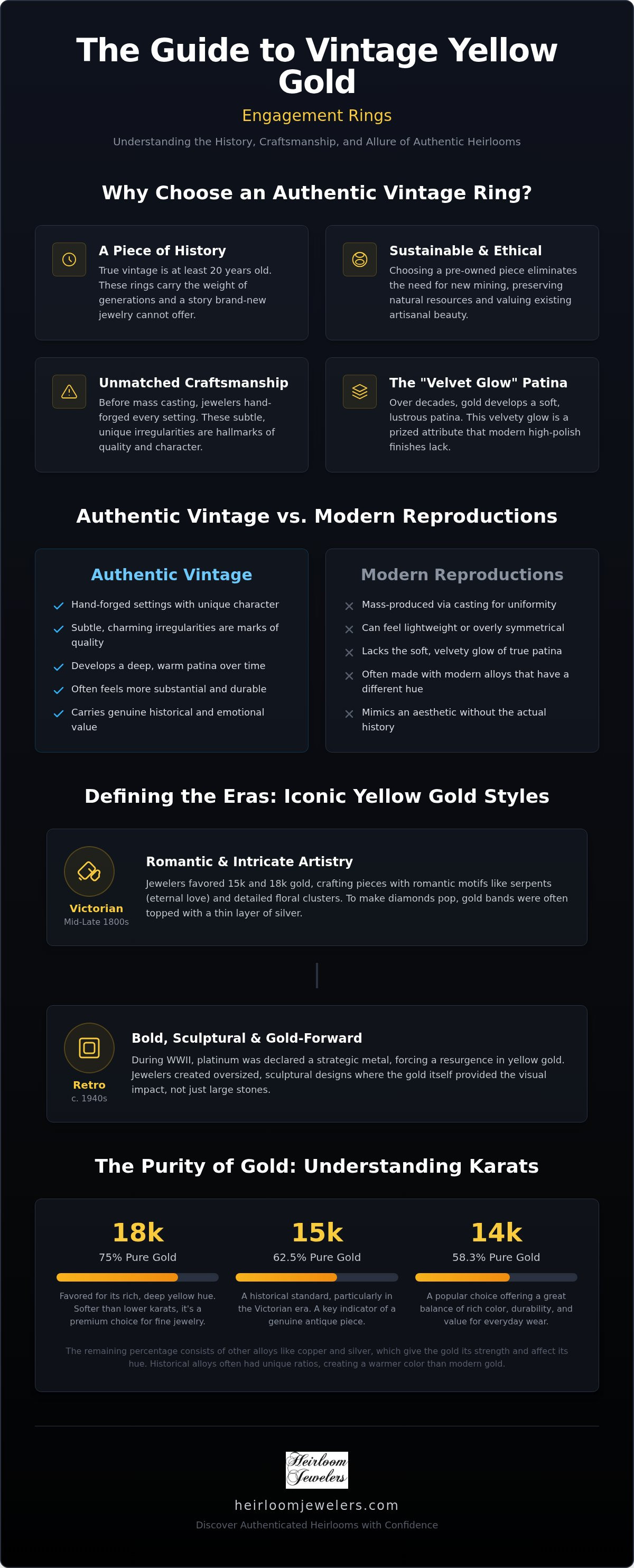
The "soul" of an authentic vintage ring lies in its hand-forged setting. Before the era of mass-produced casting, jewelers spent hours refining every claw and gallery by hand. These subtle irregularities are hallmarks of quality, not flaws. Modern reproductions often feel lightweight or overly symmetrical because they're made in bulk. They lack the historical value and unique character found in one-of-a-kind estate pieces. Curation is essential here. A professional eye can distinguish between a genuine heirloom and a modern imitation, ensuring your ring possesses the integrity of a true historical treasure.
Defining the Eras: Iconic Yellow Gold Styles
The history of jewelry design is often told through the lens of shifting metal preferences. Gold's dominance wasn't accidental. It was the result of both geological availability and cultural preference. For those seeking vintage yellow gold engagement rings, understanding the specific eras of production is essential for identifying genuine artifacts. Engagement ring styles evolved significantly over the last two centuries, moving from the delicate hand-work of the 1800s to the bold, geometric forms of the mid-20th century.
A major turning point in jewelry history occurred during World War II. The United States government declared platinum a strategic metal for military use, effectively banning its use in jewelry manufacturing. This restriction forced a massive resurgence in vintage yellow gold engagement rings during the 1940s. Jewelers had to innovate, creating oversized, sculptural designs that used gold to provide the visual impact that large stones once offered. This period, known as the Retro era, remains a favorite for collectors who value substantial, high-karat settings.
Victorian and Edwardian Gold Artistry
In the mid-to-late 19th century, Victorian jewelers favored 15k and 18k yellow gold. These pieces often featured romantic motifs like serpents, which symbolized eternal love, or intricate floral clusters. Because platinum was not yet widely used, artisans frequently topped yellow gold bands with a thin layer of silver. This "silver-topped gold" technique allowed diamonds to be set in a white metal while maintaining the structural integrity of the gold band. These two-tone pieces are hallmarks of the era's sophisticated hand-engraving and artisanal soul.
The Bold Retro Era and Mid-Century Minimalism
The 1940s Retro era introduced a warmer aesthetic characterized by rose and yellow gold alloys. These rings are often chunky and asymmetrical, reflecting the Hollywood glamour of the time. By the 1950s and 60s, the style shifted toward mid-century minimalism. Jewelers began favoring 14k yellow gold for its superior durability and accessibility. Solitaire styles became the standard, featuring clean lines and tapered shanks that emphasized the metal's natural luster. If you are looking for a piece that balances historical weight with daily wearability, our authenticated estate collection features several exceptional examples from these transformative decades.
Every era left a distinct mark on the metal. Whether it's the ornate filigree of the early 1900s or the polished surfaces of the 1950s, the design motifs serve as a map of the ring's origin. Identifying these elements ensures you aren't just buying a piece of jewelry, but a verified chapter of history.
The Warmth of Gold: Alloys and Diamond Pairings
Modern yellow gold often has a stark, bright quality that feels disconnected from the past. Authentic vintage yellow gold engagement rings possess a different chemical signature. Historical jewelers didn't have access to the standardized, high-volume alloys used today. Instead, they mixed gold with varying ratios of silver and copper to achieve specific hues. The deep, saturated warmth found in 19th-century jewelry is largely due to a higher copper content. This creates a rich tone that feels substantial and organic, far removed from the "neon" yellow of contemporary mass-produced pieces.
This inherent warmth makes yellow gold a strategic choice for diamonds with lower color grades. In a modern platinum or white gold setting, diamonds with a hint of yellow (grades I through M) can appear tinted. A yellow gold band does the opposite. The metal's reflection masks the slight yellow body color of the stone, making the diamond appear whiter by comparison. This synergy is a cornerstone of the history of engagement rings, where metal and stone were chosen to enhance one another's natural properties.
Old European Cut Diamonds in Gold Settings
The old european cut diamond is the natural partner for these warm settings. Unlike modern diamonds cut for maximum white light return, antique cuts have broad, chunky facets designed to catch the soft glow of candlelight. These facets interact beautifully with the gold's reflection, creating a deep, fiery brilliance. White metals can often make these historic stones look cold or flat. Gold brings out their inner life, highlighting the unique "fire" that defines an artisanal cut. It's a pairing that respects the original intent of the jeweler.
Understanding Karats and Hallmarks
Hallmarks act as a ring's birth certificate, providing essential data about its origin and purity. You'll commonly find stamps like 14K or 585, and 18K or 750. These numbers indicate the percentage of pure gold in the alloy. 18K gold offers a richer color but 14K provides superior daily wear resistance. While 18K is prized for its high gold content, 14K was often the preferred choice for the active lifestyles of the mid-20th century. If a hallmark is missing, it doesn't necessarily mean the piece is a reproduction. Many vintage yellow gold engagement rings lost their stamps during historical resizing or were hand-forged before hallmarking laws were strictly enforced. A professional evaluation can confirm the metal content regardless of the presence of a stamp.
A Guide to Selecting and Preserving Your Heirloom
Ownership of vintage yellow gold engagement rings requires a shift in perspective. You aren't just purchasing a piece of jewelry; you're becoming the steward of a historical object. While these rings have already survived decades, their continued longevity depends on a careful initial evaluation and proper maintenance. Before committing to a piece, you must look beyond the initial sparkle to assess its structural health. This ensures the ring is fit for daily wear and capable of being passed down to future generations.
The most common sign of age in a gold band is "thinning" at the base of the shank. Over years of contact with hard surfaces, the metal gradually wears away. A shank that has become too thin is prone to bending or snapping under pressure. When inspecting a ring, feel the thickness of the band at the very bottom. It should feel substantial and consistent with the rest of the setting. If the metal feels like a wire rather than a band, it may require a professional "half-shank" replacement to restore its integrity.
What to Look for During a Physical Inspection
Prongs are the most vulnerable part of any vintage setting. In older rings, the metal tips that hold the diamond in place can wear down until they no longer secure the stone. This is often called "flat tipping." You should also look for signs of previous repairs. Subtle color differences in the metal or visible seams on the inside of the band might indicate a resizing job that wasn't perfectly executed. It's essential to work with a jeweler who understands the specific metallurgy of antique rings, as they can identify these issues before they lead to a lost stone.
Long-term Care for Vintage Gold
Maintaining the soft, velvety glow of aged gold is simpler than many people realize. You don't need harsh chemicals or abrasive polishes. In fact, aggressive cleaning can strip away the valuable patina that gives vintage gold its character. A solution of warm water and mild dish soap is usually all that's required. Use a soft-bristled baby toothbrush to gently remove dust from behind the diamond's pavilion.
Be cautious with ultrasonic cleaners. While these machines are standard in modern jewelry stores, the high-frequency vibrations can loosen stones in delicate vintage settings. If the ring has existing stress fractures in the gold, the vibrations may cause them to expand. When you aren't wearing your ring, store it in a fabric-lined box away from other jewelry to prevent metal-on-metal scratching. If you're ready to find a piece that has been professionally vetted for structural soundess, explore our authenticated estate jewelry collection.
Discovering Authenticity with Heirloom Jewelers
The search for a significant piece of jewelry often leads to vast marketplaces overflowing with thousands of impersonal listings. While volume suggests choice, it frequently lacks the discernment required for high-value secondary markets. At Heirloom Jewelers, we believe that vintage yellow gold engagement rings deserve a more intimate and professional approach. We don't participate in the high-pressure urgency found in modern retail. Instead, we act as a steady, knowledgeable bridge between the artisanal craftsmanship of the past and the collectors of the present. Our inventory is not a list of products, but a curated selection of historical artifacts chosen for their integrity and soul.
Every ring in our care has survived the passage of time, yet it must also pass our rigorous standards for quality. We prioritize the unique character of pre-owned treasures over the uniformity of modern casting. This focus allows us to offer pieces that possess a depth of color and a level of hand-finishing that is increasingly rare. When you choose an estate piece, you're making a decision rooted in appreciation for history and a commitment to sustainable beauty.
The Heirloom Jewelers Curation Process
Our commitment to authenticity begins with a strict exclusion of mass-produced or custom-manufactured items. We remain specialists in the secondary market because we value the specific metallurgy and design language of previous eras. Every piece undergoes a methodical inspection by our specialists. We verify metal purity, analyze historical hallmarks, and confirm the structural health of the setting. This deep expertise is the foundation of our vintage engagement rings buying guide, ensuring that every piece we offer is a verified heirloom. We don't just sell jewelry; we document and preserve it.
Finding Your Unique Narrative
Selecting a vintage ring is an emotional journey that connects your modern story with a pre-existing legacy. There is a quiet confidence that comes from wearing a piece that has already been loved for generations. You aren't just buying a diamond; you're acquiring a unique narrative that modern retail cannot replicate. This connection to the past provides a sense of character and permanence that feels grounded and real. It gives you the security of knowing your ring is a one-of-a-kind treasure, authenticated by a trusted authority.
We invite you to experience a different kind of jewelry acquisition, one defined by transparency, history, and a shared passion for craftsmanship. Our role is to act as your reliable guide, helping you navigate the complexities of the vintage market with ease. Whether you're drawn to the deep copper tones of the Victorian era or the sculptural gold of the Retro period, our collection is ready for its next chapter. We encourage you to browse our current collection and discover the enduring appeal of a true authenticated heirloom.
Selecting a Legacy for the Future
Choosing an engagement ring is a significant milestone that bridges your personal history with the craftsmanship of a previous era. Authentic vintage yellow gold engagement rings offer a depth of character and a warm, velvety patina that modern manufacturing simply cannot replicate. These rings aren't just jewelry. They're sustainable treasures representing a commitment to quality over mass production. By understanding the nuances of historical alloys and structural integrity, you can select a piece built to last for generations.
As a national authority on vintage fine jewelry, Heirloom Jewelers provides the expertise needed to navigate the secondary market with confidence. We specialize in authenticated estate jewelry. Our curated selection focuses on unique, non-mass-produced treasures that carry their own story. We invite you to explore our curated collection of authenticated vintage engagement rings and find the perfect narrative for your own history. We look forward to helping you discover a piece that resonates with your personal values.
Frequently Asked Questions
Is yellow gold or white gold better for a vintage engagement ring?
The choice depends on your aesthetic preference and the specific era of the ring. Yellow gold offers a warmer, more traditional look that masks lower diamond color grades. White gold or platinum provides a cooler, more modern contrast. For authentic vintage yellow gold engagement rings, the choice often depends on the era; Victorian and Retro pieces favor yellow, while Art Deco often features white metals.
How can I tell if a yellow gold ring is truly vintage or a reproduction?
True vintage pieces show signs of hand-forged craftsmanship rather than the perfect symmetry of modern computer-aided design. Look for hand-engraving, slight irregularities in the setting, and historical hallmarks that match the claimed era. Reproductions often feel lighter and lack the dense, rich patina found on older alloys. Professional authentication is the most reliable way to ensure you're purchasing a genuine historical artifact rather than a modern imitation.
Are vintage yellow gold rings durable enough for everyday wear?
Vintage yellow gold is remarkably durable and well-suited for daily wear, provided the setting is in good structural condition. 14k gold is particularly resilient because it contains a higher percentage of alloying metals like copper and silver. We recommend regular inspections to check for prong wear or thinning of the band. With proper care, these rings can easily withstand another century of use without losing their integrity, beauty, or historical value.
What diamond cuts look best in yellow gold settings?
Old European and Old Mine cuts are the most harmonious choices for yellow gold settings. These antique cuts have broader facets that interact beautifully with the warm reflections of the metal. While modern round brilliant diamonds can work, they often look best in white metals. The soft fire of an Old European cut diamond emphasizes the velvety glow of an aged gold band, creating a unified and sophisticated historical look.
Does yellow gold tarnish or change color over time?
Pure gold doesn't tarnish, but the alloys mixed with it can oxidize slightly over many decades. This process creates the prized patina that collectors value, giving the metal a deeper, more saturated hue. Unlike white gold, which requires regular rhodium plating to maintain its color, yellow gold maintains its warm tone naturally. A gentle cleaning with mild soap is usually enough to keep the surface bright without removing its unique historical character.
What should I look for in a vintage hallmark?
Look for stamps that indicate the gold's purity, such as 14K, 18K, 585, or 750. You may also find a maker's mark, which is a unique symbol or set of initials belonging to the original jeweler. Authentic hallmarks on vintage yellow gold engagement rings should show a level of wear consistent with the age of the piece. Sharp, perfectly centered stamps on a supposedly century-old ring can sometimes be a red flag.
Can a vintage yellow gold engagement ring be resized safely?
Most vintage gold rings can be resized safely by a jeweler who understands historical metallurgy. However, rings with intricate filigree or engraving that wraps around the entire band require specialized care to avoid disrupting the pattern. It's important to use methods that match the original alloy's melting point to prevent visible seams. Always ask your jeweler if the resizing will affect the structural integrity or the visibility of any internal hallmarks or stamps.
Why is 14K yellow gold more common in some eras than 18K?
The prevalence of 14K gold in certain eras, particularly the mid-20th century, was driven by a need for increased durability and affordability. While 18K gold contains more pure gold and offers a richer color, it's softer and more prone to scratching. During wartime and subsequent economic shifts, 14K became the standard for engagement rings because it offered the best balance of longevity and value for the active, everyday lifestyles of the period.