
Why does a ring from 1870 possess a deep, sunset glow that modern jewelry simply cannot replicate? You are likely drawn to Victorian rose gold engagement rings because they feel like more than just jewelry. They represent a tangible connection to a romantic era defined by sentimentality and hand-wrought precision. Holding a piece that has witnessed over a century of history naturally inspires wonder. However, that wonder is often accompanied by the fear of purchasing a clever modern reproduction at an antique price point.
We understand that navigating the secondary market requires more than just an appreciation for beauty. It requires an eye for detail and a solid understanding of 19th-century metallurgy. This guide will help you move past the confusion of technical terms and concerns about durability. You'll gain the confidence to identify authentic craftsmanship and understand why these alloys differ from today's mass-produced metals. We will explore the unique history of Russian gold, the significance of Old European cut diamonds, and the specific hallmarks that define a true heirloom. You will be prepared to choose an estate piece that stands as a testament to both history and your own future.
Key Takeaways
- Understand how the three distinct periods of the Victorian era influenced jewelry design and romantic symbolism.
- Discover why the specific copper-to-gold ratios in authentic Victorian rose gold engagement rings create a softer blush than modern reproductions.
- Learn to identify authentic 19th-century craftsmanship by recognizing hand-applied tool marks and official assay office hallmarks.
- Evaluate the structural integrity of antique settings by learning how to inspect beaded and claw prongs for stone security.
- Recognize the ethical and aesthetic value of choosing one-of-a-kind estate pieces over mass-produced modern alternatives.
The Romantic Legacy of Victorian Rose Gold Engagement Rings
The Victorian era, spanning from 1837 to 1901, represents a transformative chapter in the history of fine jewelry. This period was deeply influenced by the personal life and aesthetic preferences of Queen Victoria. Her reign saw a shift toward sentimentalism, where jewelry served as a vessel for personal narratives and romantic devotion. Victorian rose gold engagement rings emerged as a favored choice during this time, offering a warm, copper-infused alternative to the standard yellow gold of previous generations. The metal's popularity grew as the Queen's own affinity for warm-toned jewelry became a global trend, signaling a move away from the rigid formality of earlier Georgian styles.
The Three Stages of Victorian Style
Historians generally divide this extensive era into three distinct Victorian jewellery periods. Each stage reflects a different phase of the Queen's life and the prevailing social moods of the British Empire. Understanding these stages is essential for any collector seeking to identify the specific artistry of a piece.
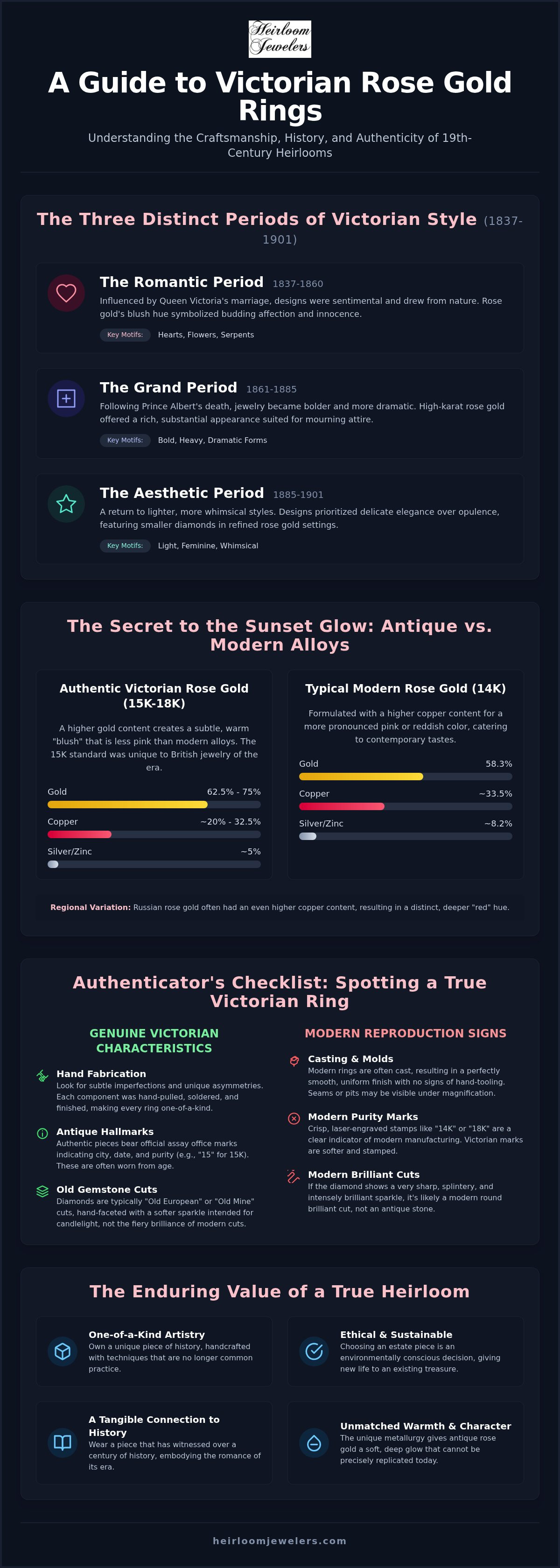
- The Romantic Period (1837-1860): This era was characterized by the Queen's youthful marriage to Prince Albert. Designs featured motifs from nature, such as serpents, hearts, and flowers. Early rose-hued alloys began to gain popularity here as symbols of budding affection and innocence.
- The Grand Period (1861-1885): Following the death of Prince Albert, the jewelry world entered a somber phase. This time was marked by bold, mourning-influenced designs. Jewelry became larger and more dramatic, often utilizing high-karat rose gold to provide a rich, substantial appearance that complemented dark mourning attire.
- The Aesthetic Period (1885-1901): The final years of the era saw a return to lightness and whimsy. Artisans moved away from the heavy weight of the Grand Period toward delicate, feminine styles. These pieces often featured smaller, sparkling diamonds set in refined rose gold bands that prioritized elegance over opulence.
Why Rose Gold Defined 19th-Century Romance
The popularity of rose gold wasn't a mere accident of fashion. It was a deliberate choice rooted in the cultural obsession with the "language of flowers." The pinkish tint of the metal was seen as a literal representation of a blushing rose, a symbol of deep love and sincerity. This blush made Victorian rose gold engagement rings the ultimate gift for a betrothed partner, as it communicated a level of intimacy that yellow or white metals lacked.
Lighting also played a significant role in the metal's enduring appeal. Before the advent of electric light, jewelry was primarily viewed under the soft glow of candles or oil lamps. The warm tones of rose gold interacted beautifully with these flickering light sources, creating a soft radiance that colder metals could not achieve. As the century progressed, jewelers transitioned from silver-topped gold to solid rose gold settings. This evolution allowed the metal's unique warmth to take center stage, solidifying it as a hallmark of 19th-century sentimental jewelry.
Metallurgy and Hand-Cut Gems: The Craftsmanship of the Era
The unique "blush" of Victorian rose gold engagement rings isn't just a matter of age. It's a result of specific metallurgical ratios that differ significantly from modern standards. In the 19th century, jewelers didn't use the high-copper 14K alloys common today. Instead, they favored 15K and 18K gold. These higher gold contents resulted in a softer, more subtle pink hue. This "blush" was achieved through a delicate balance of gold, copper, and often a small amount of silver. Every band was hand-fabricated. Jewelers pulled wire and soldered individual components rather than using modern casting methods. This labor-intensive process ensures that no two rings are identical. It also means the metal has a density and feel that modern reproductions often lack. For those who value this tradition of hand-worked metals, you might explore Direct Product Sales of artisan-crafted copper jewelry that celebrates similar craftsmanship.
The 15K gold standard was particularly unique to the British history of jewellery. It allowed for a durable yet rich metal that wasn't as brassy as lower-karat options. You'll also find regional variations. Russian rose gold often had a higher copper content, giving it a distinct "red" tone. Many high-end Victorian pieces also incorporated "green gold" or "yellow gold" accents to create intricate, multi-colored floral patterns. These three-color gold designs were highly prized for their complexity. Unlike modern white gold, these rings never used rhodium plating. This allows the metal to develop a deep, natural patina over decades. Our curated selection of vintage white gold Old European cut diamond stud earrings showcases the same hand-cut brilliance found in the finest engagement pieces of the era.
Period-Correct Diamond Cuts
The stones set within these bands were as unique as the metal itself. Before the precision of modern lasers, diamonds were cut by hand. Old Mine Cuts are a hallmark of the early Victorian years. These stones have a squarish shape with high crowns and large culets. They were designed to glow in candlelight. As technology advanced, cutters moved toward Old European Cuts. These stones achieved circular symmetry while retaining a hand-crafted soul. You might also encounter Rose Cuts. These flat-bottomed gems were often used in earlier designs. Their subtle shimmer complements the soft luster of rose gold without overwhelming it. These stones don't just sit on the metal; they're integrated into the artistry of the finest Victorian rose gold engagement rings.
Identifying Authenticity: Genuine Victorian vs. Modern Reproductions
Distinguishing an authentic antique from a modern reproduction requires a disciplined approach. Victorian rose gold engagement rings carry a weight of history that machines cannot replicate. You aren't just looking for beauty; you're looking for evidence of a life lived. Authentic pieces often reveal their age through subtle wear patterns and specific construction techniques that modern jewelers rarely use. Understanding these markers protects your investment and ensures the piece's historical integrity. It's the difference between owning a mass-produced fashion item and a unique artifact of the 19th century.
Hallmarks of the Victorian Era
British and European jewelry from this era often features a series of stamps known as hallmarks. These marks indicate the metal's purity, the year of manufacture, and the assay office that verified the piece. In Britain, 15-karat gold was a standard for high-quality jewelry between 1854 and 1932. You should look for a "15" or ".625" stamp. If a ring is marked "14K," it's likely of American origin or a later reproduction, as 14K wasn't a British standard during the Victorian peak. Don't dismiss a piece solely because it lacks marks. Many rings were resized over the decades, which often resulted in the hallmark being polished away or cut out during the process.
Construction Methods and Red Flags
True Victorian craftsmanship is defined by hand-fabrication. When you examine the gallery of a ring, look for hand-pierced filigree. Machine-stamped work from the modern era looks too perfect and uniform. Hand-cut designs will have slight variations in the spacing and depth of the metalwork. You should also inspect the solder points. An authentic antique will often show tiny seams where it was resized or repaired over the last century. If the metal is perfectly seamless and the engraving is laser-sharp, it's probably a modern "Victorian-style" piece rather than a true antique. For a deeper dive into these nuances, consult our Definitive Buying Guide to Vintage Engagement Rings.
Finally, watch for "marriage" rings. These are pieces where an authentic 19th-century diamond has been set into a modern rose gold band. While the stone is antique, the ring itself lacks the historical value of a true Victorian piece. Check the "softness" of the metal edges. After 150 years, the sharp corners of a ring naturally round out from contact with the skin. This gentle patina is a hallmark of time that a factory cannot simulate. Authentic Victorian rose gold engagement rings should feel like they've been worn and loved for generations. They possess a warmth that comes only from decades of history.
Practical Considerations: Durability and Care for Antique Rings
Many collectors hesitate to wear Victorian rose gold engagement rings daily, fearing that a piece from the 19th century is too fragile for modern life. This is a common misconception. In reality, the copper alloy that gives these rings their sunset hue also makes them harder than standard high-karat yellow gold. While a 22K yellow gold band might scratch or bend easily, a 15K or 18K rose gold band possesses a structural resilience that's already stood the test of time.
Stone security is the primary concern for any antique ring. Victorian jewelers favored beaded or claw settings. These provide a distinctive aesthetic but require periodic inspection. If the prongs look flat or snag on your clothing, they likely need retipping. This simple maintenance ensures that your hand-cut diamond remains secure for another century.
Evaluating the Setting for Daily Wear
Before committing to daily wear, inspect the base of the shank for thinning. After decades of contact with other surfaces, the metal at the very bottom of the band can become paper-thin. A skilled jeweler can perform a "half-shank" replacement to restore the ring's structural integrity without affecting the ornate gallery. Consider this checklist before choosing your piece:
- Shank Thickness: Ensure the band isn't dangerously thin at the base.
- Prong Integrity: Check that the beaded or claw tips aren't worn flat against the stone.
- Stone Security: Listen for any rattling that might indicate a loose setting.
If you prefer the ultimate in durability, you might consider how a vintage platinum 0.5 carat diamond engagement ring compares in terms of metal density and prong strength.
Preserving the Antique Patina
The "softness" and deep glow of an antique ring are parts of its historical value. You should never subject Victorian rose gold engagement rings to professional high-speed polishing or ultrasonic cleaners. These methods can strip away the natural patina or vibrate stones loose from delicate 19th-century settings. Instead, use a soft toothbrush and mild dish soap in warm water.
This gentle approach is especially critical if your ring contains organic accents like pearls or turquoise. These stones are porous and can be permanently damaged by harsh chemicals or even prolonged immersion in water. Store your Victorian pieces in a separate fabric-lined compartment. This prevents harder modern diamonds from scratching the softer, historical metal. Maintaining these pieces doesn't require constant work; it simply requires a respectful and methodical approach to preservation.
The Value of Heritage: Why Collectors Choose Estate Victorian Rings
Choosing a ring is a significant milestone. For the modern collector, this decision often extends beyond mere aesthetics. It involves a search for meaning, quality, and a connection to a specific moment in time. Victorian rose gold engagement rings satisfy these requirements by offering a unique combination of historical significance and artisanal excellence. When you acquire an estate piece, you aren't just buying a piece of jewelry. You're becoming the next steward of a storied artifact. These rings have survived over a century of history, and their continued existence is a testament to the superior craftsmanship of 19th-century goldsmiths.
Scarcity naturally drives the long-term value of these pieces. Unlike modern retail items that can be reproduced indefinitely, authentic Victorian jewelry exists in a finite supply. This makes authenticated heritage jewelry a stable choice for those looking to combine personal sentiment with investment potential. At Heirloom Jewelers, our role is to act as a bridge between these historical treasures and the modern collector. We meticulously verify the provenance and condition of every item, ensuring that the 19th-century artistry remains preserved for the next generation.
Sustainable Luxury in the 21st Century
Sustainability is a core advantage of the estate market. Purchasing a vintage ring is a zero-impact choice. It bypasses the environmental and ethical costs associated with modern mining and manufacturing. By choosing Victorian rose gold engagement rings, you're opting for a recycled luxury that doesn't require new resource extraction. You are also preserving what we call "artistic equity." This is the value of the human labor and hand-tooling that went into every Victorian band. Keeping these pieces in circulation honors the original maker's skill and keeps historical design alive in a world dominated by mass production.
Finding Your Heirloom
Starting an antique collection begins with an appreciation for the "past life" of a piece. There is an emotional resonance in wearing a ring that has witnessed decades of human experience. This history adds a layer of depth that a brand-new ring simply cannot provide. When searching for your piece, focus on the details that speak to you, whether it's the specific blush of the gold or the unique personality of a hand-cut diamond. Every ring in our collection is chosen for its character and integrity. We invite you to explore our curated collection of antique rings to find your own piece of history and begin your journey as a guardian of heritage.
Securing Your Piece of 19th-Century History
Authentic Victorian rose gold engagement rings offer a rare bridge between historical artistry and modern devotion. You now understand the metallurgical secrets behind that unique 19th-century blush and the importance of identifying hand-cut Old Mine or Old European diamonds. By looking for specific hallmarks and honest wear patterns, you can confidently distinguish a true antique from a modern imitation. Choosing an estate piece isn't just an aesthetic preference; it's a commitment to sustainability and the preservation of one-of-a-kind craftsmanship.
Our experts are dedicated to sourcing and preserving these rare finds. We invite you to view our curated collection of authentic vintage engagement rings to find a piece that resonates with your personal story. Every ring in our inventory is expertly authenticated to ensure you receive a genuine artifact of the Victorian era. Whether you're drawn to the romantic symbolism of the early Romantic period or the delicate elegance of the late Aesthetic era, your perfect heirloom is waiting to be discovered. We look forward to helping you find a ring that carries the weight of history into your future.
Frequently Asked Questions
Is Victorian rose gold real gold?
Yes, Victorian rose gold is solid gold made by alloying pure gold with copper. During the 19th century, jewelers typically produced these pieces in 15-karat or 18-karat purities. It's not a surface plating or a base metal. The distinctive "rose" color is consistent throughout the entire band. These rings are highly valued today for both their precious metal content and their unique historical provenance.
Are Victorian engagement rings durable enough for everyday wear?
Yes, these antique engagement pieces are remarkably durable because the copper alloy adds significant hardness to the metal. While they're resilient, they require respectful care. Regular inspections of the prongs and settings are necessary to ensure stones remain secure. You should avoid harsh chemicals or heavy manual labor while wearing them to preserve the delicate hand-engraved details and prevent unnecessary metal thinning.
How can I tell if my Victorian rose gold ring is authentic?
Authenticity is determined by examining hallmarks, construction methods, and wear patterns. Look for British 15K or 18K assay marks or evidence of hand-tooling in the gallery. Genuine Victorian rose gold engagement rings will show "softened" edges from a century of wear. Modern reproductions often appear too perfect or lack the specific metallurgical "blush" found in 19th-century alloys. We recommend consulting a specialist to verify the historical integrity of any piece.
What is the difference between antique rose gold and modern rose gold?
The primary difference lies in the alloy composition and the resulting hue. Modern rose gold often uses a high-copper 14K alloy, which creates a sharp, pinkish-orange tone. Antique Victorian alloys typically used 15K or 18K gold, resulting in a softer, more subtle "blush" color. Additionally, antique gold was hand-mixed and hand-fabricated. This gives it a density and a natural patina that mass-produced modern metals simply cannot replicate in a factory setting.
Why do Victorian rings often have Old European cut diamonds?
Old European cut diamonds were the standard for high-end jewelry during the mid-to-late Victorian period. These stones were hand-cut to maximize sparkle under candlelight rather than electric light. They feature a circular girdle, a small table, and a high crown, which perfectly complements the warm tones of rose gold. These cuts represent the important transition between the chunky Old Mine cuts of the early 1800s and the precision of modern brilliant diamonds.
Can I resize a Victorian rose gold engagement ring?
Most Victorian rings can be resized by a jeweler experienced in antique restoration. However, extreme resizing can stress the delicate settings or disrupt historical hallmarks. Laser welding is the preferred modern method for resizing these pieces because it minimizes heat transfer to the surrounding metal and gemstones. You should always ensure the jeweler understands the specific metallurgical properties of 19th-century rose gold before proceeding with any alterations to the original band or setting.
Does Victorian rose gold tarnish or change color over time?
Solid rose gold doesn't tarnish like silver, but it does develop a deep, rich patina over time. This change is considered desirable by collectors as it enhances the ring's historical character. The copper in the alloy may react slightly with skin oils or the environment, causing the "blush" to darken or warm up. This natural aging process is a hallmark of authenticity and should never be polished away by a machine.
What gemstones were most popular in Victorian rose gold settings?
Diamonds remained the most popular choice, but the Victorian era also favored colorful, symbolic gemstones. You'll frequently find rubies, sapphires, and emeralds set in Victorian rose gold engagement rings. Additionally, organic materials like pearls, turquoise, and coral were common accents, especially during the Romantic and Aesthetic periods. These stones were often chosen for their specific meanings in the "language of flowers," adding a layer of personal sentiment to the ring's design.