
The most captivating vintage halo engagement rings weren't produced in a modern factory. They were meticulously hand-carved by master craftsmen who worked under the steady glow of a jeweler's loupe over a century ago. You're likely drawn to these pieces because they possess a character and weight that contemporary replicas simply cannot mirror. With the current 15% import surcharge on new jewelry in 2026, choosing an authentic estate piece is more than a stylistic choice; it's a savvy way to secure a high-value heirloom that's already part of our domestic history.
It's natural to feel hesitant when searching for a ring that carries both emotional and historical value. You want to ensure the metalwork is durable and the stones are truly era-appropriate rather than modern imitations. This guide provides the expertise you need to identify genuine Victorian and Art Deco halo styles with absolute certainty. You'll learn to spot the distinct, warm fire of Old European cut diamonds and understand the enduring strength of vintage platinum and gold. We'll help you move past the uncertainty of the retail market so you can select a one-of-a-kind treasure with confidence.
Key Takeaways
- Trace the evolution of the halo design from its Georgian cluster origins through the intricate platinum work of the Edwardian era.
- Distinguish authentic vintage halo engagement rings from modern reproductions by identifying hand-carved details and period-accurate settings.
- Understand the distinct visual character and historical value of Old European cut diamonds compared to modern machine-cut stones.
- Learn to evaluate the structural integrity of estate jewelry by inspecting metal hallmarks and checking for signs of wear like thinning shanks.
- Recognize the sustainability and unique heritage of choosing authenticated, pre-owned luxury pieces over contemporary alternatives.
What Defines an Authentic Vintage Halo Engagement Ring?
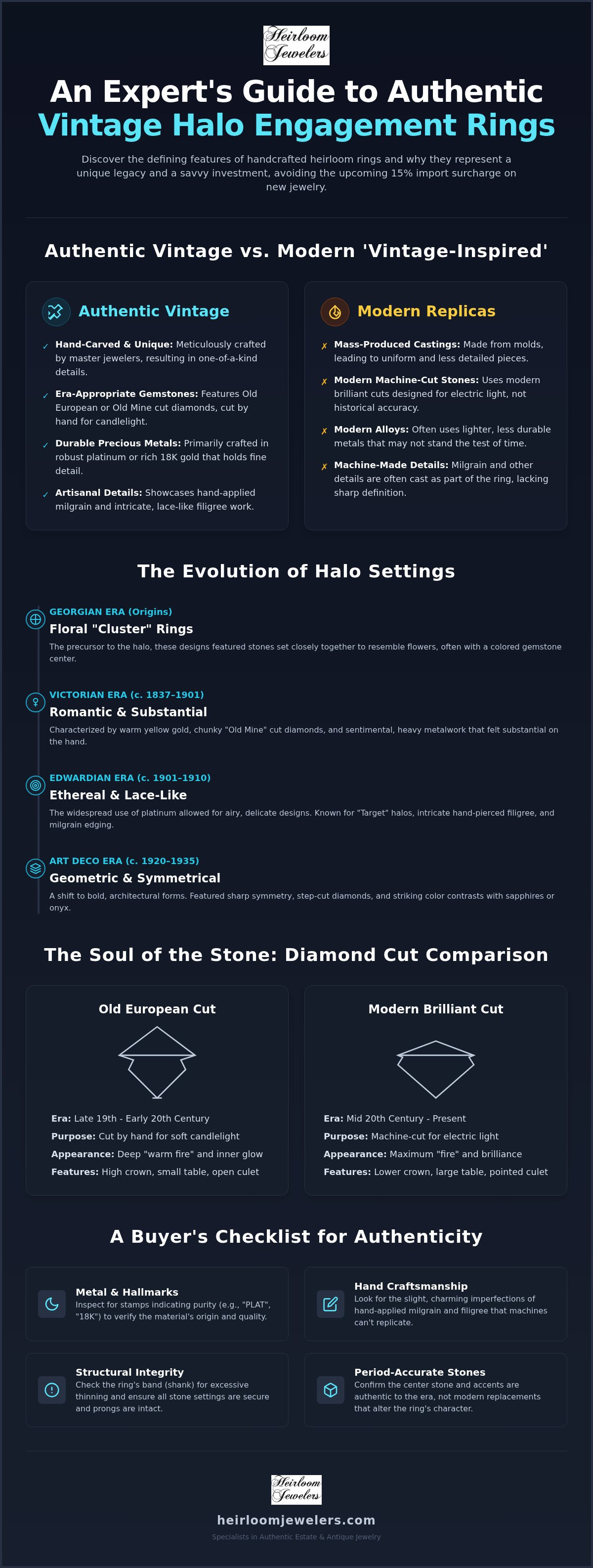
An authentic halo setting features a prominent center gemstone encircled by a frame of smaller accent stones. This design is foundational to the category of vintage halo engagement rings, offering a level of detail rarely seen in modern casting. This arrangement draws the eye inward, focusing attention on the depth of the center stone while providing a secondary layer of brilliance. While today's halos are often uniform and mass-produced, authentic estate pieces showcase the steady hand of a jeweler. This style didn't emerge in a vacuum; it evolved from the "cluster" rings popular during the Georgian era. In those early designs, stones were often set close together to resemble a flower. By the early 20th century, this evolved into the structured halo we recognize today.
Authentic pieces are distinguished by hand-applied milgrain. This technique involves creating a row of tiny metal beads along the edges of the setting to add texture and depth. You'll primarily find these authentic pieces crafted in platinum or 18K white gold within curated estate collections. These materials were favored for their durability and their ability to hold fine, lace-like details that modern machines cannot easily replicate. Collectors often seek out these specific hallmarks as proof of origin, valuing the weight and purity of the metal as much as the gems themselves. Every piece tells a story of the era it survived, making it a unique alternative to contemporary jewelry.
The Aesthetic Purpose of the Halo
The halo serves several functional and visual roles. It creates the illusion of a larger center diamond without requiring a higher carat weight. This was particularly useful for highlighting Old European cut diamonds. These stones were cut for candlelight brilliance rather than modern "fire," and the halo amplifies that soft glow. The surrounding stones also act as a protective buffer. They shield the girdle of the center diamond from accidental impact, ensuring the heirloom remains intact for future generations.
Vintage vs. Antique: Understanding the Timeline
At Heirloom Jewelers, we distinguish between these terms to help you understand a piece's history. Jewelry is classified as "vintage" if it is between 20 and 100 years old. "Antique" refers to pieces over a century old, such as those from the Victorian or Edwardian eras. The specific era dictates the arrangement and materials used in the setting of vintage halo engagement rings:
- Victorian halos often feature colorful gemstones or chunky "Old Mine" cuts in yellow gold.
- Edwardian styles lean toward delicate, circular platinum frames with intricate filigree.
- Art Deco pieces frequently utilize geometric shapes, bold symmetry, and calibrated sapphire accents.
The Evolution of Halo Settings Through Jewelry History
The halo design has undergone a remarkable transformation over the last two centuries. In the Victorian era, jewelers favored floral-inspired clusters that mimicked the natural world. These pieces often utilized warm yellow gold and Old Mine cut diamonds to create a soft, romantic aesthetic. They weren't yet the streamlined vintage halo engagement rings we recognize today; instead, they were organic, rich in texture, and often featured colorful gemstones like rubies or emeralds as the focal point. This era valued sentimentality and bold, heavy metalwork that felt substantial on the hand.
The Delicate Lace of Edwardian Halos
The Edwardian period introduced a shift toward ethereal, lightweight designs. As platinum became more widely used, jewelers could create "Target" halos, which featured concentric circles of gemstones around a central diamond. This era is renowned for antique rings that showcase incredible hand-pierced metalwork. These designs feel airy and lace-like, often incorporating milgrain and tiny accent diamonds to enhance the soft glow of an Old European cut stone. It's a style that prioritizes grace over bulk, using light to create a halo effect that feels almost weightless.
Art Deco Geometry and the Modern Halo
The Art Deco jewelry movement brought a bold, architectural perspective to the halo. Designers moved away from the soft curves of the previous decades, opting instead for step-cut diamonds and contrasting gemstones like onyx or sapphire to create striking geometric patterns. Symmetry became the priority. This period redefined vintage halo engagement rings by introducing baguette accents and clean lines that still influence contemporary bridal trends. The use of calibrated stones, where each gem is custom-cut to fit the setting perfectly, remains a hallmark of this era's craftsmanship.
Following the bold geometry of the 1920s, the mid-century years transitioned toward larger, more sculptural silhouettes. The "ballerina" halo became a signature style in the 1950s and 60s. This design uses tapered baguette diamonds set in a way that mimics the undulating skirt of a ballet dancer. These rings offered a high-drama look that reflected the post-war era's love for glamour and larger silhouettes. If you appreciate this level of historical detail, you'll find that our collection of authenticated estate jewelry offers a connection to these past eras that modern replicas cannot match.
Authentic Vintage vs. Modern Vintage-Inspired Halos
Many modern retailers market new products as "vintage-inspired," but these mass-produced items lack the soul of genuine estate pieces. Authentic vintage halo engagement rings were created before the era of Computer-Aided Design (CAD) and mass-casting. Instead of a digital blueprint, these rings were born from the intuition of a master bench jeweler. You can feel this difference in the weight and the slight, charming asymmetries that prove a human hand guided the tools. Every curve was intentional, and every setting was adjusted to the specific proportions of the gemstone it held.
Choosing an estate piece is also an act of environmental stewardship. By purchasing pre-owned luxury, you bypass the ecological impact of modern mining and industrial manufacturing. It's a way to own a piece of history while supporting a more sustainable future for fine jewelry. Furthermore, the metal itself tells a story. Over decades, platinum and high-karat gold develop a soft, satiny patina. This unique "glow" is impossible to replicate with modern polishing techniques. It signals a life lived and a story told, adding a layer of depth that a brand-new ring cannot provide.
The Art of Hand-Applied Milgrain
Milgrain is the delicate, beaded detailing often found on the borders of vintage engagement rings. In authentic estate pieces, this was applied using a tiny milgrain wheel, resulting in deep, crisp beads that catch the light individually. Modern machine-made versions often look shallow or overly uniform. When you inspect a genuine vintage piece, you'll see natural wear patterns where the milgrain has softened slightly in high-contact areas, which is a hallmark of its authentic history.
Historical Diamond Cuts in Halo Settings
The character of a vintage ring often lies in its center stone. Historical cuts behave differently than their modern counterparts:
- Old European Cut: These diamonds feature a smaller table and a higher crown than modern stones. They were cut to maximize brilliance in low-light environments, creating broad flashes of light rather than the "splintered" sparkle of modern cuts.
- Single Cut Diamonds: Authentic halos often use these simple, 17-facet stones as accents. They provide a subtle, twinkling shimmer that complements the center stone without overwhelming it.
- Visual Harmony: A machine-cut, modern brilliant diamond can often look clinical when placed in a vintage setting. The softer, more romantic light of an old-cut diamond is essential for maintaining the visual harmony of vintage halo engagement rings.
Key Features to Evaluate in an Estate Halo Ring
Selecting an authentic estate piece requires a discerning eye for detail and structural integrity. Unlike modern retail where every ring is identical, vintage halo engagement rings possess unique proportions that reflect the specific stone they were built around. A well-curated halo should complement the center diamond rather than overwhelm it. In historical designs, the halo was often used to enhance a stone's presence, creating a balanced silhouette that feels intentional and harmonious. Authentication is the bridge between a simple purchase and a lifelong investment. It relies on expert curation to verify that every component, from the side stones to the metal alloy, is era-appropriate.
Evaluating the Center Diamond
In the estate market, center diamonds often fall into a "sweet spot" between 0.5 and 1.0 carats. This size allows the intricate halo metalwork to shine without being overshadowed by the gem. You'll often find that these diamonds exhibit a soft warmth, typically in the J-L color range. This isn't a flaw; it's a characteristic of the era. These warmer tones pair beautifully with the "candlelight" sparkle of an Old European cut. When inspecting a stone, look closely at the girdle for "bearding" or small chips. These tiny fissures can occur over decades of wear, and identifying them early is essential for ensuring the stone remains secure in its setting.
Metal Integrity and Hallmarks
The durability of your ring depends on the quality of its metal. While modern rings frequently use 14K gold, high-end vintage halo engagement rings are predominantly found in platinum or 18K white gold. Platinum was the preferred choice during the Edwardian and Art Deco periods due to its exceptional strength. This allowed jewelers to create those famous, paper-thin filigree designs that remain sturdy today. You should always look for historical hallmarks or maker's marks inside the band. These small stamps provide a window into the ring's provenance and the standards of the jeweler who crafted it.
Pay close attention to the condition of the shank and prongs. Over time, the bottom of the band can thin from contact with other surfaces. If the shank feels too delicate, it may require a professional reinforcement. Similarly, check that the prongs holding the diamonds haven't worn down to the point of being "flat." A reputable specialist can safely resize these pieces without compromising the original artistry. If you're ready to find a piece with verified structural integrity, we invite you to browse our collection of authenticated vintage platinum engagement rings today.
Finding Your One-of-a-Kind Vintage Halo at Heirloom Jewelers
Heirloom Jewelers functions as a bridge between the past and your future. Unlike modern retailers who rely on high-volume sales, we prioritize rarity and historical significance. Every one of our vintage halo engagement rings has been selected for its integrity and superior craftsmanship. This curation ensures that you aren't just buying a ring; you're becoming the guardian of a storied heirloom. We value the steady, methodical pace of the secondary market, where quality remains the only metric that matters. Our role is to act as a knowledgeable curator for those who appreciate the quiet elegance of a bygone era.
Choosing heritage jewelry is also a deeply ethical decision. By selecting a pre-owned piece, you're making a sustainable choice that honors existing resources and avoids the environmental impact of modern mining. There's a profound emotional connection in wearing a ring that has witnessed decades of history. It carries a weight and a soul that a new, factory-made item simply cannot possess. Our collection represents a commitment to enduring beauty over fleeting trends. It's about finding a piece that feels as though it was always meant for you, carrying with it the quiet confidence of a life well-lived.
Our Curation Process
Our selection criteria are rigorous and focused on authenticity. We examine every prong and hallmark under magnification to ensure structural integrity. We look for pieces like the Vintage Platinum 0.5 Carat Diamond Engagement Ring, where the metalwork remains crisp and the stone's character is undeniable. We don't follow mass-produced trends that fade with the seasons. Instead, we focus on items that exhibit the hand-finished details discussed earlier, such as authentic milgrain and era-appropriate hallmarks. This professional approach provides a transparent buying experience rooted in expertise rather than high-pressure salesmanship.
Starting Your Heirloom Journey
Finding the right ring is a personal process that requires time and reflection. We're here to act as your reliable guide through the complexities of the estate market. Whether you're drawn to the geometric precision of Art Deco or the romantic lace of the Edwardian era, we provide the personalized guidance you need to choose the right era for your style. We believe the right ring should feel like a natural extension of your personality. Our atmosphere is welcoming and respectful, allowing the jewelry to take center stage. You can begin by viewing our current selection of authenticated pieces. Each one is a unique treasure waiting for its next chapter. Explore our curated collection of vintage halo engagement rings to find a piece that resonates with your own story and values.
Securing Your Piece of History
Authentic vintage halo engagement rings offer more than just a beautiful aesthetic; they're a bridge to an era of unmatched artistry. By focusing on genuine estate pieces, you've learned to value hand-applied milgrain and the soft glow of Old European cut diamonds over modern replicas. These rings represent a commitment to quality. Choosing a pre-owned heirloom is a sustainable choice that honors the past while securing a one-of-a-kind treasure for your future.
Heirloom Jewelers stands as a trusted authority on historical diamond cuts and material integrity. We're specialists in authenticated estate fine jewelry, offering expertly curated vintage platinum and 18K gold pieces that have stood the test of time. Our collection is built on the belief that a ring should tell a story as unique as your own. We're here to help you navigate the nuances of the secondary market with confidence. Quality never fades.
View Our Curated Collection of Authentic Vintage Halo Rings
We look forward to helping you find a piece with a storied past that resonates today.
Frequently Asked Questions
What is the difference between an antique and a vintage halo ring?
Antique jewelry is defined as any piece over 100 years old, which includes Victorian and Edwardian halo styles. Vintage pieces are those between 20 and 100 years old, encompassing the Art Deco and Mid-century eras. While these terms are often used interchangeably in casual conversation, they signify different historical periods and craftsmanship techniques. Understanding this distinction helps you identify whether a ring is a true century-old heirloom or a more recent estate find.
Can vintage halo rings be resized easily?
Most vintage halo engagement rings can be safely resized by a specialist who understands historical metalwork. Platinum and 18K gold are durable enough for adjustment; however, intricate details like hand-applied milgrain or filigree require a careful hand to prevent distortion. It's essential to consult a jeweler experienced in estate pieces rather than a standard retail bench. They'll ensure the structural integrity of the halo and the security of the accent stones remain intact during the process.
Are estate halo rings more affordable than new ones?
Estate halo rings often provide better value because they bypass the high markups and manufacturing costs associated with new production. In 2026, newly imported jewelry is subject to a 15% surcharge, making pre-owned domestic pieces a more cost-effective choice for many buyers. You aren't just saving on retail overhead. You're investing in higher quality materials and hand-craftsmanship that would be significantly more expensive to replicate today using modern labor and current metal prices.
What diamond cuts are most common in vintage halo settings?
The most common diamond cuts found in authentic vintage halo engagement rings are Old European and Old Mine cuts. These stones were hand-faceted to glow under candlelight, offering a softer brilliance than modern machine-cut diamonds. You'll also frequently find "Single Cut" diamonds used as small accent stones in the halo itself. These 17-facet diamonds were the standard for decades, providing a subtle, twinkling shimmer that perfectly complements the larger facets of a historical center stone.
Is it safe to wear a 100-year-old engagement ring every day?
It's safe to wear a 100-year-old ring daily provided it has been professionally inspected for structural integrity. Platinum settings from the Edwardian and Art Deco eras are exceptionally durable and resistant to thinning. However, we recommend removing your ring during strenuous activities or when using harsh chemicals. Regular checks of the prongs and the halo's accent stones will ensure that your heirloom remains secure and beautiful for another century of daily use.
How do I clean and care for a vintage platinum halo ring?
To clean a vintage platinum halo ring, use warm water mixed with a few drops of mild dish soap and a soft-bristled toothbrush. Gently scrub around the halo and under the center stone to remove oils and debris. Avoid ultrasonic cleaners, as the vibrations can sometimes loosen small accent stones in older settings. Professional cleanings twice a year are recommended to allow a specialist to check for any worn prongs or thinning metal that might require attention.
What should I look for in an authentic Art Deco halo setting?
An authentic Art Deco halo setting is defined by its geometric precision and bold symmetry. Look for architectural shapes like octagons or squares rather than soft floral curves. These rings often feature "calibrated" accent stones, such as sapphires or emeralds, which were custom-cut to fit the setting's specific angles. High-quality Art Deco halos are almost exclusively crafted in platinum or 18K white gold, showcasing the era's preference for a sleek, monochromatic, and industrial aesthetic.
Do vintage halo rings come with modern diamond certifications?
Many high-value vintage halo engagement rings come with modern certifications from laboratories like the GIA. While the ring itself is historical, the center stone can be graded using contemporary standards for color, clarity, and carat weight. At Heirloom Jewelers, we prioritize transparency by providing authentication for our estate pieces. If a specific ring doesn't have a modern lab report, a professional appraisal by an expert in the secondary market can verify the diamond's characteristics and historical origin.