
A genuine antique locket is a mechanical masterpiece designed to protect a secret, yet many modern reproductions offer only the look without the soul of the original. You likely understand that finding authentic vintage lockets for sale requires more than just an eye for beauty. It demands a deep respect for provenance and material integrity. It's frustrating to encounter pieces that claim historical significance but lack the hallmarks or weight of true estate jewelry. This confusion often leads collectors to settle for "vintage-style" items rather than the real thing.
We've created this guide to help you distinguish between a fleeting fashion accessory and a lasting investment. You'll learn how to identify period-correct hallmarks, evaluate the mechanical sound of a hinge, and understand the rarity of metals like 18K gold and platinum. We'll explore the specific characteristics of Victorian and Art Deco designs so you can acquire a piece that holds its value as both a personal treasure and a historical artifact. Our goal is to provide the clarity you need to build a collection of authenticated, high-quality estate pieces with absolute confidence.
Key Takeaways
- Learn to distinguish between vintage and antique classifications while identifying the unique symbolism found in Victorian and Art Deco eras.
- Discover how to interpret hallmarks and metal stamps to verify the authenticity of genuine vintage lockets for sale.
- Master the Three-Point Mechanical Check to ensure the hinge, clasp, and frame remain in excellent functional condition.
- Identify subtle signs of improper repair or lead soldering that may decrease the historical and financial value of a piece.
- Understand the importance of expert curation when selecting high-end gold or platinum estate jewelry for your collection.
The Timeless Appeal of Vintage Lockets for Sale
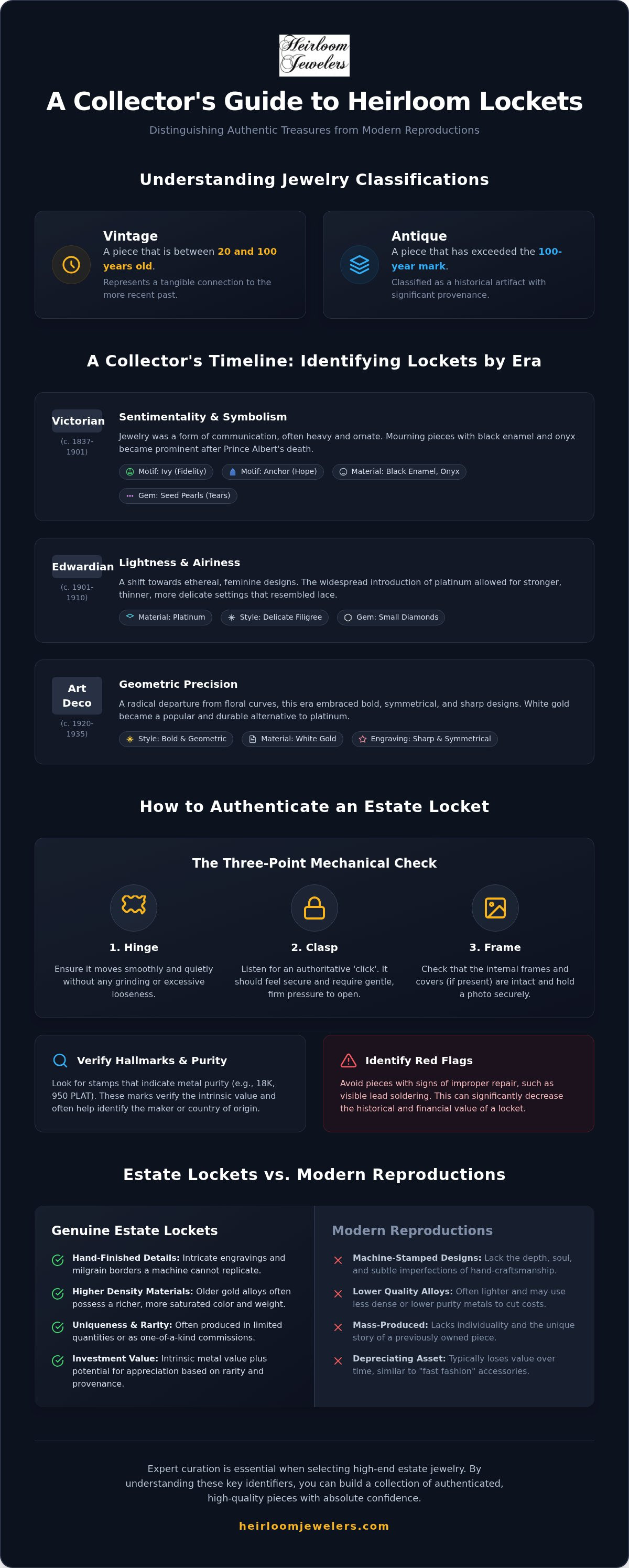
In the world of fine jewelry, age serves as a marker of both character and value. We distinguish these pieces through specific chronological categories. A vintage locket has typically existed for 20 to 100 years. Once a piece exceeds the century mark, it is classified as an antique. When browsing authentic vintage lockets for sale, collectors are often searching for a vessel for sentiment that modern retail cannot provide. These items offer a tangible connection to the past, carrying an emotional weight that mass-produced jewelry lacks.
Choosing estate jewelry is also a commitment to sustainability. Acquiring a pre-owned locket preserves the energy and resources already invested in its creation decades ago. It bypasses the environmental impact of modern mining while celebrating the enduring nature of precious metals. Unlike contemporary "fast fashion" jewelry, these pieces were built to last for generations. They represent a cycle of ownership that values preservation over consumption.
The mechanical ingenuity of a fine locket is a feat of miniature engineering. A functional locket is more than a pendant; it's a secure vault for a photograph or a lock of hair. Creating a hinge that moves smoothly and a clasp that clicks with authority requires precise hand-tooling. This level of craftsmanship ensures the piece remains wearable and secure after decades of use.
Just as a locket serves as a curated vault for a single photograph, those who appreciate visual storytelling can discover Ilkaa's Fine Art Gallery & Atelier, a photography-focused space that celebrates fine art within the walls of a historic Columbus home.
Why Estate Lockets Outperform Modern Reproductions
Modern reproductions frequently rely on machine-stamped designs that lack depth and soul. In contrast, estate pieces often feature hand-finished details, such as intricate engravings or delicate milgrain borders, that a machine cannot replicate. Older gold alloys also tend to have a higher density and a richer, more saturated color. Because these items were often produced in limited quantities or as one-of-a-kind commissions, you're unlikely to find another person wearing the exact same piece. This uniqueness is a hallmark of the estate market.
The Investment Value of Fine Gold Lockets
Fine gold and platinum lockets are more than decorative; they're portable assets. The intrinsic value of the metal provides a solid floor for your investment, but the rarity and provenance of the piece offer the potential for appreciation. Authenticated items from specific design eras, such as the Art Deco or Victorian periods, often grow in value as the supply of high-quality examples diminishes. Estate fine jewelry refers to pieces that have been previously owned but retain high intrinsic value through materials and artistry. By focusing on metal purity and verified hallmarks, you ensure that your purchase remains a stable and beautiful part of your financial portfolio.
A Collector’s Timeline: Identifying Lockets by Historical Era
Identifying the specific era of a piece is the first step in successful curation. Collectors often seek vintage lockets for sale that represent distinct shifts in societal values and artistic movements. From the romanticism of the 19th century to the streamlined geometry of the 20th, each period offers unique identifiers for the discerning eye. Understanding these nuances helps you verify that a piece's construction matches its claimed history.
Victorian Sentimentality and Mourning Jewelry
The Victorian era was defined by a language of symbols. Jewelry wasn't merely decorative; it was a form of communication. Ivy motifs represented fidelity, while anchors symbolized hope. Forget-me-nots were common on lockets intended for lovers or departing friends. Mourning jewelry became particularly prominent after the death of Prince Albert, leading to a surge in pieces featuring black enamel, carved onyx, and seed pearls to represent tears. To understand the heavy, ornate metalwork of this time, you can compare these pieces to the techniques used in antique rings from the same period.
As the 20th century began, the Edwardian period introduced a shift toward lightness and airiness. This era saw the widespread introduction of platinum, which allowed for thinner, stronger settings. Craftsmen utilized this strength to create delicate filigree designs that resembled lace or fine embroidery. Lockets from this time often feel more ethereal and feminine than their Victorian predecessors, frequently incorporating small diamonds or pearls to enhance the monochromatic elegance of the metal.
Art Deco and Mid-Century Modern Styles
The 1920s brought a radical change. The Art Deco movement discarded floral curves in favor of bold, geometric precision. This was the era where white gold became a popular and durable alternative to platinum. Engravings became sharper and more symmetrical. You can read more about this specific aesthetic in our guide to art deco jewelry. Finding authentic Art Deco vintage lockets for sale requires an eye for the high-contrast look of the period.
By the mid-century, designs evolved toward "book" lockets that could hold multiple photographs. These pieces were often larger and served as bold statement items, reflecting the changing fashion trends of the 1940s and 50s. Each era provides a different window into history, making the search for authentic pieces a rewarding pursuit for any enthusiast. If you're ready to start your own collection, exploring our curated selection of authenticated estate jewelry is an excellent place to begin.
Evaluating Craftsmanship: Metal Purity, Hallmarks, and Gemstones
The intrinsic value of a piece rests largely on its material composition. When you search for vintage lockets for sale, the most critical factor to verify is whether the item is solid gold or a layered alternative. Fine estate jewelry is defined by high-purity alloys like 14K or 18K gold and platinum. These materials don't just hold their value; they possess a density and warmth that synthetic or plated metals cannot replicate. While gold-filled or gold-plated items were common in costume jewelry, they consist of a thin layer of gold over a base metal like brass. Over decades, this layer can wear away. Solid gold pieces remain resilient and can be professionally restored without losing their finish.
Decoding the Hallmark: A Guide to Verification
A jeweler's loupe is an essential tool for identifying authentic markings. You'll often find hallmarks tucked away in inconspicuous places, such as the inside rim of the locket or the small loop at the top called the bale. American pieces typically use numeric stamps like "14K" or "18K" to indicate purity. European hallmarks are often more complex. They frequently utilize pictorial symbols, such as a crown for gold or a lion passant for sterling silver, to denote the assay office and the year of production. The physical weight is another reliable indicator. A solid 18K gold locket feels noticeably denser and heavier in the palm than a gold-plated reproduction of the same size. If a piece feels surprisingly light, it may be hollow or composed of a less valuable alloy.
Gemstone Integration in Estate Lockets
The way stones are mounted tells a clear story of quality. Authentic estate lockets feature hand-set gemstones secured by metal prongs or bezels. Modern reproductions often use adhesive to hold stones in place, which is a significant red flag for collectors. You might find Old European cut diamonds or vibrant sapphires accenting the face of a locket. These older diamond cuts, with their high crowns and large culets, offer a distinct, soft fire that modern brilliant cuts don't match. For an example of high-end gemstone settings, consider the intricate work found in the Lugano Emerald & Diamond Necklace 18K White Gold. When inspecting a potential purchase, always check the condition of the prongs. They should be smooth and intact, ensuring the stone is held firmly without the risk of falling out after years of wear.
How to Authenticate and Care for Your Estate Locket
Authenticating a piece involves more than just verifying its metal purity stamps. When you browse vintage lockets for sale, you must also evaluate its physical health. A locket is a mechanical object with moving parts. Its value depends heavily on how well those parts have survived the decades. A professional evaluation ensures that the piece is not just a relic, but a functional item of jewelry ready for daily wear.
Poorly executed repairs are a common issue in the secondary market. You should look closely for signs of lead soldering. Lead appears as a dull, grayish blob that contrasts with the bright luster of 14K gold or platinum. This type of repair is often brittle and can significantly lower the value of a fine estate piece. Professional restoration uses era-appropriate gold solder that blends seamlessly with the original metalwork.
The Mechanical Integrity Checklist
A systematic approach is best for evaluating the structural health of any piece. Focus on these three critical areas to ensure the locket remains secure:
- The Hinge: It should be tight and move smoothly without lateral wobble. A loose hinge suggests metal fatigue and is difficult to repair without leaving visible marks on the exterior.
- The Closure: A high-quality locket should close with a distinct, audible snap. This sound confirms that the tension in the metal remains strong and your photographs will stay protected.
- The Interior: Check for original photo rims. These are the thin metal inserts that hold a photograph in place. Finding original glass or celluloid covers is a significant bonus for collectors.
Safe Cleaning Practices for Antique Metals
Maintaining the beauty of an older piece requires a gentle touch. You should never submerge a locket in liquid jewelry cleaners or ultrasonic tanks. Moisture can easily get trapped inside the hinge or behind the photo frames, which leads to internal corrosion over time. Instead, use a dry, soft, lint-free cloth to gently buff the metal. This method is safe for 14K and 18K gold and helps maintain the piece's history. Patina is the natural oxidation that adds character and proof of age to a vintage piece. Removing this layer entirely can often strip the item of its historical soul and unique identity.
Storage is equally important for long-term preservation. Gold and platinum are relatively soft metals that scratch easily when they come into contact with other jewelry. Store your locket in a dedicated soft pouch to prevent other items from marring the delicate engravings or the interior frames. If you are looking for a piece that has been expertly vetted for both beauty and function, we invite you to browse our authenticated estate locket collection today.
Discovering the Heirloom Jewelers Curation: A Legacy Preserved
Heirloom Jewelers operates with a philosophy that values quality over sheer volume. While many online marketplaces offer thousands of unvetted listings, we focus on a strictly curated selection of high-end estate pieces. Finding authentic vintage lockets for sale shouldn't feel like a gamble. We act as a professional filter, ensuring that every item in our inventory meets rigorous standards for material purity and historical integrity. This methodical approach protects our clients from the common pitfalls of the secondary market.
Our commitment to authenticity means we explicitly reject modern reproductions and mass-produced items. A piece only enters our collection if it possesses genuine soul and craftsmanship. This dedication allows you to acquire heritage jewelry with total peace of mind. We believe that fine jewelry should be as enduring as the memories it protects.
The Expert Curation Process
Sourcing unique pieces requires a deep understanding of historical design. We look for items that tell a story, whether through rare hallmarks or era-specific engravings. Professional authentication is the cornerstone of our work. We verify metal content, such as 18K gold or platinum, and inspect every mechanical component for signs of wear or improper repair. This expertise extends across our entire inventory. For example, our knowledge of historical jewelry construction is also evident in our guide to vintage diamond stud earrings. Whether it's a locket or a pair of Old European cut diamonds, the vetting process remains equally stringent.
Starting Your Own Heirloom Collection
Choosing a locket is a personal decision. These pieces often become part of your family's history, passed down through generations as cherished artifacts. Because we focus on fine materials like solid gold and platinum, these items retain their intrinsic value while gaining sentimental worth. They represent a stable investment in a world of disposable fashion trends. You aren't just buying jewelry; you're preserving a piece of the past.
A gift of estate jewelry is a gesture that respects history while looking toward the future. It preserves a legacy in a tangible, wearable form. If you're ready to find a piece that resonates with your personal style and values, we invite you to explore our curated collection of authenticated vintage jewelry. We update our inventory regularly as we discover new rarities that meet our high standards for excellence and artistry.
Securing Your Own Piece of History
Identifying a truly fine estate locket requires a balance of historical knowledge and technical scrutiny. By recognizing era-specific symbols and verifying metal purity through authenticated hallmarks, you ensure your collection consists of genuine artifacts rather than modern imitations. Mechanical integrity remains equally vital. A secure clasp and a smooth hinge are the essential markers of a piece that's been well-preserved through the decades. These details don't just protect your photographs; they preserve the locket's functional legacy for the next generation.
When you seek authenticated vintage lockets for sale, the guidance of a specialist is your greatest asset. At Heirloom Jewelers, we prioritize integrity by meticulously vetting every item for material quality and historical significance. We specialize in 14K, 18K, and platinum fine jewelry that holds its value as both a stable investment and a deeply personal treasure. Our expert curation of rare historical pieces ensures that every find in our inventory is worthy of becoming a future heirloom. We invite you to browse our curated collection of authenticated vintage jewelry and discover a piece that resonates with your own story. Your journey into the world of fine estate jewelry starts with a single, well-chosen acquisition.
Frequently Asked Questions
How can I tell if a locket is real gold or gold-filled?
Real gold is identified by its density and specific hallmarks like 14K or 18K. Gold-filled items are composed of a base metal with a bonded gold layer, which eventually shows wear at the friction points. When looking at vintage lockets for sale, pay close attention to the edges of the hinge and bale. If you see a different colored metal peeking through, it's likely a gold-filled piece rather than solid fine jewelry.
Can I put a modern photo in a Victorian-era locket?
You can absolutely place a modern photograph inside a Victorian-era locket. The key is to trace the shape of the interior rim onto a piece of paper to create a template. Use this template to trim your photo to the exact size. If the locket retains its original glass or celluloid covers, handle them with extreme care, as they're often fragile and difficult to replace.
What is the difference between a vintage and an antique locket?
The primary difference lies in the age of the piece. An antique locket must be at least 100 years old to carry that designation. A vintage locket is generally defined as being between 20 and 100 years old. Both categories offer high intrinsic value if they're crafted from precious metals like 14K gold or platinum. Understanding these timelines helps you better evaluate the historical context of your purchase.
Why do some vintage lockets have hair inside them?
Hair inside a locket usually signifies a mourning piece or a sentimental token from the Victorian era. During the 19th century, it was a common social custom to keep a lock of hair from a deceased loved one or a distant relative as a sign of devotion. These pieces often feature glass compartments specifically designed to display intricate hairwork. They represent a unique and deeply personal chapter of jewelry history.
How do I clean a locket without damaging the internal photo?
Cleaning should always be done with a dry, soft, lint-free cloth to avoid damaging the internal photograph. You should never submerge the piece in liquid or use chemical dips, as moisture can seep behind the photo frames and cause permanent staining. If the locket is heavily tarnished, it's best to have a professional jeweler clean it. They can safely remove the photos before performing a deeper restoration.
Are vintage lockets safe to wear every day?
Authentic gold or platinum lockets are durable enough for daily wear if they're in excellent mechanical condition. You should regularly inspect the bale and clasp to ensure they remain secure. It's best to remove your jewelry before swimming, exercising, or applying lotions, as these activities can introduce moisture and chemicals into the hinge. Proper care ensures your piece remains a functional heirloom for many years.
What should I look for in a locket hinge to ensure it lasts?
A high-quality hinge should move with a smooth, firm resistance and show no lateral play or wobble. If the two halves of the locket don't align perfectly when closing, it suggests the hinge pin is worn or bent. When browsing vintage lockets for sale, always open and close the piece several times. A healthy hinge is silent and doesn't feel loose or gritty during its range of motion.
Do vintage lockets come with chains, or do I need to buy one separately?
Most estate lockets are sold as individual pendants, though some are occasionally found with their original period-correct chains. Finding a matching set is rare and often increases the value of the acquisition. If your locket doesn't include a chain, we recommend choosing a solid gold or platinum replacement that matches the metal purity and weight of the pendant to ensure it hangs correctly and securely.