
That ethereal blue glow catching your eye in a shop window might not be a treasure from the 19th century, but a modern piece of opalescent glass known as opalite. It's a common frustration for those seeking authentic vintage moonstone jewelry, especially as the market is often crowded with synthetic imitations that lack the natural depth of orthoclase feldspar. You aren't alone if you feel hesitant about the durability of an antique setting or confused by the shifting styles of various historical eras. Identifying a genuine piece requires a steady eye and a basic understanding of gemological properties.
We believe that a true heritage piece should be a source of pride rather than a cause for anxiety. This guide will teach you how to identify high-quality adularescence and select verified estate pieces that will retain their value for generations. We'll explore the exquisite craftsmanship of the Art Nouveau movement, discuss the technical care required for stones with a 6.0 to 6.5 Mohs hardness, and provide the clarity you need to build a collection with total confidence. By understanding the distinct hallmarks of historical periods, you can ensure your next acquisition is a genuine work of art.
Key Takeaways
- Identify the distinct design signatures of the Art Nouveau and Victorian eras, including fluid metalwork and symbolic celestial motifs.
- Learn to evaluate adularescence to distinguish between premium blue sheen and common rainbow effects in natural feldspar.
- Gain the expertise to distinguish authentic vintage moonstone jewelry from glass imitations by examining internal inclusions and period-correct hallmarks.
- Understand the structural vulnerabilities of historical settings to ensure your stones remain secure within their original bezels or prongs.
- Discover how authenticated heritage pieces set in 18K gold or platinum act as a bridge between historical appreciation and secure investment.
Why Vintage Moonstone Jewelry Captivates Modern Collectors
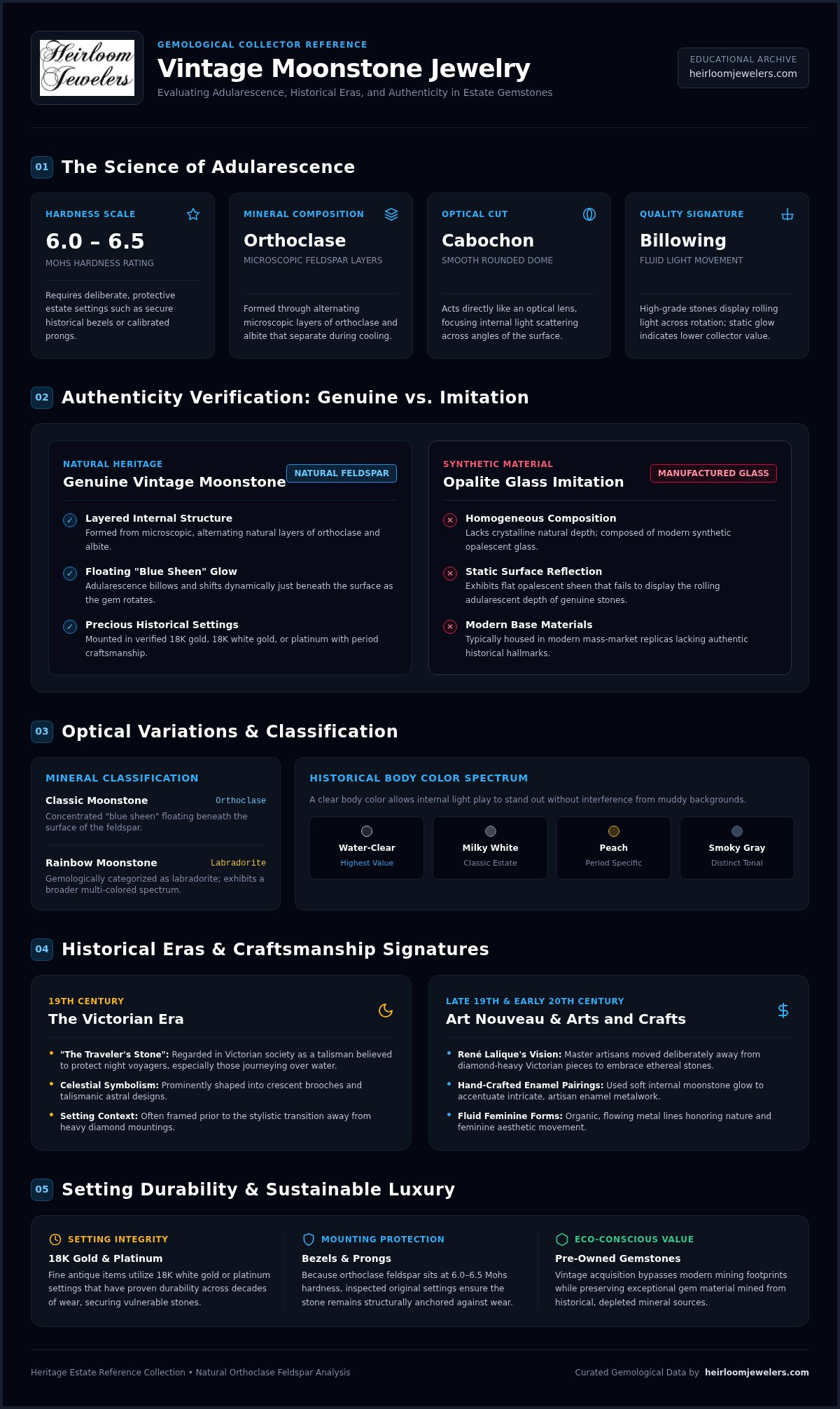
Vintage moonstone jewelry holds a specific allure that modern mass-market pieces rarely replicate. The attraction lies in the optical phenomenon of adularescence; light scatters between microscopic layers of feldspar to create a ghostly, rolling glow. In historical contexts, this "blue sheen" was prized for its mystical appearance. Collectors today seek these pieces because the gemstone quality in estate jewelry often surpasses contemporary alternatives. Older mines produced stones with exceptional transparency and vivid light play. These characteristics are increasingly difficult to find in the modern retail market.
During the late 19th and early 20th centuries, moonstone became a staple of the Arts and Crafts and Art Nouveau movements. Visionaries like René Lalique intentionally moved away from the diamond-heavy designs of the Victorian era. They favored moonstone for its ethereal qualities and its ability to complement intricate, hand-crafted enamel work. These items aren't just accessories. They're "living" stones that change with every movement of the wearer's hand. This creates a deep emotional connection that mass-produced items cannot provide.
The Symbolism of Moonstone Through History
Victorian society frequently categorized the moonstone as a "traveler's stone." People believed it protected those journeying by night, particularly over water. This protective association makes vintage moonstone jewelry a popular choice for modern collectors who value talismanic pieces. By the Art Nouveau period, the stone became central to a new feminine aesthetic. Designers used its soft, internal glow to represent the fluid and organic forms of the natural world. These historical beliefs continue to influence the desirability of estate pieces today. Owning a Victorian crescent brooch or an Art Nouveau pendant feels like holding a tangible piece of folklore.
Sustainable Luxury: The Value of Pre-owned Gemstones
Choosing vintage is a sophisticated and eco-conscious investment in 2026. It's a sustainable way to enjoy fine jewelry without contributing to the environmental footprint of modern mining. Estate pieces also offer a level of material integrity that's often sacrificed in contemporary high-street production. Most high-quality vintage items feature 18K white gold or platinum settings. These materials have already proven their durability over decades of wear. They provide a secure and elegant frame for the delicate moonstone, which requires a protective setting. You can explore more about these historical techniques in our guide on The Timeless Artistry of Antique Rings. Investing in authenticated heritage jewelry ensures you're acquiring a piece that retains its physical beauty and market value.
The Science of the Glow: Evaluating Moonstone Quality
Evaluating the quality of vintage moonstone jewelry requires an understanding of how light interacts with the stone's internal structure. This phenomenon creates the ghostly shimmer that defines the gem. According to Encyclopedia Britannica's moonstone guide, these gems are formed from layers of orthoclase and albite that separate during the cooling process. As light passes through these microscopic layers, it scatters in multiple directions. In the finest antique specimens, you'll see a concentrated "blue sheen" that appears to float just beneath the surface. This effect is distinct from "rainbow moonstone," which is gemologically classified as a variety of labradorite and displays a broader, multi-colored spectrum.
The body color of the stone significantly impacts its market value and aesthetic appeal. While many collectors prize stones with a nearly transparent, "water-clear" body, other varieties like milky white, peach, and even smoky gray were popular in specific historical eras. A clear body color allows the internal light play to stand out without interference from a muddy or opaque background. To maximize these optical properties, lapidaries almost always use a cabochon cut. The smooth, rounded dome acts like a lens, focusing the light scattering effect and making it visible from various angles across the stone's surface.
Identifying High-Quality Adularescence
High-quality adularescence should exhibit a "billowing" effect. This means the light moves fluidly across the surface of the stone as it's rotated. If the glow remains static or only appears at a narrow angle, the stone's value is generally lower. Adularescence is the light scattering from microscopic layers of albite and orthoclase. Transparency is also a critical factor in vintage moonstone jewelry. The more clear the stone, the more vivid the internal glow will appear against the metal setting.
Clarity and Inclusions in Antique Stones
Natural moonstones often contain tiny internal features that verify their authenticity. The "centipede" inclusion is the most distinctive, appearing as wispy lines with shorter perpendicular branches. Moonstone registers between 6.0 and 6.5 on the Mohs scale, so minor internal fractures are common in genuine pieces. It's vital to distinguish these natural traits from modern damage like surface chips. If you're looking for an expertly vetted piece, you can browse our authenticated collection to see these quality standards in person.
Moonstone Styles Through the Eras: Victorian to Mid-Century
The aesthetic evolution of vintage moonstone jewelry reflects broader cultural shifts in art and fashion over the last two centuries. While the stone's physical properties remain constant, the way jewelers showcased its glow changed from the romanticism of the 1800s to the sharp, industrial lines of the Jazz Age. Understanding these stylistic hallmarks helps collectors date their finds and appreciate the craftsmanship behind each era's unique contribution to jewelry history.
Victorian Sentimentality and Celestial Jewelry
During the Victorian era, jewelry was deeply symbolic and often served as a medium for expressing romantic or protective sentiments. Moonstones were a favorite for celestial motifs, particularly crescent moons and stars. You'll frequently encounter "Man in the Moon" carvings from this period, featuring faces hand-etched directly into the cabochon surface. These pieces usually utilize 15K or 18K yellow gold settings, which provide a warm, rich contrast to the stone's cool internal light. Artisans often paired moonstones with small seed pearls or turquoise to create soft, multi-textured designs that emphasized the stone's feminine associations. The delicate metalwork of the late 1800s requires careful inspection, as many pieces feature fine claws that may have thinned over a century of wear.
Art Nouveau: The Golden Age of Moonstone
The Art Nouveau movement marked a radical departure from diamond-centric designs, positioning the moonstone as a "poetic" gem. Visionaries like René Lalique valued the stone for its mystical appearance rather than its market rarity. In this era, moonstone artistry reached its peak through fluid lines and organic forms, such as dragonflies, flora, and flowing feminine silhouettes. This GIA guide to moonstone quality factors details how clarity and cut influence the value of stones from this period. If you're looking for an Art Nouveau piece, expect to find intricate enamel work and mixed-metal settings that prioritize artistic expression over traditional carat weight. You can learn more about the transition into more structured styles in our Art Deco Jewelry Guide.
By the 1920s, the soft curves of the previous decade gave way to the geometric precision of the Art Deco era. Designers began framing moonstones in platinum or white gold, often accented by sharp baguette diamonds to create a high-contrast, monochromatic look. This sophisticated aesthetic feels remarkably modern even today. Following the war, the Retro and Mid-Century periods saw a return to 14K yellow gold. These designs were much bolder and utilized significantly larger stones, reflecting a post-war desire for glamour and substantial, eye-catching jewelry. Each period offers a different way to experience the stone's ethereal beauty, allowing you to choose a piece that aligns with your personal style and historical interests.
Buying Guide: Authenticity, Condition, and Care
Acquiring authentic vintage moonstone jewelry requires a disciplined approach to verification. The market is frequently saturated with "opalite," a man-made glass that mimics the stone's appearance but lacks its geological value. According to U.S. Federal Trade Commission regulations, sellers must disclose if a stone is an imitation; however, many secondary market listings omit this detail. Identifying a genuine piece involves looking past the surface glow to evaluate the material's physical properties and the integrity of its historical setting.
Natural Moonstone vs. Opalite Imitations
You can often distinguish natural stone from glass using a few simple observations. Natural moonstone has high thermal conductivity, meaning it stays cool to the touch for several seconds when pressed against the skin. Glass imitations warm up almost immediately. Visually, opalite displays a uniform, hazy glow that often shifts between orange and blue regardless of the viewing angle. Natural adularescence is directional; the light rolls across the surface only when the stone is tilted. Under a 10x jeweler's loupe, look for tiny, perfectly round air bubbles. These are a definitive hallmark of glass. Natural gems will show the internal layers and microscopic structures mentioned in our earlier quality analysis, but they will never contain trapped air.
Beyond the stone itself, you must verify the metal and maker. Authentic estate pieces from the high-value eras we've discussed usually feature clear hallmarks. Look for stamps like "18K," "14K," or "Plat" on the inside of ring shanks or necklace clasps. These markings confirm the material quality and help establish the piece's origin. Because moonstone registers between 6.0 and 6.5 on the Mohs scale, you should also inspect the "claws" or bezels. Ensure the metal hasn't thinned to the point of instability. A secure setting is vital for a stone with perfect cleavage, as any significant impact could cause the gem to split along its internal planes.
Caring for Your Heritage Moonstone
Maintaining the luster of vintage moonstone jewelry requires a gentle touch. You must never use ultrasonic or steam cleaners on these pieces. The high-frequency vibrations and sudden temperature changes can trigger fractures along the stone's natural cleavage lines, leading to permanent damage. Instead, clean your jewelry using warm water, a mild detergent, and a soft-bristled brush. This method effectively removes oils and dust without risking the stone's structural integrity. When you aren't wearing your pieces, store them in individual soft pouches. This prevents harder gemstones, such as diamonds or sapphires, from scratching the softer surface of the moonstone. To find a piece that has been professionally inspected for these specific condition standards, explore our professionally vetted estate jewelry.
Selecting Your Next Heritage Piece at Heirloom Jewelers
Heirloom Jewelers serves as a bridge between historical appreciation and secure investment. We understand that the market for vintage moonstone jewelry can be complex, particularly when distinguishing natural stones from glass imitations. Our team rigorously authenticates every estate item to ensure it meets our exacting standards for quality and origin. We don't sell mass-produced modern items; instead, we focus on unique, pre-owned pieces that carry a sense of history and craftsmanship. This steady focus on heritage allows us to act as a trusted national authority for collectors across the country.
The Heirloom Jewelers Curation Standard
Every piece in our collection is hand-selected for its historical integrity and material value. Our curation process prioritizes moonstones that exhibit exceptional adularescence, ensuring the "blue sheen" remains vivid and rolls smoothly across the cabochon apex. We specifically seek out high-quality settings, such as 18K white gold and platinum. These metals provide the structural strength necessary to safeguard stones with a 6.0 to 6.5 Mohs hardness. This commitment to material excellence is a cornerstone of our business, whether we're evaluating a Victorian brooch or a piece from our Buying Guide to Vintage Engagement Rings. By specializing in rare vintage finds, we ensure our clients receive authenticated estate jewelry that stands the test of time.
Expert Guidance for Every Collector
Accessing professional expertise is vital when navigating the complexities of high-value secondary markets. We provide our clients with direct access to specialists who understand the nuances of historical eras, ranging from Victorian sentimentality to the geometric precision of the Art Deco period. Every piece in our inventory includes a transparent condition report and detailed historical context. We don't believe in high-pressure sales; instead, we offer a respectful atmosphere where the jewelry's craftsmanship takes center stage. Whether you're making your first purchase or building a sophisticated collection, we serve as a reliable guide to ensure your investment is secure. You can browse our curated collection of vintage jewelry to discover authenticated heritage pieces that retain their ethereal beauty and long-term value.
Invest in the Ethereal Legacy of Heritage Jewelry
Owning a piece of vintage moonstone jewelry is more than a simple style choice; it's an investment in a specific era of hand-crafted artistry. We've explored how to identify genuine adularescence and the importance of selecting 18K gold or platinum settings that protect these delicate gems. Understanding the distinction between the romantic motifs of the Victorian age and the fluid lines of Art Nouveau ensures your collection reflects a true historical narrative. Authenticity remains the primary concern for any serious collector who values material integrity over mass production.
As specialists in authenticated estate jewelry, Heirloom Jewelers provides a curated selection of high-value pre-owned items that have been rigorously vetted for quality. Our expertise in 18K gold and platinum heritage pieces ensures that every item in our inventory retains its structural stability and its ethereal glow. You can begin your journey into the past by choosing a piece that has been professionally verified for its history and material value. Explore Our Authenticated Collection of Vintage Jewelry and find a timeless treasure that resonates with your personal style. We look forward to helping you build a collection that will be cherished for generations.
Frequently Asked Questions
Is vintage moonstone jewelry durable enough for every day?
Moonstone is generally considered a "special occasion" stone rather than a gem for rigorous daily wear. It registers between 6.0 and 6.5 on the Mohs scale and possesses perfect cleavage in two directions. This makes it susceptible to chipping or splitting if it's struck against a hard surface. While a secure bezel setting in 18K gold provides protection, we recommend removing these pieces before performing manual tasks to preserve their historical integrity.
How can I tell if a vintage moonstone is real or glass?
Natural moonstone displays directional light scattering known as adularescence, while glass imitations like opalite show a static, uniform glow. You can also perform a temperature test; genuine stone stays cool to the touch, whereas glass warms quickly. Under magnification, natural stones often contain "centipede" inclusions. Glass imitations frequently contain tiny, round air bubbles. Authenticating vintage moonstone jewelry requires examining these internal structures to ensure you aren't purchasing a man-made substitute.
What is the most valuable color for a vintage moonstone?
The most valuable color is a nearly transparent, "water-clear" body with a vivid, electric blue sheen. This blue adularescence should appear to float on the surface and roll across the stone as it moves. While peach, gray, and milky white varieties were popular in certain eras, they generally command lower prices than the rare, colorless specimens with intense blue light play. High transparency allows the internal structure to scatter light more effectively.
Can moonstone be set in platinum or white gold?
Moonstone is frequently set in platinum or 18K white gold, particularly in Art Deco and Mid-Century designs. These cool-toned metals complement the stone's blue sheen and provide a durable frame. Platinum is especially valued for its strength, which helps secure the stone's edges. At Heirloom Jewelers, we prioritize these high-quality materials because they offer superior protection for delicate gemstones while maintaining the sophisticated aesthetic expected of fine estate jewelry.
What era of jewelry used moonstones most frequently?
The Art Nouveau era, roughly 1890 to 1910, represents the height of moonstone use in fine jewelry. Designers like René Lalique favored the stone for its ethereal, poetic qualities over the traditional brilliance of diamonds. The Arts and Crafts movement also utilized moonstones heavily, often setting them in hand-hammered silver. While the Victorian era featured celestial moonstone motifs, the Art Nouveau period established the gem as a centerpiece of high-art jewelry design.
How do I clean my antique moonstone ring without damaging it?
Clean your antique moonstone using warm water, a few drops of mild dish soap, and a very soft-bristled brush. You should never use ultrasonic or steam cleaners, as the vibrations and heat can cause the stone to fracture along its cleavage planes. Gently pat the piece dry with a lint-free cloth. Proper storage is equally important; keep your moonstones in individual soft pouches to prevent harder gems from scratching their surfaces.
Are moonstones in vintage jewelry always natural?
Many pieces marketed as "vintage" actually contain glass imitations or synthetic substitutes. "Opalite" is a common glass-based imitation that has been used for decades to mimic the look of natural adularescence. It's essential to purchase from a specialist who authenticates their inventory. Natural stones will show unique internal characteristics and geological inclusions that man-made glass cannot replicate. Always verify the stone's origin before investing in a heritage piece.
What are the most common hallmarks to look for in estate moonstone pieces?
Look for metal purity stamps such as "18K," "14K," "585," or "950 Plat" on the interior of the setting. These hallmarks verify the quality of the gold or platinum used. You might also find maker's marks or signatures from specific design houses, which can significantly increase a piece's historical value. Authentic vintage moonstone jewelry often features these stamps as a testament to its craftsmanship and material integrity in the secondary market.