
A genuine vintage ring is a metallurgical time capsule, not just a fashion choice. While many shoppers view white gold as a contemporary alternative to platinum, its true legacy began with a revolutionary alloy patented by the Belais brothers in 1917. Finding authentic vintage white gold engagement rings requires a discerning eye for detail and a deep respect for 20th-century craftsmanship. You're looking for a piece with a soul, not a mass-produced imitation.
It's natural to feel hesitant when exploring the estate market. You might worry about mistaking a modern reproduction for a true antique or feel confused by the subtle differences between white gold and platinum in older settings. These concerns are valid. A ring should be as honest as the promise it represents. We're here to provide the expertise you need to shop with quiet confidence and clarity.
This guide explores the history of white gold and the era-defining styles that made it a household name. You'll learn to identify authentic hallmarks and understand why the unique patina of aged gold is a mark of quality. We'll also reveal secrets for maintaining your ring's elegance. Let's begin your journey into the refined world of historical fine jewelry and timeless design.
Key Takeaways
- Trace the origins of white gold to the 1917 Belais brothers patent, which established the alloy as a sophisticated alternative to platinum.
- Identify the hallmark characteristics of Art Deco craftsmanship, including geometric precision and intricate die-struck filigree.
- Learn to appreciate the natural "straw" or "champagne" patina of authentic vintage pieces that haven't been masked by modern rhodium plating.
- Understand why Old European and Old Mine cut diamonds are the ideal pairing for vintage white gold engagement rings due to their historical synergy.
- Gain the specialized knowledge required to distinguish genuine 20th-century estate jewelry from modern, mass-produced reproductions.
The Historical Significance of Vintage White Gold Engagement Rings
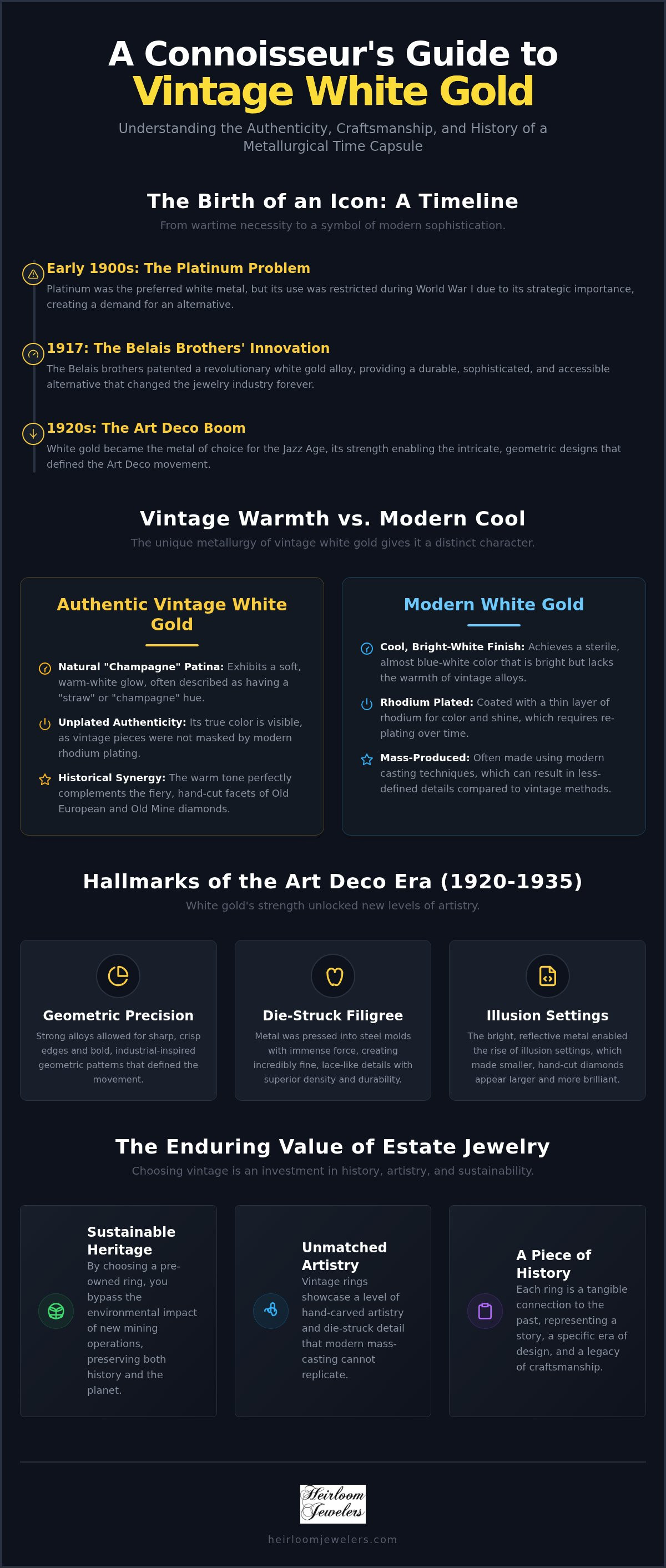
White gold represents more than a stylistic choice. It was a metallurgical solution born from necessity. During the early 20th century, platinum was the preferred metal for fine jewelry, but its scarcity during World War I drove a search for a viable alternative. In 1917, the Belais brothers patented a white gold alloy that changed the industry forever. This innovation allowed jewelers to achieve the coveted cool tone of platinum using a more accessible gold base. It wasn't just a substitute; it was a technical achievement in its own right.
Today, vintage white gold engagement rings are prized for this specific historical context. Modern collectors in 2026 often seek out the original "warm-white" glow of these pieces. This natural color stands in stark contrast to the sterile, blue-white finish of modern rhodium plating. It offers a softer, more romantic aesthetic that complements the hand-cut diamonds of the era.
The "White Metal" Revolution of the 1920s
The Jazz Age demanded a new aesthetic. The history of white gold is inextricably linked to the Art Deco movement, where geometric precision and industrial progress became the standard. White gold offered a unique advantage over early platinum alloys because it was exceptionally strong. This rigidity allowed artisans to create incredibly fine, lace-like filigree and sharp, die-struck patterns that wouldn't warp over time.
- Structural Integrity: White gold held its shape better than the softer platinum alloys used in the early 1900s.
- Modern Sophistication: The shift from "romantic" yellow gold to "modern" white gold mirrored the societal changes of the 1920s.
- Optical Enhancements: The metal enabled the rise of the illusion setting, making smaller diamonds appear larger and more brilliant.
Sustainable Heritage: Why Pre-owned White Gold Matters
Choosing an authenticated estate piece is an act of preservation. Every vintage ring represents a story and a commitment to environmental responsibility. By selecting a pre-owned ring, you bypass the ecological impact of new mining operations. These pieces also showcase a level of hand-carved artistry that modern mass-casting techniques simply cannot replicate. Authenticated vintage white gold engagement rings serve as a bridge between past craftsmanship and future legacy. For a deeper look at identifying these treasures, consult our A Definitive Buying Guide to Vintage Engagement Rings.
White Gold Through the Eras: From Filigree to Mid-Century
The aesthetic evolution of white gold is a journey from intricate hand-craftsmanship to sleek, industrial modernism. Before the invention of solid white gold alloys, Edwardian jewelers often used silver layers over yellow gold to achieve a white appearance. This method was imperfect, as silver tarnished and required frequent maintenance. The arrival of solid white gold composition alloys in the late 1910s provided a permanent, durable solution that didn't lose its luster. By the early 1920s, this metal became the definitive choice for the decade’s most ambitious designs.
Art Deco Precision and Die-Struck Details
During the Art Deco period from 1920 to 1935, 18K white gold was the premier choice for bridal jewelry. Artisans favored a technique called die-striking, where metal was pressed into steel molds under immense force. This process created vintage white gold engagement rings with incredibly sharp, crisp edges and structural density that modern casting cannot replicate. You'll often find these pieces adorned with symbolic motifs like wheat patterns representing fertility or orange blossoms signifying purity. The "Belais" era, defined by the hallmark of the brothers who first patented the alloy, serves as a primary indicator of authenticity for collectors seeking early 20th-century excellence.
In the mid-1930s, the Retro era introduced a shift toward yellow and rose gold. White gold remained essential, however, as it was used for the settings and prongs to ensure diamonds appeared as white as possible. This era focused on bold, sculptural forms that bridged the gap between the delicate filigree of the past and the minimalism of the future.
Mid-Century Illusion Settings
By the 1950s, the jewelry industry moved toward high-polish 14K white gold as the standard for the classic solitaire. Designers became masters of the "illusion" setting, using mirrored metal plates around the diamond to amplify its size and brilliance. These vintage white gold engagement rings are often harder than modern versions because they contain a higher percentage of nickel. This metallurgical choice ensured that the sharp, mirrored facets of the setting would resist scratches and maintain their reflective quality over a lifetime of wear. If you're searching for a piece that captures this specific 20th-century evolution, you can explore our curated collection of authenticated estate rings.
Metallurgy and Patina: What Makes Vintage White Gold Unique
Authentic vintage white gold engagement rings possess a metallurgical character that sets them apart from modern retail offerings. Most contemporary white gold is plated with rhodium to achieve a bright, liquid-silver finish. In contrast, early 20th-century alloys were often left unplated. This reveals the natural color of the metal, which is a sophisticated "straw" or "champagne" white. This warmth comes from the specific alloy blend of pure gold mixed with white metals like nickel, palladium, or zinc. The result is a piece that feels organic and historical rather than clinical.
When you examine estate pieces, the karat weight significantly impacts the visual profile. An 18K white gold ring contains 75% pure yellow gold, resulting in a deeper, creamier tone than its 14K counterpart. While 14K is harder and more resistant to daily wear, 18K offers a richness that many collectors prefer for its historical accuracy. If you encounter a ring that looks unnaturally bright and blue-white, it may have been "re-dipped" in modern rhodium. While this protects the metal, it often fills in the microscopic details of original engravings and can hide evidence of previous repairs or alterations.
Identifying Historical Hallmarks
Authentication begins with the stamps inside the band. Beyond the standard "14K" or "18K", you might find the mark "PLATINON". This was an early trade name for white gold alloys designed to mimic platinum's appearance. Maker-specific stamps like "BELAIS" are highly coveted, as they guarantee the piece originated from the pioneering workshop of the white gold movement. International marks like "15ct" or "18ct" often indicate British or Commonwealth origins, helping to date a piece to specific pre-war eras. It's also vital to distinguish solid alloys from "white-washed" yellow gold, where a thin layer of white metal was applied over a yellow base. A true vintage piece will show consistent color even in areas of heavy wear.
The "Natural" White Gold Aesthetic
There is a quiet elegance to the unplated look that modern jewelry fails to replicate. This softer white doesn't compete with the stone. Instead, it complements the unique fire of antique diamonds. The natural patina of age settles into the recesses of filigree and milgrain, adding a sense of three-dimensional depth to the design. This lived-in character is a hallmark of What is Heritage Jewelry?, where the story of the metal is as important as the gemstones it holds. Genuine vintage white gold engagement rings celebrate this subtle transition of color, offering a warmth that feels deeply personal and historically grounded.
Selecting the Perfect Vintage White Gold Engagement Ring
Selecting vintage white gold engagement rings is a process of finding harmony between the metal's unique history and the diamond's individual character. Unlike modern solitaires, these pieces were designed around the specific proportions of antique diamonds. The cool, unplated tone of the gold provides a neutral backdrop that allows the stone's natural fire to take center stage. You aren't just buying a ring; you're choosing a piece of wearable art that has already stood the test of time.
White gold is particularly forgiving with "near-colorless" diamonds, typically those in the G through J color range. While yellow gold can cast a warm tint into a stone, the white metal helps these diamonds appear brighter and whiter than their technical grade might suggest. Many 20th-century designs also utilized sapphires or emeralds as accent stones. These deep blues and vivid greens provide a striking contrast against the architectural lines of the white metal, a hallmark of the Art Deco sensibility that remains popular in 2026.
Always inspect the shank for signs of thinning. Over decades of wear, gold can wear away at the bottom of the band, sometimes requiring a "reshanking" to restore its structural integrity. You should also examine the prongs under magnification. If they appear flat or barely cover the diamond's edge, they may require re-tipping to ensure the stone remains secure. Authenticated pieces from a trusted specialist will have these details already vetted and addressed.
Old European Cut Diamonds in White Gold
Old European cuts are the gold standard for vintage white gold engagement rings. These diamonds feature chunky facets and a small table, which reflect light in broad, romantic flashes rather than the splintered brilliance of modern cuts. This light play is amplified by the reflective qualities of the white metal. The distinctively high crown of an antique diamond requires a secure, period-correct basket setting to protect the stone's girdle while allowing maximum light entry. To see how these artisanal cuts translate to other jewelry types, explore our guide to Antique Diamond Earrings.
Matching the Ring to a Wedding Band
Finding a matching vintage wedding band can be a challenge because most were die-struck as unique pieces. Many modern couples embrace this by mixing metals, pairing a white gold engagement ring with a platinum or rose gold stack. If you choose to stack bands, ensure the "hardness" of the metals matches. An 18K band is softer than a 14K band or platinum; wearing them together can cause the harder metal to slowly wear down the softer one over time. You can view our authenticated inventory to find a piece that resonates with your personal story and aesthetic preferences.
Discovering Authenticated Treasures at Heirloom Jewelers
Heirloom Jewelers operates as a dedicated specialist in authenticated estate and vintage fine jewelry. We focus exclusively on unique, high-value pieces that represent the pinnacle of 20th-century craftsmanship. Our collection avoids the uniformity of modern, mass-produced jewelry in favor of items with a distinct history and soul. When you explore our selection of vintage white gold engagement rings, you are viewing a curated gallery of rare finds selected for their material quality and artistic significance. We prioritize the preservation of heritage over the convenience of modern manufacturing.
Buying from a specialized estate jeweler offers a level of security that online auctions and general marketplaces simply cannot match. We act as a steady, professional bridge between the past and the present. Every ring in our inventory undergoes a rigorous evaluation to ensure it meets our standards for integrity and heritage. We look beyond the surface to find pieces that tell a compelling story of mid-century modernism or Art Deco precision. This methodical approach ensures that every client receives a piece of undeniable quality and verified origin.
Expert Authentication and Peace of Mind
Our authentication process is methodical and thorough. We verify the specific metallurgical composition, historical hallmarks, and artisanal cuts of every stone. This includes identifying the pioneering work of the Belais brothers or spotting the rare stamps mentioned in our earlier chapters. We also assess the physical health of the ring; we ensure the prongs and shank are robust enough for another lifetime of wear. This deep secondary-market knowledge allows us to provide a transparent history for each piece. You can browse our curated collection of vintage white gold rings with the certainty that every detail has been professionally vetted.
The Heirloom Jewelers Philosophy
Our philosophy is rooted in a sense of quiet confidence. We believe that the true value of a ring lies in its historical integrity rather than an artificial modern perfection. A slight patina or a "warm-white" glow is not a flaw. It's a testament to the ring's endurance and character. We invite you to move at a deliberate pace as you search for a one-of-a-kind heritage piece. Finding the right ring is a personal journey, and we are here to act as your reliable guide. Whether you are drawn to the geometric lines of the 1920s or the bold proportions of mid-century design, our goal is to help you find a ring that resonates with your own story.
Embarking on Your Heritage Journey
Choosing a ring from the 20th century is a commitment to preserving a specific moment in metallurgical history. You've learned that authentic vintage white gold engagement rings offer a distinct warm-white patina and structural integrity that modern casting cannot duplicate. From the sharp edges of die-struck Art Deco settings to the romantic fire of an Old European cut diamond, these pieces represent a bridge between past artistry and your future legacy. Authenticity remains the most critical factor. Identifying historical hallmarks and avoiding the sterile finish of modern rhodium plating ensures your selection is a genuine artifact.
Heirloom Jewelers acts as a steady guide for those navigating the complexities of the estate market. Our expertise in historical metallurgy and rare 20th-century finds ensures that every piece in our collection is a verified treasure. We invite you to Explore Our Collection of Authenticated Vintage White Gold Engagement Rings and discover a story that resonates with your own aesthetic. Your unique piece of history is waiting to be found.
Frequently Asked Questions
Is vintage white gold as durable as modern white gold?
Vintage white gold is exceptionally durable and often harder than modern versions. Early 20th-century alloys frequently used a high percentage of nickel as a bleaching agent, which created a very rigid and scratch-resistant metal. Additionally, many vintage white gold engagement rings were created using a die-striking process. This technique compresses the metal to a higher density than modern casting, resulting in a piece that stands up remarkably well to daily wear.
Does vintage white gold contain nickel?
Most authentic 20th-century white gold alloys contain nickel. Before the common use of palladium, nickel was the primary metal mixed with yellow gold to achieve a white appearance. It provides the signature crispness and strength found in Art Deco jewelry. While some modern white gold is formulated to be nickel-free for those with sensitivities, collectors should expect nickel to be present in genuine estate pieces from the 1920s through the 1950s.
Can an antique white gold engagement ring be resized?
Most antique rings can be resized by a professional jeweler who specializes in estate pieces. The process requires a deep understanding of historical alloys and their specific melting points. If a ring features intricate filigree or engraving that circles the entire band, resizing may be more complex to avoid disrupting the pattern. It's always best to have the shank inspected for thickness and structural integrity before any resizing work begins.
What is the difference between white gold and platinum in vintage jewelry?
The differences involve weight, color, and how the metal ages. Platinum is significantly heavier and denser than white gold. While vintage white gold has a natural, warm-white tint, platinum has a cooler, greyish-white tone. Over decades, platinum develops a soft matte finish known as a patina, whereas white gold tends to stay brighter. White gold was often preferred for the sharp, geometric lines of the Art Deco era because of its inherent rigidity.
Will vintage white gold turn yellow over time?
White gold does not turn yellow, but its natural color can become more visible. Authentic vintage white gold engagement rings were often left unplated, showcasing a sophisticated champagne-white tone. If a piece was later "re-dipped" in modern rhodium to appear blue-white, that plating will eventually wear off. This reveals the original, warmer alloy underneath. Many collectors prefer this natural look as it highlights the ring's historical character and artisanal origins.
What diamond cuts look best in a vintage white gold setting?
Old European and Old Mine cuts are the premier choices for these settings. These antique cuts feature larger facets and higher crowns that produce broad, romantic flashes of light. The neutral, unplated tone of vintage gold provides a perfect backdrop that enhances the brilliance of diamonds in the G to J color range. This combination creates a refined, understated elegance that modern round brilliant cuts often struggle to replicate in a historical setting.
How do I identify a "Belais" white gold ring?
You can identify these pieces by the "BELAIS" hallmark stamped inside the band. David Belais was a pioneer who patented his specific white gold alloy in 1917, and his workshop became a standard for quality during the 1920s. These rings are known for their exceptionally sharp die-struck details and masterful filigree work. Finding this stamp is a verified marker of authenticity, confirming the piece is a genuine artifact from the early white gold revolution.
How do I clean and care for a 100-year-old white gold ring?
Clean your ring using a gentle solution of warm water and mild dish soap with a soft-bristled brush. You should avoid ultrasonic cleaners or harsh chemicals, which can be too aggressive for century-old settings or delicate filigree. It's also important to have a specialist inspect the prongs annually to ensure the stones remain secure. Because vintage gold can become brittle over time, gentle manual cleaning is the safest way to preserve its beauty.