
A modern machine can replicate a diamond's sparkle, but it can't recreate the soul of a hand-sculpted stone from the turn of the century. You likely appreciate the depth and fire found only in authentic estate jewelry, yet finding genuine vintage yellow gold old european cut diamond earrings often feels like a gamble. The market is saturated with mass-produced reproductions that lack the character of a true heirloom. We understand the frustration of searching for a piece that carries both historical weight and verified authenticity. It's hard to feel certain when grading standards for antique cuts seem so different from modern certifications.
This guide explores the intricate artistry and historical significance of these rare diamonds. You'll learn the specific techniques used to authenticate Old European Cuts and discover why high-karat gold settings are essential for a collector's portfolio. We'll examine how these hand-cut facets differ from modern standards. This overview provides the clarity you need to acquire a unique piece of history with absolute confidence. From the warmth of the metal to the unique personality of every stone, we'll help you identify the markers of a truly exceptional find.
Key Takeaways
- Identify the high crown and open culet that define the Old European Cut's unique fire. These specific features create a depth of character modern cuts can't match.
- Learn how different metal tones influence the visual warmth of authentic vintage yellow gold old european cut diamond earrings.
- Discover the specific hallmarks and hand-cut facets that distinguish genuine antique pieces from modern machine-made reproductions.
- Find out why traditional grading scales often underestimate the visual performance of warm-toned vintage diamonds.
- Explore the benefits of sourcing through a curator who prioritizes historical preservation over mass-market retail trends.
The Historic Soul of the Old European Cut Diamond
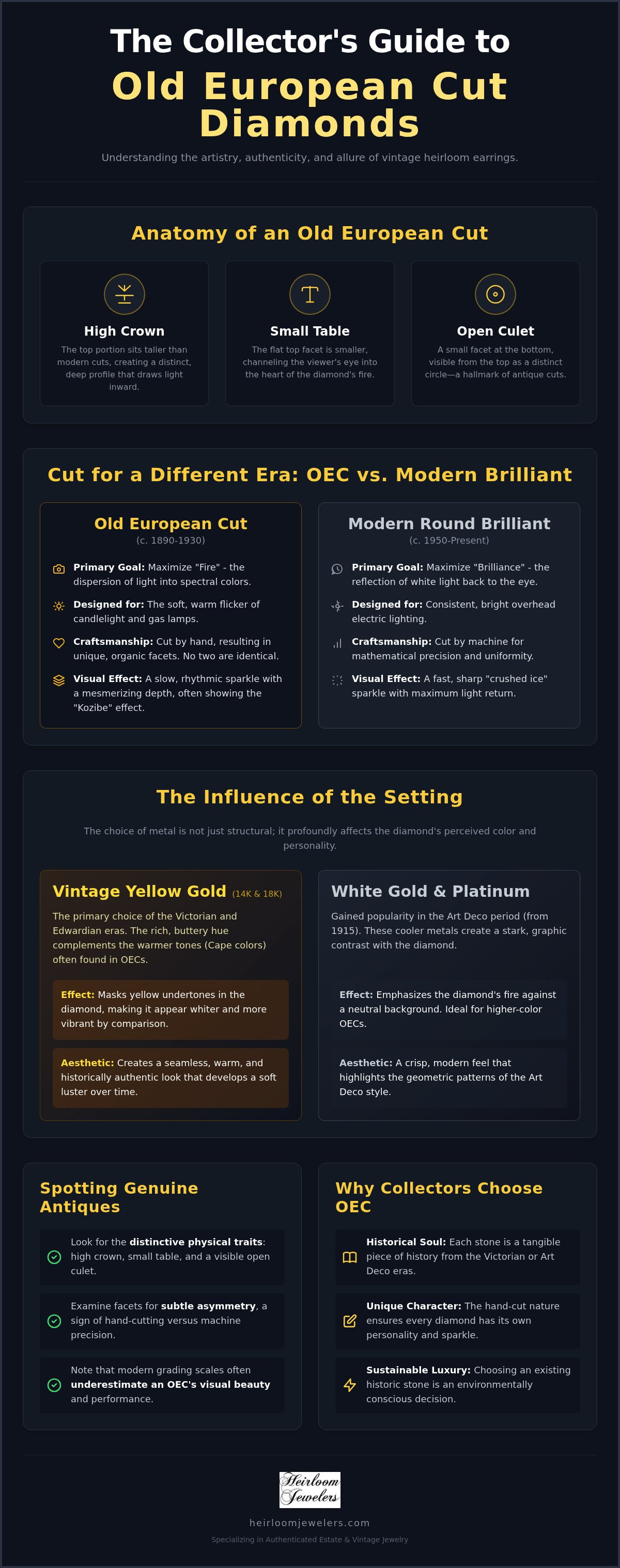
The Old European Cut (OEC) represents a pinnacle of jewelry history, serving as the standard for excellence from roughly 1890 through 1930. Unlike the machine-precise stones of today, each OEC was hand-fashioned by master lapidaries who understood how to maximize a stone's personality. This specific cut serves as the hand-wrought bridge between antique Old Mine cuts and modern rounds. When you look at a pair of vintage yellow gold old european cut diamond earrings, you aren't just seeing jewelry; you're seeing the evolution of the history of diamond cuts.
These physical characteristics define the OEC's silhouette:
- A high crown: The top portion of the diamond sits taller than modern counterparts, creating a distinct side profile.
- A small table: The flat top facet is smaller, which draws the eye deeper into the stone's center.
- The open culet: A small, flat facet at the bottom of the diamond that appears as a soft circle when viewed from above.
Modern diamonds are designed for brilliance, which is the reflection of white light. OECs focus on fire, the flash of spectral colors. This creates a mesmerizing effect in low-light environments like a dinner party or a theater. The facets are larger and less uniform, allowing the diamond to "breathe" with a slow, rhythmic sparkle that feels alive.
The Art of Hand-Cutting for Candlelight
Victorian and Edwardian artisans didn't have the benefit of electric overhead lighting. They cut diamonds to perform beautifully under the flicker of candlelight or the soft glow of gas lamps. This approach prioritized light dispersion and fire over sheer carat weight. Because these stones were cut by hand, no two are ever truly identical. You might notice the "Kozibe" effect, where the reflection of the culet creates a unique optical signature within the stone. This human element gives these diamonds an organic asymmetry that modern machine cuts can't replicate.
Why the OEC is Seeing a 2026 Resurgence
Sophisticated collectors are increasingly moving toward unique, non-standardized luxury. The current trend favors items that tell a story rather than uniform, mass-produced goods. Choosing existing, historic stones is also an inherently sustainable choice. It allows you to enjoy high-value luxury without the environmental impact of new mining. For those interested in the broader context of these pieces, The Timeless Artistry of Antique Rings: A Collector’s Educational Guide offers deeper insight into the craftsmanship of the era. The rarity of authenticated vintage yellow gold old european cut diamond earrings makes them a steady choice for those who value both heritage and enduring style.
Choosing the Setting: Vintage Yellow Gold vs. White Gold
Selecting the right metal for an Old European Cut diamond requires an understanding of both light and history. The metal doesn't just hold the stone. It influences the diamond's perceived color and personality. Modern retail often prioritizes colorless stones in white settings. However, collectors of vintage yellow gold old european cut diamond earrings know that the warmth of high-karat gold can make a stone look more vibrant. This interaction is key to understanding GIA's classification of Old European cuts before making a final selection. These historical stones perform differently than modern machine-cut diamonds.
The Warmth of Vintage Yellow Gold Earrings
Yellow gold was the primary choice during the Victorian and late Edwardian eras. Artisans typically used 14K or 18K alloys. These possess a rich, buttery hue that modern gold often lacks. This metal choice was often practical as well as aesthetic. Many OECs fall into the Cape color range, showing hints of yellow or champagne. A yellow gold setting masks these undertones. It makes the diamond appear whiter by comparison. If you're looking for a pair that captures this era, our collection of authenticated estate earrings offers several examples in original settings. These pieces develop a soft, historical luster over decades that preserves their value.
The Art Deco Shift to White Gold and Platinum
By 1915, tastes shifted toward cooler metals. Platinum became the preferred choice for the elite. The invention of 18K white gold provided a more accessible and durable alternative for the growing middle class. This transition allowed for the intricate filigree and milgrain detailing that defined the following decade. Our resource on Art Deco Jewelry: The Definitive Guide to Jazz Age Elegance in 2026 provides a deeper look into these specific design shifts. Unlike modern white gold, which is often plated in rhodium, vintage white gold alloys have a slightly warmer look. This complements the organic nature of hand-cut diamonds perfectly.
Vintage gold alloys were mixed with different ratios of copper or silver than today's standardized versions. This results in a metal that is often more durable for daily wear. The patina that develops on a 100-year-old post or basket isn't something that can be manufactured. It's a testament to the piece's survival through time. Collectors value this age-glow because it proves the item's history and authenticity. When evaluating vintage yellow gold old european cut diamond earrings, this natural wear is a mark of quality that modern reproductions simply cannot replicate.
True Vintage vs. Modern Reproductions: How to Spot the Difference
Authenticating vintage yellow gold old european cut diamond earrings requires a keen eye for the subtle markers of human artistry. The modern market is crowded with "vintage-inspired" jewelry. These are new pieces designed to mimic the aesthetic of the past. While they may look appealing, they lack the historical soul and enduring value of a genuine antique. A true collector seeks the organic asymmetry that only comes from hand-cut stones and hand-fabricated settings. We prioritize the preservation of these artifacts over modern mass production.
The primary indicator of authenticity is the facet structure of the diamond. Modern machines produce perfect, repetitive symmetry. In contrast, an original Old European Cut stone shows slight variations. A master lapidary cut these stones by eye, making every facet a unique decision. The setting also tells a story. Authentic estate earrings feature hand-fabricated prongs and baskets made from hand-drawn wire. Modern reproductions use CAD-designed castings that appear perfectly uniform. These often feel bulkier than the delicate, refined work of the early 20th century. We focus exclusively on pre-owned, authenticated estate items because we believe history cannot be manufactured.
Identifying Historic Hallmarks and Maker’s Marks
Provenance is often hidden in plain sight. Look for 18K, 14K, or "PLAT" stamps on the earring post or the back of the basket. These marks should show signs of soft wear over decades. A struck stamp from 1910 looks different than a crisp laser engraving from 2024. As a curator of historical jewelry, we verify these marks to ensure every piece is genuine. For a deeper look at these details, see our guide on Antique Diamond Earrings: A Guide to Historic Styles and Artisanal Cuts. These stamps are the signature of the artisan who created the piece.
Red Flags for 'Vintage-Style' Mass-Produced Jewelry
Collectors should be wary of perfect symmetry and standardized stones. If a pair of vintage yellow gold old european cut diamond earrings has two stones that are identical in every facet, they are likely modern reproductions. Other warning signs include:
- Modern laser engravings: These are too perfect and lack the "squish" of a traditional metal punch.
- Hollowed-out settings: Modern "vintage-style" pieces often use less metal to save on costs, resulting in a lightweight, flimsy feel.
- Sharp, crisp edges: Authentic estate pieces have softened over time, developing a comfortable, rounded patina that machines can't replicate.
Evaluating the 'Inner Fire': Color, Clarity, and Performance
Modern gemological standards prioritize colorless stones and machine-perfect symmetry. This approach often fails to capture why collectors seek out vintage yellow gold old european cut diamond earrings. While a modern round brilliant is graded on its ability to return white light, an Old European Cut (OEC) is celebrated for its fire. This refers to the dispersion of light into spectral colors. Because these stones were hand-cut, their performance relies on unique proportions that modern lab reports often penalize. We evaluate these stones based on their visual character rather than just their technical specifications.
Understanding the 'Warm' Color Palette
In the world of antique jewelry, "warmth" is an asset rather than a flaw. Many OECs fall into the J through M color grades, often referred to as "Cape" diamonds. These stones possess a soft, creamy tint that pairs beautifully with the rich tones of high-karat gold. The larger facets of an OEC don't break up light as finely as modern cuts. This means they don't show body color as easily as a modern stone would. When set in vintage yellow gold old european cut diamond earrings, these stones often appear whiter and more vibrant than their technical grade suggests. Matching these stones for a pair of studs is a curator's challenge, as each diamond has a unique personality and tint.
The Importance of the Open Culet and High Crown
The geometry of an OEC is fundamentally different from a modern brilliant. You'll notice "chunky" flashes of light rather than the "needle" flash seen in modern retail. This is due to the smaller table and the distinctive open culet. The culet is the facet at the very bottom of the stone. In an OEC, it's left flat, creating a soft circular reflection in the center of the diamond. This is a vital mark of authenticity. The high crown creates superior fire dispersion. This height allows light more room to travel and refract before exiting the stone, resulting in those deep, spectral flashes that define the era.
Clarity should be evaluated with a focus on character. While modern buyers often chase lab-perfect specifications, seasoned collectors prioritize stones that are "eye-clean." Small internal characteristics are often a byproduct of the era's mining and cutting techniques. They don't detract from the stone's beauty; they confirm its natural origin. If you're ready to see these unique optical properties in person, you can browse our current selection of authenticated estate diamond earrings to find a pair that speaks to you. We select each stone for its visual performance and historical integrity rather than just its technical report.
Why Collectors Choose Heirloom Jewelers for Authenticated Estate Earrings
Choosing a jeweler is as much about trust as it is about taste. At Heirloom Jewelers, our philosophy centers on the preservation of history. We don't participate in the cycle of modern mass production or custom manufacturing. Instead, we act as curators for those who appreciate the enduring value of pre-owned luxury. When you acquire a pair of vintage yellow gold old european cut diamond earrings from our collection, you're securing a verified piece of the past. Each item is selected for its ability to tell a story that modern machine-cut stones simply can't replicate.
The secondary market provides a sophisticated alternative to traditional retail. Collectors can access high-karat gold and rare hand-cut diamonds without the standard "new retail" markup. This approach isn't just financially prudent; it's also a sustainable way to enjoy fine jewelry. By selecting existing estate pieces, you're honoring the craftsmanship of previous generations while ensuring these artifacts continue to be worn and appreciated. It's a method of collecting that prioritizes integrity over the fleeting trends of modern storefronts.
Our Curation Process for Rare Vintage Finds
We source our inventory with a focus on structural integrity and historical accuracy. Every piece of estate jewelry we offer undergoes a detailed inspection to verify its origin and the quality of its components. We look for the "quiet confidence" that defines a well-preserved heirloom. Our experts check for original hallmarks and the specific hand-cut facets discussed in previous sections. This ensures that every pair of vintage yellow gold old european cut diamond earrings meets our rigorous standards for authenticity before it ever reaches our clients. We believe that a true artifact should be as durable as it is beautiful.
Starting Your Heritage Collection with Diamond Studs
Many collectors find that diamond studs are the perfect anchor for a growing jewelry portfolio. They offer a level of versatility that suits both daily wear and formal occasions. Starting with Old European Cut studs allows you to establish a baseline of quality and style. As your collection matures, you can look for complementary pieces that share the same historical weight. For instance, pairing your OEC studs with a significant statement piece like the Allure of the Lugano Emerald & Diamond Necklace in 18K White Gold creates a sophisticated look rooted in timeless design. We're here to guide you through this process, ensuring each new acquisition is a meaningful addition to your personal heritage.
Securing Your Piece of Jewelry History
Acquiring authentic vintage yellow gold old european cut diamond earrings is an investment in both artistry and heritage. These hand-sculpted stones offer a rhythmic fire that modern machine-cut diamonds simply can't match. By understanding the nuances of high crown geometry and identifying genuine historical hallmarks, you can navigate the estate market with confidence. Whether you prefer the warmth of Victorian yellow gold or the crisp elegance of Art Deco white gold, the right setting serves to preserve the stone's unique soul for generations to come.
Heirloom Jewelers acts as a specialized curator of authenticated estate fine jewelry. Our hand-selected inventory is chosen for its structural integrity and historical significance. We maintain a transparent, expert-led curation process that excludes mass-market reproductions in favor of true artifacts. We invite you to Explore Our Curated Collection of Authentic Vintage Diamond Studs to find a pair that resonates with your personal style. Building a collection of timeless beauty starts with a single, verified piece of history.
Frequently Asked Questions
What exactly is an Old European Cut diamond?
An Old European Cut diamond is a hand-fashioned stone that served as the industry standard from approximately 1890 to 1930. It features 58 facets, a notably high crown, a small table, and a distinctive open culet at the base. These diamonds were cut for fire and spectral color rather than the white light brilliance found in modern rounds. Each stone is an individual artifact reflecting the specific decisions of the lapidary who cut it.
Is 18K white gold better than yellow gold for vintage stud earrings?
Neither metal is objectively superior; the choice depends on the era and aesthetic you prefer. Yellow gold was the primary choice for Victorian and Edwardian jewelry, offering a rich warmth that complements stones with creamy undertones. 18K white gold became the hallmark of the Art Deco period, providing a durable and cooler-toned alternative. Both alloys in our estate collection are selected for their historical accuracy and structural integrity for daily wear.
Why do Old European Cut diamonds look warmer in color than modern diamonds?
These stones often look warmer because they were cut to maximize fire under low-light conditions like candlelight. Many fall into the "Cape" color range, which includes J through M grades. The larger facets of the stone handle these soft tints beautifully. When set in vintage yellow gold old european cut diamond earrings, this warmth becomes a desirable characteristic that enhances the diamond's depth and avoids the sterile look of mass-produced modern jewelry.
Are vintage diamond stud earrings safe for everyday wear?
Yes, authentic vintage studs are remarkably durable. Diamonds sit at a 10 on the Mohs scale, making them resistant to scratching. The gold alloys used in the early 20th century were often quite robust. We inspect every piece in our collection to ensure the prongs and posts are secure. As long as you have the settings checked by a professional every few years, these earrings are perfectly suitable for consistent daily use.
How can I tell if my gold earrings are truly vintage or just 'vintage-style'?
True vintage earrings feature struck hallmarks and maker's marks that show soft, natural wear. Modern "vintage-style" pieces often have crisp laser engravings and perfectly symmetrical, machine-cut diamonds. You should also look at the construction. Authentic estate pieces are typically hand-fabricated with solid baskets. Modern reproductions are frequently made from CAD-designed castings and may have hollowed-out sections to save on metal costs, resulting in a lighter and less substantial feel.
Do Old European Cut diamonds hold their value compared to modern cuts?
Old European Cut diamonds generally maintain their value well because they are a finite, non-renewable resource. Unlike modern diamonds, which are produced in large quantities using standardized machinery, OECs are rare historical artifacts. Collectors value their unique optical signatures and provenance. As demand for unique, sustainable, and non-standardized luxury grows, these stones continue to be a stable choice for those looking to build a high-value jewelry portfolio over the long term.
How should I clean and maintain my vintage white gold diamond studs?
The best way to maintain your earrings is with mild dish soap, warm water, and a very soft toothbrush. Gently scrub the basket and behind the stone to remove oils and debris. Avoid using harsh chemicals or ultrasonic cleaners at home, as older settings can sometimes be sensitive to intense vibrations. We recommend a professional cleaning and prong inspection once a year to ensure the historical integrity of the piece remains intact for decades.
Why does Heirloom Jewelers focus only on estate jewelry rather than new pieces?
We believe in the preservation of history and the superior character of hand-crafted artifacts. Mass-produced modern jewelry lacks the soul and unique personality found in authenticated estate pieces. Our focus on the secondary market allows us to act as curators of one-of-a-kind items that offer both sustainability and timeless elegance. By avoiding custom manufacturing and new retail trends, we provide our clients with access to genuine pieces of history that carry enduring value.