
What if the most beautiful piece in your collection was originally designed as a high-security tool for authenticating state documents? Long before digital signatures, antique intaglio rings served as the personal seals of emperors and merchants, pressing their unique identities into hot wax. It's understandable if you feel a bit lost when trying to tell a genuine Roman signet from a Victorian reproduction, or if you're unsure why some stones survive centuries of wear while others crack. These distinctions matter when you're building a collection that holds its value.
You're about to master the history and nuances of these carved treasures, from the functional elegance of sardonyx to the hidden symbolism of ancient motifs. We'll clarify the confusing differences between intaglios, cameos, and signets so you can shop with certainty. By the end of this guide, you'll know exactly how to evaluate a piece for its era and artistry. This knowledge ensures your next acquisition is a true piece of history that is durable enough for daily life.
Key Takeaways
- Distinguish between intaglios and cameos by identifying whether the artwork is recessed into the gemstone or carved in raised relief.
- Understand why sardonyx remains the premier choice for master carvers because of its unique, contrasting layers of color.
- Identify the era and symbolism of antique intaglio rings by recognizing specific motifs from Ancient Rome through the Victorian period.
- Learn to evaluate the quality of a carving by looking for crisp, hand-finished lines and traditional metalwork in the setting.
- Preserve the integrity of your estate jewelry by following essential care guidelines, such as avoiding harsh ultrasonic cleaners.
Intaglio vs. Cameo: Understanding the Art of the Incised Gemstone
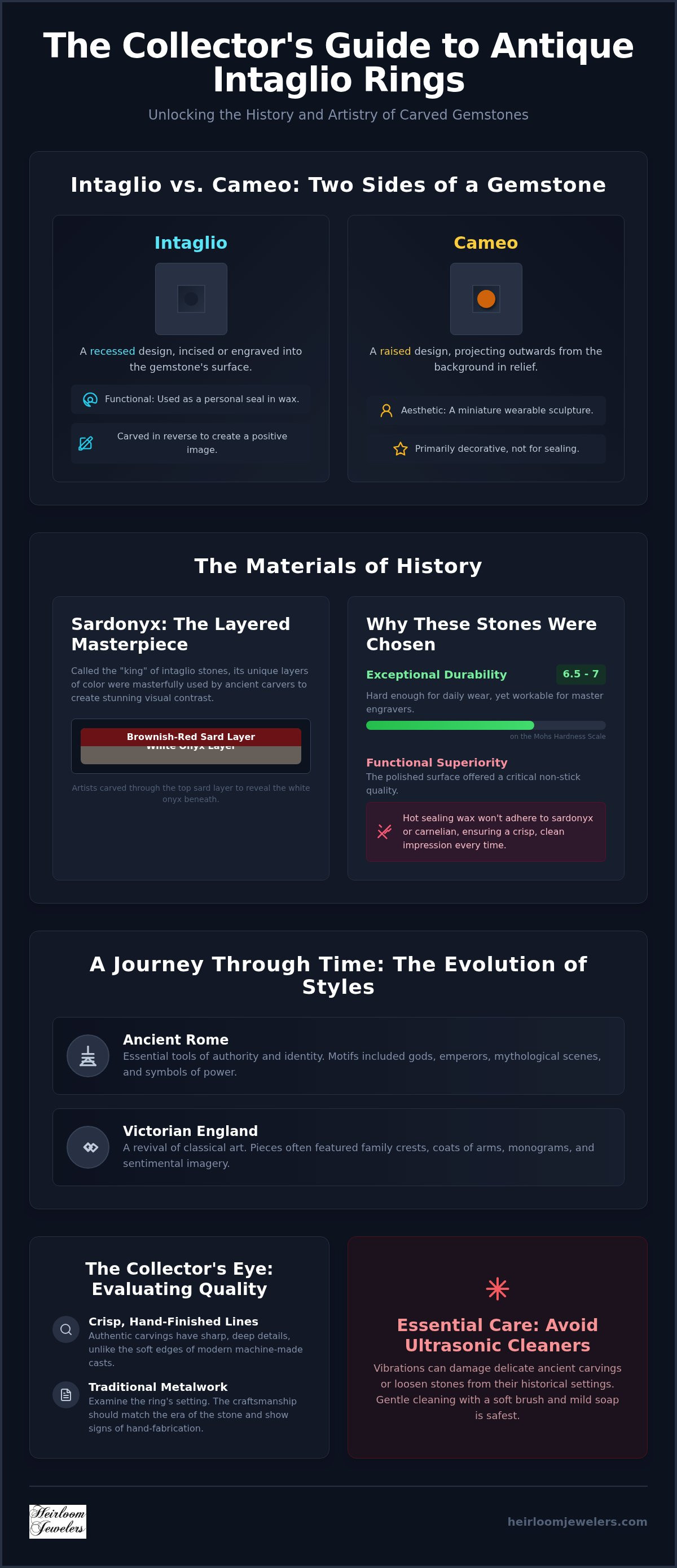
To the uninitiated, the distinction between an intaglio and a cameo can seem subtle, yet it represents two entirely different approaches to the Engraved gem. While a cameo features a design carved in relief, projecting outward from the background, an intaglio is characterized by an image incised directly into the surface of the stone. This creates a recessed, hollowed-out design that sits below the plane of the gemstone. It's a technique that prioritizes depth and shadow over the outward sculptural form of the cameo.
Historically, this technique wasn't merely decorative. Antique intaglio rings served as vital functional tools for centuries. They functioned as personal signatures, used to press a unique mark into hot sealing wax on letters and official documents. This practical origin is why these pieces are frequently categorized as signet rings in the estate jewelry market. A signet ring is essentially any ring that bears a seal, and for the discerning collector, the intaglio represents the most artisanal version of this tradition. It's a piece of history you can wear on your hand.
The Glyptic Arts: A Brief Overview
The study of these pieces falls under the glyptic arts, a term describing the meticulous craft of carving small gemstones. In ancient civilizations, a well-carved seal was a symbol of status and authority. As the need for wax seals declined, the art form evolved into a purely aesthetic pursuit. Unlike faceted diamonds or sapphires that rely on light refraction for brilliance, an intaglio relies on the interplay of light and shadow within its depths. This creates a sense of quiet, architectural beauty. The carving reveals its secrets only upon close inspection, rewarding the wearer with a private view of a miniature masterpiece.
The Mirror Image: How Intaglios Work
One of the most remarkable aspects of antique intaglio rings is the technical precision required to create them. Because they were intended to leave a positive impression in wax, the artist had to carve the original image in reverse. This negative carving meant that every letter of a family motto or every detail of a coat of arms had to be mirrored during the engraving process. It's a staggering feat of miniature engineering. Collectors today often keep a stick of sealing wax nearby to press their rings. The true complexity of the carving is often best appreciated through the positive three-dimensional impression it leaves behind in the wax.
The Materials of History: Why Sardonyx and Carnelian Define the Genre
The enduring appeal of antique intaglio rings isn't merely a matter of aesthetic preference. It's rooted in the physical properties of the gemstones themselves. For centuries, artisans favored a specific group of stones from the chalcedony family, primarily sardonyx and carnelian. These materials weren't chosen just for their beauty. They offered a unique combination of durability and functional utility that was essential for their role as sealing tools.
Sardonyx is often called the "king" of intaglio stones. It's a variety of onyx that features parallel bands of brownish-red sard and white onyx. Beyond its striking appearance, sardonyx is remarkably durable. It ranks between 6.5 and 7 on the Mohs scale of mineral hardness. This makes it tough enough to resist the scratches of daily life while remaining soft enough for a master engraver to carve with precision. This durability is why so many pieces have survived from antiquity in such excellent condition.
There's also a practical reason for the dominance of these stones. Hot beeswax, used for centuries to seal personal correspondence, won't adhere to the surface of polished sardonyx or carnelian. This non-stick quality was vital for creating a clean, crisp impression in wax without damaging the seal or the document. It's a perfect example of how historical jewelry design was often a marriage of artistry and engineering.
Sardonyx: The Layered Masterpiece
The visual depth of sardonyx comes from varying levels of iron oxide within the stone, which create its characteristic rich, earthy hues. Master carvers didn't just carve into the stone; they used its natural architecture to their advantage. By cutting through the dark sard layer to reveal the white onyx beneath, an engraver could create a stunning color contrast within the incised image. In rare and highly prized specimens, these layers form "bullseye" patterns. When centered perfectly in a ring, these patterns add a level of geometric complexity that modern casting simply can't replicate.
Other Essential Stones: Carnelian, Bloodstone, and Amethyst
Carnelian was the favorite material for Intaglios in the Roman World. Its translucent, orange-red glow was easily accessible and highly fashionable. For masculine signets, bloodstone, also known as heliotrope, was frequently the preferred choice. Its dark green body flecked with red spots of jasper provided a somber, authoritative backdrop for family crests and heraldic symbols. While less common, materials like lapis lazuli and amethyst were used for high-status commissions. These vibrant stones are now rare finds in heritage jewelry collections, representing the pinnacle of ancient luxury. If you're drawn to the history of these materials, exploring our collection of authenticated estate pieces is an excellent way to see these artisanal carvings in person.
From Ancient Rome to Victorian England: The Evolution of Intaglio Styles
The aesthetic journey of antique intaglio rings spans millennia, shifting from essential tools of statecraft to romantic tokens of sentiment. In the ancient world, these carvings were deeply personal and often protective. Roman citizens frequently chose deities that aligned with their professions or personal aspirations. A soldier might wear an image of Mars for protection in battle, while a merchant might favor Mercury to ensure success in trade. These early Intaglios in the Roman World were typically set in heavy gold or iron bands, prioritizing the security of the seal above decorative flair.
By the Renaissance, the focus shifted toward a revival of classical Greek and Roman motifs. Artisans began to sign their work, and the intaglio became a medium for showcasing sheer artistic virtuosity. This appreciation for the classical past reached its peak during the 18th and 19th centuries, fueled by the cultural phenomenon known as the Grand Tour. It was during this time that the intaglio transitioned from a functional signet into a sophisticated fashion statement for the European elite.
The Grand Tour and the Neo-Classical Revival
Young aristocrats traveling through Italy often returned with collections of engraved gems as physical proof of their education and status. These souvenirs were frequently mounted into antique rings or kept in specialized cabinets called "Dactyliotheca." Because genuine ancient gems were rare and expensive, James Tassie developed a method for creating glass paste reproductions in the late 1700s. These "Tassie gems" allowed the Victorian middle class to enjoy classical imagery and complex heraldry without the high cost of hand-carved hardstones.
Symbolism in Antique Intaglio Rings
The Victorian era introduced a complex language of symbols that transformed the intaglio into a vessel for hidden meanings. While the Georgian period favored bold heraldic crests carved into sardonyx to preserve family lineage, the Victorians preferred sentimental and allegorical motifs. These pieces often acted as amulets or romantic charms. Common symbols found in these rings include:
- The Anchor: Represented hope and steadfastness in a changing world.
- The Dog: A symbol of unwavering fidelity and loyalty to a partner or friend.
- The Skull: A memento mori, intended to remind the wearer of the fleeting nature of life.
As the 20th century arrived, Art Deco designers brought a more minimalist approach to antique intaglio rings. They moved away from classical mythology in favor of geometric settings and highly stylized monograms. The focus shifted from the narrative of the carving to the architectural balance of the entire ring, often featuring platinum or white gold settings that contrasted sharply with the dark stones.
The Collector’s Eye: Evaluating Quality and Authenticity in Estate Rings
Evaluating antique intaglio rings requires a blend of historical knowledge and technical observation. Start by looking at the carving itself. High-quality work features sharp, crisp lines that maintain their definition even under magnification. A key indicator of artisanal skill is "undercutting," where the carver has skillfully removed material beneath the visible edge to create greater depth and shadow. If the edges appear soft or rounded, it may indicate a molded reproduction or significant surface wear that has dulled the original artistry.
The material also requires scrutiny. To verify natural sardonyx, perform the "Light Test." Hold the ring up to a strong light source. Natural sardonyx will show organic, slightly irregular parallel banding. Modern dyed glass or plastic imitations often appear too uniform or show tiny air bubbles under the surface. This simple check helps distinguish genuine glyptic art from mass-produced replicas. Authentic pieces also show specific wear patterns. Because these rings were used as seals, the highest points of the carving often show a soft, matte patina from centuries of contact with wax and skin.
Magnification and Hallmarks
A 10x jeweler's loupe is an essential tool for any collector. Under magnification, hand-carved pieces reveal tiny, irregular tool marks that signify human craftsmanship. In contrast, modern machine-drilled pieces often look too "perfect" and sterile. It's also vital to examine the hallmarks on the metal. Reputable estate jewelers often find ancient Roman or Renaissance gems that were re-set into 18K yellow gold or heavy Victorian silver bands centuries later. The hallmarks on the shank will date the setting, while the stone may have a much older provenance. This layering of history is common in high-value secondary markets.
Condition Reports: Chips, Scratches, and Crazing
Condition is a major factor in value, but context is key. Small nicks, often called "flea bites," are common on the edges of antique intaglio rings and generally add character without significantly devaluing the piece. However, you should watch for "crazing," which looks like a network of tiny internal cracks. This can happen to older chalcedony stones if they've been exposed to extreme heat or dryness over many decades. Finally, check the integrity of the shank. A thin or brittle band may need reinforcement before it's safe for daily wear. If you're ready to start your own collection, you can browse our authenticated estate jewelry inventory to find a piece that meets these rigorous standards of quality and history.
Preserving Heritage: Caring for and Wearing Antique Intaglio Rings Today
Acquiring one of these pieces means you're now the steward of a story that may stretch back thousands of years. While they were once tools of commerce and statecraft, antique intaglio rings are now celebrated as sophisticated style statements. Many collectors prefer the traditional "pinky ring" placement. This follows the historical custom where signets were worn on the non-dominant hand for easy access when sealing documents. However, their architectural presence makes them equally striking on the ring or middle finger. Because they carry 4,000 years of history, they naturally act as conversation pieces in any setting.
Safe storage is a critical part of preserving antique intaglio rings. While sardonyx and carnelian are durable, they aren't invincible. You should store your intaglios in separate compartments or soft pouches. This prevents harder gemstones, such as diamonds or sapphires, from scratching the polished surface of the chalcedony. A single diamond facet can easily mar the intricate carving of a softer stone. Keeping them isolated ensures the artwork remains as crisp as the day it was engraved.
Cleaning and Maintenance Best Practices
There's one golden rule for maintaining these treasures: never use an ultrasonic cleaner. The high-frequency vibrations can cause internal fractures to expand or loosen stones from their ancient settings. Instead, use a soft-bristled brush and lukewarm, mild soapy water to gently remove dust from the deep recesses of the carving. Avoid chemical dips, especially for art deco jewelry or older gold settings. These harsh liquids can strip away the natural patina that gives antique pieces their depth. If you notice a stone feeling loose, take it to a specialist for prong repair or re-tipping immediately.
Building a Unique Collection
A well-curated collection often benefits from a mix of textures and eras. You might pair a bold sardonyx signet with the delicate sparkle of antique diamond earrings to create a balanced, heritage-focused look. Hand-carved pieces represent an investment in artisanal skill that modern mass production can't replicate. As you add to your collection, remember that you aren't just buying jewelry. You're preserving a specific moment in human history. The enduring mystery of the carved gem lies in its ability to connect the past with the present through a single, elegant object.
Building Your Legacy with Glyptic Art
Choosing a piece of history requires both a discerning eye and an appreciation for the stories carved into stone. You now understand the technical mastery required to create recessed images in reverse, and why materials like sardonyx remain the gold standard for durability and contrast. By recognizing the specific symbolism of the Roman and Victorian eras, you can select a ring that reflects your own values and heritage. Investing in antique intaglio rings is a choice to carry forward a tradition of personal identity and artistry that has survived for millennia.
At Heirloom Jewelers, we act as specialists in authenticated vintage and antique rings. Our curated collection features rare sardonyx and carnelian intaglios, each selected for its historical significance and artisanal quality. We take pride in our expertise in historical craftsmanship, ensuring that every piece in our inventory is a genuine artifact of the past. We invite you to Explore Our Curated Collection of Authenticated Estate Jewelry and find a treasure that speaks to you. Your journey into the world of heritage jewelry is just beginning, and we're honored to serve as your guide.
Frequently Asked Questions
Are antique intaglio rings suitable for everyday wear?
Yes, antique intaglio rings are suitable for daily wear provided you treat them with the respect their age deserves. Most are carved from sardonyx or carnelian, which are hardstones ranking 6.5 to 7 on the Mohs scale. This makes them resistant to scratches, though you should remove them before heavy physical labor. Their durability is why so many have survived from the Roman and Victorian eras in excellent condition.
What is the difference between sardonyx and carnelian intaglios?
The distinction lies in the internal structure of the chalcedony. Sardonyx is a layered stone featuring parallel bands of brownish-red sard and white onyx, which master carvers use to create color-contrasting images. Carnelian is a solid, translucent variety that glows with a warm orange-red hue. While both were popular in the ancient world, sardonyx was often preferred for complex heraldry because its layers added visual depth to the carving.
How can I tell if an intaglio ring is authentic or a reproduction?
Identifying a genuine piece requires looking for signs of human craftsmanship. Under magnification, a hand-carved antique intaglio ring will show slight irregularities and tool marks that machine-drilled reproductions lack. You should also examine the surface for a soft patina. Authentic pieces that were used as functional seals often show minor wear on the high points of the carving, a result of pressing into hot wax over many decades.
Why were intaglios carved in reverse?
These stones were carved in reverse, or negative, to serve as functional signatures. When the ring was pressed into hot sealing wax, the resulting impression would be a positive, three-dimensional image. This allowed the recipient to see the portrait or crest in its intended orientation. The technical skill required to engrave detailed heraldry or portraits in miniature while mirroring the entire design remains a hallmark of the glyptic arts.
What do the different symbols on intaglio rings mean?
Motifs on these rings acted as a visual language for the wearer. Ancient Roman pieces often featured deities like Mars for military status or Minerva for wisdom. During the Victorian era, the symbolism became more sentimental. An anchor represented steadfast hope, a dog symbolized fidelity, and a skull served as a memento mori. These carvings allowed the owner to broadcast their identity, beliefs, or romantic commitments without speaking a word.
Is sardonyx a real gemstone?
Yes, sardonyx is a real, natural variety of chalcedony. It's characterized by distinct, parallel bands of red-brown sard and white or black onyx. These layers are formed organically over millions of years through the deposition of silica. Because of its hardness and striking color contrast, it has been the premier choice for master engravers since the time of the Pharaohs. It's a genuine gemstone valued for its beauty and historical utility.
Can I use an antique intaglio ring to seal letters today?
You can absolutely use your ring for its original purpose today. Modern sealing wax is safe for most hardstones like sardonyx and carnelian. Pressing your ring into wax is a wonderful way to appreciate the full detail of the carving that might be hard to see on the stone itself. Just ensure you clean the recesses of the carving afterward using a soft brush and mild soap to prevent wax buildup in the design.
Are intaglio rings only for men?
These rings are entirely unisex and have been worn by both men and women throughout history. While they are often associated with masculine signets, Victorian women frequently wore smaller intaglios as romantic amulets or pinky rings. The appeal of an intaglio lies in its history and artistry rather than a specific gendered style. Today, they remain a sophisticated choice for anyone who appreciates unique, hand-carved heritage jewelry and classical design.