
What if the most significant value of a diamond isn't its carat weight, but the era of the hand that cut it? Many collectors feel a natural hesitation when they first explore the secondary market. You seek a piece with a soul and a history, yet the fear of purchasing a high-priced imitation often holds you back. It's common to feel overwhelmed by the subtle differences between a genuine Art Deco hallmark and a modern reproduction. We believe acquiring authenticated estate jewelry should be a rewarding journey. Building a collection requires more than just an eye for beauty; it requires trust in a rigorous verification process.
This guide ensures you can acquire heritage pieces with quiet confidence. You'll learn the essential standards for verifying fine jewelry and discover how to build a collection rooted in authentic craftsmanship. We'll examine the technical details of era-specific gemstone cuts, clarify the strict definitions of antique and vintage labels, and walk through the meticulous steps of professional provenance research. By the end, you'll have the knowledge to select unique pieces that serve as a bridge between the past and your personal legacy.
Key Takeaways
- Understand the technical distinctions between antique, vintage, and estate classifications to navigate the secondary market with precision.
- Learn the rigorous standards for identifying authenticated estate jewelry through metallurgical testing and gemological analysis of historic gemstone cuts.
- Discover the defining aesthetic markers of the Victorian and Edwardian eras, from romantic symbolic motifs to the refined elegance of early platinum styles.
- Master a professional framework for evaluating rarity and condition, distinguishing between desirable historical patina and structural damage.
- Gain insight into a curation process that prioritizes unique heritage pieces and material integrity over mass-produced modern jewelry.
Defining Authenticated Estate Jewelry
The term authenticated estate jewelry describes jewelry previously owned that has undergone professional verification of its era, materials, and maker. It represents more than just a pre-owned acquisition. True authentication serves as the foundation of the secondary fine jewelry market, providing the certainty required to invest in high-value heritage pieces. Without a rigorous verification process, the distinction between a genuine historical artifact and a modern reproduction remains dangerously thin. Professional curators look beyond the surface to confirm that every hallmark, gemstone cut, and metal alloy aligns with the stated history of the piece.
Estate vs. Vintage: Understanding the Timeline
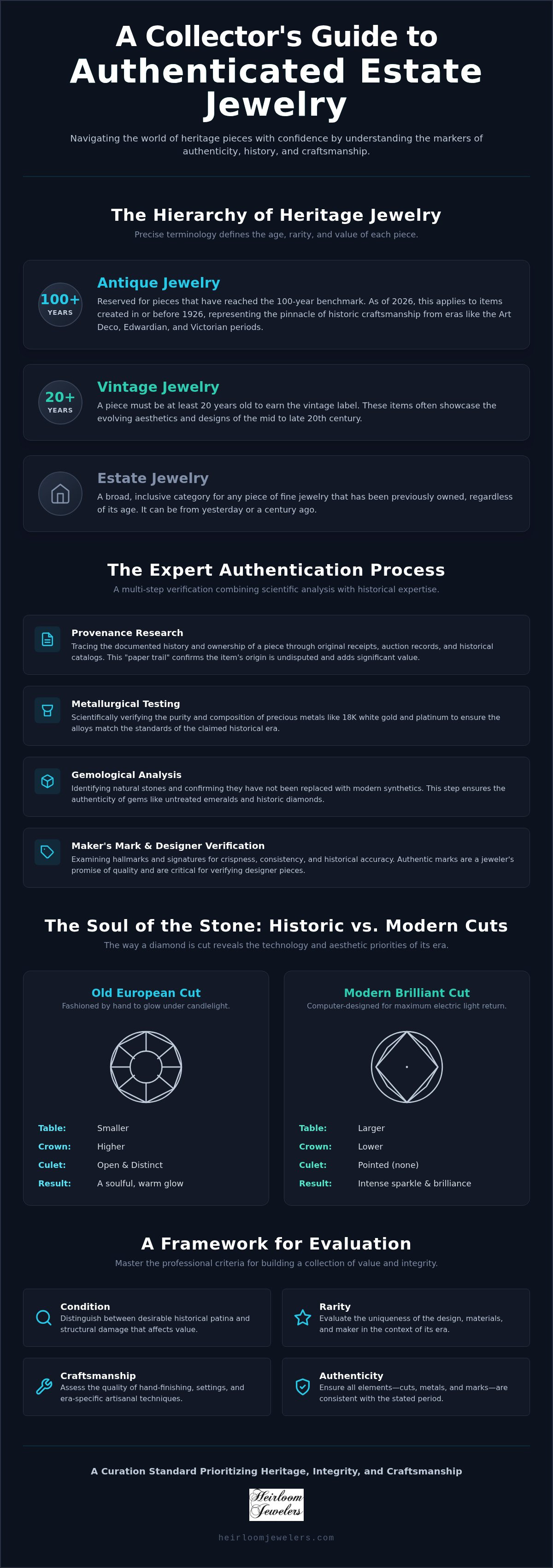
Terminology in the jewelry industry is precise. While many use these labels interchangeably, they denote specific age brackets that impact both value and rarity. Understanding these distinctions allows you to categorize a collection with the expertise of a specialist.
- Estate Jewelry: This is a broad, inclusive category. Any piece of fine jewelry that has been previously owned is technically "estate," regardless of whether it was made yesterday or a century ago.
- Vintage Jewelry: To earn the vintage label, a piece must be at least 20 years old. In 2026, this classification applies to jewelry crafted between 1926 and 2006. These pieces often showcase the evolving aesthetics of the mid-century and late 20th century.
- Antique Jewelry: This status is reserved for items that have reached the 100-year benchmark. As of 2026, an antique piece must have been created in or before 1926, capturing the artistry of the early Art Deco, Edwardian, or Victorian eras.
The Importance of Provenance
Provenance is the documented history of a piece's ownership. It functions as a historical narrative that connects the jewelry to its past. For a serious collector, provenance provides a "paper trail" of value that is often as significant as the gemstones themselves. Documentation might include original sales receipts, previous auction records, or inclusion in historical catalogs. This chain of custody ensures that the item’s origin is undisputed. When you examine antique rings or rare necklaces, provenance confirms the piece isn't just a beautiful object, but a verified fragment of history. Establishing this narrative is a critical step in the authenticated estate jewelry process, as it protects the integrity of the secondary market and the long-term value of your acquisition.
The Expert Authentication Process: Beyond the Surface
Authentication requires a blend of scientific analysis and historical expertise. We start with metallurgical testing to verify the purity of 18K white gold and platinum. This ensures the metal matches the standards of the era. Gemological analysis follows to identify natural stones, such as untreated emeralds, and to confirm they haven't been replaced with modern synthetics. For those beginning their journey, the GIA provides helpful Tips for Purchasing Estate Jewelry, emphasizing the importance of checking for previous repairs. These technical steps are the only way to guarantee you are investing in genuine authenticated estate jewelry.
Identifying Historic Diamond Cuts
The Old European cut represents a pinnacle of hand-crafted artistry. Unlike modern brilliant cuts designed by computers, these diamonds were fashioned to glow under candlelight. They feature a smaller table, a higher crown, and a distinctive open culet at the base. This unique geometry cannot be easily replicated by modern machinery without losing the authentic proportions of the era. Collectors often seek out authenticated estate jewelry specifically for these soulful, hand-finished stones. Understanding these nuances is essential when selecting antique diamond earrings for a private collection.
Designer Verification: The Case of Lugano
Verifying designer pieces, such as a Lugano Emerald & Diamond Necklace, requires identifying specific markers of high-end craftsmanship. We examine the 18K white gold settings for consistency in weight and finishing. Authentic designer signatures and hallmarks are more than just stamps; they are the jeweler's promise of quality. We look for several key indicators during this phase:
- Crisp, well-defined maker's marks consistent with the brand's historical dies.
- Precision in stone setting that mass-produced imitations fail to achieve.
- Natural wear patterns on the metal that align with the piece's purported age.
Evaluating wear is equally vital to the process. A century-old piece should show subtle softening of its edges and microscopic signs of use. If a piece looks too pristine for its age, it warrants closer inspection for potential modern reproduction. This methodical approach ensures every item in our collection meets the highest standards of integrity. You can explore our current selection of curated estate pieces to see these standards in practice.
Iconic Eras and Their Aesthetic Markers
Identifying the specific era of a piece is central to the curation of authenticated estate jewelry. Each period reflects the distinct social and technological shifts of its time, leaving behind physical markers that experts use to verify age. The Victorian Era (1837–1901) was defined by Romanticism and the frequent use of yellow gold. Jewelers of this time often incorporated symbolic motifs like snakes, which represented eternal love, or acrostic gemstone arrangements. Later, the Retro and Mid-Century periods saw a return to bold floral motifs and a preference for 14K and 18K yellow gold, moving away from the icy white metals of the early 20th century.
Art Deco Geometry and Platinum
The Art Deco period (1915–1935) introduced a radical shift toward geometric precision and architectural influence. This era marked the rise of the platinum diamond engagement ring, as the Jazz Age embraced the durability and cool luster of this metal. Designers favored symmetry and bold gemstone pairings, often contrasting diamonds with vibrant onyx, rubies, or sapphires. This aesthetic was a direct response to the machine age, emphasizing clean lines over organic curves. For a deeper look at these specific styles, you can explore our art deco jewelry guide. Authentication of these pieces focuses on the crispness of the geometry and the caliber of the stone settings.
Victorian and Edwardian Artisanship
The transition between the Victorian and Edwardian periods is one of the most fascinating areas for collectors. Early Victorian pieces often utilized mixed metals, specifically silver over gold. This technique allowed stones to be set in silver to enhance their color, while the gold backing protected the wearer's skin and clothing from tarnish. As we moved into the Edwardian Period (1901–1915), the introduction of the oxyacetylene torch allowed jewelers to work with platinum more effectively. This led to the "garland" style, characterized by lace-like metalwork and fine milgraining.
- Victorian: Characterized by heavy yellow gold and silver-topped settings.
- Edwardian: Defined by ethereal, airy designs and the mastery of platinum filigree.
- Art Deco: Known for its high-contrast gemstone combinations and stepped, linear forms.
Professional authentication reveals these subtle shifts in fabrication. By examining the metal fusion and the delicacy of the milgrain, we can confirm if a piece is a true Edwardian artifact or a later reproduction. This level of detail ensures that your authenticated estate jewelry collection is built on a foundation of historical accuracy and artisanal integrity.
Building a Collection: A Framework for Evaluation
Building a collection requires a methodical approach to evaluation that balances aesthetic appeal with structural integrity. Condition is the most critical factor in determining long-term value. In the world of authenticated estate jewelry, we distinguish between a desirable patina and structural damage. A soft, microscopic wear on the metal surface is often preferred. It confirms the piece's history and age. However, thinned ring shanks, chipped gemstone facets, or compromised prongs represent damage that can decrease a piece's worth. High-quality curation ensures that these structural issues are identified before a piece enters your collection.
Rarity is driven by the scarcity of specific gemstone and metal combinations. Curated vintage pieces often outperform mass-produced modern jewelry as long-term assets. While modern retail items carry high markups for branding and manufacturing, estate pieces derive value from their intrinsic materials and historical significance. As the market sees a strategic bifurcation between natural and lab-grown stones, high-clarity natural diamonds and verified colored gemstones are increasingly viewed as finite assets. Authentication serves as the bridge that protects this investment, ensuring the piece's provenance remains undisputed over time.
The Rarity of Natural Gemstones
Natural, untreated gemstones command significant premiums in the secondary market. Collectors prioritize stones with verified geographic origins and minimal treatment, as these factors directly impact rarity. The allure of untreated emeralds and sapphires lies in their unique inclusions and rich, natural saturation. For instance, a Lugano Emerald & Diamond Necklace 18K White Gold represents a pinnacle of this category. It combines high-grade natural emeralds with the timeless durability of designer-crafted 18K white gold. These pieces are sought after because they cannot be mass-produced; their value is tied to the limited availability of high-quality natural earth-mined stones.
Documentation and Certification
Independent gemological reports from organizations like the GIA or AGL are essential for high-value acquisitions. These documents provide an objective analysis of stone quality, weight, and treatment status. While these reports are vital, a jeweler’s internal authentication is the first line of defense. A professional appraisal should adhere to the Uniform Standards of Professional Appraisal Practice (USPAP) to be legally defensible for insurance or estate purposes. When reviewing documentation, look for a clear "paper trail" that includes:
- Detailed descriptions of the mounting and metal purity.
- Specific gemstone grading including color, clarity, and cut.
- Verification of any maker's marks or historical hallmarks.
- A statement of the appraisal’s purpose, such as Fair Market Value or Retail Replacement Value.
Investing in pieces with this level of transparency ensures your collection remains a source of pride and security. To start your own journey with confidence, you may view our curated collection of authenticated heritage pieces.
The Heirloom Jewelers Standard of Curation
At Heirloom Jewelers, curation is a commitment to historical integrity. We intentionally exclude mass-produced modern items. Our focus remains on pieces with a unique story and verified origin. This philosophy ensures that every acquisition from our collection is a genuine artifact rather than a commercial commodity. When you invest in authenticated estate jewelry through our house, you're securing a piece of history that's been vetted by specialists who value craftsmanship over volume. Our role isn't just to sell, but to preserve the narrative of every item we represent.
Our selection process for vintage white gold and platinum pieces is methodical. We examine each setting for structural stability and the quality of the alloy. Platinum is particularly prized for its enduring nature and ability to hold fine detail. We prioritize these metals because they serve as the perfect vessel for heritage gemstones. This rigorous standard provides a steady, professional environment where collectors can browse without the urgency of modern retail. Our expertise functions as a bridge; it connects the artisanal mastery of the past with the sophisticated tastes of the modern era.
A Focus on Rare Artisanal Finds
We maintain a specific interest in items that showcase hand-finished artistry. This is evident in our collection of Old European cut diamond stud earrings. These diamonds possess a warmth and character that modern, laser-cut stones lack. Similarly, our curation of 18K white gold and platinum engagement rings focuses on the intricate milgraining and filigree that defined earlier centuries. If you're beginning your search for a symbolic piece, our guide to vintage engagement rings provides the historical context necessary to make an informed choice. These items are rare finds. They represent a strategic flight to quality in a market increasingly saturated with mass-produced alternatives.
Your Trusted Guide in the Estate Market
Our brand is built on a foundation of quiet confidence and timeless elegance. We understand that high-value secondary markets can feel complex. We act as a reliable guide for those navigating these intricacies. Whether you're a seasoned collector or a first-time buyer, our experts are available to provide technical insights and provenance research. Building a legacy through authenticated estate jewelry is a deliberate process. It requires a partner who prioritizes long-term relationships and the preservation of heritage. We invite you to explore a more respectful way to acquire fine jewelry, where the subject matter always takes center stage.
Securing Your Legacy with Authenticated Fine Jewelry
Authentication transforms a simple purchase into a meaningful investment. By understanding the technical markers of specific eras and the importance of provenance, you move from a casual buyer to a discerning collector. You now have the framework to evaluate condition and rarity with the eye of a specialist. This knowledge ensures that your collection is built on a foundation of integrity and historical significance. It's about more than just aesthetics; it's about preserving a tangible link to the past.
We focus on rare finds such as Lugano emerald necklaces and Old European cut diamonds. Our collection features meticulously vetted vintage settings crafted from 18K white gold and platinum. We prioritize the preservation of craftsmanship, acting as a bridge between the artistry of the past and your modern style. It's our goal to provide a steady, professional environment for your acquisition of authenticated estate jewelry. Every piece we offer represents our commitment to timeless elegance and material quality.
Explore our curated collection of authenticated estate jewelry
It's a privilege to assist you in selecting a heritage piece that will endure for generations to come.
Frequently Asked Questions
What makes estate jewelry "authenticated"?
Estate jewelry is considered "authenticated" when it has undergone a professional verification process to confirm its era, materials, and maker. This includes metallurgical testing to verify the purity of 18K white gold or platinum and gemological analysis to identify natural gemstones. Authentication ensures the piece isn't a modern reproduction. It provides the certainty required to invest in high-value heritage pieces while establishing a documented historical narrative for the collector.
Is authenticated estate jewelry a good investment?
Authenticated estate jewelry often serves as a resilient asset because it derives value from intrinsic materials and historical rarity. Unlike mass-produced modern jewelry, which carries significant retail markups, estate pieces are valued for their craftsmanship and the finite nature of natural gemstones. As natural, high-quality diamonds and untreated colored gemstones become increasingly scarce, verified heritage pieces continue to be sought after by collectors who prioritize quality over fashion trends.
How do you verify the age of a vintage platinum ring?
Verifying the age of a vintage platinum ring requires examining hallmarks, construction techniques, and specific wear patterns. Platinum became more prevalent after 1901 with the introduction of the oxyacetylene torch, allowing for the intricate filigree seen in Edwardian designs. Experts look for microscopic softening of edges and signs of use consistent with the piece's purported timeline. We also analyze the gemstone cuts, such as Old European or transitional cuts, to confirm they align with the era.
What is the difference between an appraisal and authentication?
An appraisal determines the monetary value of a piece for insurance or estate purposes, while authentication confirms the piece is genuine and historically accurate. Authentication is the foundation of the process, verifying that the materials, maker's marks, and era are legitimate. An appraisal follows this step, assigning a dollar amount based on current market conditions. Both are essential, but authentication provides the historical certainty that justifies the item's valuation in the secondary market.
Can I find modern designer pieces in an estate collection?
Yes, estate collections often include modern designer pieces that have been previously owned. The "estate" category is inclusive of any fine jewelry with a prior owner, regardless of its age. You can find exceptional contemporary items, such as a Lugano Emerald & Diamond Necklace in 18K white gold, alongside much older artifacts. These pieces are valued for their exceptional designer craftsmanship and the quality of their natural gemstones, offering a unique alternative to current retail offerings.
Why are Old European cut diamonds highly sought after?
Old European cut diamonds are prized for their hand-crafted artistry and unique light performance. Unlike modern computer-cut diamonds, these stones were fashioned to glow under candlelight, featuring a higher crown and a smaller table. Each stone is unique, reflecting the individual skill of the diamond cutter from a bygone era. Collectors seek them for their soulful character and historical significance, making them a centerpiece of many authenticated estate jewelry collections.
How should I care for authenticated 18K white gold jewelry?
Caring for authenticated 18K white gold jewelry requires gentle maintenance to preserve its luster and structural integrity. You should clean your pieces using a solution of mild dish soap and warm water, followed by a light scrubbing with a soft-bristled brush. It's important to have a professional jeweler inspect the prongs and settings once a year to prevent stone loss. Avoid exposing these heritage items to harsh chemicals or abrasive surfaces that could damage the metal or gemstones.
Does authenticated jewelry always come with original paperwork?
Authenticated jewelry doesn't always include original sales receipts or historical documents, as these are often lost over decades. In these cases, professional curators establish provenance through meticulous research of hallmarks, maker's marks, and era-specific design elements. We supplement this with modern gemological reports from independent organizations like the GIA. This technical documentation serves as a reliable modern record, ensuring the piece's identity and quality are verified for future generations of collectors.