
A collector discovers a platinum ring featuring the soft, romantic glow of an Old European cut diamond. While the piece looks antique, the lack of a clear hallmark creates immediate doubt. Is this a genuine 1920s treasure or a modern "vintage-style" reproduction? This uncertainty is common when building a collection. You want to invest in history, not a clever imitation, and you certainly don't want to risk damaging a fragile find while caring for estate jewelry at home.
We understand that true value lies in the details of craftsmanship and the integrity of the secondary market. This guide provides professional techniques to help you identify era-specific markers with confidence. You'll learn how to interpret worn stamps and recognize the subtle signs of hand-tooling that modern machines cannot replicate. We'll also establish a clear maintenance routine to keep your 18K white gold and platinum settings in pristine condition.
By the end of this article, you'll know exactly what to look for when evaluating a potential purchase. We'll cover everything from 2026 insurance appraisal requirements to the specific moments when a piece requires professional restoration rather than a simple cleaning. You'll gain the expertise needed to act as a knowledgeable steward for these timeless treasures.
Key Takeaways
- Establish a clear timeline for your collection by learning the 2026 standard for antique classification, which includes any piece crafted before 1926.
- Gain confidence in identifying authentic 18K white gold and platinum hallmarks by using a jeweler's loupe to inspect shanks and clasps.
- Learn to recognize the distinct geometry of Old European cut diamonds, focusing on the flat culet and high crown that define these historical stones.
- Master the specialized art of caring for estate jewelry to preserve delicate hand-applied milgrain and protect sensitive gemstones from improper cleaning.
- Understand the importance of professional curation and GIA certification as the ultimate safeguards when navigating the high-value secondary market.
Defining Authenticity: Vintage vs. Antique vs. Estate
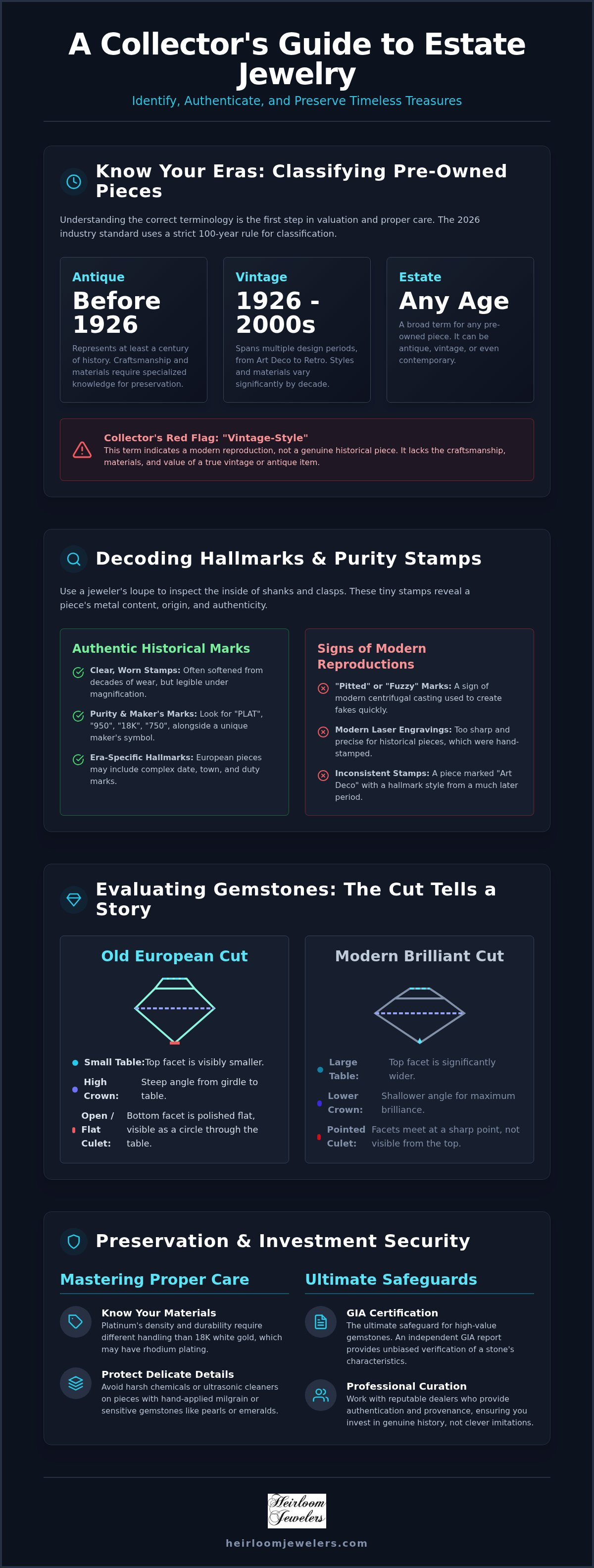
Understanding the distinction between antique, vintage, and estate jewelry is essential for any serious collector. As of 2026, the industry follows a strict 100-year rule for classification. Identifying the specific era of a piece is the first step in properly caring for estate jewelry. The materials and construction methods vary significantly across decades, requiring different approaches to preservation and cleaning. A mistake in identifying the age of a piece can lead to using cleaning agents that are too harsh for historical alloys.
- Antique: Items crafted in 1926 or earlier, representing at least a century of history.
- Vintage: Pieces spanning from the mid-1920s through the early 2000s.
- Estate: A broad category referring to any pre-owned jewelry, regardless of its historical age.
The Significance of Era-Specific Standards
The early 20th century marked a transition from yellow gold to the dominance of platinum, particularly during the Art Deco movement. These material shifts dictate how a piece should be maintained over time. A 1920s platinum setting requires a different structural evaluation than a 1980s retro item, which might feature heavier gold and more robust prongs. Many collectors focus on heritage rings because these pieces often retain their value through superior historical craftsmanship. Understanding these standards allows you to anticipate potential wear points before they lead to stone loss or metal fatigue. Proper evaluation ensures the setting remains secure for decades to come.
Common Misconceptions in Terminology
Terminology in the secondary market can be misleading for the unwary buyer. "Vintage-style" is a significant red flag; it indicates a modern reproduction designed to look old rather than an authentic historical piece. True restoration involves using era-appropriate techniques to repair an item, whereas a reproduction is a mass-produced copy that lacks historical soul. Understanding hallmarks is critical for verifying these claims. Authentic pieces will have stamps consistent with their purported age and origin. If a piece is described as "Art Deco" but features modern laser engravings or lacks appropriate patina, it's likely a counterfeit. Mastering these linguistic cues helps you avoid overpaying for modern imitations. It also ensures you are correctly caring for estate jewelry that possesses genuine historical value and requires specific, gentle handling.
Decoding Hallmarks and Metal Purity Stamps
A jeweler's loupe is the most essential tool for any collector. You must inspect the interior of ring shanks, the tiny surfaces of lobster clasps, and the curves of jump rings. These small stamps provide the first line of defense when caring for estate jewelry. They tell you the metal's purity and, often, its origin. Identifying these marks requires patience; they are frequently worn down by decades of contact with the skin.
Gold standards have shifted significantly over the last century. While 18K white gold is common in high-end 20th-century pieces, you'll also find 10K and 14K variants. White gold gained popularity as a platinum substitute during the World Wars when platinum was diverted for military use. Platinum itself is usually identified by "PLAT" or "950" stamps, common in Art Deco rings. These marks don't just indicate value; they dictate how you handle the item. Platinum is denser and more durable than gold, yet its unique patina requires specific maintenance to preserve its luster.
Reading the Language of Hallmarks
European hallmarking systems are often more complex than American purity stamps. They include town marks and date letters that pinpoint exactly when and where a piece was made. In contrast, American pieces typically feature a simple purity stamp and a maker's mark. If you see "pitted" or "fuzzy" marks under your loupe, be cautious. These are signs of centrifugal casting, a modern technique used to create fakes. It's also vital to realize that many authentic 19th-century antique rings lack marks entirely. In these cases, we rely on acid testing and style analysis for authentication rather than stamps alone.
Maker’s Marks and Designer Signatures
Signatures from prestigious houses add significant value and security to your collection. Authenticating a signature, such as those found on a Lugano Emerald & Diamond Necklace, requires looking at the font and placement. These signatures evolve over decades. A mark from the early 20th century will look different than one from the 1970s. Identifying these shifts helps confirm the piece's age and provenance. If you're unsure about an obscure historic mark, consult professional registries or curated collections. Reviewing an authenticated inventory is an excellent way to familiarize yourself with how these signatures should appear on genuine heritage pieces.
Evaluating Gemstones: Old European Cuts vs. Modern Fakes
Authentic gemstones are the heart of any heritage piece. Distinguishing between a hand-cut historical diamond and a modern machine-cut imitation requires a trained eye. Modern reproductions often attempt to mimic the silhouette of the past but fail to replicate the specific light performance of era-authentic stones. Understanding these differences is a prerequisite for anyone committed to caring for estate jewelry properly.
Historic Diamond Cuts: A Visual Guide
The Old European cut is defined by its distinct geometry. Unlike modern round brilliant diamonds, these stones feature a high crown, a remarkably small table, and large, blocky facets. While the earlier Old Mine cut has a squarish "cushion" shape, the Old European cut is circular. One of the most recognizable traits is the culet. This is the flat bottom facet that appears as a small circle when viewed through the top of the stone. Modern fakes typically come to a sharp point at the bottom.
Vintage diamonds often possess a warmer color grade, typically in the K through M range. This warmth contributes to the "inner glow" that characterizes antique diamond earrings. While modern cuts produce a "disco ball" effect with many tiny pinpoints of light, Old European cuts offer broad, dramatic flashes of fire. This slower light movement is a hallmark of hand-craftsmanship that machines can't easily replicate.
Authenticating Colored Gemstones
Natural colored gemstones in estate pieces often show signs of their history. Look for "facet abrasion," which are tiny nicks where facets meet, on softer stones like emeralds or sapphires. This natural wear is rare in modern synthetic reproductions. Collectors should also be aware of "flame fusion" stones. These early synthetics were common in the early 20th century and are technically authentic to the era, though they lack the value of natural earth-mined gems.
Recognizing era-appropriate gemstone pairings, such as peridot combined with quartz, provides further clues to a piece's origin. The setting itself often speaks to the stone's quality. For instance, the intricate 18K white gold work on a Lugano Emerald & Diamond Necklace 18K White Gold is designed to complement the specific saturation of high-value emeralds. Expertly caring for estate jewelry involves recognizing these delicate pairings and using specialized cleaning methods that won't compromise the unique chemistry of older stones.
Caring for Estate Jewelry and Inspecting Craftsmanship
Authentication and preservation are two sides of the same coin. When you evaluate the physical construction of a piece, you aren't just looking for beauty; you're looking for the structural integrity that justifies its history. A primary method for vetting a piece is the weight test. Platinum and 18K gold possess a density that base metal counterfeits cannot replicate. A platinum ring will feel surprisingly heavy for its size, whereas a modern imitation often feels light or "tinny" in the palm of your hand.
Examine the mechanical elements like hinges, clasps, and prongs. Authentic heritage items show signs of "honest wear," which is a soft, natural rounding of edges from decades of use. Modern fakes often have perfectly sharp, industrial edges or, conversely, blurry details from poor casting. Hand-fabricated hinges move with a deliberate, smooth resistance that mass-produced components lack. Inspecting these details is a vital part of your maintenance routine, as it helps you identify which components might need reinforcement before they fail.
The Art of Filigree and Milgrain
Authentic milgrain, the tiny beaded borders found on fine jewelry, is applied by hand using a specialized wheel. This results in crisp, individual beads. In contrast, modern cast reproductions often show "bubbles" or seams where the mold failed to capture the fine detail. Filigree should consist of delicate, individual wires soldered together, not a single piece of cast metal. These intricate details are what give vintage engagement rings their unique character and value. If the metalwork looks soft or melted under a loupe, it's likely a modern copy.
Safe Cleaning and Maintenance Routines
Mastering the art of caring for estate jewelry requires a "less is more" approach. You should avoid ultrasonic cleaners for many stones, especially emeralds, as the vibrations can shatter stones with internal inclusions or strip away traditional oil treatments. Instead, use lukewarm water, a drop of mild dish soap, and a very soft toothbrush. This gentle method is safe for most metals and stones, including delicate organic gems like pearls or cameos that are easily damaged by chemicals.
The most critical maintenance step is a professional prong inspection. Over time, the metal holding your gemstones in place can thin or pull away. Having a specialist tighten these settings every six months prevents the heartbreak of a lost stone. If you have recently acquired a historical piece, we recommend a professional condition assessment to ensure its longevity. This steady, methodical approach to maintenance ensures your collection remains a source of pride for future generations.
Securing Your Investment with Authenticated Heritage Pieces
Professional curation serves as the ultimate safeguard for collectors. While individual technical checks are valuable, they can't replace the comprehensive oversight of a specialist. Authenticating high-value items requires a holistic approach that considers metallurgy, gemstone optics, and historical context simultaneously. This level of scrutiny ensures your investment remains secure and that you're correctly caring for estate jewelry from the moment it enters your collection.
Third-party lab reports are vital for estate diamonds. Reports from the Gemological Institute of America (GIA) or EGL provide an objective baseline for quality and origin. In the 2026 market, these documents are essential for insurance purposes and future resale value. A specialist in the retail sale of estate and vintage fine jewelry will always prioritize pieces with verifiable certification, particularly for rare Old European cut diamonds and significant designer items like a Lugano Emerald & Diamond Necklace.
The Importance of Provenance
Provenance adds an intangible layer of value to a piece. Original boxes and paperwork can significantly increase the desirability of a find, but they must be scrutinized carefully. Modern counterfeiters often pair fake jewelry with authentic-looking vintage packaging to deceive buyers. Tracing a documented trail of ownership protects the long-term value of your collection. It also confirms the piece was ethically acquired. A clear history allows for a more focused approach to maintenance, as you know the conditions under which the piece was previously kept.
Trusting the Curator’s Eye
Building a relationship with a trusted curator provides lasting peace of mind. Heirloom Jewelers focuses on a highly curated inventory of authenticated 18K white gold and platinum treasures. This specialized focus eliminates the uncertainty often found in general secondary markets. Expert curation simplifies the ongoing process of caring for estate jewelry across generations. When a specialist has already vetted the structural integrity and stone security of a piece, you can focus on the enjoyment of ownership. Use this final checklist before your next acquisition:
- Does the piece include a third-party lab report or professional authentication?
- Are the metal hallmarks and maker's marks consistent with the purported era?
- Is there a documented ownership history or ethical provenance?
- Has a specialist recently inspected the prongs, hinges, and clasps for integrity?
- Does the seller specialize specifically in the high-value secondary market?
These questions serve as a final filter for quality. Investing in heritage jewelry is about more than aesthetics; it's about preserving a tangible piece of history. By prioritizing authenticated pieces, you ensure your collection remains both a personal joy and a stable financial asset for decades to come.
Investing in the Legacy of Fine Craftsmanship
Authenticity is found in the deliberate imperfections of hand-craftsmanship. By mastering the geometry of Old European cut diamonds and the nuances of historical hallmarks, you protect your collection from modern imitations. These technical details are the foundation of a sophisticated collection. Beyond identification, a consistent routine for caring for estate jewelry ensures that delicate 18K white gold and platinum settings remain secure for the next century.
A documented provenance and a professional curator's eye are your best tools in the high-value secondary market. We serve as a national authority on heritage and Art Deco styles, offering the peace of mind that only comes with expert authentication. Whether you're seeking rare Old European cut diamonds or verified designer signatures, your journey should be guided by expertise and integrity. We invite you to explore our curated collection of authenticated vintage treasures at Heirloom Jewelers. Your next heritage piece is waiting to be discovered, and we're honored to act as your trusted guide through the complexities of history.
Frequently Asked Questions
Is all jewelry with a 925 stamp actually vintage?
A 925 stamp simply indicates that the metal is 92.5% pure silver. It doesn't guarantee that a piece is vintage. Modern manufacturers use this mark on millions of mass-produced items today. To verify a vintage origin, you must look for era-specific construction techniques and signs of natural wear. Identifying a genuine historical piece requires looking beyond a single stamp to the overall craftsmanship and the context of the design.
How can I tell if a diamond is an Old European cut at home?
You can identify an Old European cut by looking for a small circular facet at the bottom of the stone, known as a culet. When viewed through the top with a jeweler's loupe, this facet appears as a tiny hole or circle. These diamonds also feature a notably high crown and a small table. These geometric traits create broad flashes of light rather than the smaller pinpoints seen in modern brilliant cuts.
Do all authentic vintage rings have hallmarks?
Not all authentic vintage rings bear hallmarks. While stamps are helpful, many older pieces were never marked, or the marks were lost during previous resizing. In the 19th and early 20th centuries, hallmarking regulations varied significantly by region. Authentication in these cases depends on a holistic evaluation of the metal's weight, the stone's cut, and the presence of hand-tooling marks that are consistent with the piece's purported era.
What is the magnet test and is it reliable for fine jewelry?
The magnet test is a simple way to detect base metals like iron or nickel, which are magnetic. Precious metals like 18K gold and platinum are non-magnetic. If your jewelry sticks to a strong magnet, it's likely a plated base metal. However, this test isn't definitive. Many modern counterfeits use non-magnetic alloys like brass or copper. It should only be used as an initial screening tool rather than a final verification.
Why does my vintage gold ring have a green or dark patina?
Discoloration often occurs when the alloys mixed with gold react to environmental factors. Lower-karat gold contains higher percentages of copper or silver, which can oxidize and create a dark or green patina. This is a common concern when caring for estate jewelry that hasn't been stored in a climate-controlled environment. While 18K white gold is more resistant, any vintage piece can show these signs. Professional cleaning safely restores the metal's original luster.
How do I clean estate jewelry without damaging the setting?
The safest method for caring for estate jewelry involves using lukewarm water and a single drop of mild dish soap. Use a very soft toothbrush to gently clear away dust and oils from behind the stones. It's vital to avoid ultrasonic cleaners for fragile gems like emeralds or pearls, as the vibrations can cause irreversible damage. Regular, gentle cleaning preserves the setting's integrity while keeping your collection in pristine, wearable condition.
Can a modern jeweler recreate an authentic Art Deco filigree?
Modern casting can replicate the look of Art Deco filigree, but it rarely captures the crispness of authentic hand-tooling. Original filigree was created using delicate, individual wires that were soldered together by hand. Modern reproductions are usually cast as a single piece of metal. This often results in fuzzy edges or tiny bubbles that are visible under a loupe. Authentic hand-worked metal possesses a structural depth and sharpness that machines cannot easily duplicate.
How do I identify a real Lugano emerald necklace from a replica?
Authentic Lugano pieces are defined by their exceptional gemstone quality and precise designer signatures. A real Lugano Emerald & Diamond Necklace 18K White Gold will feature stones with consistent saturation and a signature that matches the house's historical font standards. Replicas often use lower-grade stones or lack the refined, hand-finished details found in the setting. Professional curation is the most reliable way to verify these high-value items and ensure their long-term investment value.