
A genuine Lugano piece is defined as much by its internal engineering as its external brilliance. You understand that acquiring a one-of-a-kind estate treasure, such as a Lugano Emerald and Diamond Necklace in 18K white gold, is a significant investment. It's natural to feel a sense of hesitation when a rare item lacks a traditional catalog reference or standard mass-market hallmarks. You want certainty that the quality and heritage you're investing in are authentic.
Learning how to authenticate Lugano jewelry requires looking past the surface to find the "Simply One of a Kind" DNA embedded in every setting. This guide will help you master the art of identifying genuine pieces through hallmark verification, craftsmanship analysis, and professional estate appraisal techniques. We'll examine the specific physical markers to inspect, the non-negotiable documentation required for a secure purchase, and why mechanical complexity is your best defense against imitations. By the end, you'll have the expertise needed to distinguish true artistry from a clever counterfeit.
Key Takeaways
- Identify specific "LUGANO" engravings and metal purity stamps like 18K gold or Platinum 950 to confirm the material integrity of a piece.
- Learn why mechanical complexity and flawless stone settings, such as invisible or pave work, are essential indicators of Lugano's artisanal engineering.
- Master the steps on how to authenticate Lugano jewelry by evaluating "Simply One of a Kind" design elements that defy mass-production standards.
- Understand which documents are non-negotiable, including GIA certificates for primary gemstones and original boutique sales records.
- Discover how working with a specialized estate jeweler provides a layer of historical vetting that ensures the provenance of rare, secondary-market acquisitions.
The Prestige of Lugano Diamonds in the Estate Market
Lugano Diamonds occupies a rare space in the secondary market. They don't cater to the masses or follow the predictable patterns of high-street luxury. Instead, they focus on bespoke, high-jewelry artistry that treats every piece as a singular work of art. For collectors, finding a Lugano Emerald and Diamond Necklace in 18K white gold is a significant discovery. These items are prized for their exceptional materials and the meticulous labor required to create them.
The challenge for many buyers is that Lugano's "Simply One of a Kind" philosophy means there's no standard catalog to reference. Learning how to authenticate Lugano jewelry becomes a specialized endeavor because you aren't looking for a mass-produced model. You're looking for the fingerprints of a master jeweler who likely only made that specific item once. This uniqueness is what drives the rising demand among heritage collectors who value exclusivity above all else.
This level of artistry is a hallmark of heritage jewelry. Such pieces are designed to preserve their value across generations, acting as a bridge between the past and the present. At Heirloom Jewelers, we view these pieces as curated assets that represent a fusion of historical significance and modern luxury. They are steady presences in the secondary market, holding their worth through their intrinsic quality and brand prestige.
Why Authentication Matters for High-Value Estate Pieces
Purchasing high-jewelry involves substantial financial commitment. Without a clear path on how to authenticate Lugano jewelry, a buyer faces the risk of acquiring a piece that doesn't meet the brand's rigorous standards. Lugano's limited production runs mean that scarcity is built into the brand's identity. This rarity often leads to "inspired by" designs that mimic the aesthetic but fail the test of structural integrity. A key part of the vetting process involves understanding jewelry hallmarks to confirm the purity of the 18K gold or platinum used in the setting. Authentic estate pieces carry the weight of their materials and the precision of their origin.
The "Simply One of a Kind" Design Philosophy
Lugano rarely repeats a design exactly. This commitment to uniqueness is what defines the brand's engineering. When you inspect an estate piece, the stone selection should be the primary focus. Lugano selects each gem for its individual character, ensuring the metalwork serves the stone rather than a predetermined template. If a setting feels generic or doesn't perfectly fit the stone's unique dimensions, it's a clear red flag. Authenticity is found in the bespoke details that mass-production simply cannot replicate. Every curve and prong is a deliberate choice made by an artisan.
Inspecting Lugano Hallmarks and Designer Signatures
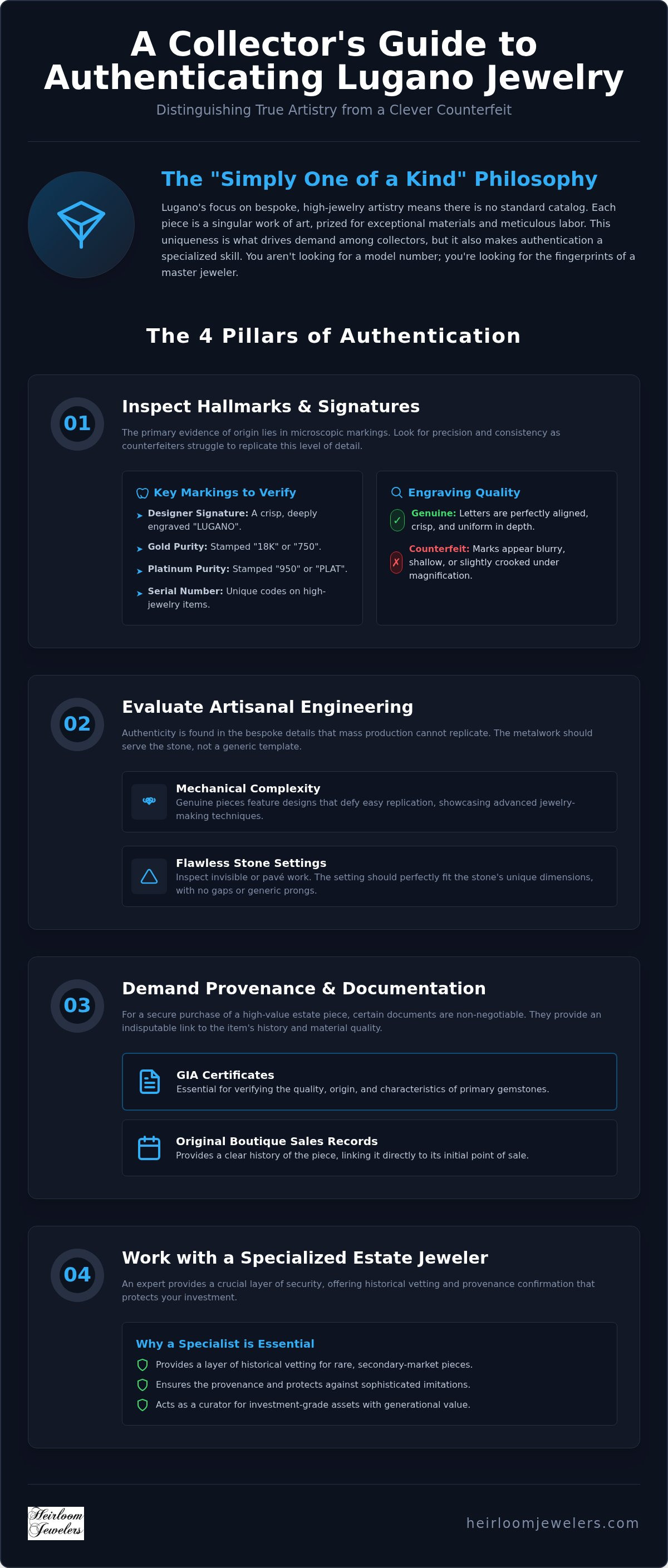
Authentic markings serve as the primary evidence of a piece's origin. When you're determining how to authenticate Lugano jewelry, the first step is a microscopic inspection of the designer's signature. Lugano pieces are typically signed with "LUGANO" in a crisp, deeply engraved font. These marks aren't stamped haphazardly; they're placed with intention, usually on the interior of a ring shank or the reverse side of a pendant. You should look for these specific hallmarks during your inspection:
- Designer Signature: A clear, uniform "LUGANO" engraving.
- Gold Purity: An "18K" or "750" stamp indicating 18-karat gold content.
- Platinum Purity: A "950" or "PLAT" stamp for platinum settings.
- Serial Numbers: Unique identification codes often found on high-jewelry or limited-run items.
The precision of these engravings is a key differentiator. In a genuine piece, the letters are perfectly aligned and uniform in depth. Counterfeiters often struggle to replicate this level of detail. Their marks may appear blurry, shallow, or slightly crooked under magnification. Many high-jewelry items from the brand also feature a unique serial number that allows for direct verification with the brand's archives. This provides an indisputable link to its production history and original sale.
Engraving Consistency and Font Analysis
Lugano has evolved its branding over the years, and knowing how to authenticate Lugano jewelry involves recognizing these subtle shifts. Modern pieces often favor a clean, sans-serif font, while older estate items might display a more traditional serif style. The placement of these signatures is critical. For instance, on a Lugano Emerald & Diamond Necklace 18K White Gold, the signature is frequently found on the clasp or a small, integrated plaque near the closure. If the signature feels like an afterthought or is located in a high-friction area where it would easily wear away, exercise caution. Artisans at this level prioritize both aesthetics and longevity in their branding.
Metal Purity and Weight Verification
The materials used are just as important as the name engraved on them. Lugano works exclusively with high-purity precious metals. You should look for the "750" stamp for gold or "950" for platinum. These stamps must be as clear as the designer's signature. Understanding the standards for vintage 18k gold rings can help you recognize how these hallmarks should appear on older estate pieces. High-purity gold and platinum have a distinct heft that's difficult to mimic with cheaper alloys or hollow construction. If a piece feels surprisingly light for its size, it's a significant red flag.
For absolute certainty, a professional jewelry appraisal is the most reliable way to verify metal content and stone quality. At Heirloom Jewelers, we've already performed these rigorous checks on our curated collection. We ensure every item meets our high standards for authenticity before it ever reaches our display, acting as a trusted guide for your next acquisition.
Evaluating Craftsmanship and Artisanal Engineering
Lugano jewelry is recognized by its technical ambition. When you're learning how to authenticate Lugano jewelry, you must look at how the piece moves. The brand often creates articulated necklaces and bracelets that flow like fabric against the skin. If a piece feels stiff or catches on clothing, it likely isn't authentic. True Lugano pieces also hide small surprises, such as tiny gemstones or intricate engravings on the interior of a band or clasp. These hidden details are hallmarks of their "Simply One of a Kind" approach and are rarely found in mass-produced imitations.
Mechanical Integrity of Transformable Jewelry
Many of the brand's most famous designs are transformable. A necklace might detach to become a pair of bracelets, or a brooch might convert into a pendant. Testing these mechanisms is a critical part of the authentication process. Authentic hinges and locks should feel smooth, secure, and entirely silent. There should be a definitive, crisp "click" when a clasp engages. Signs of poor engineering, such as wobbly joints, visible solder marks, or a clasp that requires force to close, are immediate red flags. High-end engineering is difficult and expensive to replicate. This makes mechanical testing one of the most reliable ways to verify a piece's origin in the secondary market.
Stone Setting and Pave Quality
Lugano is celebrated for its mastery of pave and invisible settings. When inspecting estate emerald and diamond jewelry, use a 10x loupe to scrutinize the prongs and bezels. In a genuine piece, the metal seems to disappear, creating a seamless field of color and light. The stones should be perfectly level with consistent spacing. Authentic Lugano work exhibits a flawless transition between metal and gemstone, where the setting enhances the stone's brilliance without overwhelming it. Every stone is selected to match the specific character of its neighbors, ensuring a uniform brilliance that defines the brand's aesthetic.
While physical markers are vital, they should always be supported by documented history. Understanding the role of provenance helps collectors verify that these complex engineering feats originated in Lugano's studio. At Heirloom Jewelers, we prioritize this level of scrutiny. We analyze every joint and setting to ensure the artisanal integrity matches the brand's reputation. This methodical approach ensures that every piece in our collection is a true representative of the brand's heritage, providing you with the confidence that your investment is sound and authenticated.
The Role of Provenance and Documentation
Documentation serves as the final, indisputable layer of security for any collector. While mastering how to authenticate Lugano jewelry involves a keen eye for craftsmanship, the paper trail provides the historical context needed for a high-value investment. Original sales receipts from Lugano boutiques are the most desirable form of provenance. These documents often include detailed descriptions of the piece's unique features, confirming its place in the brand's limited production history. A lack of this paperwork doesn't necessarily disqualify a piece, but it does impact its resale value. Collectors often pay a premium for items that come with their complete history intact. This is because documentation removes the burden of proof from the buyer and places it firmly on the brand's own records.
GIA Reports and Gemstone Verification
Gemological reports are equally vital. Most Lugano pieces featuring significant diamonds or colored stones will be accompanied by GIA or AGSL certificates. These reports allow you to match the laser inscription on the girdle of a diamond directly to the physical document. Understanding the history of emerald jewelry can provide perspective on why certain stone origins require such rigorous verification. Lugano frequently selects stones with exceptional character, such as Colombian emeralds, which must be verified for their natural origin and treatment levels. These certificates ensure you aren't paying designer prices for treated or synthetic materials. They act as a biological passport for the gemstones, detailing every attribute from clarity to geographic origin.
Secondary Market Appraisals
A standard insurance appraisal is often insufficient for true authentication. These documents focus on replacement value rather than verifying the designer's hand. Instead, you should seek a "Statement of Authenticity" from a reputable estate jeweler who understands the brand's specific engineering. The physical presentation also matters. Original Lugano boxes and travel pouches are crafted with the same attention to detail as the jewelry itself. The weight of the box, the quality of the suede lining, and the precision of the logo placement all contribute to the piece's narrative. Counterfeiters rarely invest in high-quality packaging, making it a useful indicator of authenticity. If you're looking for a fully vetted acquisition, we invite you to browse our collection of authenticated estate jewelry where every piece of documentation has been meticulously verified by our specialists.
Why Estate Jewelers are Essential for Authentication
Professional verification is the ultimate safeguard for any collector. While you can learn the basics of how to authenticate Lugano jewelry through visual markers, an estate expert provides a level of scrutiny that only comes from years of handling high-value pieces. Specialized retailers understand the nuances of the brand's "Simply One of a Kind" philosophy. They recognize that these items aren't just jewelry; they're engineered assets that require a deep understanding of high-jewelry construction. This expertise acts as a bridge between the brand's exclusive boutiques and the secondary market, giving you the certainty needed for a secure investment.
The Vetting Process at Heirloom Jewelers
Our team follows a rigorous multi-point inspection for every piece that enters our collection, applying the same precision standards we've shared on how to authenticate Lugano jewelry to every item we vet. We don't just look for a signature; we analyze the structural integrity of the entire item. Our experts draw on a vast knowledge of historical design cues to vet older Lugano collections. We look for the evolution of the brand's engraving styles and stone-setting techniques across different eras. For a Lugano Emerald & Diamond Necklace in 18K white gold, this means testing the security of every pave setting and the fluidity of the metalwork. This professional curation ensures that every estate find we offer has already passed the most demanding standards in the industry.
Taking the Next Step in Your Collection
Building a relationship with trusted estate jewelers is the most effective way to grow a high-jewelry collection. We act as your eyes in the secondary market, sourcing rare items that rarely reach the general public. A dedicated curator understands your specific aesthetic preferences and investment goals. This partnership allows you to explore the complexities of the estate market with quiet confidence. If you're interested in current availability for Lugano pieces or other emerald estate treasures, we invite you to start a conversation with our specialists.
Before you finalize any purchase, use this final checklist to ensure your peace of mind:
- Confirm the metal purity stamps are crisp and correctly positioned.
- Test all mechanical joints and clasps for a smooth, silent "click."
- Match any laser inscriptions on primary diamonds to their GIA reports.
- Verify the presence of original branded packaging or boutique sales documentation.
- Review the jeweler's statement of authenticity and historical vetting process.
Choosing an authenticated path doesn't just protect your finances. It honors the craftsmanship and history of the piece you're bringing into your life. You aren't just buying a necklace; you're acquiring a piece of history that has been vetted by a passionate enthusiast who values quality as much as you do.
Securing Your Next Masterpiece
Mastering how to authenticate Lugano jewelry requires a disciplined approach to hallmark verification and mechanical analysis. You've discovered that true authenticity lies in the details, from the precision of a laser-inscribed GIA report to the silent, effortless click of a transformable clasp. By combining physical inspection with rigorous provenance checks, you can navigate the secondary market with the poise of a seasoned collector.
Heirloom Jewelers takes this responsibility seriously. We're specialists in authenticated Lugano and emerald estate pieces, performing an expert vetting of every vintage item before it joins our curated inventory. Our focus remains on rare, one-of-a-kind craftsmanship that stands the test of time. We invite you to view our curated collection of authenticated estate jewelry and experience the peace of mind that comes with professional curation. Your commitment to quality ensures that these remarkable treasures will be enjoyed for generations to come.
Frequently Asked Questions
Does all Lugano jewelry have a serial number?
Not every piece features a serial number, though modern high-jewelry and limited-run items often do. Older estate pieces or unique bespoke commissions might only carry the designer hallmark and metal purity stamps. If you're researching how to authenticate Lugano jewelry, don't rely solely on a number. Instead, look for the consistency of the "LUGANO" engraving and the overall structural integrity. The artisan's signature is often more telling than a single digit.
How can I tell if my Lugano emerald necklace is real gold?
You can verify the metal content by locating the purity hallmark, typically "18K" or "750" for gold pieces. A Lugano Emerald & Diamond Necklace in 18K white gold has a specific weight and density that counterfeit alloys can't replicate. A professional acid test or XRF analysis by an estate jeweler can confirm the gold's purity without damaging the item. Authentic pieces won't show signs of plating or base metal showing through at high-friction points.
What should I do if an estate piece has no paperwork?
If an estate piece lacks original documentation, you should seek a professional authentication from a specialized estate jeweler. Experts can verify the piece through physical markers, such as the specific artisanal engineering and hallmark styles discussed in this guide. While original receipts add value, a lack of paperwork is common in the secondary market. A reputable curator can provide a Statement of Authenticity based on a multi-point inspection of the materials and craftsmanship.
Are Lugano diamonds always GIA certified?
Most primary diamonds in Lugano's collections are accompanied by GIA or AGSL reports. However, smaller pave stones or colored gemstones might not have individual certificates unless they're of significant size or rarity. When purchasing estate jewelry, always ask for existing reports to match laser inscriptions. If reports are missing, an independent gemological appraisal is the most reliable way to confirm the quality and origin of the stones before you commit to a purchase.
Can I take an estate piece to a Lugano boutique for authentication?
Lugano boutiques generally don't provide formal authentication services for items purchased on the secondary market. Their focus is on new collections and their established clientele. For estate acquisitions, it's more effective to work with a specialized estate retailer who has deep experience vetting vintage items. These experts use historical knowledge of the brand's production eras to verify pieces that boutique staff might no longer be familiar with or trained to identify accurately.
What are the most common signs of a fake Lugano ring?
Common signs of a counterfeit include blurry or shallow engravings, uneven stone spacing, and surprisingly lightweight materials. Authentic Lugano rings exhibit perfect symmetry and a seamless transition between the metal and gemstones. Look closely at the signature; if the letters are poorly aligned or the font style doesn't match known era-specific standards, the piece is likely a fake. Counterfeits often lack the meticulous "hidden details" found inside the bands of genuine pieces.
Why is craftsmanship more important than the hallmark for authentication?
Hallmarks are easily forged, but master-level craftsmanship is nearly impossible to replicate perfectly. While a stamp can be copied, the flawless execution of an invisible setting or the fluidity of an articulated joint requires immense skill and time. When learning how to authenticate Lugano jewelry, prioritizing the technical complexity of the piece ensures you're looking at the artisan's hand. True luxury is found in the structural perfection and mechanical integrity of the item.
How does the "transformable" feature help prove a piece is authentic?
The "transformable" feature is a signature of Lugano's innovative engineering and serves as a strong indicator of authenticity. These complex mechanisms, such as a necklace that converts into a bracelet, require precise hinges and secure, silent locks. Counterfeiters rarely have the resources to engineer these features correctly. If the conversion is clunky, loud, or feels insecure, it's a major red flag. A smooth, silent mechanical "click" is a hallmark of genuine artisanal work.