
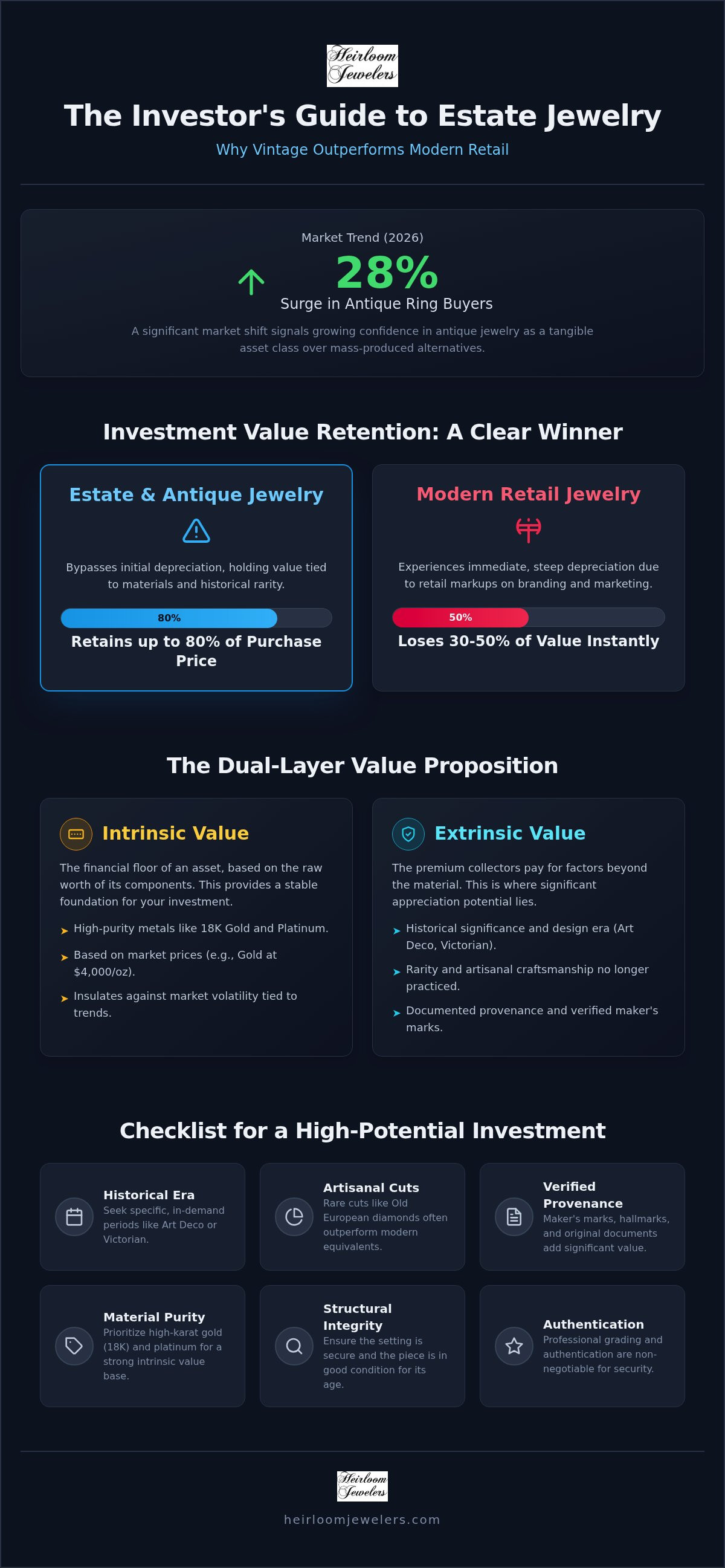
In 2026, the market for antique wedding rings saw a 28% surge in buyers, signaling a shift from modern retail toward lasting heritage. Many collectors are finding that investing in vintage diamond rings offers a unique hedge against the rapid depreciation typical of mass-produced jewelry. While modern pieces often lose about half their value upon resale, authentic antique rings can retain up to 80% of their original purchase price. You likely understand the frustration of seeing a significant investment lose its luster in the secondary market. It's difficult to distinguish between a simple second-hand item and an investment-grade heritage piece.
This guide provides a clear framework for identifying authenticated estate jewelry that serves as a resilient financial asset. You'll learn how historical rarity and intrinsic material value, such as 18K gold and platinum, create long-term appreciation. We'll examine why rare artisanal cuts, like Old European diamonds, are outperforming modern equivalents. By the end of this collector guide, you'll have the confidence to select pieces that offer both aesthetic beauty and enduring financial stability.
Key Takeaways
- Understand how purchasing authenticated estate pieces allows you to acquire fine jewelry assets below their modern replacement cost.
- Discover why investing in vintage diamond rings provides a dual-layer of value through intrinsic metal purity and historical design scarcity.
- Learn how you'll avoid the steep retail depreciation of modern luxury brands by focusing on secondary market pieces with established provenance.
- Identify high-potential items like Old European cut diamonds by verifying hallmarks and evaluating stones through the specialized lens of antique grading.
- Prioritize professional authentication to ensure the structural integrity and long-term security of your collection.
The Financial Logic: Why Estate Jewelry is a Resilient Investment
Estate jewelry represents a strategic acquisition of a tangible asset rather than a simple retail purchase. Most modern jewelry carries a significant markup for branding, labor, and marketing. These new pieces typically experience an immediate depreciation of 30% to 50% once they leave the showroom. In contrast, estate items have already moved past this initial loss. By purchasing in the secondary market, you're often buying at or near the replacement cost of the materials and labor alone. This allows you to bypass the premium paid for mass-produced items and focus your capital on the intrinsic value of the piece itself. When you're investing in vintage diamond rings, you're prioritizing a stable floor of material worth over the volatile markups of contemporary luxury brands.
This financial resilience comes from a combination of historical rarity and artisanal craftsmanship that modern mass production cannot easily replicate. Choosing a piece with a history offers a sense of quiet confidence. You aren't chasing fleeting trends that might lose relevance in a few seasons. Instead, you're securing an item with a proven aesthetic that has already survived decades of shifting tastes. This stability makes estate jewelry a compelling alternative for those looking to diversify their portfolios with assets that offer both beauty and historical significance.
Defining Estate Jewelry for the Modern Investor
It's vital to distinguish between generic second-hand items and curated heritage jewelry. True investment-grade pieces possess a level of rarity that sets them apart from common used goods. This rarity is often defined by several key factors:
- Historical significance linked to specific design periods like the Art Deco or Victorian eras
- Artisanal techniques, such as hand-pierced filigree, that are no longer commercially viable
- High-purity precious metals like platinum and 18K white gold
In 2026, market conditions have shifted toward these tangible assets. With gold prices settling in the $4,000 per ounce range, the inherent value of heavy vintage settings provides a sturdy financial foundation. Specific eras continue to drive market demand due to their unique geometric designs and exceptional durability, making them highly sought after by collectors and investors alike. To further understand the digital strategies and technological shifts shaping this market, you can explore Jewelry eCommerce Consulting and Industry Reports.
A low price doesn't always indicate a high-value investment. A strategic acquisition requires looking beyond the tag to understand the underlying asset. When investing in vintage diamond rings, you must evaluate the structural integrity of the setting alongside the stone's quality. Documented provenance, such as original boxes or maker's marks from renowned houses, significantly increases the resale premium. These details provide the authentication necessary for future liquidity in a market that values transparency. Investment Grade is a piece where material value and historical rarity intersect. By focusing on pieces with verified origins and exceptional craftsmanship, you ensure that your collection remains a resilient financial asset for years to come. This approach moves you away from the noise of modern retail and toward a portfolio of timeless value.
Intrinsic vs. Extrinsic Value: Driving Asset Appreciation
Successful asset allocation requires an understanding of two distinct value layers. Intrinsic value provides the financial floor. This is the raw worth of the materials, such as the melt value of 18K gold and platinum. As of mid-2026, with gold prices settling in the $4,000 per ounce range, this floor has never been more substantial. Extrinsic value represents the premium collectors pay for historical significance, era-specific design, and rarity. While modern jewelry relies almost entirely on branding for its extrinsic worth, estate pieces derive it from being finite resources. When investing in vintage diamond rings, you're acquiring a piece that benefits from the scarcity multiplier. Since these items are no longer in production, they often appreciate faster than their modern, mass-produced counterparts.
Designer authentication further elevates this extrinsic premium. A piece with a verified maker's mark, such as a Lugano designer necklace, commands a higher price because its origin is documented. This combination of material security and historical rarity creates a dual-asset profile that is difficult to find in other luxury categories; for collectors looking to expand this strategy into horology, Luxury Time NYC offers a curated selection of timepieces that follow similar investment principles. Art Deco pieces, for instance, have seen an annual appreciation of 15% to 20% in the 2026 market. This growth is driven by a global community of collectors who value the distinct geometry and superior craftsmanship of that era.
The Scarcity of Old European Cut Diamonds
Old European cut diamonds were hand-faceted to maximize brilliance under candlelight. This artisanal approach results in a unique light performance that modern, standardized brilliant cuts cannot replicate. These stones are increasingly rare, as many have been recut into modern shapes over the decades. Collectors of antique diamond earrings specifically seek out the "inner fire" and large facets characteristic of these historic cuts. In the 2026 market, both Old Mine and Old European cuts represent a high-potential segment for those investing in vintage diamond rings due to their dwindling supply and rising demand among connoisseurs.
Precious Metals: The Resiliency of 18K Gold and Platinum
Platinum has long been the preferred metal for vintage engagement rings because of its exceptional density and durability. It holds stones more securely than most other metals and maintains its structural integrity over generations. Similarly, 18K white gold offers a high-purity alternative with a melt value of approximately $103 per gram. These high-purity estate metals act as a traditional hedge against inflation. They provide a tangible sense of security that paper assets cannot match. If you're looking to build a resilient collection, you might consider exploring the curated inventory at Heirloom Jewelers to find pieces that balance these two value layers perfectly.
Estate vs. Modern Retail: A Comparative Investment Analysis
Modern retail jewelry is priced to cover heavy overhead, global marketing, and significant profit margins. When you buy a new diamond ring from a luxury boutique, you're paying for more than just the materials and craftsmanship. You're paying for the brand's name. This leads to a steep depreciation curve. Authentic antique wedding rings often retain up to 80% of their purchase price. In contrast, modern mass-produced jewelry frequently loses half its value the moment it leaves the showroom. By investing in vintage diamond rings, you're acquiring assets that have already navigated this initial loss.
The one-of-a-kind nature of estate pieces also provides a distinct advantage during resale. In the modern market, thousands of identical rings compete for attention. Estate items are unique. This scarcity reduces competition and allows the piece's historical rarity to dictate the price. You aren't just selling a commodity; you're offering a piece of history that cannot be found elsewhere. This uniqueness ensures that your investment remains distinct in a crowded secondary market.
Avoiding the New Jewelry Depreciation Trap
Modern mass-produced jewelry rarely recaptures its original price on the secondary market. This is because the initial markup is too high to be supported by material value alone. Estate pieces have already bottomed out their depreciation. Their price is more closely aligned with their intrinsic worth and historical significance. When you choose estate, you're trading the Brand Premium for an Artisan Premium. You're paying for the skill of a long-dead master jeweler rather than a corporate marketing budget. This makes investing in vintage diamond rings a more logical choice for long-term growth.
Sustainability as a Value Driver in 2026
In 2026, collector behavior has shifted decisively toward ethical recycled luxury. This trend contributed to a 28% surge in antique wedding ring buyers this year. Consumers, particularly millennials, view vintage jewelry as the ultimate sustainable asset. This "green premium" is increasingly reflected in resale values. Estate gemstones are seen as eco-conscious alternatives to newly mined stones. These pieces carry a story without the environmental footprint of modern mining operations. By choosing pre-owned luxury, you're securing a high-value asset that aligns with the values of the next generation. It's a way to preserve both history and the planet while building a resilient portfolio.
Key Indicators of a High-Potential Investment Piece
Identifying a true asset requires a methodical approach that goes beyond the initial aesthetic. When you're investing in vintage diamond rings, you must look past the charm of the era to verify the technical markers that guarantee long-term value. A high-potential piece is defined by a specific set of criteria:
- Step 1: Verify hallmarks and maker’s marks for specific designer attribution.
- Step 2: Evaluate the Four Cs through the specialized lens of antique grading.
- Step 3: Inspect the structural integrity of the setting, particularly in platinum or 18K gold.
- Step 4: Assess gemstone rarity, focusing on color saturation and origin.
Decoding Hallmarks and Authenticity Markers
Metal purity is the first layer of verification for any serious collector. Look for stamps like 18K, 14K, or Plat to confirm the material foundation of the piece. High-end provenance is often signaled by hidden maker’s marks, which are frequently located on the inside of the band or the delicate curve of a clasp. While a missing hallmark is not always a deal-breaker, an authenticated one adds a 15-20% premium. This attribution transforms an anonymous vintage item into a documented piece of jewelry history. It provides the transparency necessary for future liquidity and ensures the item holds its place as a recognized asset.
Next, you must evaluate the diamonds using an antique-specific framework. Grading old cuts is fundamentally different from grading modern stones. You aren't looking for the clinical symmetry of a modern brilliant cut. Instead, you're looking for the character and "inner fire" of hand-faceted stones. These artisanal cuts often possess unique light-reflecting properties that are highly prized by connoisseurs in the secondary market.
Evaluating Structural Integrity in Vintage Settings
Structural health is non-negotiable for an investment-grade piece. Inspect the band for thinning, especially at the bottom where decades of wear can compromise the metal. Prongs should be sturdy enough to secure the stone without being overly bulky. Platinum settings are particularly prized for their strength and density, but even they can show signs of fatigue after a century. Original, un-repaired settings are more valuable to serious collectors because they preserve the piece's historical context. Professional restoration should be minimal and respectful. Over-polishing can strip away the natural patina that proves age and authenticity, potentially lowering the extrinsic value.
Finally, assess the rarity of any secondary gemstones. Saturation and clarity are paramount. For instance, the deep, vivid saturation found in a Lugano Emerald & Diamond Necklace represents a peak investment asset. These high-quality stones are becoming increasingly difficult to source as historic mines deplete. If you're ready to begin investing in vintage diamond rings or rare gemstones, view our authenticated collection at Heirloom Jewelers to find pieces with verified structural integrity and exceptional provenance.
Building Your Portfolio with Heirloom Jewelers
Building a collection of fine estate jewelry requires more than just an eye for beauty. It demands a partnership with a trusted authority that prioritizes curation over sheer volume. Heirloom Jewelers acts as that knowledgeable guide, helping you navigate the complexities of high-value secondary markets. When you're investing in vintage diamond rings, you need the assurance that every piece has been vetted for both its material purity and its historical significance. Our focus remains on quality and heritage. This ensures that your acquisitions are not just ornaments but resilient financial assets that stand the test of time.
The year 2026 has proven to be a pivotal moment for the estate market. With gold prices reaching the $4,000 per ounce range and a 28% surge in antique wedding ring buyers, the demand for tangible, historical assets is clear. Entering the market now allows you to secure pieces that combine intrinsic metal value with a finite supply of artisanal craftsmanship. We help you move beyond the high-pressure urgency of modern retail and toward a steady, respectful atmosphere where quality takes center stage.
The Role of Expert Authentication
Security in the estate market begins with rigorous evaluation. Heirloom Jewelers filters out the noise of mass-produced items to focus exclusively on investment-grade finds. We verify the structural integrity of every 18K white gold and platinum setting. This ensures the craftsmanship is capable of enduring for another century. Our experts examine hallmarks and maker’s marks to confirm designer attribution, providing the transparency necessary for long-term value. This methodical approach gives you the peace of mind that your gemstones and precious metals are exactly what they're claimed to be. By preserving the history of these pieces, we protect the extrinsic value that makes them so rare.
Curation as a Strategy for Long-Term Appreciation
A successful portfolio often benefits from a focused strategy. Rather than acquiring random items, many serious collectors choose to specialize in specific niches. You might focus on the geometric precision of the Art Deco period or the romantic light performance of Old European cuts. A diverse collection that mixes antique rings with statement necklaces, such as a Lugano emerald piece, provides a balanced asset profile. This variety allows you to capitalize on different market trends while maintaining a cohesive aesthetic.
Transitioning from a casual buyer to a dedicated collector is a journey that rewards both the mind and the portfolio. Professional guidance helps you identify which pieces offer the most potential for appreciation based on current market data. Owning a piece of history offers an emotional connection that modern retail can't duplicate. It's a quiet confidence that comes from knowing your investment is as enduring as the craftsmanship it displays. When you're investing in vintage diamond rings, you're not just buying jewelry; you're preserving a legacy of excellence.
Securing Your Financial Future Through Timeless Artistry
The transition from a casual buyer to a strategic collector begins with understanding that fine jewelry is a dual-asset. You've seen how estate pieces bypass the steep markups of modern retail while providing a sturdy financial floor through high-purity metals. By investing in vintage diamond rings, you're acquiring a finite piece of history that modern mass production cannot replicate. These items offer a unique combination of intrinsic material worth and the extrinsic premium of historical rarity.
Heirloom Jewelers is dedicated to this legacy of craftsmanship. Our expertise in Old European cut diamonds and authenticated Lugano Emerald & Diamond pieces ensures every acquisition is backed by professional curation. We invite you to explore our curated collection of authenticated investment-grade estate jewelry. Whether you're seeking a resilient financial asset or a piece of timeless artistry, we're here to guide you with quiet confidence. Start building a portfolio today that reflects both your values and your vision for the future.
Frequently Asked Questions
Is estate jewelry worth more than new jewelry?
Yes, estate jewelry often provides better value retention because it lacks the heavy retail markups found in modern boutiques. New pieces typically lose 30% to 50% of their value immediately upon purchase. Estate items are priced closer to their intrinsic material worth and historical rarity. This makes them a more stable financial asset for those who want their jewelry to hold its value over the long term.
Does estate jewelry appreciate in value over time?
Rare estate pieces from specific eras or those with exceptional stones frequently appreciate as they become harder to find. This growth is driven by a finite supply and an increasing global demand for artisanal craftsmanship. Items from the Art Deco period and those featuring rare cuts like Old European diamonds have shown consistent market strength. This appreciation makes high-quality estate jewelry a resilient choice for a diversified portfolio.
How can I tell if a piece of estate jewelry is a good investment?
A high-potential investment piece combines high metal purity with documented provenance and historical scarcity. You should look for verified hallmarks and maker's marks that confirm a specific designer's attribution. When you're investing in vintage diamond rings, prioritize structural integrity and rare hand-faceted stones. These technical details create a resale premium that anonymous or mass-produced items cannot achieve in the secondary market.
What is the difference between antique, vintage, and estate jewelry for investors?
Estate is a broad term for any pre-owned jewelry. Vintage items are generally at least 20 years old, while antique pieces must be at least 100 years old to carry that label. For investors, antique pieces often command the highest premiums because of their extreme scarcity. Vintage items from iconic design houses also offer strong growth potential. Understanding these categories helps you target pieces with the best historical value.
Why is platinum a better investment for vintage rings than gold?
Platinum is often considered a superior investment because of its extreme density and durability. It holds gemstones more securely than gold and does not wear away after decades of use. In the secondary market, platinum settings are highly sought after for their structural integrity. This metal's rarity and weight contribute to a higher intrinsic value floor compared to many gold alloys used in modern production.
Are designer estate pieces like Lugano better investments than unbranded ones?
Yes, designer attribution adds a significant layer of extrinsic value that unbranded pieces lack. An authenticated Lugano Emerald & Diamond necklace carries a name premium because its origin is documented and verified. This transparency is crucial for future liquidity and resale. Collectors are willing to pay more for pieces from established houses that have a known history of quality and elite craftsmanship.
How do I ensure the authenticity of a vintage diamond’s cut and clarity?
You should seek professional authentication from a specialist who understands antique grading standards. While modern lab reports are useful, an expert eye is needed to evaluate the unique light performance of old cuts. When investing in vintage diamond rings, check for original facets that haven't been recut. This preserves the stone's historical character and ensures the diamond remains an investment-grade asset rather than a generic commodity.
What should I look for in a jeweler when buying investment-grade estate pieces?
Prioritize a jeweler who functions as a knowledgeable curator rather than a high-volume retailer. They should provide detailed authentication for every item and demonstrate deep expertise in the secondary market. Look for a steady, professional atmosphere that values long-term relationships over quick sales. A trustworthy jeweler will always be transparent about a piece's condition, metal purity, and any documented provenance that supports its investment value.