
A hallmark is more than a simple stamp on a post; it's a silent testament to a piece's history and purity that has survived decades of wear. You've likely felt the hesitation that comes with browsing the estate market, wondering if a beautiful find is genuine 18K gold or merely a clever imitation. It's natural to feel uncertain when faced with the subtle differences between a modern brilliant cut and the romantic depth of an Old European diamond.
We believe that acquiring vintage gold diamond earrings should be an experience rooted in confidence rather than guesswork. This guide will teach you how to evaluate craftsmanship, identify authentic eras, and select a pair of real gold diamond earrings that will endure for generations. We'll examine the specific hallmarking standards required by the FTC, the aesthetic markers of the Edwardian and Art Deco periods, and the gemological details that separate a true heirloom from a mass-produced replica. By the end, you'll have the technical knowledge to verify a piece's history and the aesthetic insight to choose a design that resonates with your personal style.
Key Takeaways
- Learn to distinguish investment-grade fine jewelry from mass-produced fashion items to ensure your collection maintains its long-term value.
- Understand the structural and aesthetic differences between 14K and 18K gold to select settings that provide the best balance of purity and resilience.
- Discover the defining characteristics of Victorian, Edwardian, and Art Deco eras to confidently identify authentic vintage gold diamond earrings.
- Use a professional checklist to locate hallmarks and verify historical diamond cuts, ensuring every purchase is a genuine estate piece.
- Gain insight into the curation standards that transform a simple purchase into a meaningful investment in wearable history.
Defining the Value of Real Gold and Diamond Jewelry
Real gold and diamonds have remained the standard for heirlooms because they possess intrinsic value that transcends shifting trends. Unlike mass-produced fashion jewelry, which often relies on base metals and synthetic coatings, investment-grade pieces are crafted from materials that endure. Vintage gold diamond earrings represent a unique intersection of history and tangible asset. They don't just decorate; they preserve wealth and craftsmanship in a form that can be worn daily. Choosing fine jewelry over modern "fast fashion" alternatives ensures that the piece will survive the rigors of time without losing its structural integrity or aesthetic appeal.
Earrings occupy a distinct space in the history of earrings and estate collecting. Because they sit in close proximity to the face, they often serve as the primary focal point of an ensemble. This visibility makes the quality of the gold and the fire of the diamonds particularly important. Selecting a pair from a previous era offers an emotional connection to the past while providing the financial security of solid precious metals. It's a choice that favors substance over temporary sparkle.
The Difference Between Estate, Vintage, and Antique
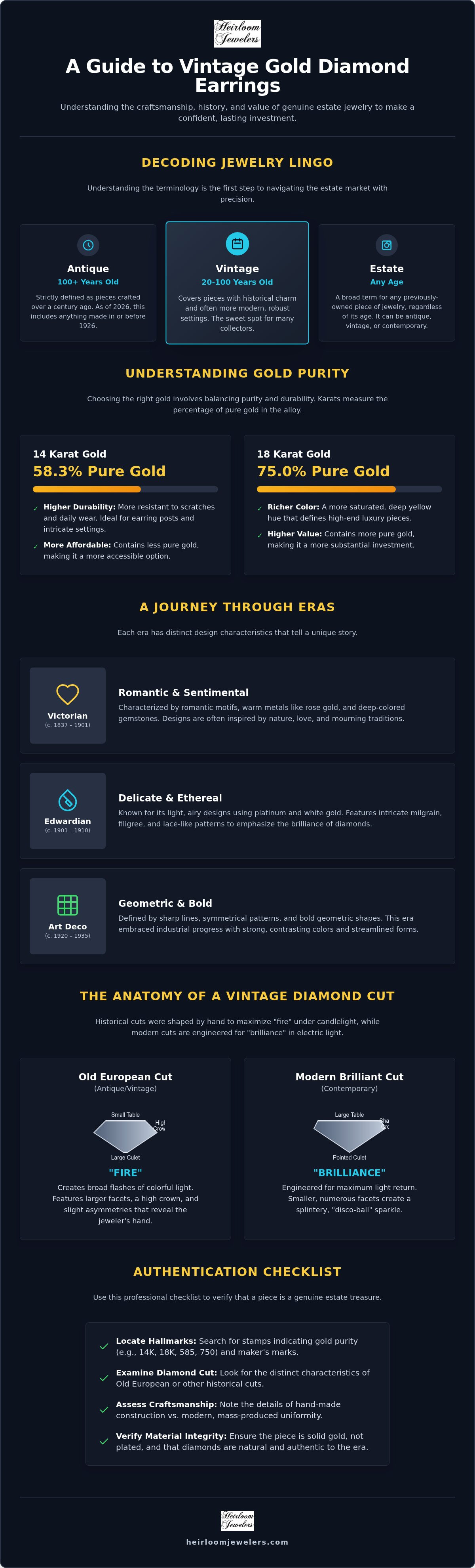
Understanding industry terminology helps you navigate the market with precision. Estate is a broad term that refers to any piece of jewelry that was previously owned, regardless of its age. Antique jewelry is strictly defined as pieces over 100 years old; as of 2026, this includes anything crafted in or before 1926. Vintage jewelry covers the period between 20 and 100 years old. Many collectors find that the vintage category offers the best balance of historical charm and modern durability, as these pieces often feature more robust settings than their older antique counterparts.
Why Material Authenticity Matters in 2026
As of August 2026, the price of gold has reached approximately $4,341 per troy ounce. This high valuation has led to a rise in sophisticated gold-plating techniques that can easily deceive the untrained eye. Solid gold remains essential because it doesn't tarnish or wear away. It ensures your vintage gold diamond earrings retain their luster for decades. Authenticity also extends to the stones. With the price gap between natural and lab-grown diamonds widening, professional verification is critical. We focus on curating pieces that exclude mass-produced items, prioritizing the integrity of 14K and 18K gold settings and authenticated natural diamonds.
Understanding Gold Karats and Diamond Integrity
Selecting the right metal for vintage gold diamond earrings involves a careful balance between metallurgical purity and daily resilience. In the United States, jewelry descriptions must adhere to the FTC Guides for the Jewelry Industry, which ensure that metal content is accurately represented. 14K gold, containing 58.3% pure gold, is often favored for its hardness, making it an excellent choice for intricate filigree or secure earring posts. However, 18K gold, with 75% purity, offers a saturated, buttery hue that many collectors find irresistible. While 18K is softer, it provides a sense of luxury and weight that defines high-end estate pieces.
The specific alloy used also dictates the diamond's visual performance. 18K white gold was historically developed as a more accessible alternative to platinum, particularly during the early 20th century. By mixing pure gold with white metals like nickel or palladium, jewelers created a durable, reflective surface. It provides a cool, neutral backdrop that emphasizes the diamond's lack of color. Conversely, yellow gold can complement diamonds with warmer color grades, blending seamlessly with the stone's natural tint. Rose gold, though less common in traditional diamond studs, adds a romantic, copper-toned warmth that was especially popular in the late Victorian era. Each alloy tells a different story and serves a specific aesthetic purpose.
The Anatomy of a Vintage Diamond Cut
Collectors often distinguish between the "brilliance" of modern stones and the "fire" of historical cuts. Modern brilliant cuts are engineered for maximum light return, resulting in a splintery, disco-ball effect. In contrast, Old European cuts feature larger facets and a higher crown. This geometry creates broad flashes of light and deep, colorful fire. These hand-cut stones often possess slight asymmetries that reflect the individual jeweler's touch. For a deeper exploration of these differences, consult our vintage diamond stud earrings guide to see how these eras compare.
Choosing Between Yellow and White Gold
The choice between metals often comes down to skin tone and existing collection harmony. Yellow gold old european cut diamond earrings provide a classic, sun-drenched glow that suits warmer complexions. White gold and platinum offer a sleek, architectural look that defines the Art Deco movement. These cooler metals are ideal for those who prefer a monochromatic, modern-leaning aesthetic. If you're looking to start your own collection, our curated selection of vintage gold diamond earrings offers a bridge between historical craftsmanship and modern elegance.
Historical Eras: Victorian, Edwardian, and Art Deco
Every pair of vintage gold diamond earrings acts as a window into the cultural priorities of its time. Design doesn't exist in a vacuum; it evolves alongside social changes and technological breakthroughs. In the estate market, identifying the specific era of a piece is essential for determining its historical accuracy and market value. High-value collectors prioritize "period-correct" materials, such as the specific 18K gold alloys used before modern refining techniques became standardized. These subtle details ensure that an heirloom is an authentic representative of its history rather than a later reproduction.
Integrating these historical pieces into a contemporary wardrobe requires an appreciation for contrast. A pair of ornate Victorian drops can provide a sophisticated counterpoint to a minimalist modern blazer. Conversely, the sharp lines of the Art Deco period feel remarkably current when paired with structured evening wear. These shifts in aesthetic are well-documented by the GIA on Historic Jewelry Styles, which highlights how the transition from candlelight to electric light fundamentally changed how diamonds were cut and set.
Victorian and Edwardian Grace
The Victorian era was defined by romanticism and heavy symbolism. Early pieces often utilized 15K or 18K yellow gold and featured rose-cut diamonds, which have a flat base and a faceted dome. As the century progressed, the Edwardian era introduced a shift toward ethereal, "lace-like" designs. This period saw the first widespread use of platinum, allowing jewelers to create incredibly fine filigree that remained strong enough to hold precious stones. Our antique diamond earrings pillar offers a comprehensive look at how these artisanal cuts were developed to shimmer under the soft glow of early 20th-century interiors.
The Bold Geometry of Art Deco
Moving into the 1920s and 30s, the aesthetic shifted toward symmetry and architectural influence. The Art Deco movement rejected the flowing curves of the past in favor of bold, geometric shapes and stepped designs. White gold and platinum became the primary metals of choice, providing a high-contrast backdrop that emphasized the brilliance of the diamonds. This focus on clean, industrial lines is why art deco jewelry remains the most sought-after vintage style. It bridges the gap between the ornate craftsmanship of the past and the streamlined preferences of the modern era, making it a versatile choice for the discerning collector.
How to Evaluate and Authenticate Estate Earrings
Authenticating vintage gold diamond earrings requires a disciplined eye and a basic understanding of traditional jewelry construction. Start by examining the overall weight and balance of the piece. Authentic estate jewelry feels substantial in the hand because it's typically crafted from solid precious metals rather than hollow alternatives. Modern reproductions often use lightweight alloys or thin plating to reduce material costs. Look closely for casting lines. Real vintage pieces are usually hand-finished, so you shouldn't see a faint seam running along the edge of the metal. Such seams are a common sign of mass-produced modern molds.
Warning signs of modern "fakes" include laser-sharp engravings on pieces that claim to be century-old antiques. True vintage marks show softened edges from decades of contact with skin. For high-value acquisitions, a third-party appraisal from a GIA-certified gemologist provides an unbiased verification of the diamond's specifications and the metal's purity. This documentation is essential for insurance purposes and long-term value retention.
Reading the Hallmarks
Gold stamps are the primary indicator of metal purity. You'll likely see "14K" or "18K" in American pieces, while European items often use decimal stamps like "585" for 14K or "750" for 18K gold. These marks are typically located on the earring post, the butterfly back, or the flat interior surface of a lever-back closure. Maker's marks, which identify the specific workshop or jeweler, can significantly increase a piece's value by establishing its provenance. If a hallmark is missing, it isn't always a cause for alarm. Decades of wear or professional repairs can occasionally polish these marks away. In these instances, a professional acid test is required to confirm the metal's integrity.
Inspecting Diamond Settings
Use a jeweler's loupe to examine the prongs. Gold is a relatively soft metal that wears down over time. If the prongs appear thin or flattened, the diamond may not be secure. Vintage designs frequently feature "open-back" settings. These allow light to enter the stone from multiple angles, maximizing the fire of older diamond cuts. This design also makes it easier to remove the soaps and oils that accumulate behind the stone. Look for milgrain, the tiny, beaded metal borders common in Edwardian and Art Deco jewelry. Authentic milgrain is hand-applied and shows slight, charming irregularities. Modern machine-made milgrain appears perfectly uniform and lacks the depth found in historical pieces.
To see examples of expertly vetted pieces that meet these high standards, view our current selection of authenticated vintage gold diamond earrings.
Selecting the Perfect Pair: The Heirloom Jewelers Approach
Heirloom Jewelers operates as a bridge between the craftsmanship of the past and the discerning tastes of the present. Selecting the right pair of vintage gold diamond earrings is a deeply personal endeavor that requires both technical assurance and aesthetic alignment. We prioritize the curation of pieces that display exceptional artistry, ensuring that every item in our collection is a verified asset. Our approach favors a steady, methodical evaluation over the high-pressure sales tactics common in modern jewelry retail. We focus on the enduring nature of these objects.
Matching a piece to your personal aesthetic involves considering how different silhouettes interact with your features. For instance, vertical drops or elongated Art Deco designs often complement rounder face shapes by creating a sense of length. Conversely, classic studs or clustered Victorian styles can add soft volume to angular features. We help you navigate these choices by focusing on the unique character of each piece, from the warmth of the gold alloy to the specific fire of the diamond cut. It's about finding a balance between historical significance and modern wearability.
Curated Excellence Over Mass Production
Our collection strictly excludes new, mass-produced jewelry. We believe that true value lies in the rarity of authenticated estate pieces. Every item undergoes a rigorous process to verify its material purity and historical era. We specialize in sourcing rare old European cut diamonds, which offer a depth and personality that modern machine-cut stones cannot replicate. By focusing on 14K and 18K gold settings, we ensure that our offerings meet the highest standards of durability and historical accuracy. This dedication to quality allows us to provide pieces that aren't just accessories but significant investments in wearable history.
Your Journey with Heirloom Jewelers
We view every purchase as the beginning of a long-term relationship. We offer personalized consultations to help you find an investment piece that aligns with your collection goals. Caring for your vintage gold diamond earrings is essential to preserving their status as future heirlooms. We recommend regular professional inspections to check prong security and gentle cleaning with mild solutions to maintain the gold's luster. Our goal is to empower you with the knowledge needed to enjoy your jewelry for a lifetime. When you're ready to explore these unique treasures, we invite you to view our curated collection of real gold diamond earrings.
Cultivating Your Heritage Collection
Acquiring fine estate jewelry is a journey that rewards patience and technical knowledge. By understanding the nuances of gold hallmarking and the distinct design languages of the Victorian, Edwardian, and Art Deco eras, you can confidently distinguish authentic treasures from modern imitations. Choosing vintage gold diamond earrings is more than a purchase; it's a commitment to preserving craftsmanship that has already stood the test of time. These pieces carry a weight of history that mass-produced items simply cannot replicate.
Heirloom Jewelers remains a trusted authority in heritage fine jewelry. Every piece in our inventory is hand-selected for historical integrity, ensuring that the provenance and materials meet our rigorous standards. We specialize in rare Old European and Mine cut diamonds, offering collectors access to stones with a unique fire and character. Whether you're starting a new tradition or expanding an established collection, we're here to act as your knowledgeable guide. Explore Our Authenticated Collection of Real Gold Diamond Earrings today and discover a piece that resonates with your personal story.
Frequently Asked Questions
How can I tell if my vintage earrings are solid gold or gold-plated?
You can identify solid gold by checking for official purity stamps and inspecting the metal for signs of wear. Gold-plated items often show a different colored metal beneath the surface at high-friction points like the posts or edges. Solid gold is also non-magnetic. If you're unsure about a pair of vintage gold diamond earrings, a professional acid test can provide definitive confirmation of the metal's integrity without damaging the piece.
What is the difference between an Old European cut and a modern diamond?
The primary difference lies in the facet arrangement and light performance of the stone. Old European cuts feature larger facets and a higher crown, which produces broad flashes of colorful fire. Modern brilliant cuts are engineered for maximum white light return, creating a sharp, splintery sparkle. While modern cuts prioritize uniformity, Old European diamonds possess unique, hand-cut characteristics that many collectors find more romantic and historically significant.
Are vintage diamond earrings safe for sensitive ears?
High-karat gold and platinum settings are generally safe for those with sensitive ears. Most allergic reactions are caused by nickel, which is often found in gold-plated fashion jewelry or lower-quality alloys. By choosing authenticated 14K or 18K gold, you minimize the risk of irritation. It's important to verify that the earring posts are solid gold rather than just plated, as the post has the most direct contact with your skin.
Why do some vintage gold earrings not have hallmarks?
Missing hallmarks are often the result of decades of wear or past professional repairs. Over time, the friction of earring backs can gradually polish away shallow stamps on the posts. Additionally, some historical jewelry was crafted in regions where hallmarking wasn't legally mandated during that specific era. In these cases, we rely on professional metallurgical testing and stylistic analysis to verify the age and purity of the vintage gold diamond earrings.
Can I wear real gold diamond earrings every day?
Real gold and diamonds are resilient enough for daily wear if the settings are well-maintained. 14K gold is particularly durable for everyday use due to its hardness and resistance to scratches. However, you should regularly inspect the prongs to ensure the diamonds remain secure. We recommend removing your jewelry before swimming in chlorinated water or using harsh household chemicals, as these can eventually weaken the metal alloys and dull the stones' luster.
What should I look for in an appraisal for estate jewelry?
A professional appraisal should provide a comprehensive technical breakdown of the piece's components. It must include the verified gold karat, the weight and quality of the diamonds, and a description of the historical era or maker's marks. Ensure the appraisal is conducted by an independent, GIA-certified gemologist. This documentation is vital for securing accurate insurance coverage and establishing a clear record of the jewelry's fair market value.
Is 14K or 18K gold better for diamond earrings?
The choice between 14K and 18K gold depends on your preference for durability versus color richness. 14K gold contains more alloy metals, making it harder and more resistant to bending, which is ideal for secure earring posts. 18K gold has a higher pure gold content, resulting in a deeper, more saturated yellow tone. Both are excellent choices for fine jewelry, though 18K is often favored for high-value estate pieces due to its luxury.
How do I clean vintage gold and diamond jewelry without damaging it?
The safest way to clean your jewelry at home is with warm water and a small amount of mild dish soap. Use a very soft toothbrush to gently reach the areas behind the diamond settings where oils tend to accumulate. Avoid using ultrasonic cleaners for older pieces, as the vibrations can loosen stones in delicate vintage settings. After rinsing, dry the earrings thoroughly with a lint-free cloth to restore their original brilliance.