
A sapphire doesn't just represent a choice of color. It signals a commitment to a legacy that modern, mass-produced jewelry often fails to capture. For many, the search for vintage sapphire engagement rings is driven by a desire for individuality and a connection to the craftsmanship of previous generations. You likely want a ring that tells a unique story. However, the complexities of the secondary market can feel overwhelming. It's natural to worry about the authenticity of a stone or whether a century-old setting can withstand daily wear.
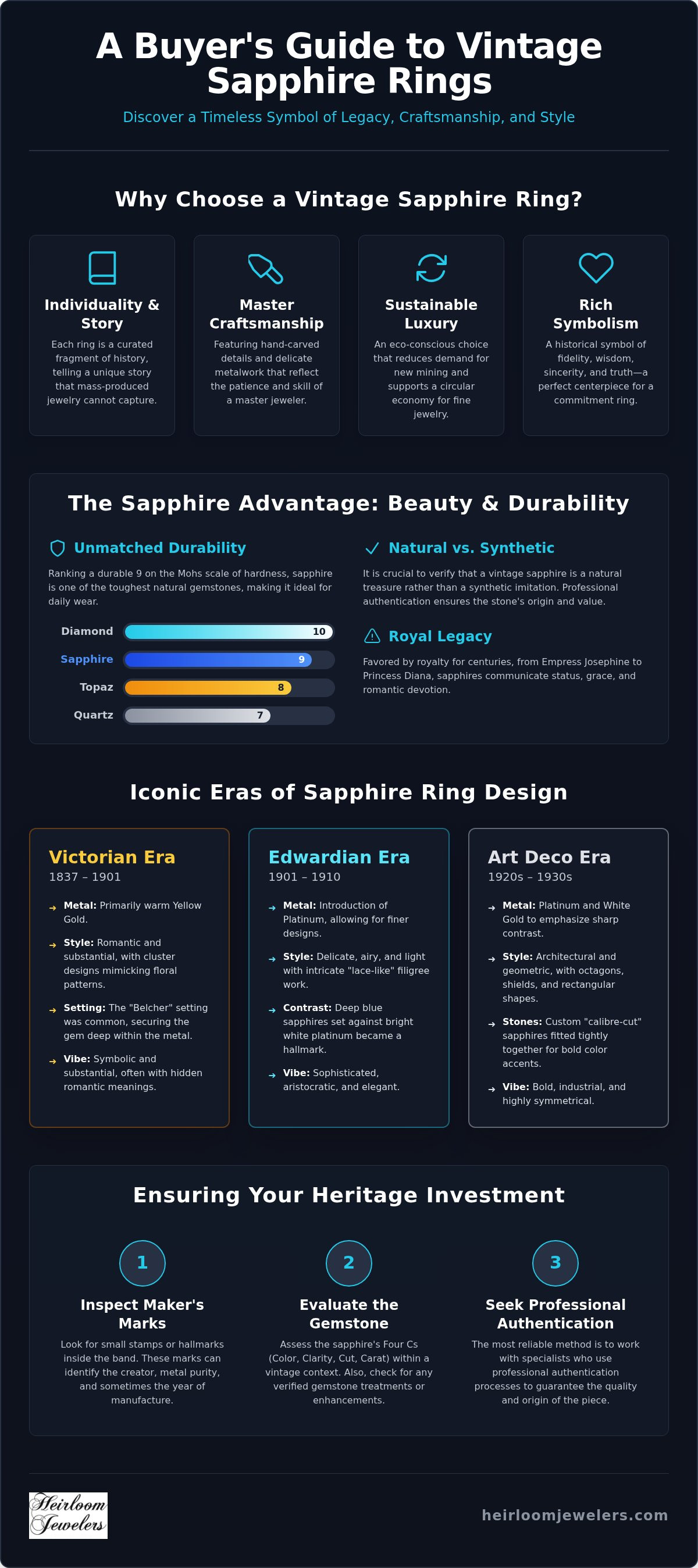
We understand that choosing an estate piece requires an appreciation for beauty and a discerning eye for technical detail. This guide provides the clarity you need to identify historical eras and expert authentication standards. You'll discover the distinct characteristics of Victorian, Edwardian, and Art Deco settings. We also share how to verify that a sapphire, which ranks a durable 9 on the Mohs scale, is a natural treasure rather than a synthetic imitation. By the end of this article, you'll have the confidence to select a timeless piece that serves as a beautiful bridge between the past and your future.
Key Takeaways
- Understand the historical symbolism of sapphires and why these pieces offer a sustainable alternative to modern mass production.
- Identify the specific design hallmarks of the Victorian and Edwardian eras to find the style of vintage sapphire engagement rings that best reflects your personal aesthetic.
- Learn why a sapphire's hardness makes it ideal for daily wear and how to evaluate the Four Cs within the context of an estate piece.
- Discover how to inspect maker's marks and verify gemstone treatments to ensure the integrity of your heritage investment.
- Gain insight into the professional authentication process used by specialists to guarantee the quality and origin of every curated setting.
Why Choose a Vintage Sapphire Engagement Ring?
A vintage sapphire engagement ring is more than a simple piece of jewelry. It is a curated fragment of history that offers a distinct alternative to modern mass production. In the world of fine jewelry, these pieces are defined as authenticated pre-owned rings that originate from specific historical eras. They carry a sense of character that is difficult to replicate in a contemporary setting. Choosing a sapphire allows for a personal expression of style through vibrant color and intricate metalwork.
The sapphire has long been a symbol of fidelity, wisdom, and sincerity. These attributes make it an ideal centerpiece for a commitment ring. Many couples appreciate the "something blue" tradition, which finds a permanent and elegant home in a sapphire setting. Understanding Sapphire gemstone properties helps explain why these stones were favored by past generations. They offer exceptional durability and a depth of color that ranges from velvety cornflower blue to deep midnight hues.
The Symbolism of the Sapphire through History
Royalty has frequently turned to the sapphire to communicate status and grace. Empress Josephine famously wore a sapphire and diamond "Toi et Moi" ring gifted by Napoleon, which remains a landmark of romantic jewelry design. In more recent history, Princess Diana’s iconic cluster ring cemented the sapphire's place as a premier choice for engagements. Ancient cultures often viewed the stone as celestial. They believed its blue hue protected the wearer from envy and harm. Over the centuries, the sapphire transitioned from a stone of divine favor to a powerful symbol of romantic devotion and truth.
Sustainability and the Ethics of Estate Jewelry
Selecting vintage engagement rings is a deliberate step toward more responsible luxury. This choice significantly reduces the demand for new mining operations, which can be resource-intensive. Estate jewelry preserves artisanal craftsmanship that has largely disappeared from the modern market. Many vintage sapphire engagement rings feature hand-carved galleries and delicate milgrain details that reflect the patience of a master jeweler. These rings represent a circular economy where beauty is inherited rather than manufactured. By opting for a pre-owned piece, you honor the history of the jewelry while supporting an eco-conscious approach to fine adornment. It is a way to find a one-of-a-kind treasure that aligns with modern values of conservation and integrity.
Iconic Eras of Sapphire Ring Design
The design evolution of vintage sapphire engagement rings mirrors the changing technologies and social tides of the last two centuries. Each era introduced distinct methods of highlighting the stone's natural brilliance. From the romantic gold work of the 19th century to the sharp lines of the early 20th, the architecture of a setting tells a specific story about its origin. Understanding these periods allows you to identify the craftsmanship that resonates with your personal style.
Edwardian and Victorian Elegance
Victorian rings, dating from 1837 to 1901, often featured warm yellow gold settings and cluster designs that mimicked floral patterns. The "Belcher" setting was particularly common during this time. In this style, the sapphire is secured deep within the metal with substantial prongs, providing a sturdy yet elegant profile. These pieces feel substantial and romantic, often incorporating hidden symbolic meanings in their metalwork.
As the century turned, the Edwardian era (1901-1910) introduced the widespread use of platinum. This stronger metal allowed jewelers to create incredibly fine, "lace-like" filigree that made heavy metal appear weightless. These rings were delicate and airy, often focusing on the history of sapphires as symbols of aristocratic grace. The contrast between the deep blue stone and the bright white platinum remains a hallmark of this period's sophisticated aesthetic.
Art Deco: Geometry and Contrast
By the 1920s, the soft curves of the previous decade gave way to architectural precision. Sapphires became the primary gemstone for art deco jewelry due to their deep color, which provided a sharp contrast against white diamonds and platinum. This era favored geometric shapes like octagons, shields, and rectangles.
Jewelers utilized calibre-cut sapphires, which were custom-cut stones fitted tightly together to accent a central diamond or create a bold border. The influence of skyscrapers and industrial design is evident in these ring silhouettes. The result was a high-contrast aesthetic that felt modern and daring. If you appreciate this era’s bold spirit, you may find your ideal piece among our curated selection of vintage rings.
Retro and Mid-Century Presence
The 1940s through the 1960s saw a return to yellow and rose gold. Design shifted toward larger "statement" sapphires as economic prosperity grew following the war. These pieces often featured bold, sculptural gold work and larger carats. While Art Deco was about precision and thin lines, Mid-Century design was about presence and volume. These vintage sapphire engagement rings often used the sapphire as a singular, powerful focal point, sometimes flanked by substantial side stones to create a look of timeless luxury.
Durability and Quality: The 'Big Three' Advantage
Sapphires belong to the corundum family. They rank 9 on the Mohs Scale of Mineral Hardness, making them the second hardest natural gemstone used in jewelry. In the context of vintage sapphire engagement rings, this durability is a significant advantage. It explains why a ring crafted in the 19th century can still appear vibrant today. While diamonds are the only stone harder, sapphires provide exceptional resistance to scratches and abrasions from daily wear.
Evaluating quality in a vintage piece differs from assessing modern jewelry. The "Four Cs" still apply, but they're viewed through a lens of historical character. Color remains the most critical factor. You'll encounter a spectrum from the velvety "Cornflower" blue to the deep, saturated "Royal Blue." Rare "Padparadscha" stones offer a delicate pink-orange hue that is highly prized by collectors. A vintage stone's value is often tied to its ability to maintain these rich colors under various lighting conditions.
Sapphire vs. Diamond: A Practical Comparison
Choosing a sapphire doesn't mean you're sacrificing longevity. Diamonds are harder, but sapphires are remarkably tough. They lack the "cleavage" planes found in diamonds, which are internal directions where a stone can split if struck. This makes a sapphire less prone to chipping or fracturing during an accidental impact. For those with active lifestyles, a sapphire is a resilient and reliable choice. When caring for 18K white gold and sapphire combinations, regular professional inspections ensure the metal continues to protect the stone effectively.
Identifying Quality in Estate Sapphires
Vintage cuts possess a unique charm. Before modern laser cutting, stones were shaped by hand to maximize their natural color. This often resulted in deeper profiles and unique facet patterns that modern stones cannot replicate. Look for "silk" within the stone. These are fine, needle-like inclusions of rutile. They serve as a hallmark of natural origin and can create a soft, glowing internal appearance. While modern standards favor high clarity, these natural markers prove the stone isn't a lab-created imitation.
Be mindful of "extinction" in the gemstone. This refers to dark areas where light doesn't reflect back to the eye. A high-quality vintage sapphire balances its deep color with enough brilliance to avoid looking flat or black. Understanding sapphire history and symbolism helps one appreciate why these specific visual traits were cherished by master jewelers of the past. Finally, always inspect the setting. Check the prongs for thinning and the gallery for structural integrity. A durable stone deserves a secure, well-maintained home.
How to Authenticate and Buy a Heritage Sapphire Ring
Authenticating heritage jewelry requires a methodical eye and an appreciation for technical detail. When evaluating vintage sapphire engagement rings, the goal is to confirm that the stone and setting are both original and of the era claimed. This process protects your investment and ensures the piece carries the historical integrity you seek. It's about looking for evidence of age that modern reproductions simply cannot replicate.
Decoding Hallmarks and Metal Purity
Hallmarks are the primary evidence of a ring's origin. These tiny stamps inside the band indicate the metal's purity and often the maker's identity. In our guide to antique rings, we detail how to recognize specific stamps for platinum and various gold karats. Authentic pieces also develop a natural patina. This soft glow from decades of wear is distinct from the harsh, uniform finish of modern artificial distressing. Additionally, the weight of the metal can be telling. Edwardian platinum rings often feel heavier than they appear, reflecting the dense purity required for fine filigree work.
The Question of Treatments
Heat treatment is a common practice used to enhance a sapphire's color and clarity. It's been used for centuries, so finding a heat-treated stone in a vintage setting isn't unusual. However, "unheated" sapphires are significantly rarer and command a premium in the estate market. Professional gemologists also look for "flame-fusion" synthetics. These lab-created stones were popular in the early 20th century. While they were often set in genuine gold or platinum, they don't hold the same value as natural earth-mined gems. Verifying these details through an independent GIA or AGL report is essential for high-value acquisitions.
Beyond the stone, analyze the setting for signs of a "marriage." This occurs when a newer stone is placed into an older setting, or vice versa. Look for inconsistencies in the prong wear or metal color around the basket. A genuine heritage piece should show uniform aging across all its components. It's also vital to assess the reputable nature of the curator. A professional jeweler will provide detailed authentication records and stand behind the provenance of their collection. If you're ready to begin your search, we invite you to explore our authenticated collection of rare estate finds.
Finding Your Legacy Piece at Heirloom Jewelers
At Heirloom Jewelers, we approach each piece with a sense of quiet confidence and timeless elegance. We focus on vintage sapphire engagement rings that offer a level of craftsmanship and character missing from modern retail. Our collection is composed of unique estate finds rather than mass-produced styles. Every sapphire and setting we present has been through a professional authentication process. This ensures that the history you're buying is as genuine as the materials themselves. We verify metal purity, check for gemstone treatments, and ensure the structural integrity of the setting. We look for pieces that tell a story, whether it's a delicate Edwardian filigree or a bold Art Deco geometric design. Our passion for history ensures that every item in our inventory is a worthy representative of its time. You can begin your search by viewing our current collection of heritage jewelry.
The Value of a Curated Collection
There is a significant difference between a general reseller or pawn shop and a specialist estate jeweler. A specialist functions as a curator and a passionate enthusiast. We don't simply stock inventory; we select pieces based on their historical significance and material quality. This focus allows us to offer jewelry that has a documented past and a clear stylistic identity. We look for rare historical cuts and settings that represent the best of their respective eras. Owning a vintage ring creates an emotional connection to the artisans of the past. It's a way to preserve history while celebrating your own future. Each piece in our collection is chosen because it stands as a testament to enduring beauty and quality.
Personalized Service for a National Audience
We serve a national audience with the warmth and expertise of a local merchant. For remote buyers, we provide professional photography and transparent, detailed descriptions. We understand the weight of these decisions and the trust required to buy from a secondary market. Our specialists offer expert guidance to help you understand the complexities of gemstone origins and era-specific details. Every interaction is handled with a steady and respectful atmosphere, avoiding the pressure of modern sales tactics. We prioritize long-term relationships and integrity above all else. We bridge the gap between historical artistry and modern commitment through meticulously vetted estate jewelry.
Securing Your Heritage Piece
Selecting a ring that bridges the past and the present is an act of preservation. Throughout this guide, we've explored the symbolic depth and structural resilience that define vintage sapphire engagement rings. From identifying the intricate filigree of the Edwardian era to verifying gemstone treatments, you're now equipped to navigate the secondary market with confidence. A heritage piece offers a level of individuality that mass-produced jewelry simply cannot provide. It’s a sustainable choice that honors the artisans of previous generations while celebrating your unique story.
Heirloom Jewelers is dedicated to acting as your trusted guide in this journey. We specialize in expertly authenticated estate pieces from the Art Deco and Victorian eras, ensuring every selection meets our standards for material quality and historical integrity. We provide professional curation and national shipping to help you find a one-of-a-kind treasure regardless of your location. We invite you to explore our curated collection of authenticated vintage sapphire rings. Your perfect legacy piece is ready to begin its next chapter with you.
Frequently Asked Questions
Are vintage sapphire engagement rings durable enough for everyday wear?
Sapphires are exceptionally durable and well-suited for daily wear. They rank 9 on the Mohs scale, which is second only to diamonds in terms of hardness. This characteristic makes them highly resistant to scratches and surface abrasions. While the stone is resilient, the integrity of the setting is equally important. We recommend regular inspections of the prongs and band to ensure your heritage piece remains secure over decades of use.
How can I tell if a sapphire in a vintage ring is real or synthetic?
Professional gemological authentication is the most reliable way to distinguish natural stones from synthetics. Natural sapphires often contain "silk," which are fine, needle-like rutile inclusions that prove their earth-mined origin. Synthetic stones, such as the flame-fusion varieties popular in the early 20th century, may show curved growth lines or gas bubbles under magnification. Our curation process involves rigorous vetting to ensure every stone in our collection is authenticated and genuine.
What is the difference between an 'antique' and a 'vintage' sapphire ring?
The distinction between these terms is primarily a matter of age. A ring is generally classified as "antique" once it reaches 100 years of age, covering pieces from the Victorian and Edwardian eras. "Vintage" refers to items that are at least 20 years old but haven't yet reached the century mark. Both categories offer unique craftsmanship and historical narratives that are fundamentally different from the uniformity of modern, mass-produced jewelry.
Do vintage sapphire rings hold their value over time?
High-quality estate jewelry often retains its value due to its rarity and the finite supply of historical pieces. Unlike modern retail jewelry, which can depreciate quickly, vintage sapphire engagement rings are valued for their artisanal craftsmanship and historical significance. Factors such as the gemstone's geographic origin and the presence of rare maker's marks can contribute to a piece's long-term worth as a stable heritage asset.
What should I look for in a sapphire's color when buying estate jewelry?
You should prioritize a balance of deep saturation and internal brilliance. The most prized colors are often "Cornflower Blue" or "Royal Blue," which maintain their vibrancy even in low-light environments. Be mindful of "extinction," which occurs when a stone appears black or flat in certain areas. Whether you're seeking a classic blue or a rare fancy-colored sapphire, the hue should be consistent across the stone without significant zoning or dark patches.
Why are some vintage sapphires much more expensive than modern ones?
Scarcity and provenance are the primary drivers of value for heritage sapphires. Many vintage stones were sourced from legendary mines that are now depleted, making them irreplaceable. Additionally, these stones feature unique hand-cut facets that provide a different visual character than modern precision cuts. The historical artistry of the setting and the documented past of the piece add layers of value that new, mass-produced items cannot offer.
Is it possible to resize a vintage sapphire engagement ring?
Most vintage rings can be resized, though the process requires a specialist's expertise. Simple gold or platinum bands are easily adjusted. However, rings with intricate Edwardian filigree or Art Deco calibre-cut accents require careful handling to maintain their structural integrity. It's important to consult a jeweler who understands historical metallurgy before making modifications. We focus on ensuring the longevity of every piece, so we recommend a cautious approach to resizing.
Should I only buy a vintage sapphire ring that has a GIA certificate?
A GIA or AGL report is an essential tool for verifying high-value estate pieces. These independent certificates document the stone's origin and disclose any heat treatments, which significantly impacts value. While not every vintage sapphire engagement ring requires a full report, having one provides a definitive baseline of quality. We prioritize transparency and authentication to ensure you feel confident in the integrity and history of your selected piece.